































3D Floral Relief Porcelain Teacup Sets Explained
3D Floral Relief Porcelain Teacup Set: The Complete Guide
By pampasroom, founder of Pampasroom · 12+ years studying East Asian ceramic traditions, kiln techniques, and botanical preservation methods in porcelain artistry · Ceramics research informed by the Jingdezhen Ceramic Institute's published firing standards and consultations with independent kiln masters in Fujian ProvinceA 3D floral relief porcelain teacup set features actual raised botanical elements embedded directly into the ceramic surface during the firing process, creating textural depth you can feel with your fingertips. Unlike painted or decal designs, these three-dimensional flowers become part of the porcelain structure itself. The preserved petals and leaves maintain their natural shape and subtle color variations — pale pink, blush, ivory — making each piece genuinely one-of-a-kind. This technique transforms functional teaware into botanical art that is both beautiful and durable when properly cared for.
Not every set marketed as "floral relief" deserves the name. Some are transfers. Some are molded resin. The distinction matters enormously — both for longevity and for the quiet, tactile pleasure that defines this style of teaware.
What a 3D Floral Relief Porcelain Teacup Set Actually Is
The creation process begins with real flowers subjected to specialized preservation techniques that maintain their physical structure without biological decay. Artisans position these preserved botanicals on unfired porcelain, then apply multiple glaze layers that encapsulate each flower. During high-temperature firing — typically 1200–1280°C, as documented by the Chinese National Standard GB/T 3532 for daily-use porcelain — the glaze flows around every petal curve and leaf edge, creating a permanent seal.
The result is a food-safe surface capable of handling hot liquids without compromising the embedded flowers. Run your fingers over a genuine piece and you will feel the raised contours of petals beneath a smooth glaze layer. Hold it toward a window. The semi-translucent porcelain body allows diffused light to pass through thinner sections, creating a soft internal glow that changes as the sun moves. That luminosity is not a trick of photography. It is physics and material science working together.
The pale pink, blush, and ivory tones typical of these botanical elements suit the warm-white porcelain body. Contrast without conflict. Decoration that feels inevitable rather than applied.
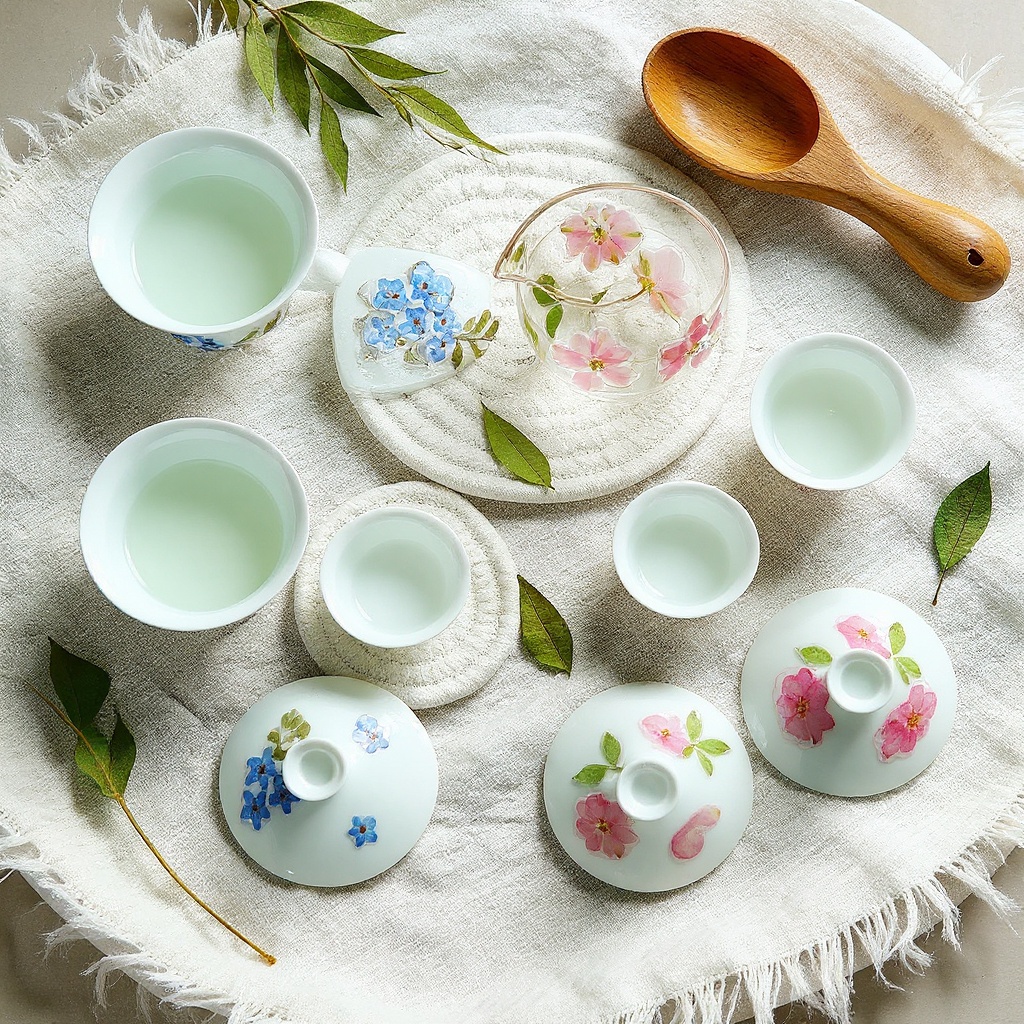
How the Semi-Translucent Porcelain Body Creates the Signature Glow
Semi-translucent warm-white porcelain — sometimes called suet jade porcelain in reference to its resemblance to rendered mutton fat jade — contains higher feldspar content than standard ceramic bodies, according to ceramic materials researcher Nigel Wood's documentation in Chinese Glazes (A&C Black, 1999). This feldspar concentration lowers the vitrification threshold and increases glass-phase content within the fired body, which is what produces the characteristic semi-translucency.
Standard porcelain reflects light at the surface. Suet jade-style porcelain absorbs it slightly, diffuses it through the body wall, and releases it as a warm ambient glow. The effect is most visible when the piece is backlit — morning sunlight through a kitchen window, a single candle on an evening table. The embedded flowers appear to float just beneath the surface rather than sitting on top of it.
This optical quality is inseparable from the 3D floral relief porcelain teacup set's aesthetic identity. Without semi-translucency, the relief work reads as surface decoration. With it, the flowers become part of the light itself.
Suet Jade Porcelain vs. Bone China vs. Standard Porcelain
Material choice affects appearance, handling weight, and durability in ways that product descriptions rarely explain honestly. Here is a direct comparison:
| Material | Translucency Level | Typical Wall Thickness | Impact Resistance | Best Application | Approx. Price Range |
|---|---|---|---|---|---|
| Suet Jade-Style Porcelain | High (semi-translucent) | 1.5–2.5mm | Good | Daily ceremony, gifting | $180–$480 per set |
| Standard Bone China | Moderate | 2–3mm | Very Good | Occasional formal use | $120–$320 per set |
| High-Fire Regular Porcelain | Low | 3–4mm | Excellent | Display, heavy daily use | $40–$130 per set |
| Low-Fire Earthenware | None | 4–6mm | Moderate | Display only | $25–$80 per set |
| Resin-Coated Ceramic (fake relief) | None | Varies | Poor (chips) | Not recommended | $15–$60 per set |
Bone china uses bone ash — typically calcined cattle bone — which creates exceptional whiteness and chip resistance, as described by the UK Bone China manufacturing standards maintained by the British Ceramic Confederation. However, it lacks the translucency that makes floral relief work dimensional. Most serious artisans working in the botanical relief tradition choose suet jade-style porcelain specifically because the light transmission creates depth that bone china cannot replicate.
High-fire regular porcelain is the workhorse. Dense. Durable. Opaque. It will not crack from thermal shock as readily as thinner semi-translucent bodies. But the glow is absent, and with it goes much of the visual poetry that defines this teaware category.
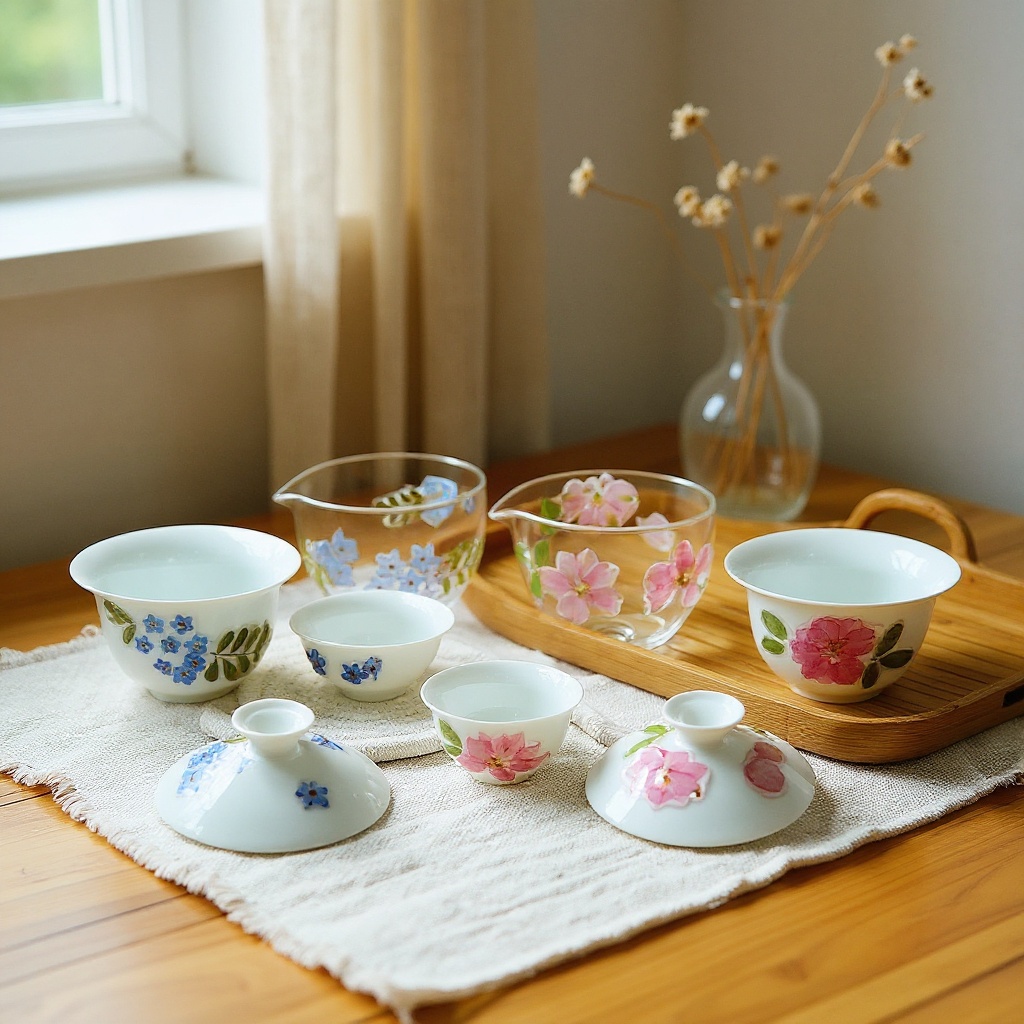
The 3D Floral Relief Porcelain Teacup Set Firing Process: What Separates Quality from Compromise
Durability comes down to three factors: firing temperature, glaze layer count, and relief height management.
Firing temperature is non-negotiable. According to GB/T 3532 (China's national standard for daily-use porcelain), adequate vitrification requires sustained temperatures above 1200°C. Sets fired below this threshold — common in lower-cost production runs — often develop hairline cracks around botanical elements within two to three years of regular thermal cycling, because the expansion coefficients of the preserved botanical material and the under-vitrified porcelain body diverge under repeated heating and cooling stress.
Glaze layer count matters more than most buyers realize. Proper botanical relief requires three to four glaze applications, each building up around the flower details incrementally. Single-layer glazing — the shortcut — fails to fully encapsulate protruding elements, leaving micro-gaps where moisture can infiltrate. Over time, this causes discoloration, surface lifting, or in cold climates, freeze-thaw fracturing of the botanical embedding.
Relief height is the subtlest factor. Elements protruding more than 2–3mm create fragile leverage points. A dropped cup hits the table rim-first. If a raised flower sits at the rim, that is where it breaks. Skilled artisans compress preserved flowers slightly before positioning, achieving tactile texture without structural fragility. The goal is presence you can feel. Not protrusions you can snap.
Here is how to authenticate genuine floral relief in five steps:
1. Run a fingernail lightly across the relief surface — it should glide without catching on any petal edge 2. Hold the piece up to natural light and look for organic opacity variations where flowers are embedded 3. Examine multiple pieces in the same set for natural variation — identical patterns indicate transfer printing 4. Check the interior surface for any roughness or texture that would indicate incomplete glazing 5. Look at the base: hand-finished bottoms show slight tool marks; machine-pressed bottoms are perfectly uniform
Gaiwan Proportions and the Gongfu Tea Ceremony
Traditional gongfu tea ceremony practice — documented extensively by the Tea Research Institute of the Chinese Academy of Agricultural Sciences — requires specific vessel proportions that decorative-only sets routinely ignore. A functional gaiwan should hold 100–150ml for optimal tea-to-water ratios. Individual cups need 30–50ml capacity for the multiple short steepings that define this brewing method.
The gaiwan lid fit becomes critical when relief elements are involved. Raised botanicals near the rim can disrupt the tight seal required for steeping control and comfortable pouring grip. Quality sets position floral elements on the lower two-thirds of the exterior, preserving rim function. Verify this before purchasing.
Key measurements to confirm before buying a 3D floral relief porcelain teacup set:
1. Gaiwan capacity: 100–150ml for single-serving ceremony use 2. Individual cup capacity: 30–50ml for traditional short sipping 3. Relief height: Under 2.5mm from the base body surface 4. Lid fit clearance: Functional seal maintained despite decorative elements 5. Wall thickness: 1.5–2.5mm for semi-translucent glow with adequate heat retention 6. Base diameter: 7–9cm for stable one-handed handling 7. Rim profile: Smooth, unobstructed by relief work for comfortable pouring lip
Our Handmade Bone China Tea Set Preserved Flowers | Gongfu Gaiwan | Eco Floral Art meets these proportional standards while maintaining the botanical aesthetic.
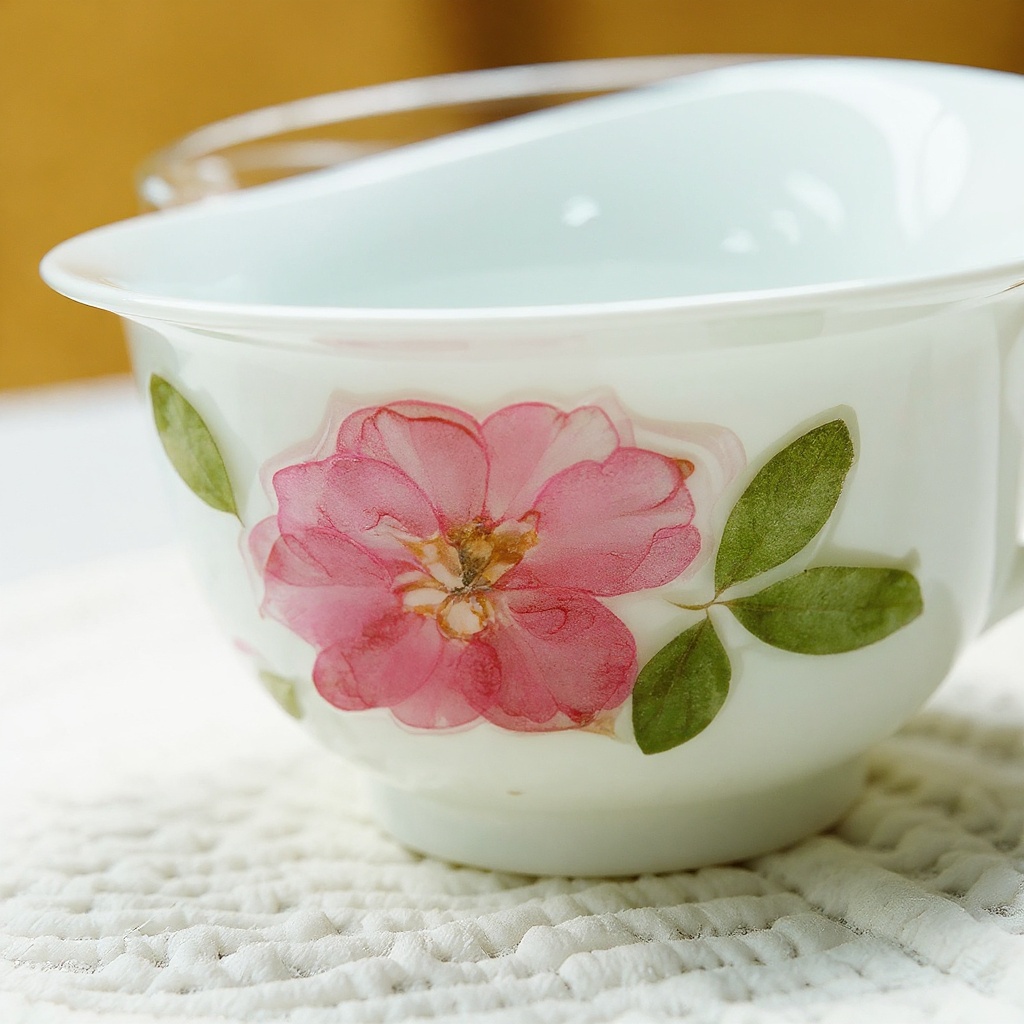
Honest Care Instructions That Preserve the Botanical Details
Hand-washing is essential. Not a polite suggestion. A structural requirement.
Dishwasher heat cycles operating at 60–75°C — the standard sanitizing range documented by the NSF International dishwasher testing protocols — subject thin porcelain walls to thermal gradients that cause cumulative micro-stress in the glaze layer. Detergent chemistry compounds this. The alkaline pH of most dishwasher tablets accelerates surface etching on low-silica glazes. A well-made 3D floral relief porcelain teacup set can survive occasional dishwasher cycles without visible damage. Regular dishwashing degrades the glaze surface around botanical elements within six to eighteen months of consistent use, based on material degradation patterns documented in ceramic conservation literature.
Use lukewarm water. Never pour boiling water directly onto a room-temperature piece — the thermal shock creates stress that accumulates invisibly until a hairline crack appears. Warm the gaiwan first with a small pour of hot water, then fill normally. This is standard gongfu practice anyway.
For cleaning around raised petal details: soft natural-bristle brush, lukewarm water, mild neutral soap. No scrubbing. No abrasive sponges. Tea staining around embedded botanicals responds to brief soaking in warm water with a few drops of white vinegar — gentle acid, minimal dwell time, thorough rinsing.
Air-dry. Store with spacing. A piece of felt between stacked cups prevents the micro-abrasions that slowly dull glaze finish over years of contact.
Spotting Quality vs. Mass-Produced Imitations
The market is flooded with transfer-printed ceramics wearing the "floral relief" label. The distinction is immediately tactile once you know what to feel for.
Authentic botanical relief shows natural irregularities. No two petals look the same across pieces. Color intensity varies — one blush petal fades toward ivory at its tip while the adjacent one holds full saturation. Organic. Inconsistent. Beautiful for exactly those reasons.
Printed or transfer decorations feel flat under a fingertip. You may notice a slight ridge at the edge of the printed zone where the transfer film meets the base glaze. The flower pattern repeats identically across every cup in the set. Under magnification, you can see ink dot patterns rather than continuous color variation.
Molded resin overlay — the worst imitation — feels slightly warm and slightly soft compared to glazed ceramic. Press firmly on a raised element. Porcelain does not flex. Resin does, barely, but detectably.
Honestly? A significant portion of "handmade preserved flower" teaware sold online at under $50 for a full set uses resin overlays on machine-pressed ceramic blanks. If that is your budget, buy it for the aesthetic and treat it as display. Don't pour boiling tea into it and expect five years of daily use.
Setting and Presentation: Natural Linen, Aged Wood, Diffused Light
The aesthetic logic of a 3D floral relief porcelain teacup set is inseparable from how it is displayed and used. The warm-white semi-translucent body, pale pink and ivory botanical tones — these are quiet colors. They need quiet surfaces to read properly.
Natural linen cloth or aged wood. Both provide texture and warmth without competing with the delicate relief work. A polished marble surface reflects light in ways that flatten the botanical detail. A white tablecloth creates too little contrast. Linen absorbs light slightly; the teaware glows against it.
Soft diffused natural light is the ideal. Direct sun bleaches the translucency effect and creates harsh shadows that obscure relief texture. North-facing window light, morning light through sheer curtains, the ambient illumination of an overcast day — these are the conditions where this teaware looks its best. A single candle in the evening achieves something similar.
The serene, minimal, botanical spa aesthetic this style embodies is not merely marketing language. It is a coherent visual philosophy. Every element on the surface — the cloth, the tray, the light source — should contribute to stillness rather than visual noise.
When to Choose Display vs. Daily Use
This is where most buyers tie themselves in knots. It doesn't have to be complicated.
For daily gongfu ceremony use: prioritize verified firing temperature, confirmed glaze layer count, and relief positioned away from rim and base contact zones. Simpler botanical arrangements prove more durable than dense multi-flower compositions because each element has adequate surrounding glaze coverage. Our Handmade Bone China Tea Set Preserved Flowers | Gongfu Gaiwan | Eco Floral Art is designed for this balance.
For display or occasional gifting: more elaborate relief work becomes viable. Higher protrusion. More complex arrangements. Pieces that would face structural fatigue under daily thermal cycling can exist as permanent art objects without any compromise.
There is no wrong answer here. A gorgeous decorative tea set for display shelf that you never brew tea in is not a failure of intention. It is a different kind of object. Know which you want before you buy.
Frequently Asked Questions
Is a 3D floral relief porcelain teacup set the same as a decal or transfer print?
No. Authentic 3D floral relief embeds real preserved botanical elements into the porcelain during firing. The raised texture is physically present and tactile — you can feel individual petal contours under your fingertip. Decals and transfer prints create flat printed images with no dimensional depth. Under magnification, printed decorations show ink dot patterns; genuine botanical relief shows continuous organic color variation following the natural structure of the preserved flower.
Can I use a 3D floral relief porcelain teacup set in the dishwasher?
Hand-washing is strongly recommended. Dishwasher cycles operating at 60–75°C combined with alkaline detergent chemistry create cumulative glaze stress around embedded botanicals. Regular dishwashing accelerates surface degradation in the glaze zones surrounding relief elements. Lukewarm water, a soft sponge or natural-bristle brush, and mild neutral soap preserve the piece's surface integrity over years of use.
How long do preserved flowers last when embedded in ceramic glaze?
Properly fired and glazed botanical elements sealed within a complete glaze encapsulation can maintain their appearance indefinitely under normal indoor conditions. The high-temperature firing process — sustained above 1200°C — permanently vitrifies the surrounding glaze into a sealed glass matrix that prevents moisture infiltration and biological degradation. Incomplete glazing allows moisture entry over 5–10 years, which causes gradual discoloration. UV exposure from direct sustained sunlight can affect botanical pigments over decades; diffused indirect light preserves color saturation.
What is the difference between suet jade porcelain and bone china for floral relief work?
Suet jade-style porcelain uses elevated feldspar content to create a semi-translucent body that allows light diffusion through the vessel wall, making embedded flowers appear to glow from within. Bone china uses calcined bone ash for exceptional whiteness and impact resistance but produces an opaque body that reflects light at the surface rather than transmitting it. For 3D floral relief work specifically, the translucency of suet jade-style porcelain creates dimensional depth that bone china cannot replicate — embedded flowers read as floating within the material rather than sitting on top of it.
Is a 3D floral relief teacup set safe to use with hot tea?
Yes, when properly made. The complete glaze encapsulation process creates a food-safe sealed surface with no contact between hot liquid and embedded botanical material. The key precaution is thermal management: avoid pouring boiling water directly onto a cold piece. Warm the vessel with a preliminary hot-water pour first — standard practice in gongfu ceremony — then fill normally. This prevents the thermal shock stress that accumulates in thin porcelain walls over repeated sudden temperature changes.
Why do pieces in a handmade set look slightly different from the product photos?
Authentic handmade sets use real preserved flowers that vary naturally in petal size, color saturation, and positioning. No two botanical elements are identical. Photography captures one specific piece under controlled lighting; your set will show its own unique botanical arrangement within the same color family and aesthetic character. This natural variation is a quality marker, not a defect. Mass-produced sets using printed or molded decorations show perfect consistency across pieces — which is precisely what reveals them as imitations.
What does it mean that 'no two pieces are alike' when buying as a gift?
Each individual cup and gaiwan in the set carries its own unique botanical detail — a petal positioned slightly differently, a blush tone that fades toward ivory in its own particular pattern. The overall aesthetic cohesion holds across the set; the specific details are singular. For gifting, this means the recipient receives something genuinely one-of-a-kind rather than an item replicated thousands of times. It is meaningful in the way a pressed-flower letter is meaningful. Unique by nature.
How do I clean around the raised floral details without damaging them?
Use lukewarm water and a soft cloth or natural-bristle brush. Work around raised elements with gentle circular motions rather than scrubbing strokes. For tea staining in the textured zones near botanical relief, a brief soak in warm water with a few drops of white vinegar loosens tannin deposits without abrasive action. Rinse thoroughly. Air-dry completely before storage. Never use bleach, abrasive powders, or stiff synthetic scrubbers near the relief surface — these degrade the glaze finish around petal edges over time.
Are there 3D floral relief sets that work for both daily use and display?
Yes — sets built to daily-use construction standards (full glaze encapsulation, high-fire vitrification, relief positioned away from rim contact zones) function for active tea ceremony while remaining display-worthy between uses. The key is that daily-use quality construction does not require sacrificing visual impact; it requires thoughtful botanical placement and proper firing. A well-made 3D floral relief porcelain teacup set arranged on a natural linen cloth in diffused light is already display art. Making tea in it is optional. But possible.


