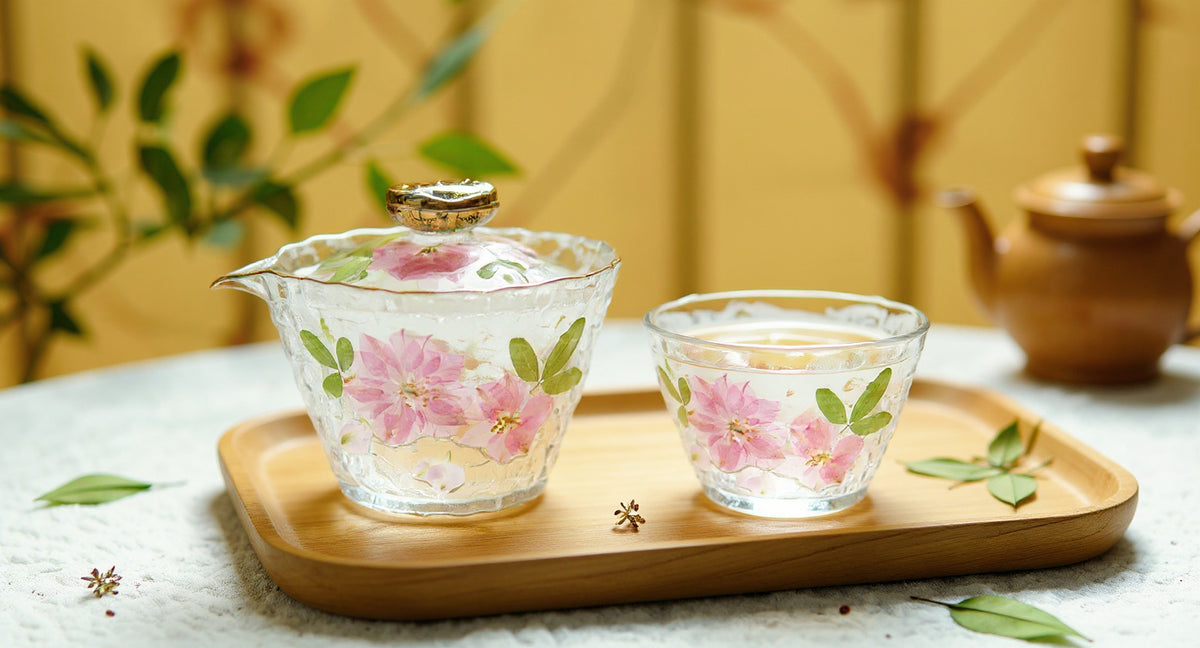
A good handmade tea gift for tea ceremony fits the recipient’s brewing method, feels personal, and comes with clear instructions for the finished vessel. A floral glass gaiwan and matching fair cup can suit someone who enjoys both botanical craft and sharing loose-leaf tea. But decorative detail doesn’t establish hot-tea safety.
Start with the brewing habit. If the recipient already enjoys a gaiwan, the paired vessels have a clear purpose; if they prepare matcha or prefer a teapot, the same gift may introduce equipment they don’t want.
A beautiful mismatch is still a mismatch.
The floral glass set at a glance
The Handcrafted Floral Gaiwan Fair Cup Set | Real Preserved Flowers | Eco Resin Glass pairs a delicate glass gaiwan with a matching fair cup. Real dried and preserved botanical material, including rose petals, baby’s breath, and leaves, is embedded beneath a smooth resin surface. The flowers have raised detail beneath the coating, rather than a printed floral pattern.
Blush pink or soft blue gives the set a gentle botanical palette. On a wooden or marble tea tray, soft natural light brings out the petals and transparent glass without needing elaborate styling.
Flowers beneath a smooth surface. Not a printed motif.
The product description identifies a heat-resistant glass base and a crafting period of 3–5 days per set. It also lists about 400ml, but doesn’t assign that capacity to a particular vessel or distinguish brim capacity from working fill.
That distinction matters when the gaiwan’s infusion needs to fit into the fair cup without filling it to the edge.
| Product detail | Information available | What it establishes |
|---|---|---|
| Included vessels | Glass gaiwan and matching fair cup | A paired brewing-and-serving set |
| Botanical decoration | Real preserved petals and leaves beneath resin | Actual botanical material, not a printed design |
| Glass base | Described as heat-resistant | A material description, not a temperature rating for the complete assembly |
| Capacity | About 400ml; vessel assignment not specified | Separate vessel capacities and working fills remain unconfirmed |
| Crafting time | 3–5 days per set | Production time, not a complete delivery estimate |
The handcrafted floral gaiwan and fair cup set is the product reference for these details. No laboratory report, maximum operating temperature, or complete written cleaning specification is available in the information supporting this guide.
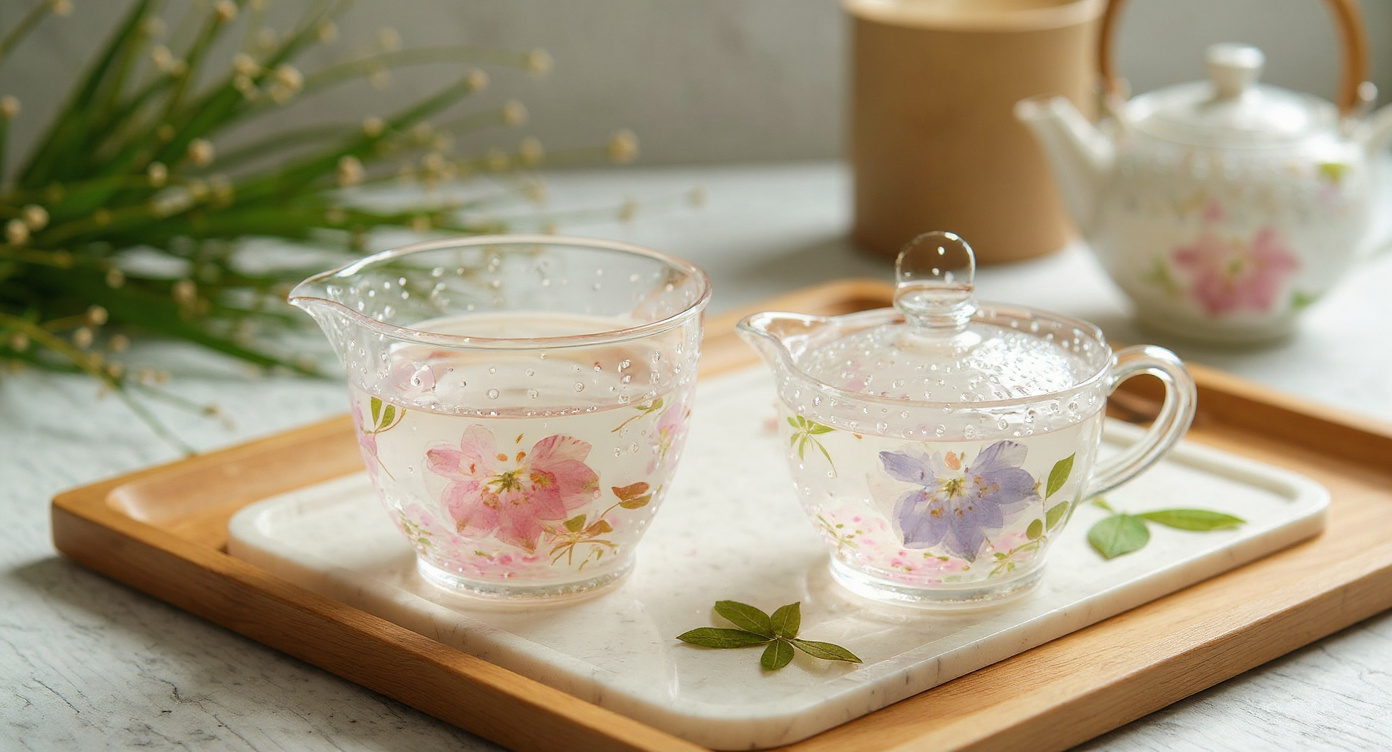
Decide whether the recipient will use it
A gaiwan is a lidded bowl used for brewing tea. During a pour, its lid helps retain the leaves. The fair cup receives the infusion so it can be divided among drinking cups with a more consistent strength.
The gaiwan reference explains the vessel’s background and use. It doesn’t establish the suitability of this particular glass-and-resin construction.
Choose by habit, not appearance.
1. Identify the current brewing method. A recipient who uses a gaiwan has a stronger practical match than someone whose routine centers on matcha equipment or a large teapot. 2. Check whether they share infusions. A fair cup has a useful role when brewed tea is divided among cups. It may be an extra object to store for someone who drinks straight from their brewing vessel. 3. Confirm the size match. Obtain the gaiwan’s working fill and the fair cup’s receiving capacity before assuming the listed 400ml suits an established tea routine. 4. Consider the care commitment. Mixed-material glassware needs instructions covering the coating as well as the glass. This won’t work if the recipient expects dishwasher convenience and that use hasn’t been confirmed. 5. Match the botanical detail to their taste. Roses, baby’s breath, and leaves make sense for someone who values preserved-flower craft. They aren’t an improvement for a recipient who prefers undecorated teaware.
The broader reference on tea ceremony traditions also helps explain why there’s no single equipment checklist for every ceremony.
Compare the gift without invented prices
A plain gaiwan and a botanical glass set solve different problems. One can prioritize uncomplicated brewing; the other adds floral craft and a matching serving vessel. Neither category guarantees quality or safety.
No dated, linked competitor listings are available for this comparison, so numerical price ranges have been removed. Prices and specifications shouldn’t be presented as like-for-like evidence without identifiable products.
| Gift option | Price | Materials or construction | Included pieces | Recipient fit |
|---|---|---|---|---|
| Mass-produced ceramic gaiwan | varies by seller | Ceramic; coating details vary by seller | varies by seller | Someone seeking a ceramic brewing vessel |
| Artisan ceramic set | varies by seller | Ceramic; making process varies by seller | varies by seller | Someone who values ceramic handwork |
| Botanical resin art sold through Etsy | varies by seller | Botanical resin art; tea-use suitability varies by seller | varies by seller | Someone seeking botanical decoration; brewing suitability needs separate evidence |
| Floral glass gaiwan and fair cup set | quote only | Heat-resistant glass base with real preserved flowers beneath resin | Gaiwan and matching fair cup | Someone who enjoys botanical craft and wants paired tea vessels, subject to confirmed use limits |
Here’s the less comfortable buying advice: if the recipient’s priority is frequent hot-tea brewing and the finished floral set’s temperature and food-contact conditions remain undocumented, choose an alternative with clear documentation.
That’s not a verdict against floral glassware. It’s a condition for choosing functional teaware with confidence.
What preserved flowers contribute
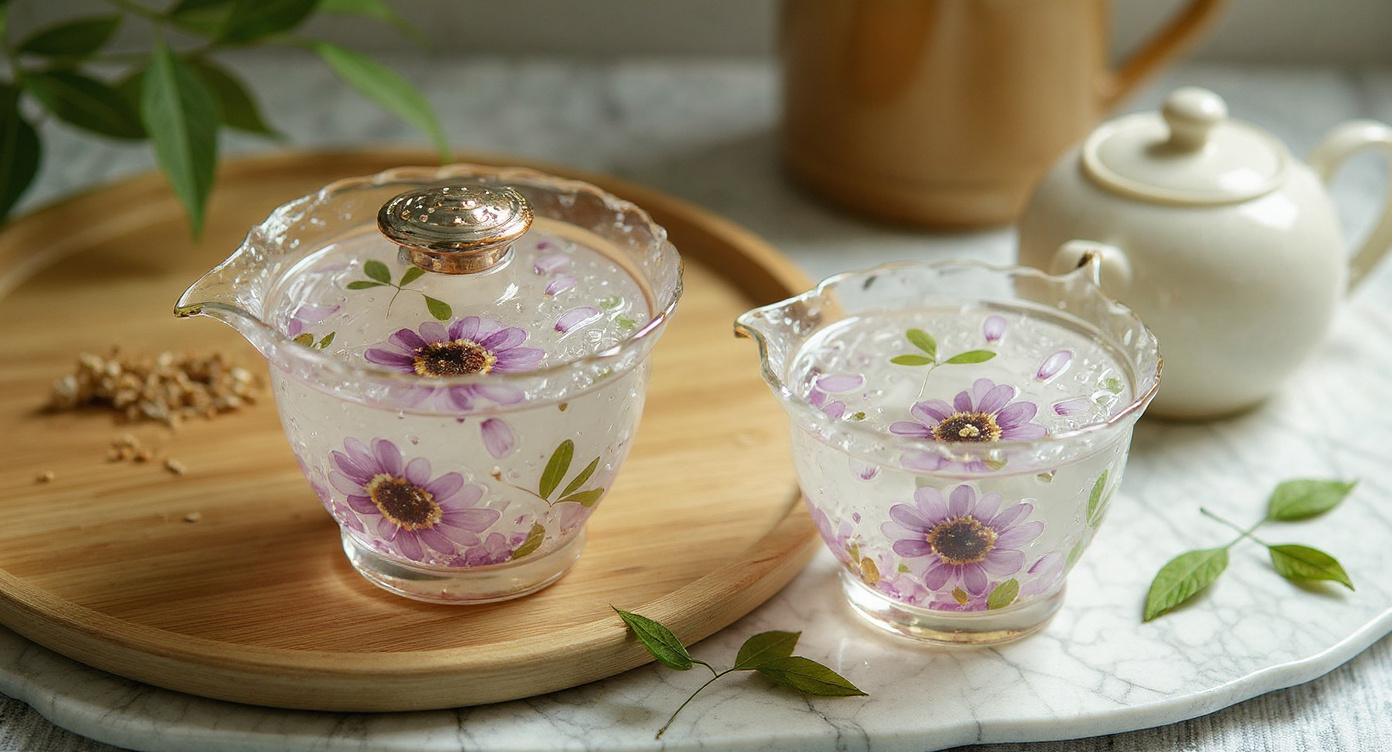
Real botanical material gives this gift a connection to flower preservation rather than surface illustration. The reference on pressed flower craft provides background on decorative work using dried plant material. It doesn’t verify this set’s preservation method or lifespan.
The permitted firsthand account is simple: when I sealed my first batch of preserved blooms into a heat-resistant glass cup. That experience belongs to the craft story, not to evidence of food-contact safety or temperature performance.
Craft and testing answer different questions.
The stated 3–5-day crafting period describes production time. It doesn’t establish resistance to sunlight, repeated washing, or temperature changes. No quantified colour-retention result or durability warranty is available here, so claims that the flowers will never fade or the coating will never change would go too far.
For product photography, keep the styling faithful to the object: the gaiwan and fair cup on a wooden or marble tea tray, soft natural light, and shallow depth of field. Loose dried flowers and a small teapot belong in the background. A close-up should show the real roses, baby’s breath, and leaves raised beneath the smooth resin surface.
Process photographs would add useful evidence of assembly if available. Styled product photographs alone cannot demonstrate resin placement along every tea-contact surface or prove a heat limit.
Food contact, heat, and care: what must be established
“Heat-resistant glass” describes the base material. “Eco resin” doesn’t identify a food-contact standard. Neither phrase, by itself, establishes approved conditions for the finished vessel.
For a US regulatory reference, 21 CFR §175.300 addresses resinous and polymeric coatings under specified conditions. It is not a certificate for this product, and citing it doesn’t establish compliance. Any applicable testing must identify the relevant coating or finished article and the conditions covered.
No certification claim is made here.
Before choosing the set for brewing, obtain these details in writing:
1. Resin placement: identify whether the coating is confined to exterior decoration or extends to the interior, rim, lid, or pouring path. 2. Food-contact evidence: request the applicable standard, laboratory, report identification, tested material, and permitted contact conditions where testing is claimed. 3. Finished-assembly temperature limit: confirm the permitted water temperature for the glass, coating, and their interface, including whether freshly boiled water is allowed. 4. Separate vessel measurements: establish each vessel’s brim capacity and recommended working fill. 5. Cleaning and damage guidance: confirm detergent, water temperature, soaking, appliance compatibility, and what to do if the coating cracks, lifts, or becomes tacky. 6. Order timing: distinguish the 3–5-day crafting period from dispatch and transit, then check damage reporting and returns terms.
Until those details are established, don’t substitute generic resin-care advice for instructions covering this set. Even handwashing needs compatible water temperature and cleaning products.
For further browsing, the Pampasroom studio homepage is an additional internal reference. It isn’t presented as a testing report or a care manual.
FAQ
What comes with the floral glass set?
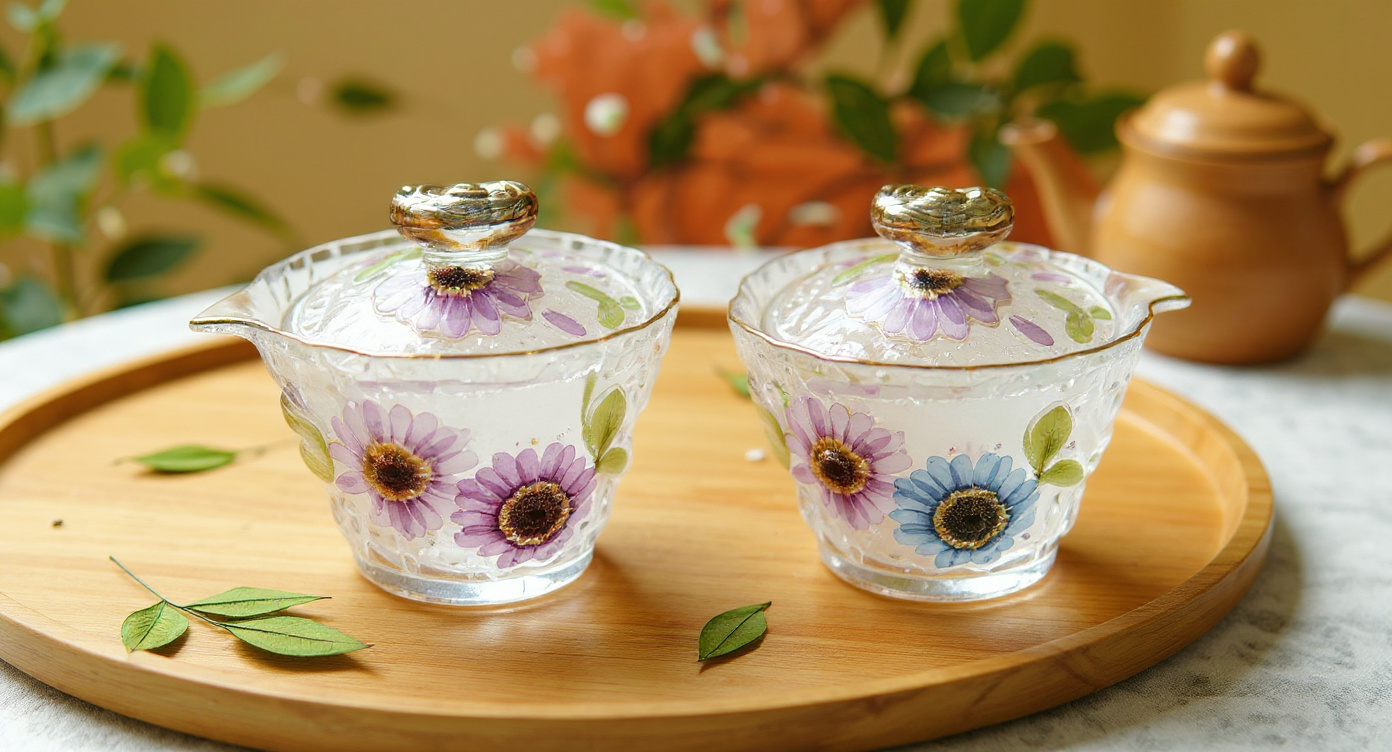
The described set includes a glass gaiwan and matching fair cup. The wooden or marble tray, loose dried flowers, and small background teapot are styling elements, not confirmed included accessories.
Are the flowers real or printed?
They are real dried and preserved botanical material beneath a smooth resin surface. The product identity includes roses, baby’s breath, and leaves, with raised floral detail visible beneath the coating.
What does the fair cup do?
It receives tea poured from the gaiwan before the infusion is divided among drinking cups. This helps distribute the brewed infusion rather than serving different portions straight from the brewing vessel.
Does each vessel hold 400ml?
That is not established. About 400ml appears in the product description, but separate capacities and working fills are not identified. It shouldn’t be repeated as the capacity of each piece.
Is the set safe for boiling water?
A boiling-water rating for the complete glass-and-resin assembly is not documented in the available information. The heat-resistant glass description doesn’t establish the coating’s limit or approved food-contact conditions.
Can it go in a dishwasher or microwave?
Neither use is confirmed. Glass alone doesn’t establish appliance compatibility for a vessel that also contains resin and botanical material. Use written instructions for the finished set rather than instructions for plain glass.
Will the preserved flowers fade?
No colour-retention testing or quantified lifespan is available here. Real preserved flowers are a material feature, not a guarantee of permanent colour. Follow the maker’s confirmed storage guidance.
How long does the set take to make?
The stated crafting period is 3–5 days per set. Dispatch, processing, and transit are separate from that period, so it isn’t a delivery promise for a birthday or housewarming.
Is it a good gift for a beginner?
It can suit a beginner who wants to learn gaiwan brewing. Pouring a lidded bowl of hot tea takes practice, so a floral appearance alone isn’t a reason to choose it over the recipient’s preferred brewing method.
Choose the gift that fits the ritual
The strongest reason to choose this set is the overlap between tea preparation and botanical craft. The weakest is assuming that handmade decoration makes every practical detail suitable.
A gift with a clear purpose.
For someone who wants paired floral vessels and accepts their documented care requirements, Pampasroom’s set is worth considering. Review the real preserved flower gaiwan and fair cup set, confirm the unresolved specifications, and include the resulting care guidance with the gift.