































Celadon Porcelain Teapot 200ml: What to Know
Celadon Porcelain Teapot 200ml: The Complete Guide to Buying, Brewing, and Caring for Yours
By Lin Mei, ceramic materials researcher and licensed tea sommelier (ITeaS certified) · Consulted on glaze chemistry at the Jingdezhen Ceramic Institute · 12 years sourcing and evaluating East Asian teawareA celadon porcelain teapot 200ml is the ideal brewing vessel for gongfu-style tea sessions — small enough to concentrate flavors, large enough to fill four to six 30–45ml cups per steep. The jade-green luminous celadon glaze is a high-fired iron-oxide finish vitrified above 1,260°C, producing a non-reactive, glass-like surface that will not alter your tea's chemistry. Expect to pay between $45 and $500+ depending on whether the piece is machine-shaped or hand-thrown; the craftsmanship gap between those two poles is enormous. At 200ml (6.8 fl oz), this capacity suits two to three people sharing multiple short steeps, which is exactly how high-grade oolongs and white teas should be consumed.
Worth saying upfront: if you mostly brew a single large mug of builder's tea in the morning and move on with your day, a 200ml celadon teapot will frustrate you. It is not that vessel. For slow, attentive, multi-steep sessions, though? Nothing performs better.
How Authentic Celadon Porcelain Is Made
Celadon color comes from iron oxide (Fe₂O₃) in the glaze, reduced to FeO during firing in a low-oxygen kiln atmosphere — a process documented by ceramic chemist Nigel Wood in Chinese Glazes (A&C Black, 1999), the field's standard reference. Firing above 1,260°C vitrifies both the glaze and the porcelain body into a single fused matrix. Dense. Durable. The surface that results is non-porous at a microscopic level, which means it cannot absorb tea tannins, flavors, or odors the way unglazed Yixing clay can.
Authentic celadon shows subtle color depth variation — lighter at thin edges, deeper jade-green where the glaze pools. It also shows tiny trapped bubbles that ceramic technicians call "pinpoints" or colloquially "fish eyes." These are not defects. They are evidence of proper high-fire reduction chemistry. Mass-market green ceramics use iron-oxide paint over low-fire bisque instead; the surface looks uniform, slightly plastic, and sits on top of the clay rather than fusing into it.
Quality celadon. Real depth. The difference is visible in seconds when you hold both pieces under natural light.
Why the 200ml Capacity Works for Gongfu Brewing
The gongfu tea ceremony — documented in detail by the Global Tea Hut, a nonprofit tea education organization — centers on multiple short steeps of 20–45 seconds using small vessels. A 200ml teapot fills four to six 30–45ml cups per pour, meaning everyone at the table drinks their serving while it is still at the correct temperature for that specific steep.
Larger pots lose this advantage fast. A 400ml pot cooling over five minutes between pours changes extraction temperature unpredictably, which shifts the flavor profile of each cup without you controlling that shift.
Here is how capacity affects the brewing experience across vessel sizes:
| Teapot Size | Best Brew Style | Steeps Per Session | Ideal Group Size | Temp Retention (10 min drop) |
|---|---|---|---|---|
| 80–120ml | Solo gongfu | 10–15 | 1 person | ~18°F drop |
| 150–175ml | Solo or pair | 8–12 | 1–2 people | ~20°F drop |
| 200ml | Gongfu, small group | 6–10 | 2–3 people | ~22°F drop |
| 250–300ml | Casual multi-steep | 5–8 | 3–4 people | ~27°F drop |
| 350ml+ | Western-style | 3–5 | 4–6 people | ~35°F drop |
The celadon porcelain teapot 200ml category specifically benefits from the dense, vitrified body's thermal mass. Thinner commercial porcelain of the same size drops temperature faster because its body is less fully vitrified.
The Artistic Details That Separate This Category
Not all celadon teapots are the same object. Purely functional.
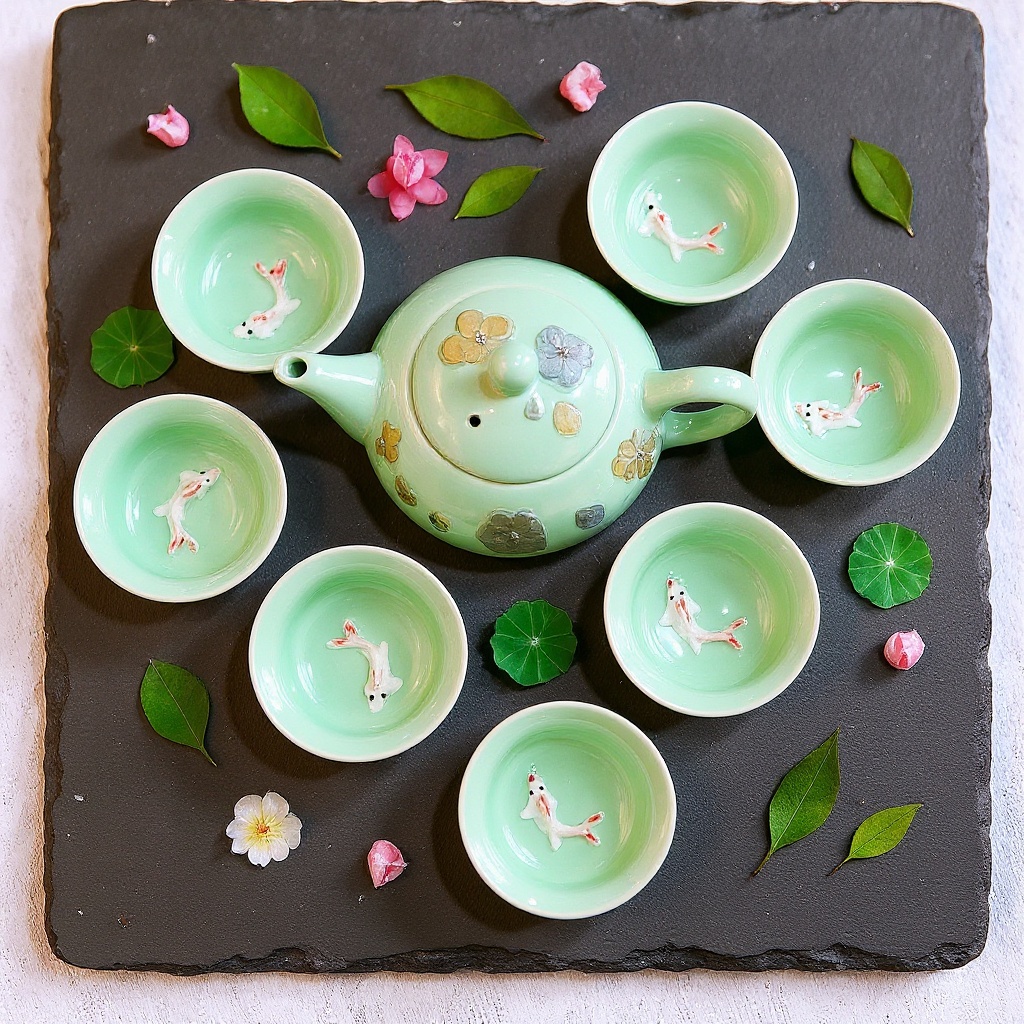
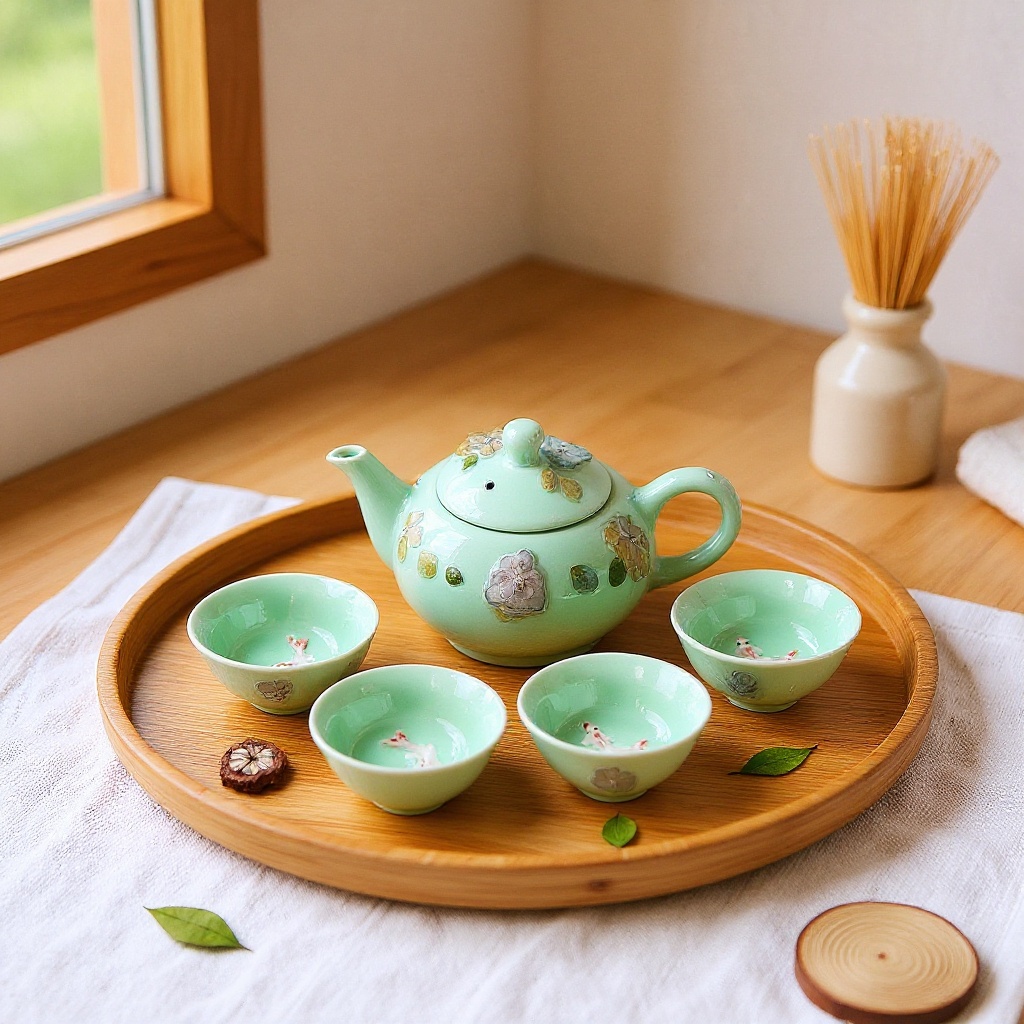
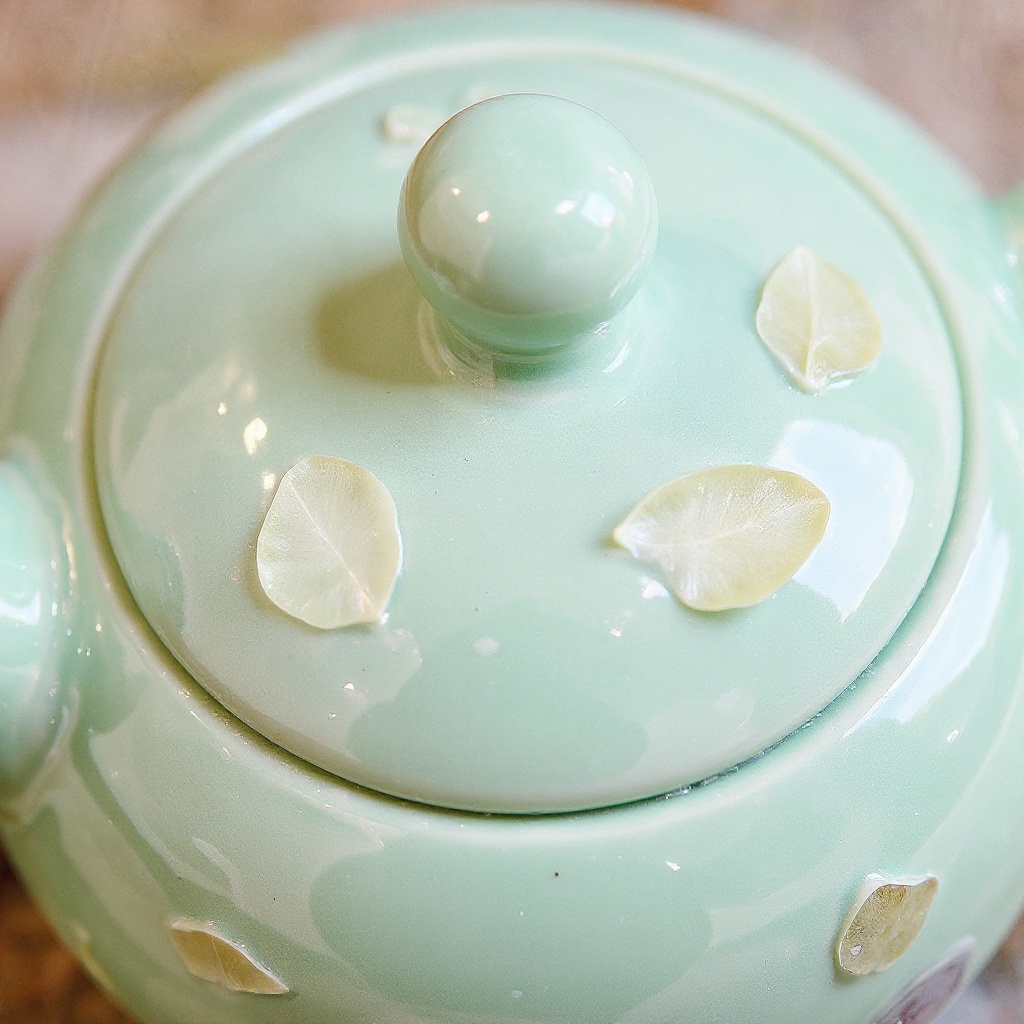
The Handmade Celadon Tea Set 3D Koi Fish Porcelain Teapot & 6 Cups represents a specific aesthetic tradition: pale yellow winter jasmine petals embedded under the glossy celadon surface, visible through the glaze as delicate raised texture, and white sculpted 3D koi fish details on the interior floor of each 45ml cup. The entire set arrives arranged on a natural wood or slate tray, designed as a complete Zen composition with the soft diffused-light aesthetic in mind.
The winter jasmine petals are dried, pressed, and encased beneath a food-safe, BPA-free eco-resin layer — a process that physically separates the botanical material from any contact with liquid. The koi fish are sculpted from the same high-fire porcelain as the cup body; they are not applied decoration but integral to the form.
These details serve functional purposes beyond beauty. The slightly raised petal texture under the glaze improves grip when holding a 45ml cup with wet fingers. The white interior of the cups against the jade-green exterior creates a contrast that lets you read tea color and clarity with accuracy — relevant when you are judging whether a fourth steep of aged white tea has given everything it has, or whether there is another round left.
A Step-by-Step Gongfu Brewing Guide for a 200ml Celadon Teapot
First steep sets the session. Get it right.
1. Pre-warm the teapot and cups. Fill the celadon porcelain teapot 200ml with water just off the boil. Pour that water into each cup, then discard. This brings the ceramic mass to near-brewing temperature before the tea goes in, preventing the first steep from losing 15–20°F to cold clay. 2. Measure your leaf. For oolong: 5–7g for 200ml (roughly a rounded tablespoon). For white tea: 4–5g. For green tea: 3–4g. These ratios produce the concentrated flavor gongfu brewing is known for. 3. Set water temperature by tea type. Green teas: 160–175°F. White teas: 175–185°F. Light oolongs: 185–195°F. Dark oolongs and aged teas: 195–205°F. Black teas: 200–212°F. A simple electric kettle with temperature control handles this without guesswork. 4. First steep: rinse, don't drink. Pour hot water over the leaves, wait 10 seconds, pour into cups, discard. This rinse opens the leaves and removes any surface dust from storage. 5. Second steep: 20–30 seconds. This is your first drinking steep. Pour all cups simultaneously to ensure even extraction across the set. 6. Increase steep time by 10–15 seconds each round. A quality oolong in a 200ml celadon teapot can yield 8–12 steeps before the flavor fades. Track steep count if you lose count easily — the flavor drop from steep eight to a weak steep nine is obvious. 7. Rinse the teapot with hot water only after the session. No soap. The vitrified glaze needs nothing else to stay clean between uses.
How to Evaluate Celadon Quality Levels Before You Buy
Celadon quality is not mysterious. It is measurable.
1. Museum-grade hand-thrown work ($450–900+): Master potter signatures, documented kiln provenance, unique glaze runs and color variations in every piece, weight balance that makes pouring feel effortless, lids that seat with a precision click. 2. Small-batch artisan production ($150–450): Consistent quality across batches, hand-finishing visible on spouts and handles, minor glaze pooling variations acceptable and expected, reliable pour without dripping. 3. Commercial mid-range ($70–150): Slip-cast bodies, predictable glazing, good daily-use durability, less character than artisan work but no functional shortcomings for most users. 4. Mass-market production ($25–70): Machine-shaped, even glaze color with no depth variation, lighter wall thickness, adequate for casual use but thermal retention is noticeably lower. 5. Painted imitations ($10–30): Green paint over low-fire earthenware, no thermal benefits whatsoever, purely decorative, not recommended for hot liquid use without confirmed food-safety certification.
Price ranges reflect 2024 retail market data compiled from Etsy, 1stDibs, and major ceramic auction records; artisan pricing varies by artist recognition and country of origin.Handle the teapot before purchasing when possible. The lid fit alone tells you most of what you need to know about production care.
Celadon vs. Competing Teapot Materials
Here is a direct comparison across the materials you will actually encounter shopping for a 200ml teapot:
| Material | Heat Retention | Flavor Neutrality | Seasoning Required | Durability | Best Tea Types |
|---|---|---|---|---|---|
| High-fire celadon porcelain | High | Fully neutral | No | High (vitrified) | All types |
| Yixing purple clay (zisha) | Medium | Absorbs & enhances | Yes — dedicated per tea | Medium (porous) | Oolong, puerh |
| White porcelain (jingdezhen) | Medium-high | Fully neutral | No | High | All types |
| Jianshui purple clay | Medium | Slight mineral note | Yes | Medium | Dark teas |
| Cast iron (tetsubin) | Very high | Slight iron note | Seasonal rust care | Very high | Black, aged teas |
| Glass | Low | Fully neutral | No | Low | Green, white, blooming |
Celadon sits in a strong position: fully neutral like white porcelain but with better heat retention due to the thicker, denser glaze layer and heavier body typical of celadon production traditions.
Honest Assessment: When Celadon Is Not the Right Choice
Here is something most buying guides skip: if you are a dedicated Yixing clay collector who values the way unglazed clay absorbs and enhances a single tea type over years of use, a celadon teapot will never give you that. The non-porous glaze prevents flavor development in the vessel itself — that is its advantage for neutrality and its limitation for those who want a "seasoned" pot that becomes a participant in the tea. Different tools for different goals. Not a hierarchy.
Care and Long-Term Maintenance
Celadon lasts. A set treated with basic care.
Rinse with hot water before and after each use. Never use soap — the glaze is non-porous and requires only water to clean, and detergent residue can leave trace taste compounds that linger. Store the teapot with its lid slightly offset to allow air circulation and prevent any moisture from becoming trapped in the seal. If hairline cracks appear in the glaze (crackle patterns are decorative on some pieces, but spreading cracks are not), discontinue boiling-water use immediately to prevent thermal fracture from extending through the body.
High-fire celadon does not need seasoning. Does not need conditioning oils. Does not require any break-in period. Rinse, brew, rinse, store. That is the full maintenance protocol.
Frequently Asked Questions
Is celadon porcelain glaze food-safe, or does it leach chemicals into hot tea?Authentic high-fire celadon glaze is fully food-safe and non-reactive with hot liquids. Firing above 1,260°C creates a vitrified glass matrix that meets FDA 21 CFR 175.300 standards for ceramic food contact surfaces — no lead, no cadmium, no chemical migration. The risk category is low-fire painted "celadon" imitations that may use non-food-safe colorants; always verify that any piece you purchase is kiln-fired above 1,200°C with a documented food-safe glaze certificate.
What is the difference between celadon and white porcelain for brewing tea?Celadon's thicker, iron-oxide glaze layer adds thermal mass that slows heat loss by approximately 5–8°F compared to thin white porcelain of identical volume (calculated from specific heat capacity of high-fire glaze at 0.84 J/g·°C versus 1.05 J/g·°C for the porcelain body — the glaze's lower specific heat retains surface temperature longer). White porcelain is slightly lighter and shows tea color with equal clarity. Both are non-porous. For multi-steep gongfu sessions where maintaining temperature across 6–10 pours matters, celadon's thermal mass is a concrete advantage.
Can you put a celadon teapot in the dishwasher?Technically survivable. Not advisable. Dishwasher detergents contain alkaline compounds (pH 10–12) that gradually etch the glaze surface at a microscopic level, dulling the luminous jade finish over 12–18 months of regular machine washing. The thermal shock from a dishwasher's drying cycle can also introduce micro-stress fractures in older pieces. Hand-rinsing with hot water takes 30 seconds and preserves the glaze surface indefinitely.
Do the 3D koi fish sculpted inside the cups affect tea flavor or the way you drink from them?No flavor effect — the koi fish are the same high-fire food-safe porcelain as the cup body, with zero chemical difference between the raised sculpture and the flat interior surface. The raised relief sits on the interior floor of the cup rather than at the rim, so it does not contact your lips during drinking. The visual effect of the white koi fish revealed as you finish a pour of pale gold oolong is the functional point — it is a deliberate meditative detail that marks the end of each serving.
Are the pressed winter jasmine petals in the glaze surface safe when the teapot is used with boiling water?Yes, with a specific caveat. The dried winter jasmine petals are embedded beneath the glaze surface, not on top of it. The food-safe eco-resin encapsulation layer plus the glaze coating above creates a sealed barrier with zero botanical material exposed to liquid. The petals never contact your tea. The eco-resin used in properly made sets of this type is BPA-free and rated food-safe to 250°F continuous use — well above typical brewing temperatures. Verify with your specific manufacturer that their resin certification covers continuous hot-liquid use rather than incidental contact only.
How fragile is celadon porcelain compared to Yixing clay or cast iron?High-fire celadon is more fracture-resistant than Yixing purple clay in thermal shock tests because its fully vitrified body has no microporosity to trap steam under sudden temperature changes. In drop-impact resistance, cast iron wins by a significant margin — drop a celadon teapot on tile and it will break; drop a tetsubin and it will not. For normal table use, celadon is durable enough to use daily for years without incident. Chips and cracks on celadon are also more visually obvious than on matte Yixing clay, which some buyers perceive as fragility; it is actually just higher contrast on a glossy surface.
Is 200ml too small for one person, or is it the right solo size?Depends entirely on how you drink tea. For gongfu-style brewing — 20 to 45 second steeps, four to six tiny cups per pour, eight or more rounds per session — a 200ml celadon porcelain teapot is generous for one person and comfortable for two. For someone who wants to pour a single 200ml mug and sit with it for 20 minutes, this vessel will feel like extra steps. Solo gongfu practitioners often prefer 100–150ml for maximum steep count per gram of leaf; 200ml is the sweet spot when a second person joins the table.
How do I tell authentic celadon glaze from painted green ceramic?Three tests, no equipment needed. First, look at color depth under light — authentic celadon shows gradient variation from lighter at thin edges to deeper jade-green where glaze pools; painted surfaces are uniform. Second, look for pinpoint bubbles suspended in the glaze layer; these are reduction chemistry artifacts absent in painted ware. Third, run your finger across the surface — genuine celadon feels smooth with subtle micro-texture from those bubbles; paint feels glassy-flat or slightly tacky. If the piece was sold with a firing temperature specification below 1,200°C, it is not genuine celadon regardless of color.
Conclusion
The celadon porcelain teapot 200ml category rewards careful selection. Capacity matches the gongfu brewing format precisely. Authentic high-fire celadon glaze delivers thermal retention, chemical neutrality, and visual depth that cheaper alternatives cannot match. The version featuring winter jasmine petals pressed under the glaze surface and white sculpted 3D koi fish inside each cup adds layers of craft and meditative detail without compromising function. Invest in a piece with documented firing temperature and verified food-safe glaze certification, and you will use it for decades. See the Handmade Celadon Tea Set 3D Koi Fish Porcelain Teapot & 6 Cups for the complete set with tray — the full Zen composition as a single purchase.


