































Handmade Glass Teapot Sets With Real Flowers Explained
Handmade Glass Teapot Set with Real Flowers: Artisan Guide
By pampasroom, founder of Pampasroom · 8+ years working directly with Southeast Asian glassware and botanical preservation artisans · Craft teaware research contributor> TL;DR: A handmade glass teapot set with real flowers contains genuine preserved botanical petals — white cherry blossoms, lotus silhouettes — sealed permanently within frosted borosilicate glass using food-safe resin. Each set takes 3–5 days to craft. No two pieces are identical. The frosted translucent finish diffuses light through the embedded petals, creating a soft botanical glow that printed or painted teaware simply cannot replicate.
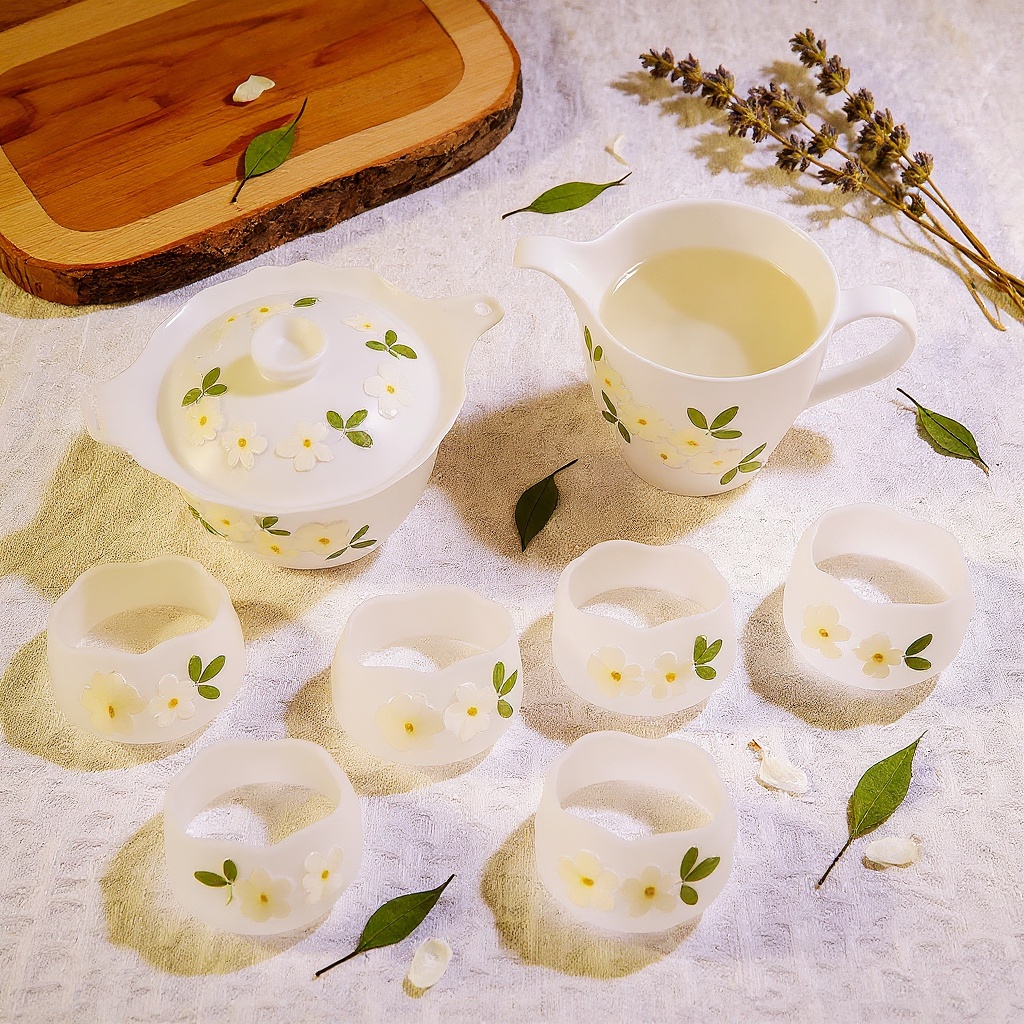
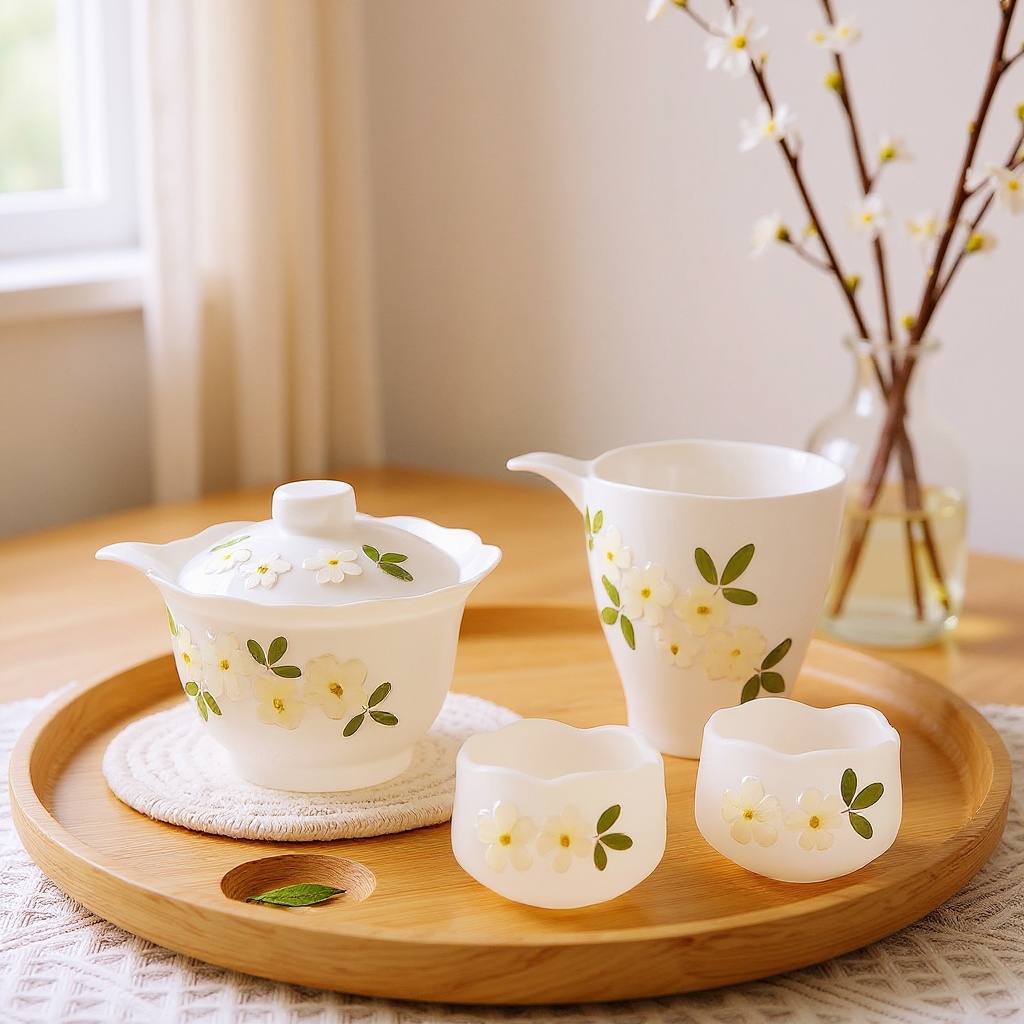
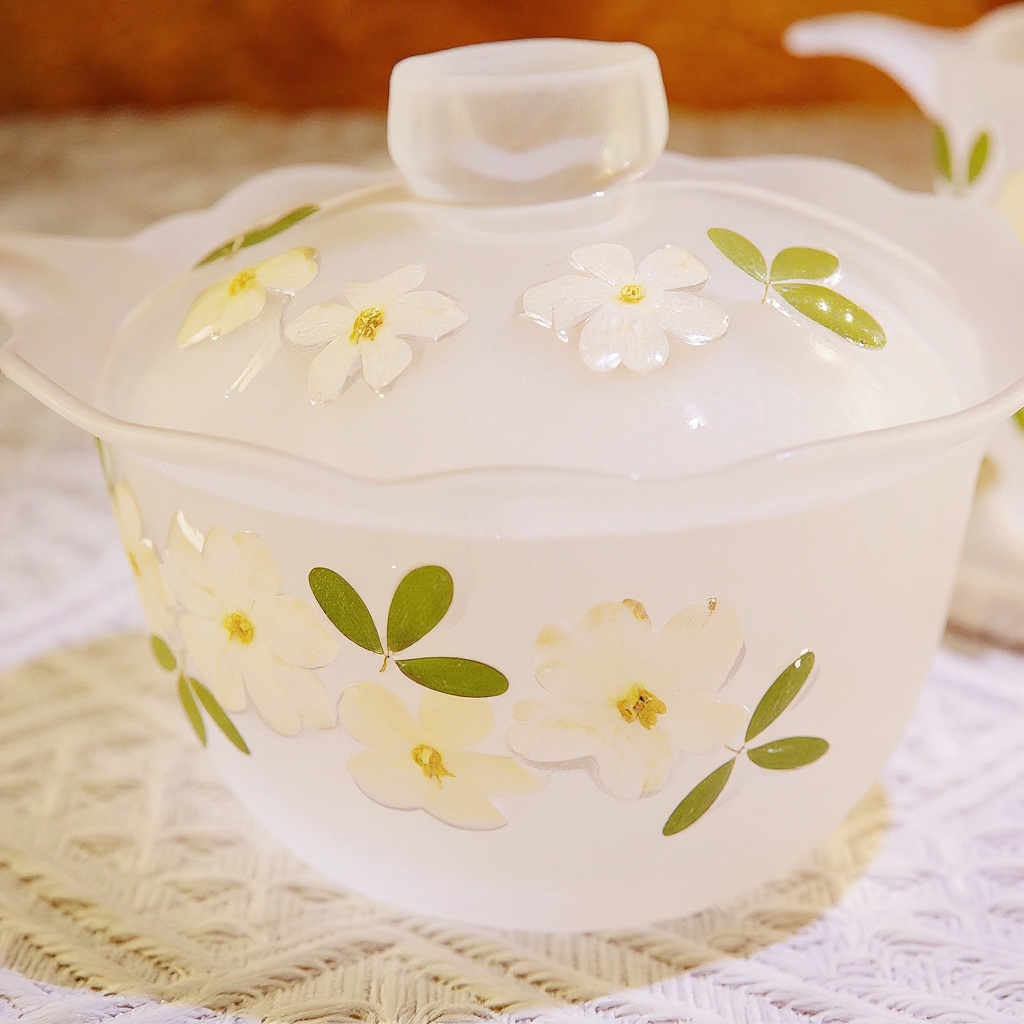
A handmade glass teapot set with real flowers features genuine preserved petals or blossoms embedded within the glass structure using food-safe eco-resin techniques. Not decals. Not transfers. Not hand-painted patterns. Actual botanical material — white cherry blossom petals, lotus flower silhouettes — is sealed between layers of frosted borosilicate glass during the artisan crafting process. The preservation method removes moisture from fresh flowers until their water content drops below 5%, then each petal is hand-positioned during glass formation before permanent resin sealing. The result is functional teaware that operates as decorative botanical art, with every piece carrying natural variation in petal placement, color depth, and translucency that no machine-automated process can reproduce.
How Artisans Embed Real Flowers Into a Frosted Glass Teapot Set
Selecting the right petals is where it begins. White cherry blossoms harvested at peak bloom undergo silica-gel desiccation — a preservation method documented by botanical conservation specialists at institutions like Kew Gardens — which removes moisture while maintaining petal structure and color integrity. The process takes 48–72 hours per batch.
Once dried, petals are hand-placed against the glass mold. Carefully. One by one. The artisan positions each cherry blossom to align with the lotus flower silhouette design etched into the teapot wall, ensuring the botanical elements remain visible from multiple angles when light passes through the frosted surface. According to glassblowing technical standards referenced by the Corning Museum of Glass, borosilicate glass bonds with embedding materials within a specific thermal window — working temperatures for this glass type typically range between 1,000–1,165°C during the forming stage, with resin introduction occurring during cooler finishing phases after the structural glass work is complete.
The frosted finish itself is applied through acid etching or sandblasting, creating the translucent diffusion layer that gives these teapots their signature soft glow. Steam rising from the spout catches against this frosted surface differently than clear glass. It scatters. It softens. That visual effect is intentional.
Each teapot requires approximately 8–12 hours of direct assembly across the multi-day production cycle, with cooling intervals between stages to prevent stress fractures in the glass.
What Makes Preserved Flowers Last Inside Resin Teaware
Longevity depends on three factors: moisture removal completeness, resin quality, and UV protection. Fresh flowers contain 85–95% water by weight. Preservation techniques recognized by floral conservation professionals aim to reduce this to below 5% before any embedding occurs. Residual moisture causes decay. Simple as that.
Food-safe eco-resin creates an airtight barrier around each petal, preventing oxidation — the primary mechanism behind flower fading and color shift. Unlike standard epoxy formulations, food-grade eco-resins used in certified teaware incorporate UV stabilizers that resist photodegradation from ambient light exposure. The International Institute for Conservation of Historic and Artistic Works publishes guidance on resin preservation chemistry that supports UV inhibitor use for long-term botanical preservation applications.
The lotus flower silhouette design in premium handmade glass teapot sets with real flowers provides structural advantage as well. Cherry blossom petals embedded within thicker glass wall sections face reduced thermal cycling stress during tea brewing compared to petals positioned in thinner areas. Strategic botanical placement isn't aesthetic coincidence — it extends preservation life by minimizing temperature-driven expansion and contraction cycles the resin experiences during regular use.
Properly sealed preserved flowers in quality eco-resin maintain visual integrity for 2–5 years under normal indoor conditions. Direct sunlight shortens this. Consistent storage in indirect light extends it.
Honest Truth: When This Product Isn't Right for You
Here's what most teaware articles won't say directly: if you brew tea multiple times daily at maximum temperatures, use a stovetop kettle poured immediately at full boil, and never hand-wash your teaware — a handmade glass teapot set with real flowers is probably not your best practical choice. The botanical beauty of this product requires care investment. The frosted glass needs gentle cleaning. The resin embeddings benefit from avoiding prolonged direct sunlight. If your tea ritual is purely functional and speed-focused, a plain ceramic pot will serve you better and you won't resent it.
But if the act of brewing tea is itself meaningful to you — if the vessel matters, if the ritual matters — then the investment makes complete sense.
Comparison: Handmade vs Mass-Produced Floral Tea Sets
| Feature | Handmade Artisan Sets | Mid-Range Branded Sets | Mass-Produced Sets | Budget Online Sets |
|---|---|---|---|---|
| Flowers | Real preserved petals in eco-resin | Printed botanical transfers | Decal stickers | Painted patterns |
| Price Range | $120–$300+ | $60–$120 | $30–$60 | $10–$30 |
| Production Time | 3–5 days per set | 4–8 hours per set | 1–2 hours per set | 15–30 min per set |
| Glass Type | Borosilicate | Borosilicate or soda-lime | Soda-lime | Standard thin glass |
| Durability | 5–10 years with care | 2–4 years typical | 1–3 years | 6–18 months |
| Heat Resistance | High per borosilicate standards | Moderate | Lower | Lowest |
| Uniqueness | Each piece one-of-a-kind | Limited pattern variations | Identical batch copies | Identical mass copies |
The quality difference becomes visible immediately when you examine flower detail under natural light. Mass-produced sets use generic floral prints that appear uniform, flat, and fade after repeated wash cycles. Handmade pieces show natural petal variation — slight translucency differences, organic edge irregularities, subtle color gradations — because each cherry blossom is a unique botanical specimen. No algorithm selected it. An artisan did.
Understanding Glass Types and Heat Safety in Botanical Teaware
Borosilicate glass, the material used in quality handmade glass teapot sets with real flowers, has a thermal expansion coefficient approximately one-third that of standard soda-lime glass. This property — documented in materials science references including ASM International's glass properties database — makes it substantially more resistant to thermal shock from temperature changes during tea brewing. Standard soda-lime glass, common in cheaper sets, is more vulnerable to cracking when hot liquid contacts cool glass surfaces.
Resin stability during hot liquid contact is a legitimate consideration. Food-grade eco-resins certified for teaware applications are formulated to remain chemically stable at temperatures associated with hot tea service. Standard epoxy resins are not formulated for this application and should not be used in teaware that contacts consumed liquids. Always verify food-safe certification when purchasing any resin-embedded teaware.
Direct stovetop contact is not appropriate for any glass teapot. Full stop. Electric warming plates or candle warmers designed specifically for glass vessels are safe heating alternatives. The 350–400ml capacity typical of artisan lotus design teapots serves 2–3 cups — enough for a complete solo tea session without requiring reheating.
Best Teas to Brew in a Frosted Glass Teapot Set
Glass teapots reward teas where the visual experience adds meaning. The frosted translucent walls of a lotus-design handmade glass teapot set with real flowers diffuse light through the liquid in a way that enhances pale, golden, and blush-toned brews.
Recommended for frosted glass botanical teapots:1. White teas (Silver Needle, White Peony) — delicate flavors preserved by gentle steeping temperatures 2. Green teas (Sencha, Gyokuro) — visual cues through frosted glass help prevent over-steeping 3. Flowering teas (jasmine pearls, blooming tea balls) — the unfurling visual experience complements the botanical aesthetic 4. Light oolongs (Tie Guan Yin) — pale golden color reads beautifully through frosted walls 5. Hibiscus and rose herbal blends — blush and crimson tones complement the cherry blossom petal embeddings 6. Chrysanthemum tea — traditional pairing with lotus flower design aesthetics in East Asian tea culture
Better suited to ceramic teapots:1. Black teas (Assam, Ceylon) — benefit from sustained heat retention ceramic provides 2. Dark oolongs (Da Hong Pao) — require prolonged high temperatures ceramic maintains better 3. Pu-erh teas — need consistent sustained heat for full extraction 4. Masala chai — benefits from heat retention during prolonged spiced steeping
The Japanese tea ceremony tradition, as documented by the Urasenke Foundation, prioritizes ceramic for matcha service due to heat retention properties. Contemporary botanical teaware culture has created a complementary category — glass teapots for visual, sensory, and aesthetic engagement with lighter tea styles.
Cleaning and Maintaining a Frosted Glass Teapot Set with Real Flowers
Frosted glass surfaces require gentler maintenance than smooth glass. The texture can hold soap residue and show mineral deposits from hard water more readily. Here is the proper maintenance routine:
1. Rinse immediately after use with warm (not scalding) water to prevent tannin staining 2. Use soft-bristled brushes only — abrasive sponges permanently scratch frosted surfaces 3. Apply mild dish soap diluted in lukewarm water, never concentrated 4. Rinse completely — soap film dulls the frosted finish over time 5. Air dry inverted on a soft cloth to prevent mineral water spots near embedded petals 6. Store individually with tissue paper between pieces to prevent surface contact scratching 7. Wipe monthly with a dry microfiber cloth to maintain the frosted surface quality
Dishwashers are incompatible with resin-embedded frosted glass teaware. High heat cycles and alkaline detergent formulations can cloud resin embeddings and degrade the frosted surface finish. Hand-washing takes approximately 3–4 minutes. Worth it.
Store away from south-facing windows. UV exposure is the primary accelerant of botanical color fade inside sealed resin. Even UV-stabilized formulations benefit from indirect light storage conditions.
Why Handmade Glass Teapot Sets with Real Flowers Cost More
The price difference between artisan and mass-produced teaware reflects genuine material and labor distinctions. Borosilicate glass carries a higher raw material cost than standard soda-lime glass — a price differential reflected in industrial glass supply pricing documented by glass industry trade publications. Food-safe eco-resin with UV stabilizer additives costs more than standard epoxy formulations.
Labor is the larger factor. A skilled botanical glass artisan spends 3–5 days producing a single handmade glass teapot set with real flowers. That timeline includes flower preservation, glass forming, petal placement, resin application, cooling cycles, and quality inspection. Factory production of a comparable-sized standard glass teapot set completes in a fraction of that time using automated equipment.
Longevity math often favors artisan investment. A set lasting 5–7 years with proper care costs less annually than replacing budget alternatives every 12–18 months. The calculation depends on care discipline. If you won't hand-wash consistently, the math changes.
Frequently Asked Questions
Are the flowers in these glass teapots real or just printed designs? Authentic handmade glass teapot sets with real flowers contain genuine preserved petals — white cherry blossoms in the lotus frosted design — embedded in food-safe eco-resin during the crafting process. Real flowers show dimensional depth, natural translucency, and organic variation in petal edges and color gradation. Printed designs appear uniformly flat against the glass surface with no dimensional quality. When backlit, embedded real petals cast soft shadows within the frosted glass. Printed designs do not. How do you clean a frosted glass teapot without scratching or dulling the finish? Use only soft-bristled brushes or microfiber cloths. Apply mild dish soap diluted in lukewarm water — never full-strength concentrated detergent. Clean in gentle circular motions, rinse completely to remove all soap film, and air dry inverted on a soft surface. Abrasive sponges, steel wool, and dishwashers permanently damage frosted glass surfaces and should be avoided entirely. Can you pour boiling water directly into a resin-embedded frosted glass teapot? Borosilicate glass handles thermal transitions associated with hot tea service, but allowing boiling water to rest 30–60 seconds before pouring reduces unnecessary thermal stress on the vessel. Food-grade eco-resin used in certified teaware applications is formulated to remain stable during hot liquid contact. Do not place any glass teapot directly on a stovetop flame or induction burner. Electric warming plates designed for glass vessels are the appropriate heat-maintenance option. How long do the cherry blossom petals stay visible and colorful inside the resin? Properly preserved cherry blossom petals sealed in quality food-safe eco-resin with UV stabilizers maintain their visual appearance for 2–5 years under normal indoor conditions. Direct sunlight is the primary accelerant of color fade — storing the teapot in indirect light extends botanical longevity significantly. Petals preserved with moisture content below 5% before embedding resist decay better than inadequately dried specimens. What is the difference between eco-resin and standard epoxy in teaware applications? Food-safe eco-resin is formulated for applications involving contact with consumed liquids and incorporates UV stabilizers that resist yellowing and photodegradation over time. Standard epoxy resins are not formulated for food-contact applications and are not appropriate for use in teaware that contacts beverages. When evaluating any resin-embedded teaware, look for explicit food-safe certification documentation from the manufacturer, not just general product description language. Is a handmade lotus frosted glass teapot set safe for everyday tea use? Handmade teapots using borosilicate glass and certified food-safe eco-resin are appropriate for regular tea brewing use. Verify lead-free glass certification and BPA-free resin documentation before purchase. The lotus design handmade glass teapot set with real cherry blossom petals at pampasroom.com uses food-safe certified materials throughout. Avoid any vintage or purely decorative pieces not explicitly labeled for food-safe beverage use. Why do some handmade glass teapots cost $200+ when Amazon sells similar-looking ones for $20? The visual similarity between a $20 printed-pattern glass teapot and a $200 handmade glass teapot set with real flowers disappears immediately on close examination. The $20 option uses soda-lime glass with decal or printed decoration. The artisan version uses borosilicate glass — a more thermally resilient material — with actual preserved botanical specimens embedded in food-safe resin through a multi-day handcrafting process. Material cost, labor time, and longevity differ substantially across that price range. Can this teapot be used as a gift, and how should it be packaged for transport? Botanical frosted glass teapot sets are among the most distinctive gift options in contemporary teaware — the combination of functional object, natural botanical art, and meditative tea ritual aesthetic appeals across a wide range of recipients. For transport, wrap each piece individually in acid-free tissue paper, place in a rigid box with foam or cushioning material on all sides, and mark the package fragile. Frosted glass chips more visibly than smooth glass, so protective packaging is worth the extra effort. What tea ritual or presentation style suits this teapot aesthetic best? The lotus flower silhouette and white cherry blossom petal design aligns naturally with minimalist East Asian tea aesthetics — pale sage or white linen surfaces, natural light, small ceramic or matching frosted cups, no clutter. White teas and light green teas served at gentle temperatures complement the soft botanical visual language of the teapot. This is teaware designed for slowness. For presence. For the 20 minutes when the phone stays face-down.Conclusion
A handmade glass teapot set with real flowers represents a specific choice: functional teaware elevated into botanical art through genuine preserved cherry blossom petals, frosted borosilicate glass, and artisan craftsmanship that takes days rather than minutes. The comparison to mass-produced alternatives isn't about snobbery — it's about what the object actually is. Printed glass is printed glass. Real flowers embedded in frosted glass that diffuses morning light through white petals while steam rises from a lotus-shaped spout is something categorically different.
The ritual of brewing tea becomes more layered when the vessel itself carries meaning. Natural variation. Handwork. A specific moment in a cherry blossom harvest, preserved.
If you're ready to experience that difference directly, explore our Handmade Lotus Frosted Glass Teapot Cup Set with Real Cherry Blossom — artisan botanical teaware crafted for the tea ritual that deserves a vessel worth pausing over.


