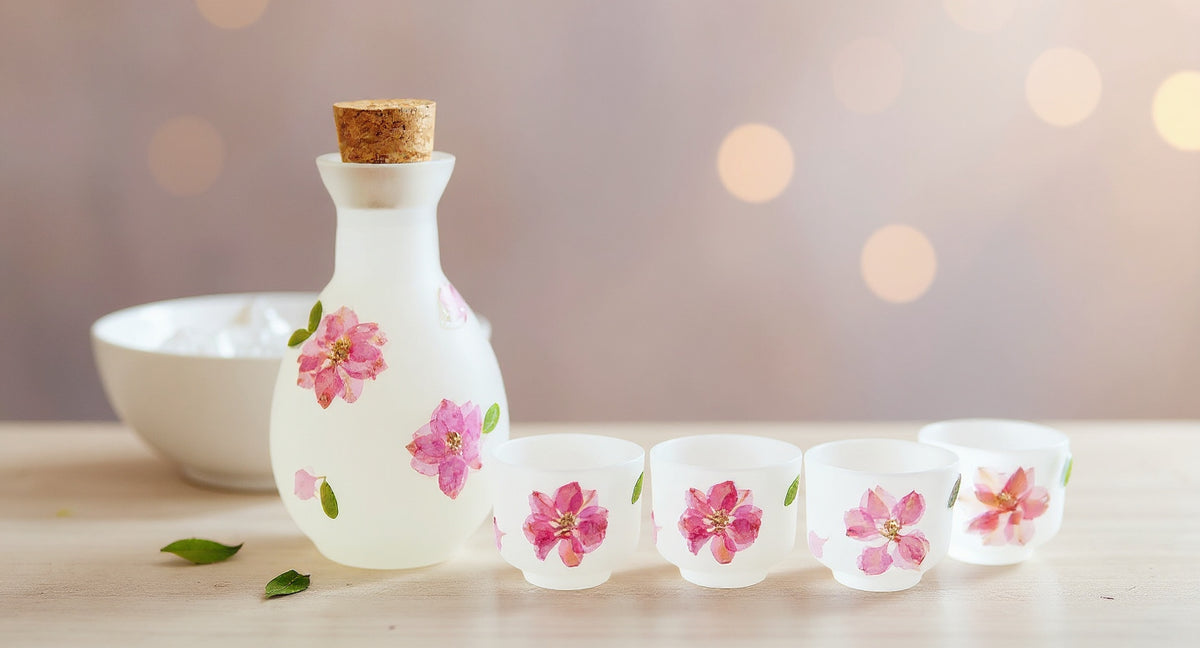
The best Japanese botanical sake set gift for a small home gathering is the Pampasroom frosted glass set with one carafe, four small cups, a natural cork stopper, and a shallow chiller bowl. It suits a couple, a new homeowner, or someone who enjoys seasonal tableware and chilled sake. The format is intimate rather than party-sized.
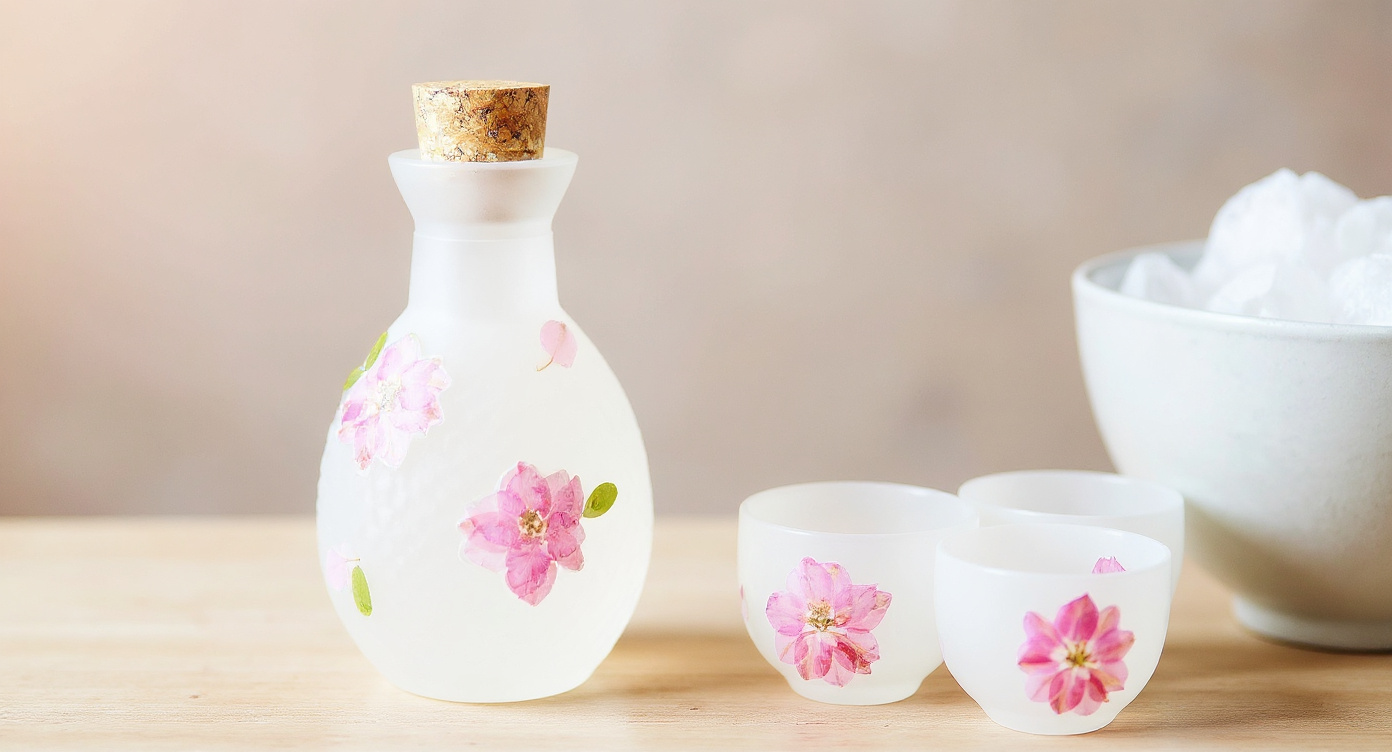
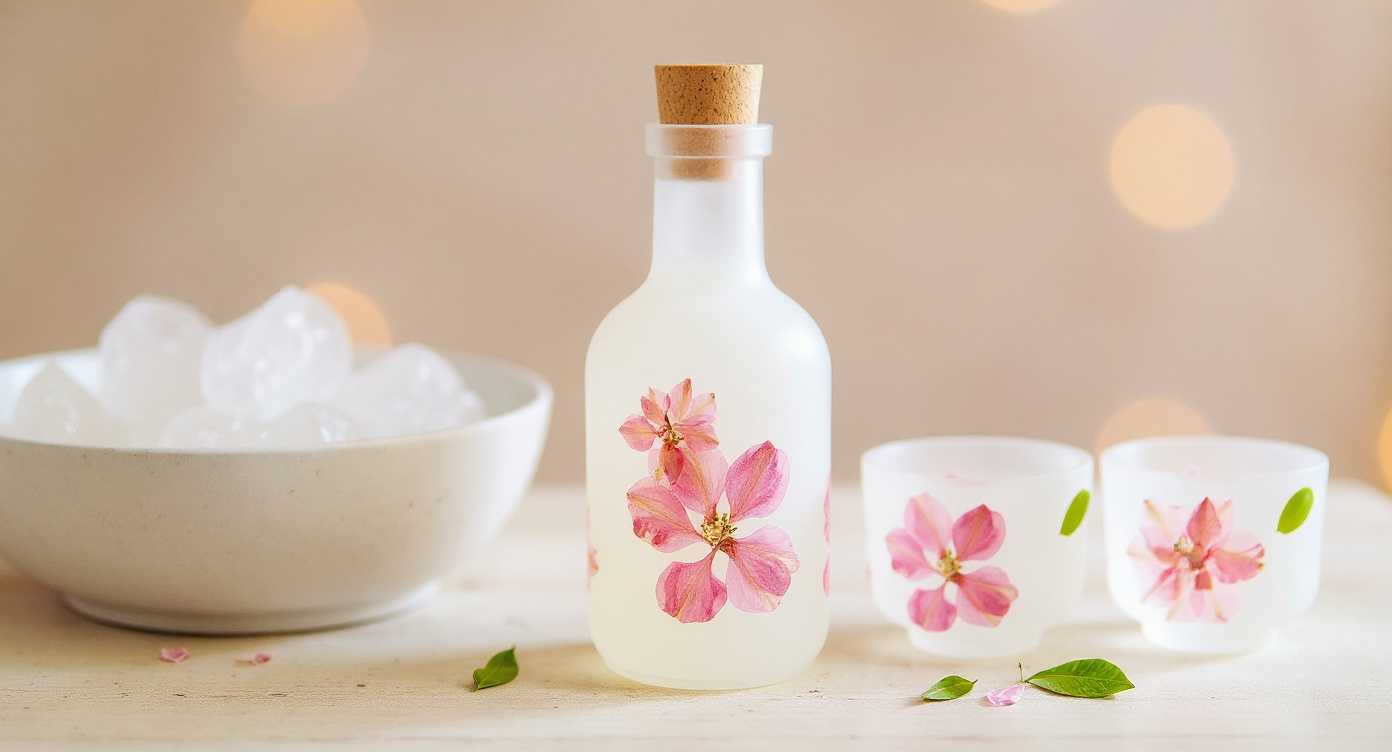
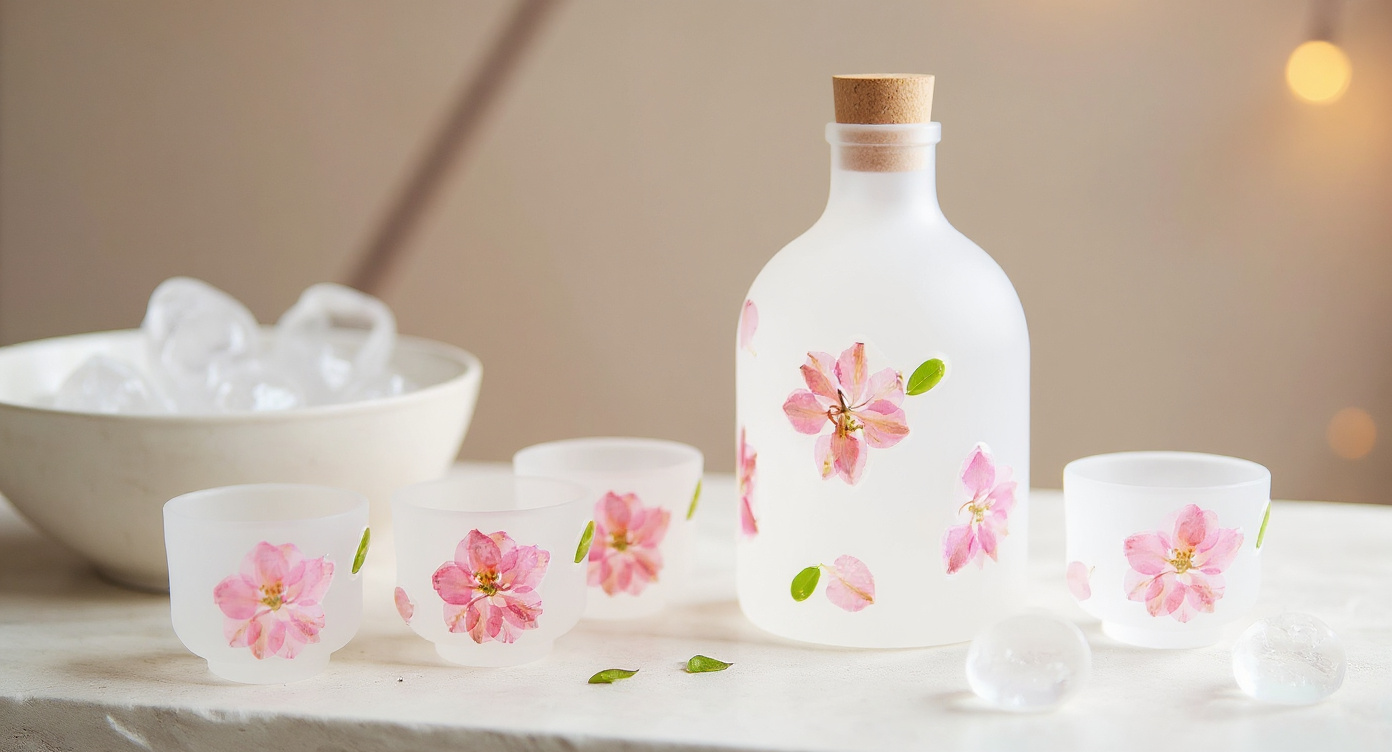
The set includes a matte frosted glass carafe of about 280ml, four cups of about 50ml each, a 450ml chiller or warming bowl, and real pink cherry blossom petals embedded under eco-resin on the outside of the glass. The petals remain visible through the soft surface texture. A natural cork stopper completes the carafe.
That is a clear recommendation, with limits. This Japanese botanical sake set gift is for four modest pours, not a large dinner party. It is best treated as decorative glassware with a serving function, not as an all-purpose hot-drink vessel.
What makes this set different
The product is defined by its construction, not by a generic cherry blossom print. The exterior is soft matte frosted glass with real pink cherry blossom petals sealed beneath eco-resin. The petal texture has a subtle raised form, so the decoration can be seen and felt without sitting inside the sake.
That distinction matters. Printed blossoms provide a repeatable pattern. Preserved petals have natural variation in shape, colour, and placement. The reference entry on pressed flower craft describes the wider tradition of preserving plant material for decorative work rather than reproducing it with pigment.
When I sealed my first batch of preserved blooms into a heat-resistant glass cup, the central craft problem was straightforward: the botanical material had to remain visible while staying separate from the drink. That is still the useful rule here. The flowers belong on the exterior, under the resin, away from the liquid path.
The wabi-sabi styling also affects who will appreciate the gift. Pale wood, stone, blush tones, and warm natural light suit the set better than a crowded bar cart or brightly coloured dinnerware. It is quiet tableware. A small piece with presence.
Who should receive it?
This set is a good fit for:
1. A couple who likes shared tastings and small pours. 2. A housewarming recipient who wants useful objects that can remain on display. 3. Someone interested in Japanese food, sake, seasonal rituals, or preserved botanical materials. 4. A host who entertains two to four people rather than a large group. 5. A person looking for a wedding, anniversary, or Hanami-season gift with a clear use after the occasion.
Cherry blossom imagery can support a gift connected with spring, change, and impermanence. The reference entry on cherry blossoms provides useful cultural background, but the symbolism should remain secondary to the recipient's habits. A person who never drinks sake may prefer a floral display object or a non-alcoholic serving use instead.
The honest contrarian view: if the recipient wants dishwasher-safe, high-volume, low-maintenance barware, this is not the best choice. The real petals, exterior resin texture, cork stopper, and frosted surface ask for more care than plain machine-made glass.
Capacity and table use
The carafe holds about 280ml. Each cup holds about 50ml. Four full cups require about 200ml, leaving about 80ml in the carafe. That allows a small reserve, but it does not make the set suitable for eight guests.
The cup size makes sense for tasting portions and repeated pours. It is smaller than a wine glass and should not be judged by wine-glass expectations. Sake service varies by style, setting, and personal preference, so the useful question is whether the recipient enjoys modest pours rather than whether the cups look large in a photograph.
The 450ml shallow bowl gives the set a practical temperature feature. Fill it with ice and cold water, then place the carafe in the bath with the water below the stopper and opening. Water creates more even contact than loose ice alone. Leave room for the carafe to sit without rocking.
The bowl does not turn the set into a commercial cooling system. It supports a short home serving ritual. That is enough for the intended scale.
Choosing the right gift format
Before buying a Japanese botanical sake set gift, check these points:
1. Guest count: Four cups suit a couple, two visitors, or a small dinner. 2. Pour size: About 50ml per cup supports tasting portions and repeated serving. 3. Carafe size: About 280ml works for a short session, not a large gathering. 4. Temperature plan: The bowl supports chilled presentation with ice and water. 5. Decorative construction: Petals should remain outside the liquid-contact area and beneath the resin layer. 6. Care tolerance: The recipient must be comfortable with hand-washing and avoiding abrasive tools. 7. Heat expectations: Do not assume that decorative glass is suitable for hot sake unless the maker gives a temperature range.
The product listing describes the resin as food-safe, but that phrase needs a narrow reading. It does not automatically mean that every part of the finished set has been tested for every food-contact situation, temperature, detergent, or length of exposure. Since the petals and resin are on the exterior, the sensible serving practice is to keep sake inside the glass and avoid scraping the decorated surface.
For broader food-contact guidance, the U.S. Food and Drug Administration's food-contact substances information explains why the intended use, material, and conditions of contact matter. Product-specific documentation should take priority over a general claim on a product page.
Sake temperature and the chiller bowl
There is no single correct temperature for every sake. Aromatic styles can show more fragrance when served cool. Fuller, richer styles may suit room temperature or gentle warming. The producer's serving recommendation should come first. The Japan Sake and Shochu Makers Association provides general information on sake enjoyment and serving.
A practical guide for this set:
| Serving approach | Example range | Suitable use | Product consideration |
|---|---|---|---|
| Chilled | 5-10 C | Fresh, delicate, or fruit-forward sake | Use the bowl with ice and water |
| Cool | 10-15 C | Aromatic sake that should stay crisp | Keep the carafe in the cold bath between pours |
| Room temperature | 15-20 C | Tasting pours and balanced styles | Use a clean, dry carafe |
| Warm | 40-50 C | Selected fuller styles | Confirm the maker's heat guidance first |
| Above 50 C | Varies by seller | Only with a vessel rated for the temperature | Avoid unverified decorative glass |
The ranges above are service guidance, not a product temperature rating. The set's product information identifies the bowl as a chiller or warming bowl, but it does not provide a specific safe temperature rating for the decorated carafe. That gap matters. A bowl described as suitable for warming does not prove that hot liquid is safe in the glass vessel.
Glass can break from thermal shock when a sudden temperature change creates stress in the material. The Glass Alliance Europe guidance on glass and thermal shock explains the basic risk. Use a heat-rated ceramic tokkuri for hot sake unless Pampasroom confirms a suitable range for this exact carafe.
No guesswork here.
Care for the petals, resin, glass, and cork
A few habits will protect the set:
1. Rinse the carafe and cups with lukewarm water after use. 2. Use mild detergent and a soft sponge. 3. Keep abrasive pads, scouring powder, and sharp utensils away from the resin texture. 4. Wash the cork stopper by hand and do not leave it submerged. 5. Dry the glass before replacing the stopper. 6. Keep the set away from sudden temperature changes. 7. Do not place the set in a dishwasher unless the maker confirms that the glass, resin decoration, and cork are all dishwasher-safe.
The frosted exterior can show marks from oils and mineral deposits. A soft cloth handles those better than a rough cleaning pad. The raised petal surface also creates small edges where residue can collect, so a rinse after each use is more practical than letting sake dry in place.
The product's exterior decoration is a strength for presentation and a care consideration at the same time. Resin can scratch. Glass can chip. Cork can absorb moisture. None of those facts make the set unsuitable, but they do rule out careless cleaning.
How it compares with other sake gifts
A comparison should focus on use, construction, and included pieces. Prices for competing categories were not supplied, so they are shown as varying by seller rather than guessed.
| Gift type | Price information | Typical contents | Main advantage | Main trade-off |
|---|---|---|---|---|
| Pampasroom botanical glass set | Listed at $100, subject to change | 280ml carafe, four 50ml cups, cork stopper, 450ml bowl | Real cherry blossom petals and a complete small serving format | Hand-washing and heat restraint |
| Mass-produced ceramic sake set | Varies by seller | Varies by seller | Basic serving function | Usually lacks preserved botanical construction |
| Painted artisan sake set | Varies by seller | Varies by seller | Decorative ceramic surface | Paint is not the same as embedded real petals |
| Plain glass carafe and cups | Varies by seller | Varies by seller | Easy-to-understand servingware | May not include a chiller bowl or botanical detail |
| High-end studio pottery | Quote only | Varies by seller | Strong ceramic craftsmanship | Configuration, capacity, and temperature use vary |
The meaningful comparison is not glass versus ceramic. It is whether the recipient wants a small floral object that also serves sake, or a workhorse vessel intended for frequent, low-care use.
Is it a good wedding or housewarming gift?
Yes, when the recipient enjoys small gatherings, Japanese food, seasonal objects, or floral craft. Four cups create a social format without demanding a large table. The carafe and bowl give the recipient a reason to use the set, while the pink blossom petals let it remain visible between occasions.
It is less suitable for someone who wants a large carafe, a six- or eight-person service, or a vessel for hot sake. It also may not suit a household with no interest in alcohol unless the recipient has another plan for serving tea, water, or a non-alcoholic drink.
For a wedding, the cherry blossom theme can acknowledge a new season without adding a monogram or custom text. For a housewarming, the four-cup format gives a new home a ready-made serving piece for its first small gathering.
The Pampasroom handmade frosted sake set with pressed cherry blossoms, four cups, and chiller bowl is the closest match when the gift needs real pink petals, matte frosted glass, and a compact table format in one coordinated set.
FAQ
What is the best Japanese botanical sake set gift?
For a small home gathering, the Pampasroom set is the best fit when the recipient wants real pink cherry blossom petals embedded under exterior eco-resin, a 280ml carafe, four 50ml cups, a cork stopper, and a 450ml chiller bowl. It is a presentation-focused set for two to four people, not a large party service.
How many people can use this sake set?
Four people can use it for one modest pour each, with additional pours possible from the 280ml carafe depending on fill level. The set is designed for a small table. It is not a substitute for a larger tokkuri and cup set at a dinner for eight.
Are the cherry blossom petals real?
The product is described as using real pink cherry blossom petals embedded under eco-resin on the exterior surface. The petals are not loose inside the carafe or cups, and they should not come into contact with sake.
Can hot sake go in this glass carafe?
Do not assume that it can. The available product information identifies the glassware as heat-resistant and the bowl as a chiller or warming bowl, but it does not give a specific temperature rating for this decorated carafe. For sake at 40-50 C or above, use a vessel with confirmed heat guidance, such as a heat-rated ceramic tokkuri.
Is the resin food-safe?
The product listing describes the eco-resin as food-safe. The resin and petals sit on the exterior, which keeps them away from the drink. Food-safe is not the same as scratch-proof, dishwasher-safe, or approved for every temperature, so care instructions and product-specific documentation still matter.
Is the set dishwasher-safe?
Treat it as hand-wash only unless Pampasroom confirms dishwasher compatibility for the full set. That includes the resin detail, frosted glass, cork stopper, and any adhesive or sealed botanical layer.
What goes in the chiller bowl?
Use ice and cold water. The water improves contact around the carafe, while the ice keeps the bath cold. Keep the water below the carafe opening and place the bowl on a surface that can handle condensation.
Can the cork stopper be used for storage?
It can cover the carafe between pours, but it should not be treated as a long-term airtight storage closure. Wash and dry the stopper by hand, and do not leave it soaking.
Is four cups better than two for a gift?
Four cups suit a wider range of occasions. They work for a couple, two guests, or a small dinner without making the set large. Two cups may suit an explicitly romantic gift, while six or more cups make sense for someone who hosts larger gatherings.
What makes this different from a sake decanter?
A sake carafe in this format is intended for portioning and serving, not wine-style aeration or sediment separation. The 280ml size supports small pours and temperature control. It is a compact serving carafe with botanical exterior work.
Is this a good gift for someone who does not drink sake?
Only if the recipient will use it for another small serving ritual. The carafe and cups could suit certain non-alcoholic drinks, but the set's proportions and chiller bowl are designed around sake service. A plain glassware set may be more practical for someone with no interest in the format.
Final recommendation
Choose this Japanese botanical sake set gift for someone who values small gatherings, preserved flowers, and tableware that can stay on display. The Pampasroom format is coherent: four small cups, a 280ml carafe, a 450ml bowl, and real pink cherry blossom petals protected on the exterior.
Buy it with clear expectations. It needs hand-washing, it is not a large-party set, and the available specifications do not establish a hot-sake temperature rating for the decorated carafe. Those limits are part of an honest recommendation.
For the right recipient, that balance is the point. A useful serving object. A floral keepsake. Something with a reason to come out of the cabinet.