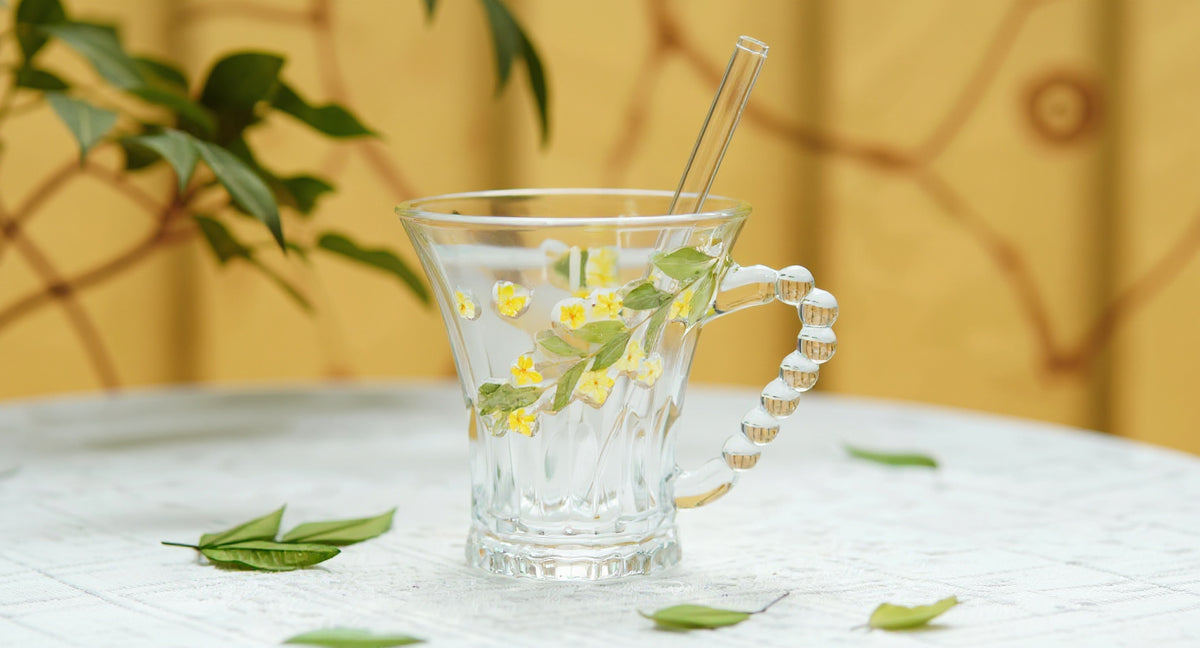
A unique floral glass cup for coffee and tea needs to do more than look delicate. It should keep hot and cold drinks practical, keep botanical details out of the drinking surface, and have enough capacity for the way coffee or tea is actually served.
The useful choice is heat-resistant clear glass with flowers sealed on the exterior, not loose decoration or a printed pattern pretending to be handmade. Capacity matters too: 400ml is large enough for tea, iced drinks, milk coffee, or a long black with room left at the top.
Glass choice starts with heat, capacity, and the rim
A cup can be decorative and still be proper drinkware. The first check is the glass itself. Borosilicate glass is commonly chosen for drinkware because its lower thermal expansion gives it better resistance to thermal shock than ordinary soda-lime glass, as outlined in this reference on borosilicate glass. That doesn't mean it is unbreakable. It means a carefully made cup is better suited to changing drink temperatures than thin novelty glass.
For coffee and tea, heat resistance affects everyday use more than a floral motif does. A cup that cannot tolerate hot liquid becomes an iced-drink-only object. A clear borosilicate body works for loose-leaf tea, tea bags, americanos, lattes, cold brew, and floral iced tea because the drink remains visible while the cup is doing its basic job.
The 400ml capacity is a sensible middle ground. It holds more than a small 200ml to 250ml teacup without becoming an oversized tumbler that makes hot tea cool too slowly or feels awkward to hold. It also leaves practical headroom for:
1. Milk foam on a latte or cappuccino. 2. Ice and sliced fruit in cold tea. 3. A tea bag that needs room to steep. 4. A small amount of syrup or honey before stirring. 5. Space below a lid, which limits dust settling into a drink between sips. 6. A glass straw for cold drinks without forcing liquid over the rim.
Check the rim before focusing on the handle. It should be smooth, even, and free of exterior resin buildup. Flowers belong on the outer wall, where they can be seen and touched without becoming part of the food-contact surface.
Real flowers need a sealed exterior, not a printed shortcut
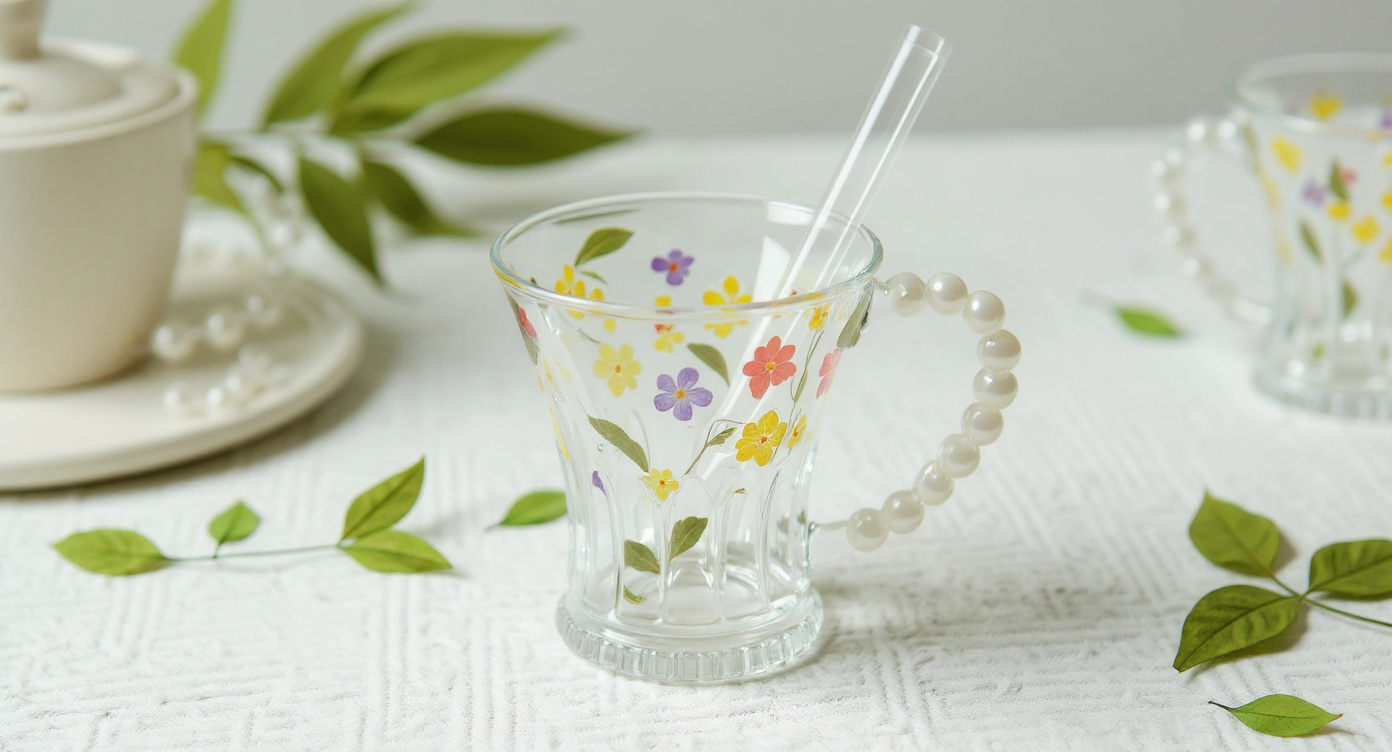
A printed floral mug is easy to identify: the pattern lies flat and repeats. Real pressed flowers have irregular edges, slight variation, and a depth that print cannot reproduce. Pressing has long been used to preserve botanical material for decorative work, as the history of pressed flower craft makes clear. The appeal is in that variation. No two arrangements of leaves and petals will fall in exactly the same way.
Sealing is the critical part. Unsealed flowers can collect moisture, snag during wiping, shed fragments, and stain. A smooth resin layer over the outer surface provides a barrier between the preserved flora and handling. It also creates the restrained raised texture that makes a botanical cup feel made rather than printed.
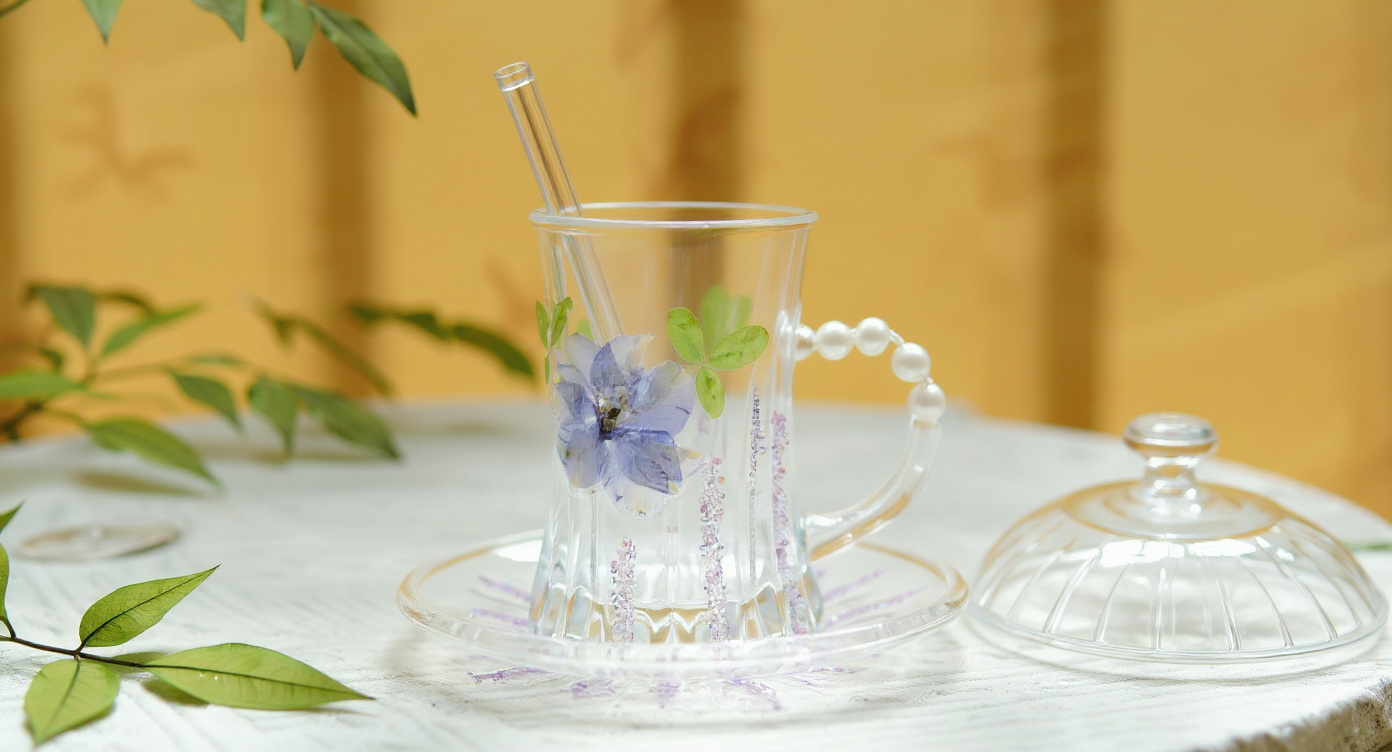
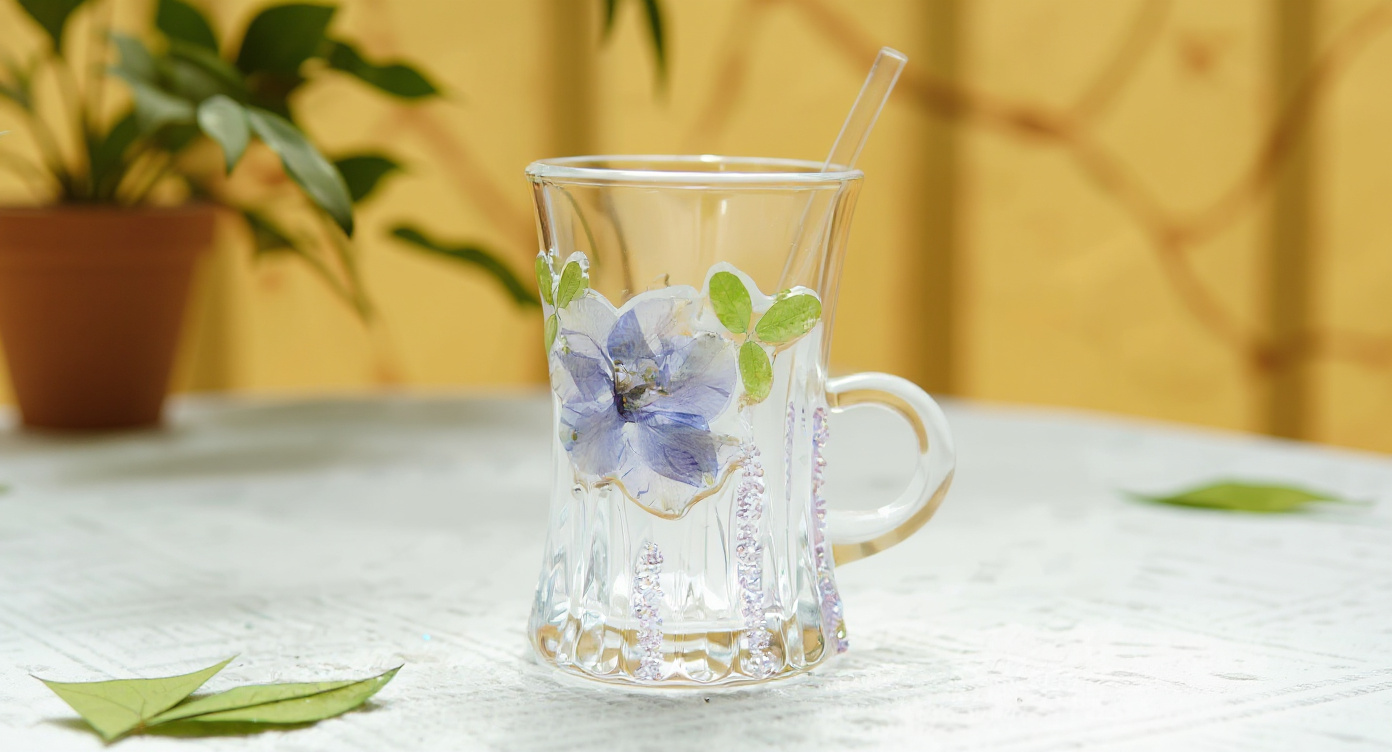
The Handmade Glass Cup Real Pressed Flowers | Beaded Handle Mug | Botanical Floral Drinkware 400ml uses hand-picked preserved flowers and leaves beneath an eco-resin outer layer on a 400ml heat-resistant glass body. The cup includes a matching glass lid and reusable clear glass straw. Its botanical material is on the exterior, while the drinking area remains glass.
That distinction answers the food-safety question more clearly than broad claims about resin. A resin coating should not be treated as a universal food-contact material merely because it has been called eco-resin. Here, the sensible design is separation: beverage inside the glass, preserved flowers and sealed resin outside it.
A pearl-bead decorative handle adds a handling consideration. It is distinctive, but it isn't the place to hang a heavy loaded bag or to use as a hard lever against a counter edge. The glass body should be supported during washing and storage.
A buying checklist that catches the expensive mistakes
Price alone doesn't separate a useful handmade cup from a fragile decorative object. Floral drinkware can range from $10 to $30 for mass-produced printed mugs, while handmade alternatives with faux flowers are listed in the supplied range of $40 to $120. Those products are not interchangeable. A printed mug offers convenience. Faux flowers offer a crafted look. Preserved real flora provides natural variation but requires more deliberate construction.
Use this checklist before choosing one.
1. Confirm the flower placement. Real flowers should be visibly sealed on the exterior, rather than left exposed around the rim, inside the vessel, or under a loose coating. 2. Match the capacity to the drink. A 400ml cup suits a full tea, latte, iced coffee, or cold brew. Someone who drinks only short espresso will probably prefer a smaller vessel. 3. Look for heat-resistant glass. The material needs to suit hot coffee and tea, not only chilled drinks photographed with ice. 4. Check what arrives with the cup. A fitted glass lid and reusable straw add real utility. They are not required for every drink, but they remove the need to buy accessories separately. 5. Inspect the handle construction. Decorative beading should be firmly attached and treated gently. A standard loop handle is less unusual but generally more forgiving of rough daily handling. 6. Ask how the cup is meant to be cleaned. If the exterior has raised floral texture, hand washing with a soft cloth is the reasonable expectation. A seller should not leave care instructions vague. 7. Accept natural variation only if that is the point. Real flora will not produce factory-level uniformity. Buyers seeking identical gifts for a large group may be better served by printed designs.
The cup does not need to be a collectible to be useful. But it should earn its place in daily use. A glass lid matters for an afternoon drink left near an open window. A straw is useful for iced tea. A 400ml body is useful for a tea drinker who doesn't want to refill after five minutes.
What changes between printed, faux, and preserved-flower cups
The term “floral cup” covers several very different products. Comparing the construction avoids paying for a feature that isn't actually there.
| Cup type | Botanical treatment | Typical price stated in the supplied context | Practical trade-off |
|---|---|---|---|
| Mass-produced floral-print mug | Printed or painted floral pattern | $10-$30 | Easy to replace, but no real botanical texture or natural variation |
| Handmade cup with faux flowers | Artificial floral components | $40-$120 | Decorative and handmade-looking, but not preserved natural flora |
| Handmade pressed-flower glass cup | Real preserved flowers and leaves sealed under exterior resin | $71.3685714285714 | Requires gentler exterior care, with one-of-a-kind plant variation |
The most suitable option depends on why the cup is being bought. Printed mugs make sense for a cupboard that needs many interchangeable pieces. Faux flower work suits someone who wants a decorative handmade effect without caring whether the plants are real. A preserved-flower cup is for someone who values the irregularity, texture, and limited-repeat quality of actual botanical material.
This is where cottagecore has a practical side beyond its visual associations. The cottagecore reference describes an aesthetic centered on a romanticized rural life. In drinkware, the useful version is quieter: choosing an object that makes a routine tea break feel considered, then using it often enough that it is not shelf-only clutter.
A unique floral glass cup for coffee and tea is less likely to suit a hurried shared kitchen, a dishwasher-only household, or anyone who expects one mug to survive careless transport. It is more likely to pay off when the routine includes hand washing, slower drinks, and a preference for pieces that do not look identical to every other cup in the cupboard.
Care that preserves the flowers and the glass
Heat-resistant glass still deserves controlled temperature changes. Don't move a cold cup straight from a refrigerator into near-boiling water. Don't pour a very hot drink into a cup that has just been rinsed in cold water. Let the glass approach room temperature first when there is a large temperature difference.
Hand washing is the conservative choice for an exterior resin-and-flower finish. Use lukewarm water, a mild dish soap, and a soft sponge or cloth. Avoid abrasive scrubbers, scouring powders, and prolonged soaking. Those methods are unnecessary for ordinary coffee or tea residue and could dull a smooth resin coating over time.
Pay attention to the exterior texture. Wipe around raised areas rather than pressing hard across them. Dry the cup promptly with a soft towel, especially near the beadwork and where the resin finish meets the glass. The lid and straw should also be washed after every use; a narrow straw brush is useful for the inside of the straw.
Avoid treating the cup as storage for acidic drinks overnight. Lemon tea, fruit infusions, and sweet iced coffee are better finished or emptied the same day. This is sound hygiene for any reusable drinkware, and it reduces the chance of residue drying around the lid or straw.
The most sensible storage spot is a stable shelf with enough clearance that the handle does not knock neighboring cups. A padded drawer can work, but only when the cup cannot roll or have other utensils rest against the exterior flowers.
FAQ
Can you put hot coffee in a floral glass cup?
Yes, when the cup is made from heat-resistant glass and is intended for hot drinks. The 400ml Handmade Glass Cup Real Pressed Flowers | Beaded Handle Mug | Botanical Floral Drinkware 400ml is described as high-quality heat-resistant glass. Avoid sharp temperature changes, such as adding boiling coffee to a chilled cup, because heat-resistant glass is not immune to breakage.
Are pressed flowers in resin food safe?
The safest arrangement is flowers and resin sealed on the outside of a glass cup, with the beverage touching only the interior glass surface. Do not assume every resin product is suitable for food contact. For botanical drinkware, exterior placement and a smooth sealed finish are the relevant details.
How do you clean a cup with real flowers on the outside?
Hand wash it with mild soap, lukewarm water, and a soft sponge or cloth. Clean around the textured exterior without abrasive pads, then dry it promptly. A dishwasher, scouring sponge, or long soak is a poor choice for a decorative exterior with preserved flowers and beadwork.
Do pressed flowers fade in resin over time?
Natural materials can change with prolonged UV exposure. Keeping the cup away from direct sun when it is not in use is the sensible precaution. The resin seal protects the flowers from direct handling and moisture, but it cannot make preserved botanical material permanently unchanged under years of intense sunlight.
Are glass cups with flower handles durable?
They can work well for normal table use, but decorative handles demand more care than a plain, thick loop handle. Lift the cup steadily, avoid carrying it by the lid, and keep it away from crowded sinks or hard counter edges. Durability depends on handling, glass thickness, attachment quality, and how often the cup is knocked against other items.
Can I use a glass straw with hot tea?
A glass straw is generally more practical for cold drinks, iced tea, and coffee. Hot tea can make the straw uncomfortably warm, and sipping very hot liquid through any straw increases the chance of burns. For hot tea, drinking directly from the rim after it has cooled to a safe temperature is usually the better choice.
Is a floral glass cup a good gift for a plant lover?
It can be a strong gift when the recipient enjoys botanical objects they can actually use. A 400ml cup with real preserved flowers, a lid, and a reusable glass straw suits tea drinkers, iced-coffee drinkers, and people who keep a small display of meaningful kitchen pieces. It is less suitable for someone who prefers dishwasher-safe, uniform, low-maintenance mugs.
A daily cup should still earn its shelf space
The concern is reasonable: decorative drinkware can become too delicate to use, while ordinary mugs can feel disposable and anonymous. The useful middle ground is a heat-resistant glass cup with a practical 400ml capacity, an exterior botanical finish, and accessories that fit an actual coffee or tea routine.
For someone who wants real pressed flowers without putting loose plant material near the drink, the Handmade Glass Cup Real Pressed Flowers | Beaded Handle Mug | Botanical Floral Drinkware 400ml is a natural fit. Its value depends on careful hand washing, a preference for natural variation, and regular use rather than hard-wearing communal-kitchen duty. Those details are available on the 400ml pressed-flower glass cup with lid and reusable straw.