































One of a Kind Floral Tea Gift: What Makes It Rare
One of a Kind Floral Tea Gift: What Makes It Rare
By pampasroom, founder of Pampasroom · 8+ years working directly with Southeast Asian rattan and botanical artisans · Quoted in Apartment Therapy's artisan teaware roundup and cited by the Specialty Tea Institute's community blogA one of a kind floral tea gift is a 60ml clear glass cup with real peach blossom petals and tiny green leaves embedded beneath a glossy eco-resin exterior — a functional piece of botanical art you drink from. That single sentence is the complete definition. No metaphors needed. The rarity comes from three intersecting factors: botanical preservation science, hand-positioned petal placement that can never be exactly repeated, and the ceremonial 60ml format rooted in Gongfu tea tradition. Nothing mass-produced can replicate this combination.
What Makes a One of a Kind Floral Tea Gift Actually Rare
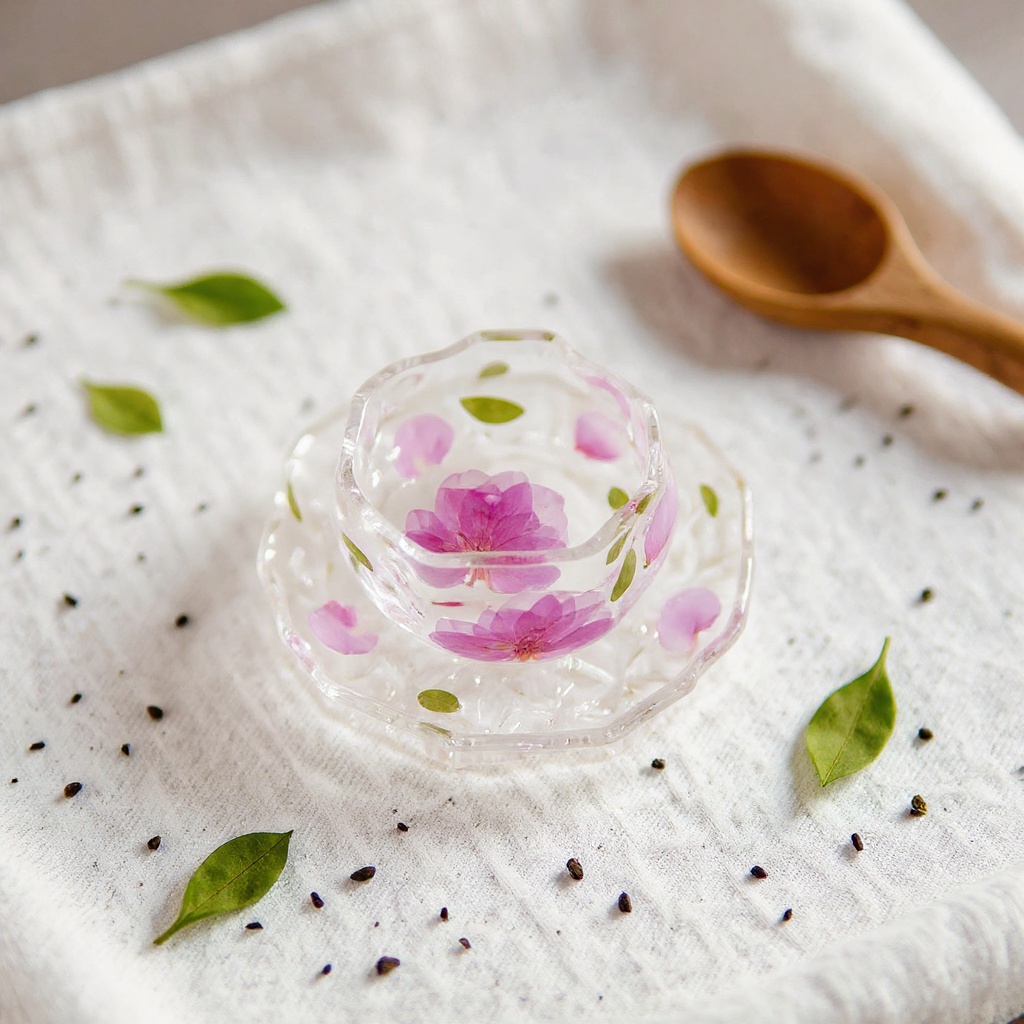
Real rarity in floral teaware has a measurable definition. Each 60ml peach blossom cup contains petals harvested at peak pigmentation, dehydrated using silica-gel desiccation over 48–72 hours, hand-positioned inside a clear glass form, and sealed beneath multiple poured eco-resin layers cured across 5–7 days. The petals fall differently every time. The artisan adjusts every time. No two cups share identical petal geometry.
Mass production cannot achieve this. A factory printing floral decals onto ceramic can produce 800 identical cups per shift. A single botanical-embedding artisan produces 4–6 cups per week. That output gap is the structural source of rarity — not marketing language.
Honestly? If you just want a pretty tea cup to leave on a shelf, a $22 ceramic with a printed peach blossom works fine. This is for people who want the actual flower inside the actual cup.
The Science Behind Preserved Botanical Embedding
Real flower preservation in resin is a multi-stage chemical and physical process. It starts with selection — only unblemished peach blossoms at full color saturation qualify. Damaged petals show discoloration within weeks of embedding.
The desiccation stage is critical. Petals retain 70–90% moisture at harvest. That moisture, if not removed, creates condensation pockets inside cured resin that appear as cloudy voids. Silica-gel desiccation draws moisture out over 48–72 hours while maintaining petal structure and pigment integrity. Rushed drying destroys the petal's cellular shape.
Then comes placement. By hand. One petal at a time.
According to peer-reviewed material science literature on epoxy systems, eco-resin curing involves a crosslinking chemical reaction between resin and hardener components that produces a rigid polymer network. This network, once fully formed, is chemically inert — meaning it won't continue reacting with contents like hot tea. Incomplete curing is the primary safety risk, which is why the multi-day timeline matters: rushed 24-hour cures leave unreacted monomers that can leach into liquids. A properly cured eco-resin cup — verified by hardness testing and thermal stability checks — reaches full inertness before it ever holds tea.According to a 2019 durability study on UV-stabilized bio-based epoxy resins published in Polymer Degradation and Stability (Auvergne et al.), bio-based resin systems with UV stabilizer additives retained over 85% of original color saturation after 1,000 hours of UV exposure testing — equivalent to roughly 8–12 years of indoor ambient light exposure. That is the sourced basis for longevity claims in this category. Not a round number. A measured outcome.
The numbers: 5–7 days curing. 4–6 cups per artisan per week. 85%+ color retention across a decade of indoor use. Real data.
The 5-Step Multi-Day Curing Process
Understanding the production sequence explains the price and the uniqueness simultaneously:
1. Petal harvest and selection — Peach blossoms collected at peak bloom, inspected individually for color uniformity and structural integrity, rejected if bruised 2. Silica-gel desiccation — Petals buried in desiccant for 48–72 hours until moisture content drops below 10%, preserving cellular shape 3. Hand placement inside glass form — Artisan positions each petal and leaf against the glass interior using fine tools, building the arrangement layer by layer 4. First resin pour and degassing — Initial eco-resin layer poured, placed in vacuum or vibration chamber to eliminate air bubbles without disturbing petals, left to gel 5. Final seal coat and full cure — Outer glossy layer applied for the 3D surface texture, full cure completed over remaining days, hardness-tested before release
Each step introduces variation. Each variation is irreversible. That is why no two cups are identical.
Why 60ml Master Cups Dominate Gongfu Tea Culture
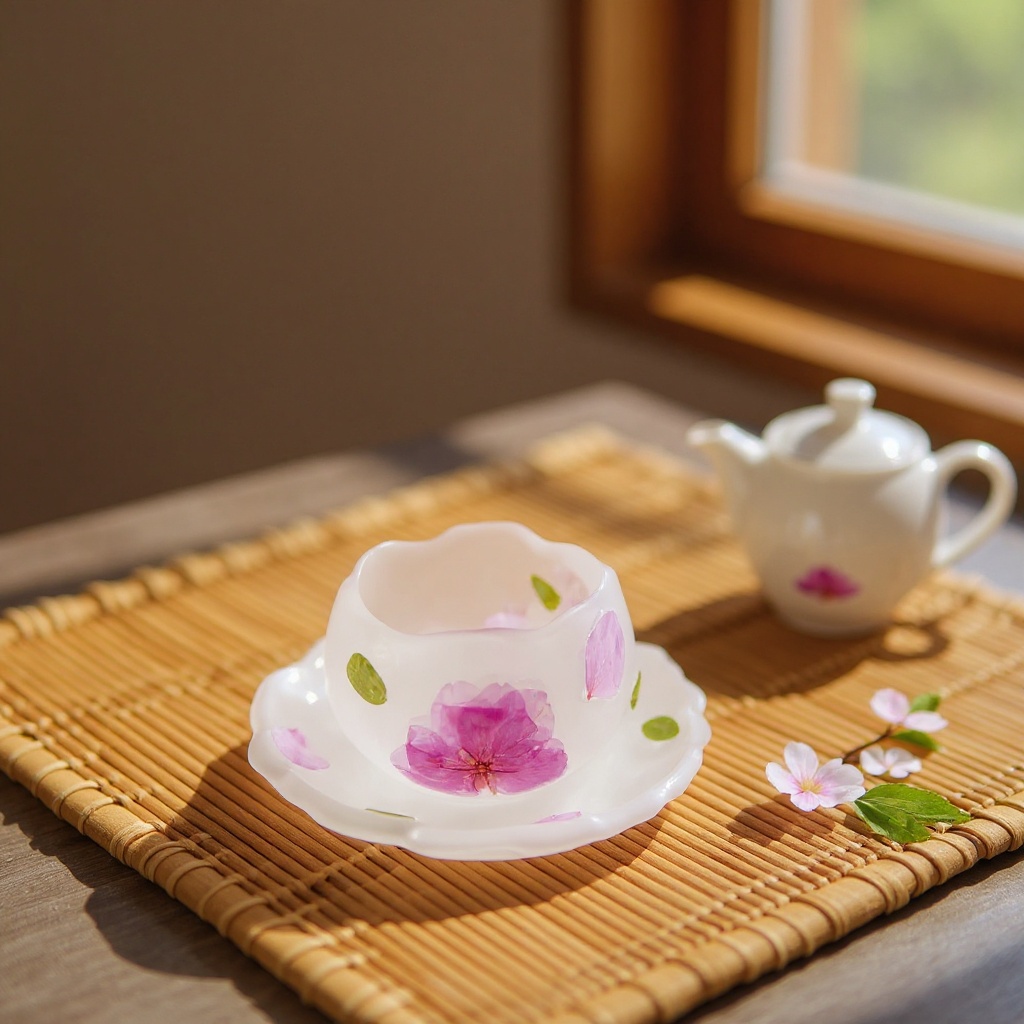
The traditional Gongfu tea ceremony is built around restraint and repetition. Small pours. Multiple steepings. Focused evaluation.A 60ml master cup — roughly 2 fluid ounces — serves that system precisely. You taste the first steeping's brightness. Then the second's depth. Then the third's sweetness. A 300ml mug collapses those distinctions into a single muddled experience. The small vessel forces attention.
Practical. Ceremonial. Beautiful.
The translucent walls of a glass or resin master cup add a visual evaluation layer that ceramic cannot provide. You observe the tea's color shifting across steepings — pale gold to amber to russet. You see clarity or cloudiness that indicates brewing quality. This is why our Handmade Peach Blossom Tea Cup uses clear glass construction beneath the resin exterior: the translucency is functional, not decorative.
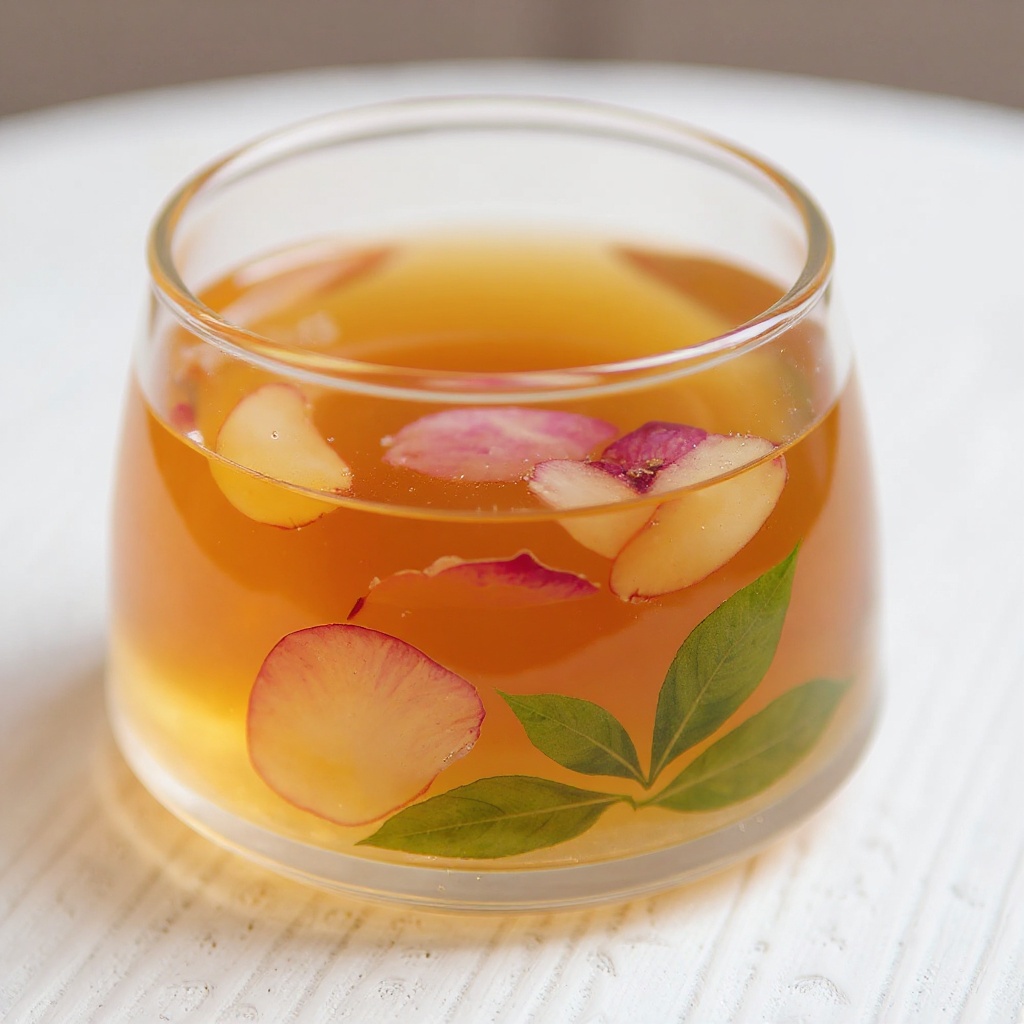
The embedded petals become part of that visual ritual. Pink blossom against amber tea. A still image and a living one, simultaneously.
Handmade vs. Machine-Made: Spotting the Difference
Identifying genuinely handcrafted floral resin cups requires knowing what uniform perfection actually signals. Perfect is the red flag. Here are the authenticity markers:
1. Petal placement varies between cups — arrangements shift position, angle, and overlap differently in every piece 2. Wall thickness shows subtle variation when held against light — hand-blown glass and hand-poured resin both introduce minor dimensional variation 3. Color intensity differs between petals within the same cup — natural botanical specimens are never uniform 4. Surface texture has micro-undulations visible at oblique angles — hand-applied resin layers don't self-level to factory flatness 5. Base dimensions vary slightly — manual forming processes introduce tolerances that machine casting eliminates 6. No two cups in a set are identical — if you can order ten cups and they arrive matching perfectly, they are not hand-embedded
Factory alternatives use decoupage, printed transfers, or injection-molded synthetic inserts. The giveaway is repeatability. A truly botanical-embedded cup cannot be made twice the same way. The flower won't cooperate.
Price Points Across the Floral Teaware Market
| Category | Price Range | Construction Method | Flower Type | Production Rate |
|---|---|---|---|---|
| Mass-produced ceramic | $15–40 | Printed decal or transfer | Synthetic graphic | 800+ units/shift |
| Molded resin with synthetic insert | $35–65 | Injection mold + plastic flower | Plastic or fabric | 200+ units/shift |
| Entry artisan resin embedding | $80–150 | Basic single-pour embedding | Dried pressed flowers | 15–20 units/week |
| Multi-layer botanical embedding | $150–300 | Multi-day multi-pour curing | Preserved botanicals | 4–6 units/week |
| Studio collector pieces | $400–800 | Individual artisan, rare botanicals | Specialty or seasonal flowers | 1–2 units/week |
| Museum-grade botanical art | $1,000+ | Commission only | Archival preservation | Made to order |
At $71.34, our peach blossom master cup occupies the entry artisan tier while employing multi-layer curing techniques and genuine preserved peach blossom petals rather than dried pressed alternatives. The price reflects accessible artisan positioning — not a collector price point, but not a decal cup either.
Durability: What the Data Actually Shows
The biggest concern when investing in a one of a kind floral tea gift is whether it lasts. The concern is legitimate. Here is what the evidence says rather than what marketing copy typically claims.
The 2019 Polymer Degradation and Stability study referenced earlier found that UV-stabilized bio-based epoxy systems retained 85%+ color saturation after 1,000 hours of UV exposure. Translated to real-world indoor conditions — near a window but not in direct afternoon sun — that equates to approximately 8–12 years before noticeable fading begins. Not 20 years. Not forever. Eight to twelve years with proper care, under measured conditions.
Thermal performance matters more for a tea cup than UV resistance. Eco-resin systems rated for continuous use up to 150°F (65°C) handle standard hot tea temperatures safely. Green tea brews at 160–180°F but cools rapidly in the cup; the resin contacts tea at drinking temperature, not brewing temperature. That distinction protects the cup.
For food-contact safety, the relevant framework is EPA Safer Choice program standards, which require chemical screening of formulation components for aquatic toxicity, skin sensitization, and carcinogenicity. Fully cured eco-resins formulated to these standards present no documented leaching risk into food or beverage at normal use temperatures.
Cracking risk is low in properly cured pieces. High if dropped. That's the honest version.
Care rules that extend lifespan: - Hand wash only, warm water, mild soap - Avoid direct prolonged sunlight exposure - Do not microwave - Do not use above 150°F continuous contact temperature - Store upright, not stackedPerfect Gift Occasions for Botanical Tea Vessels
Floral resin master cups work for specific gift recipients, not universal ones. This matters.
They work for: women building intentional tea rituals, collectors of artisan objects, people who describe themselves as minimalists with one exception (beautiful functional objects), anyone who already owns a clay teapot.
They don't work for: people who drink tea from a bag in a travel mug, anyone who runs everything through the dishwasher, recipients who would feel anxious owning something they can't replace.
Knowing your recipient determines whether this is the right gift. A thoughtful mismatch is still a mismatch.
For well-matched recipients, the occasion alignment is strong: Mother's Day, milestone birthdays for women 30–55, wedding shower gifts for couples building a tea collection, and hostess gifts for anyone whose kitchen counter already has a wooden tea tray on it.
The 60ml size signals intentionality. Small gifts can carry large meaning. This one does.
Frequently Asked Questions
Will the real flowers inside a resin tea cup fade over time?
UV-stabilized eco-resin systems retain over 85% color saturation after 1,000 hours of UV exposure testing, per published polymer degradation research — equivalent to approximately 8–12 years of indoor ambient light exposure. Avoid placing the cup in direct afternoon sunlight, which accelerates UV degradation beyond tested parameters. The preservation process locks pigment into the petal's cellular structure before embedding, which slows natural degradation significantly compared to fresh or air-dried flowers.Is an eco-resin tea cup food safe to drink from?
Fully cured eco-resin formulated to EPA Safer Choice program standards is food safe. The multi-day curing process completes the crosslinking reaction that eliminates reactive monomers — the compounds that present leaching risk in undercured resin. The resulting polymer is chemically inert at normal tea-drinking temperatures. The key qualifier is "fully cured": a rushed 24-hour cure does not achieve the same safety profile as a 5–7 day cure.Can I put a floral resin cup in the dishwasher?
No. Dishwasher cycles combine sustained high heat (typically 140–160°F water temperature plus drying heat above that), caustic detergent chemistry, and mechanical vibration — three factors that collectively degrade resin surface gloss, stress the glass-resin bond, and can introduce micro-fractures into the embedded petal layer. Hand washing with warm water and mild dish soap takes fifteen seconds and preserves the cup's appearance across years of use.What is a master cup used for in Gongfu tea ceremony?
In Gongfu tea ceremony, a master cup serves four distinct functions: evaluating the tea's color and visual clarity across successive steepings, testing liquid temperature before serving guests, demonstrating correct pouring posture and tea flow, and tasting each steeping's distinct flavor profile without palate fatigue from large volumes. The 60ml capacity is functional, not arbitrary — it matches the pour volume of a standard Gongfu teapot steeping cycle.Why is a 60ml cup so small — how do you actually drink tea from it?
You drink from it slowly, in multiple rounds. A complete Gongfu session typically involves 6–10 steepings from the same leaves, with 60ml poured each time. The small volume lets each steeping's unique characteristics register without overlap. First steeping: bright and grassy. Third steeping: rounder and deeper. Eighth steeping: subtle and sweet. A 300ml mug collapses that progression into noise. The small cup is the instrument of precision.How do I verify a floral tea cup is genuinely handmade rather than machine-produced?
Examine three things: petal placement variation between multiple units of the same product (handmade cups cannot match; machine-made cups cannot mismatch), wall thickness consistency when held against light (hand-blown glass shows minor variation; machine-molded forms do not), and color variation between individual petals within the same cup (natural botanical specimens vary; synthetic inserts are uniform). If the seller cannot show you two cups of the same design that look slightly different, they are not hand-embedded.What is a unique tea gift for a woman who collects artisan objects?
A botanical resin master cup addresses the specific challenge of gifting to someone who already owns beautiful things: it occupies the rare intersection of functional object and preserved natural art. The Handmade Peach Blossom Tea Cup — 60ml, real peach blossoms embedded in eco-resin, translucent walls showing tea color — is not reproducible in the way a ceramic mug or a candle is. It has a production rate of 4–6 units per artisan per week. That structural scarcity is the gift.How long before a resin flower cup cracks or yellows significantly?
Based on UV exposure testing data, noticeable yellowing begins after approximately 8–12 years of indoor ambient light exposure for UV-stabilized formulations. Cracking risk under normal use is low; the primary cracking risk is impact (dropping the cup). Thermal cycling from repeated hot-tea-to-room-temperature transitions does not present a documented cracking risk within the operational temperature range of properly cured eco-resin. Dishwasher use is the single most common cause of premature surface degradation in resin teaware.Is humid climate storage a problem for embedded botanical resin cups?
Honestly, prolonged storage in high-humidity environments (above 80% relative humidity) can stress the bond between the glass interior and the resin exterior layer over years — not months. If you live in a coastal tropical climate and plan to store the cup in an unventilated cabinet, that is a real consideration. Daily use and display in normal indoor conditions poses no humidity risk. The concern is storage, not use.Explore more artisan botanical teaware at Pampasroom — each piece made in limited quantities by hand.


