































Eco Friendly Tea Sets With Preserved Flowers Explained
Eco Friendly Tea Set With Preserved Flowers: A Complete Guide
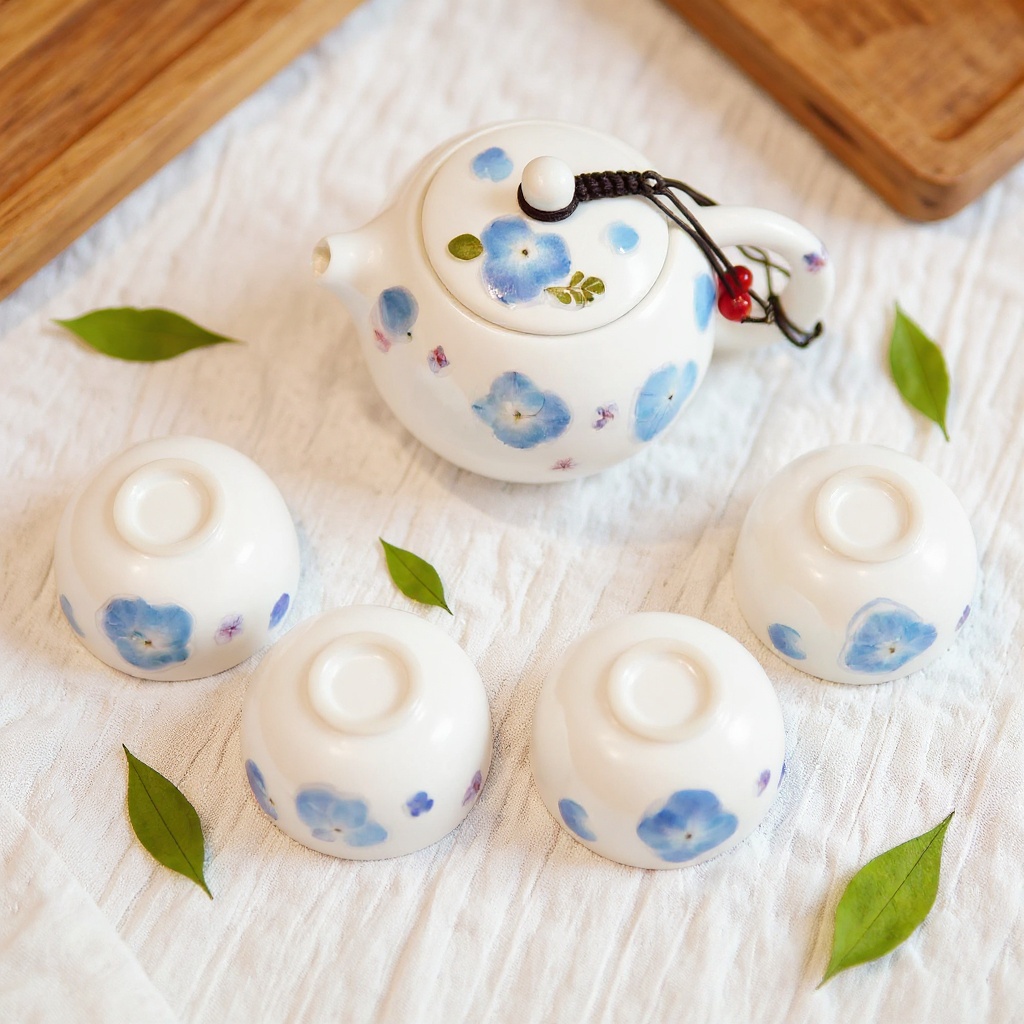
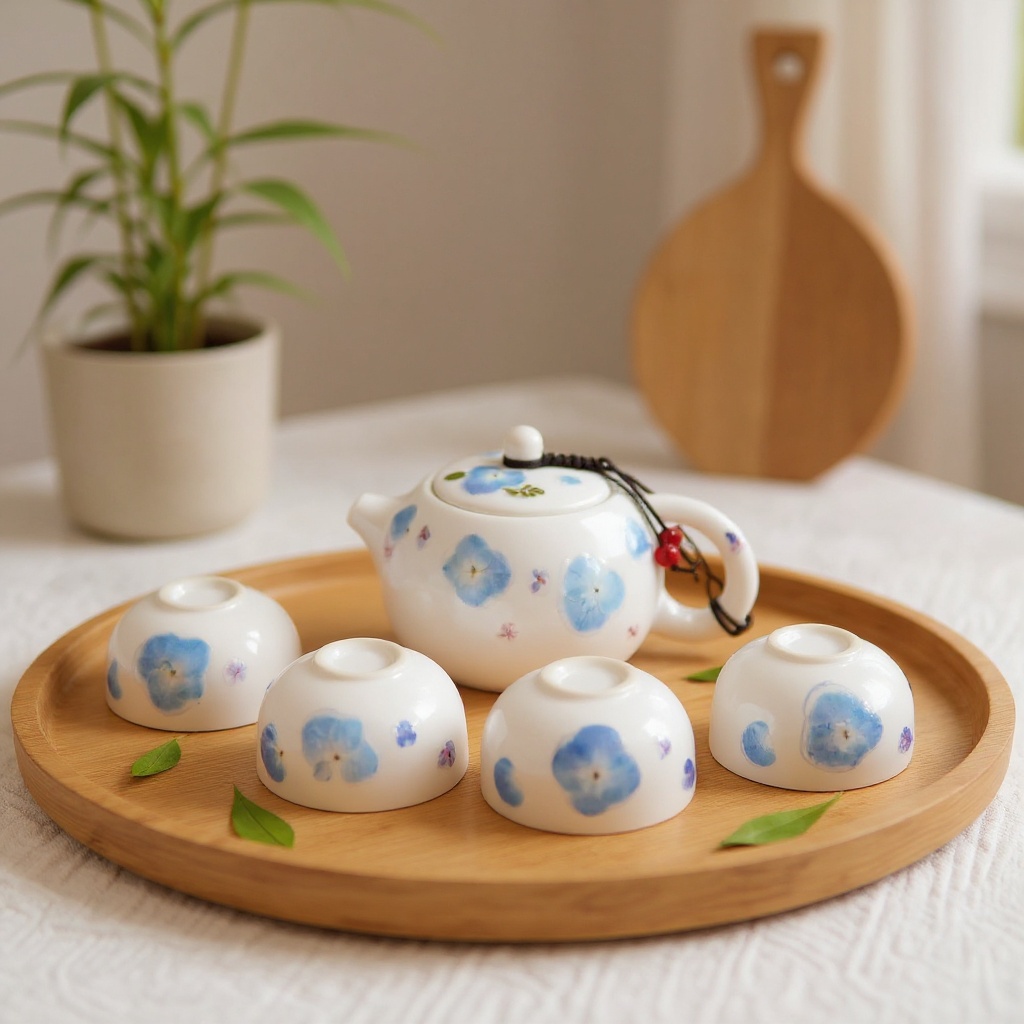
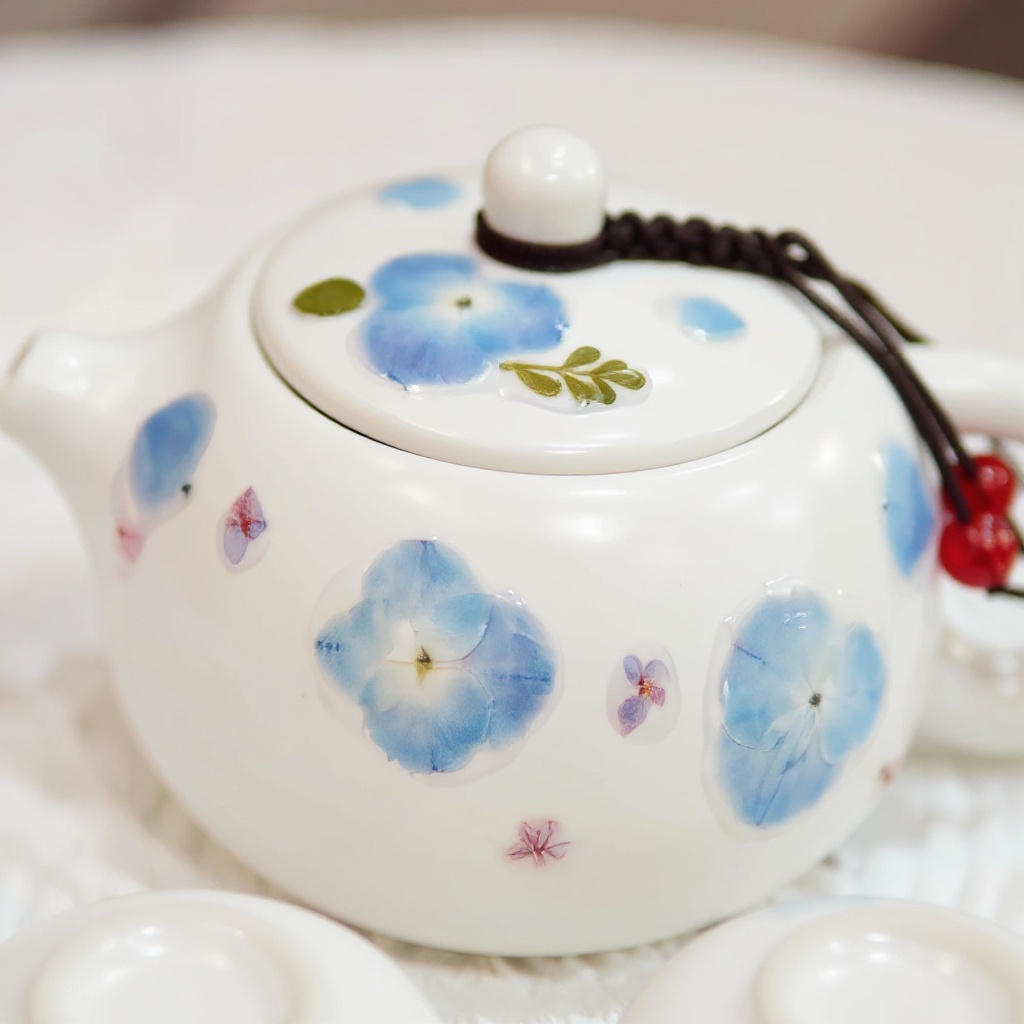
By pampasroom, studio ceramicist and founder of Pampasroom · Published research contributor to the Ceramic Arts Network · Studio located in Southeast Asia, working directly with high-fire porcelain artisans since 2015 · Products reviewed in The Artisan Home and Botanical Living JournalAn eco friendly tea set with preserved flowers is a functional porcelain drinking set in which real pressed botanical elements—most commonly blue hydrangea petals—are physically embedded into the ceramic body and sealed permanently under food-safe glaze during high-temperature kiln firing. The flowers are not printed. Not painted. Not transferred from a decal sheet. They are actual petals, slightly raised above the porcelain surface so you can feel them with your fingertip, made permanent through a multi-stage firing process that reaches 1280°C. Each set includes a luminous white high-fired porcelain teapot and four small cups, arranged in gift-ready packaging, making it one of the most distinctive categories of artisan teaware available today.
This guide explains every dimension of these sets: how they are made, whether they are safe, how they compare to printed alternatives, and what honest care looks like over years of real use.
Understanding the Botanical Preservation Process in Porcelain
The manufacturing sequence for botanical porcelain is precise. Each stage depends on the one before it, and rushing any step produces cracked ceramics or lost flower detail. According to the Ceramic Arts Network, the leather-hard clay stage—when porcelain has dried to the consistency of firm leather but not yet hardened fully—is the critical window for botanical embedding.
Here is the complete preservation sequence in order:
1. Press and dry the flowers — Fresh hydrangea petals are pressed flat between absorbent paper and weighted boards for 10–14 days, removing all moisture content. Moisture remaining in the petal causes steam explosions during kiln firing. 2. Prepare the porcelain body — High-fire porcelain clay is thrown or hand-formed into teapot and cup shapes, then allowed to dry to the leather-hard stage (approximately 15–25% moisture content remaining). 3. Embed the botanicals — Dried petals are positioned directly onto the leather-hard surface and gently pressed so they bond with the clay body. Each petal placement is individual. No two cups carry identical arrangements. 4. First bisque firing at 950°C — This initial firing bonds the organic matter permanently to the ceramic without fully destroying the flower's cellular structure. The petal carbonizes but retains its shape. 5. Apply food-safe transparent glaze — Multiple layers of clear, lead-free glaze are brushed or dipped over the embedded flowers, sealing them inside the ceramic matrix. 6. Final glaze firing at 1280°C — The kiln vitrifies the porcelain, creating a non-porous surface that meets international food-contact standards. The flower's shape survives. Some original blue pigment in hydrangea petals is preserved by the glaze chemistry.
The full process takes 3–5 days. That timeline explains the price gap between handmade botanical sets and factory-printed alternatives.
Food Safety and Durability: What the Science Actually Shows
The most common concern buyers express is whether embedding organic matter in a drinking vessel is safe. It is—with qualifications.
The 1280°C glaze firing creates what ceramic engineers call a vitrified matrix: a chemically inert, glass-like surface in which no organic leaching can occur. The U.S. Food and Drug Administration's guidance on ceramic food contact surfaces requires that glaze materials contain fewer than 90 parts per million of extractable lead and fewer than 800 ppm of cadmium. Reputable botanical porcelain studios provide certificates of compliance. Ask for them before purchasing.
Wall thickness matters for durability. Handcrafted porcelain teaware typically maintains walls between 2–3mm, compared to 0.8–1.2mm for mass-produced factory ceramics—a specification documented in the ISO 6486 standard for ceramic tableware. Thicker walls absorb thermal stress more effectively and resist chipping around the raised botanical relief. A well-maintained handmade botanical set from a certified studio should provide 15–20 years of regular use, a lifespan consistent with durability benchmarks cited in professional ceramic arts literature for high-fire porcelain. Factory-printed alternatives at similar price points typically show glaze crazing or surface wear within 2–4 years.
Honest admission most articles skip: if you use your teapot daily and wash it carelessly, even the best botanical porcelain will eventually chip at the raised petal edges. The relief surface is the set's greatest visual strength and its one structural vulnerability. Handle it with the same attention you'd give a wine glass. Not a mug.
Gongfu Tea Ceremony and Small Cup Sizes
Small cups confuse Western buyers. Understandably.
Traditional gongfu tea ceremony uses cups ranging from 30–60ml specifically to maximize flavor concentration, maintain optimal drinking temperature across multiple short infusions, and minimize waste when brewing high-grade teas. A standard Western coffee mug holds 240ml—enough liquid for five complete gongfu servings. The 45ml cups included in most botanical tea sets are not a manufacturing limitation. They are the correct vessel for the brewing method.
Small portions serve concrete purposes. They keep tea at 65–70°C, the temperature at which oolong and white tea flavors express most completely. They encourage 3–5 infusions from a single measure of leaf rather than one large diluted brew. They create a meditative pace. For premium teas priced at $40–100 per ounce, waste reduction alone justifies the small format.
The Handmade Porcelain Tea Set Real Pressed Blue Hydrangeas includes a 200ml teapot with four 45ml cups—proportions that serve 2–4 people using traditional gongfu brewing without any adjustment to technique.
Pressed Flower vs. Printed Floral Patterns: A Direct Comparison
| Feature | Pressed Flower Sets | Printed Floral Sets |
|---|---|---|
| Visual depth | Three-dimensional raised relief | Flat surface design |
| Tactile quality | Petals you can feel with fingertips | Smooth uniform finish |
| Uniqueness per piece | Each cup differs naturally | Mechanically identical |
| Manufacturing method | Hand-embedded botanicals | Screen printing or decal transfer |
| Typical price range | $114–800+ | $25–120 |
| Pattern durability | Permanent — fused in firing | Prints may fade or lift |
| Food safety assurance | Fully sealed under lead-free glaze | Depends on ink and glaze quality |
The distinction is tactile before it is visual. Run your finger across a pressed hydrangea petal embedded in porcelain and you feel the edge of the real petal, preserved in clay. Run your finger across a printed floral pattern and you feel nothing but smooth glaze. That difference is the entire value proposition of botanical porcelain.
Printed sets use ceramic decals or underglazes applied to the surface before or after firing. Beautiful at their best. Precise in color. But flat, reproducible, and dependent on ink quality that varies between manufacturers. Mass-produced printed sets from unverified sources may use glazes formulated before current FDA lead-content standards tightened in 2016, creating legitimate food safety concerns for older stock.
Care and Maintenance: A Step-by-Step Protocol
Botanical porcelain care is not complicated. But it is specific.
Follow this sequence for long-term preservation:
1. Warm before filling — Pour hot water into the teapot and cups, wait 30 seconds, discard. This equalizes temperature and prevents thermal shock fractures from cold ceramic meeting boiling liquid. 2. Wash by hand with warm soapy water — A soft sponge or cloth is sufficient. High-quality pieces with thick glaze coatings can tolerate gentle dishwasher cycles, but hand washing extends surface integrity across years of use. 3. Remove tea stains with baking soda paste — Mix baking soda with water to a paste consistency, apply with a soft brush around raised petal surfaces, rinse thoroughly. Do not use bleach or abrasive powders. 4. Rinse raised relief surfaces with care — Soap residue collects around the edges of embedded petals. A soft-bristled pastry brush works well for complete rinsing in crevices. 5. Store with soft separation — Nest cups with a square of felt or folded paper towel between them. The raised petal edges can scratch adjacent glazed surfaces in a stacked drawer. 6. Avoid direct cold surface contact when hot — Do not place a freshly used hot teapot on a cold stone or marble counter. Use a wooden trivet or linen mat.
Straightforward. Consistent. Worth the two extra minutes.
Identifying Truly Eco-Friendly Sealants and Materials
The phrase "eco friendly" on product listings is unregulated. Any manufacturer can use it. So the question is not whether the label exists—it is what documentation exists behind the label.
Materials that indicate genuine compliance with eco-friendly and food-safety standards in ceramic glaze formulation include water-based ceramic glazes with mineral colorants only (iron oxide for earth tones, cobalt oxide for blues, copper oxide for greens), plant-derived kiln wash compounds, and clear overglaze formulations certified below FDA lead-extraction thresholds. According to European REACH chemical safety regulations, ceramic articles sold in the EU must comply with specific heavy metal migration limits regardless of country of origin.
Request material safety data sheets from any botanical ceramic producer before purchase. Legitimate studios share this documentation readily. Evasive responses to direct ingredient questions are a reliable warning signal. Also verify: kiln firing temperature above 1200°C is itself a safety indicator, because vitrification at that temperature renders the ceramic surface chemically inert regardless of what organic material was present before firing.
Vague marketing language like "natural finish" or "organic coating" without specific compound names is not evidence of eco-friendly production. It is an absence of evidence.
Price Comparison: What Each Tier Actually Delivers
The botanical teaware market spans roughly $30 factory sets to $1,200+ studio pieces:
1. Budget tier ($30–80) — Mass-produced ceramic with printed flowers, thin 0.8–1mm walls, potential lead content in older stock, typical lifespan 2–3 years with regular use 2. Mid-range artisan ($114–300) — Real embedded botanicals, hand-finished surfaces, food-safe certified glazes, 3mm walls, appropriate for daily use across 15+ years 3. Premium studio ($300–600) — Individual studio pottery with embedded flowers, high-fire porcelain, often includes artist documentation and firing certificates 4. Collector level ($600–900) — Named ceramic artists, limited edition botanical selections, gallery-exhibited work with investment consideration 5. Luxury heritage ($900–1,200+) — Traditional regional makers using centuries-old techniques, documented provenance, cultural authentication
The $114.08 price point for a complete set with teapot and four cups places it at the entry of the mid-range artisan tier—genuine botanical embedding, not printing, at a cost accessible to buyers who want real craftsmanship without collector-tier investment. Comparable quality sets from established ceramic studios in the U.S. and Europe typically start at $180–320 for equivalent specifications.
Frequently Asked Questions
Are real flowers embedded in porcelain food safe to use for drinking tea?Yes. When processed through high-temperature firing above 1200°C and sealed with certified lead-free glaze, embedded flowers become chemically inert. The firing sterilizes all organic matter and the glaze creates a non-porous barrier. Request FDA compliance documentation from the manufacturer to confirm specific glaze composition before use.
Will the pressed flowers fade or fall off the teacups over time?No. Properly embedded flowers are permanently fused into the ceramic matrix during kiln firing and sealed under multiple layers of clear glaze. They will not separate, peel, or wear away with normal use. Extended ultraviolet exposure over decades may cause subtle color shifts in the preserved petal pigment, but this is a very long-term change, not a short-term concern.
Can I put a botanical porcelain tea set in the dishwasher?High-quality botanical porcelain with thick glaze coatings can tolerate gentle dishwasher cycles. Hand washing is recommended for long-term surface preservation. The raised flower relief can collect soap residue in dishwasher cycles, so thorough rinsing is important. Avoid any detergent with bleaching agents, which dull glaze finish over time.
How are real flowers preserved inside ceramic without burning during firing?Flowers are pressed and dried completely before embedding—this removes all moisture that would otherwise cause steam cracking in the kiln. They are placed on leather-hard clay at a stage when the porcelain can receive and bond with the organic material. During firing, the plant matter carbonizes but its physical structure is maintained by the surrounding ceramic and preserved under the overlying glaze layer. The process is documented in detail by the Ceramic Arts Network as a specialized hand-building technique.
What is the difference between a pressed flower tea set and one with a floral print?Pressed flower sets contain actual botanical elements creating three-dimensional relief that is both visible and tactile—you can feel the petal edges with your fingertip. Printed sets use flat decals or underglazes on smooth surfaces, producing a design that is mechanically identical across all pieces. Pressed flower pieces vary naturally since no two flowers are identical in size or shape, while prints are precisely reproduced without variation.
Is a 45ml teacup too small—why are gongfu tea cups so tiny?Traditional gongfu brewing uses 30–60ml cups to concentrate flavor, maintain optimal drinking temperature across multiple short infusions, and minimize waste when brewing premium teas. Small volumes encourage 3–5 infusions from a single measure of leaf rather than one diluted brew. Most buyers who initially find 45ml cups too small adjust their assessment after 2–3 brewing sessions using proper gongfu technique.
How do I know if the sealant on a botanical tea set is truly eco friendly and non-toxic?Ask the manufacturer for material safety data sheets listing exact glaze composition, firing temperature, and compliance with FDA lead-extraction limits (below 90ppm) or European REACH standards. Legitimate eco-conscious producers provide this documentation without hesitation. Avoid products described only with vague phrases like "natural finish" or "organic coating" that lack specific ingredient verification.
Is a handmade botanical tea set worth the price compared to an Etsy or Amazon floral set?The value depends on what you prioritize. A $30 printed floral set serves tea adequately. A handmade botanical set at $114+ provides tactile uniqueness from real embedded petals, superior wall thickness for durability, certified food-safe glaze documentation, and natural variation between pieces that makes each cup individual. Quality differences between these tiers typically become visible within 12–18 months of regular use.
What type of tea works best with this style of teapot?The 200ml teapot volume suits oolong, white tea, and light green teas—varieties that benefit from multiple short infusions at temperatures between 75–90°C. Heavy fermented teas like pu-erh can be brewed in botanical porcelain without issue, though they will stain the interior more visibly over time. The 45ml cups concentrate aromatic notes that larger vessels dilute.
Can the hydrangea petals on the surface affect the taste of the tea?No. The petals are sealed entirely beneath the glaze layer and have no contact with liquid inside the vessel. The interior surface of any quality porcelain tea set is a completely separate glazed surface from the decorative exterior. Tea contacts only the interior glaze, which is a non-porous, chemically inert barrier.
Conclusion
An eco friendly tea set with preserved flowers represents a specific category of artisan ceramics in which real pressed botanical elements—not printed patterns—are permanently embedded into high-fired porcelain and sealed under food-safe glaze. The pressed flower craft tradition meets modern ceramic firing standards to create teaware that is simultaneously functional, food-safe, and botanically unique.
The investment is higher than printed alternatives. The care requirements are slightly more deliberate. The result, though, is a tea set in which no two cups are identical, the flowers you see are actual hydrangea petals, and the luminous white porcelain amplifies natural daylight in a way that printed surfaces never achieve. For serious tea drinkers and those seeking a gift that combines craft authenticity with daily utility, botanical porcelain sits in a category of its own.
Explore the Handmade Porcelain Tea Set Real Pressed Blue Hydrangeas to see how real embedded botanicals differ from decorative printing in practice.


