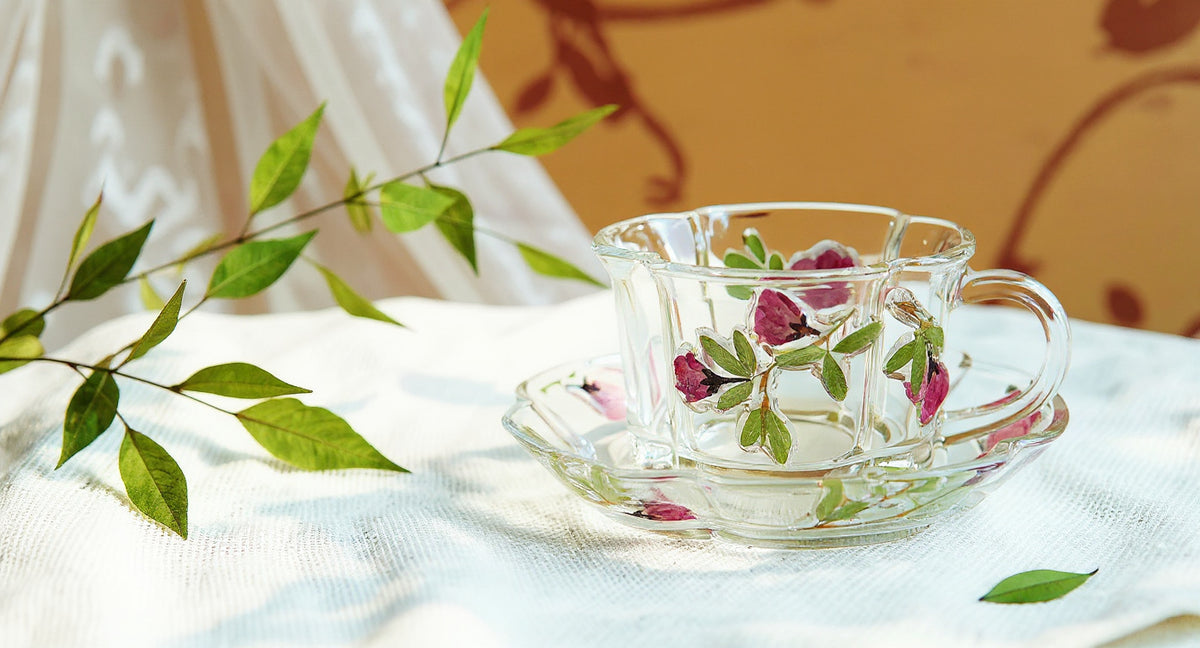
A glass cup with 3D botanical relief can be used for tea when the interior and drinking rim remain clear glass and the dried floral work stays on the outside. Pampasroom’s 200ml cup and matching saucer are made from heat-resistant clear glass with real dried petals and green leaves in raised relief on the exterior. It is a hand-wash-only piece, not a dishwasher shortcut.
Not for a crowded dishwasher.
The honest answer is that this type of cup suits a small tea, coffee, or gift ritual far better than high-volume kitchen use. If large capacity, microwave use, and dishwasher cleaning are the priorities, a 200ml raised-flower cup is the wrong choice.
What makes a glass cup with 3D botanical relief different?
A floral decal cup has a printed image or transfer fixed flat against the glass. A glass cup with 3D botanical relief has physical dried petals and leaves arranged on its exterior, so the surface has texture that can be seen and felt.
That distinction matters.
The product is not a flower pattern printed onto a cup. The petals and leaves are visible as separate botanical elements, with overlapping edges and small changes in height across the glass. Each arrangement has its own placement because natural leaves and petals do not repeat with machine precision.
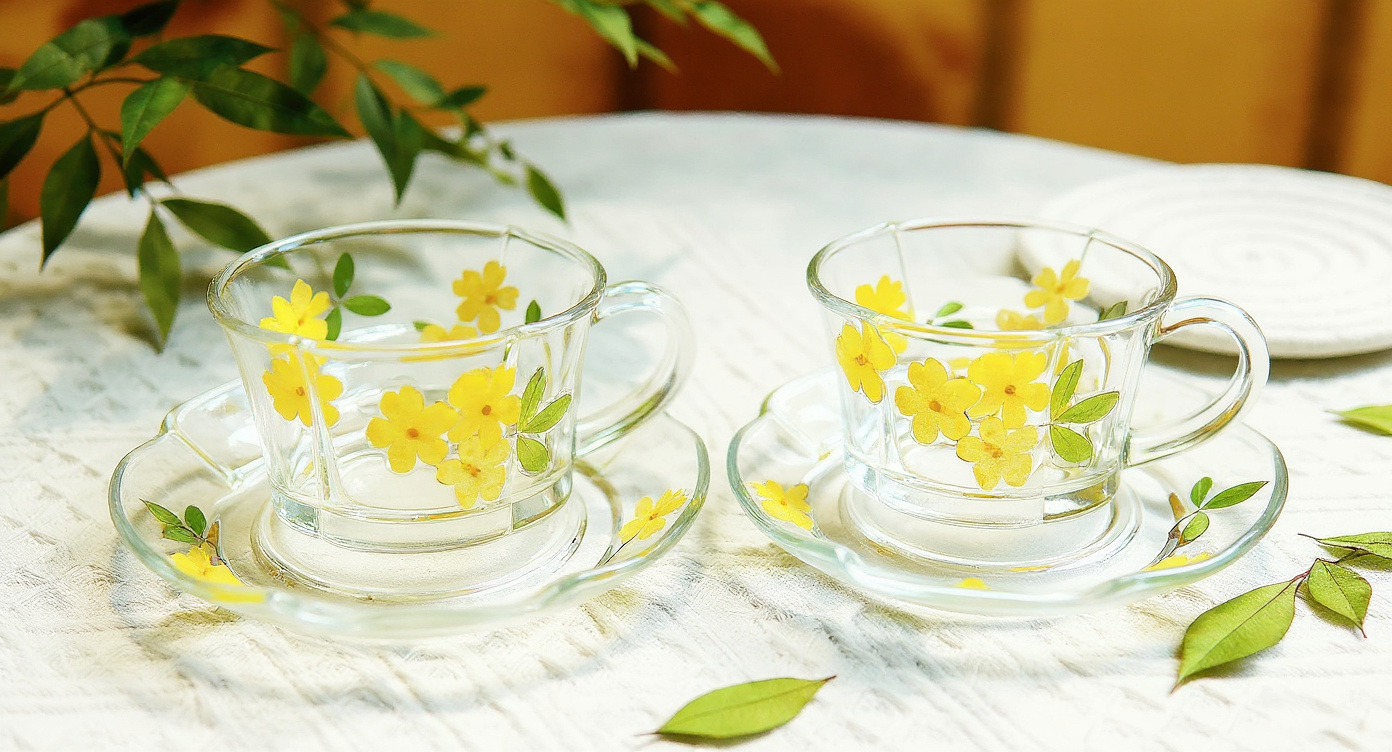
Pampasroom’s Handmade Glass Cup & Saucer Set | Real Pressed Flowers | Cottagecore Tea Gift is sold as a 200ml clear glass cup with a matching saucer. The listing identifies purple, yellow, and blue floral colourways. The exact petal shapes and leaf placement vary from set to set.
Small, tactile, particular.
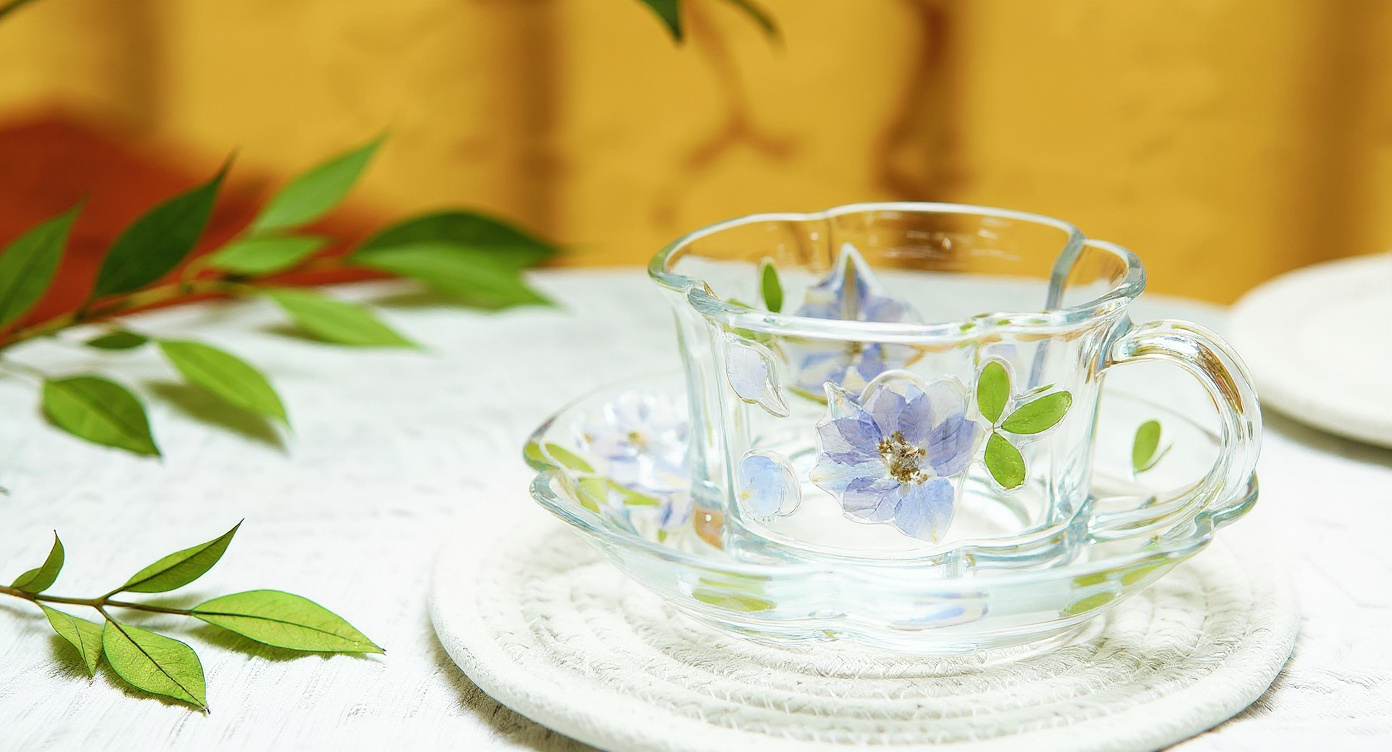
Verified product details and limits
The table below separates the listed Pampasroom details from details that depend on another seller’s construction or published care instructions.
| Feature | Pampasroom glass cup and saucer set | Printed floral glass cup | Other handmade floral glassware |
|---|---|---|---|
| Cup capacity | 200ml | varies by seller | varies by seller |
| Decorative material | Real dried petals and green leaves | varies by seller | varies by seller |
| Decorative placement | Raised 3D relief on the outer glass surface | varies by seller | varies by seller |
| Matching saucer | Included | varies by seller | varies by seller |
| Available floral colourways | Purple, yellow, and blue | varies by seller | varies by seller |
| Cleaning instruction | Hand wash only | varies by seller | varies by seller |
| Maximum temperature, wall thickness, microwave rating, and food-contact certification | Not stated in the supplied product specification | varies by seller | varies by seller |
The product specification confirms heat-resistant glass, but it does not give a numeric temperature limit. That means no one should claim a maximum safe temperature, microwave approval, or resistance to rapid temperature changes without a published manufacturer rating.
Heat-resistant does not mean indestructible.
How the raised floral surface is made
The finished look depends on preparation before any petal reaches the glass. Dried botanical material must be free of moisture before it is enclosed in a decorative finish. Moisture can alter colour and can affect the appearance of plant material over time.
When I sealed my first batch of preserved blooms into a heat-resistant glass cup, the contrast between a flat printed motif and a real raised petal edge became obvious.
A raised arrangement also needs restraint. Thick flower heads, long stems, and heavy clusters can make a cup hard to hold, hard to clean, and prone to contact with nearby glassware. Low-profile petals and leaves make more sense for a drinking vessel because they keep the relief close to the outer wall.
A typical construction sequence involves several stages:
1. Dry botanical selection. Petals and leaves are chosen for their size, shape, and ability to sit against curved glass. 2. Glass preparation. The cup exterior and saucer surface need to be free from dust, oil, and fingerprints before botanical placement. 3. Composition planning. The arrangement must account for the handle, the base, and the drinking rim. Decorative elements should not interfere with how the cup is held. 4. Layered placement. Petals and leaves are set in an arrangement that creates visible depth without forming bulky projections. 5. Protective finishing. The floral layer is secured while retaining the raised edges that make real botanical relief distinct from a flat decal. 6. Cure and inspection. The cup and saucer need time before use so the decorative finish can be checked for loose edges, gaps, and placement near handling areas.
This won’t work if the goal is twelve identical place settings. Real dried materials have variation in colour, vein pattern, petal edge, and size. That variation is part of the object, not a production error.
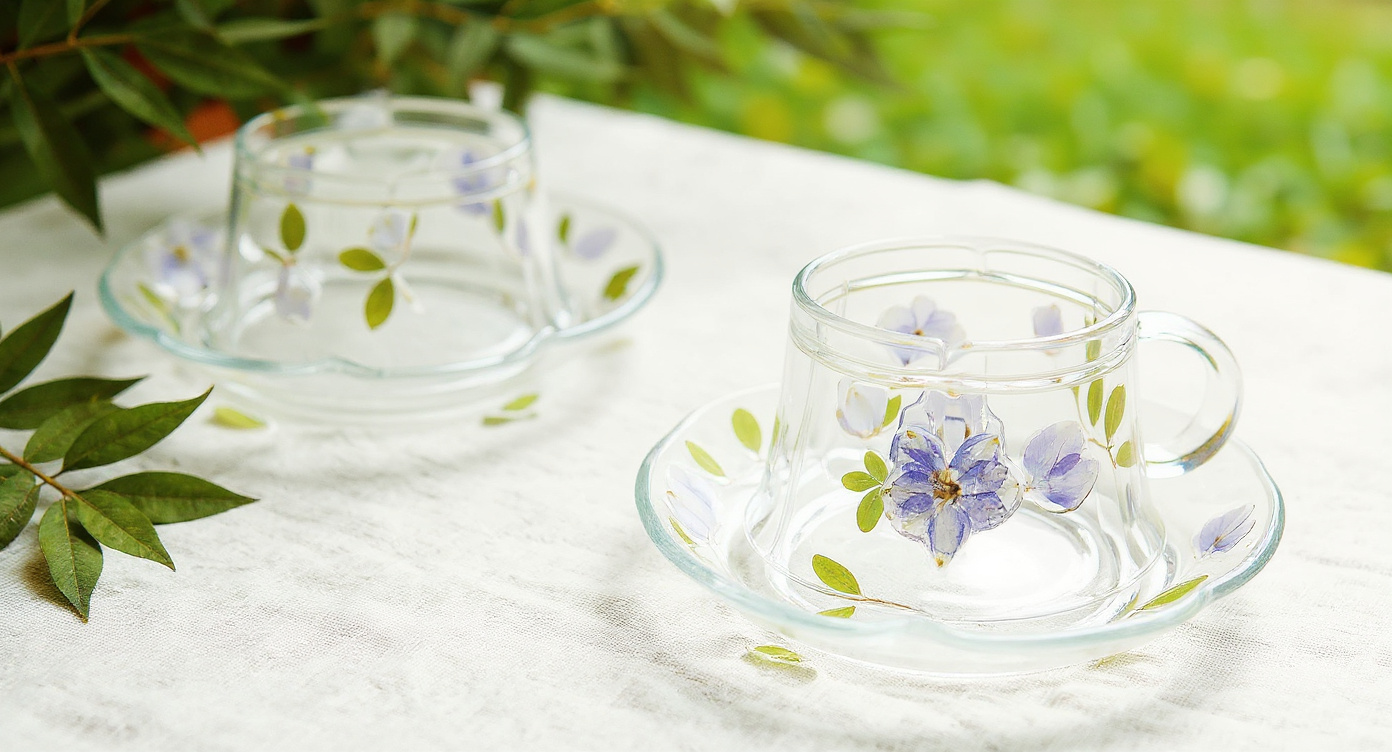
Is a 200ml cup useful for tea and coffee?
Yes, for a small serving. A 200ml cup suits tea, a short milk coffee, or a modest pour that can be held with the matching saucer nearby.
It is not a large latte glass. Nor is it meant to replace an all-day mug.
The smaller size also fits the visual character of raised botanical glassware. A larger vessel creates more exterior area to handle, more opportunity for knocks against other dishes, and more weight when full. A 200ml capacity keeps the cup in the range of a slow tea break rather than a large drink carried from room to room.
The product specification does not state a maximum liquid temperature. For that reason, avoid treating the cup as suitable for boiling water, stovetop heating, microwave heating, freezer-to-hot-drink use, or any rapid temperature shift. Letting freshly boiled water stand before pouring is a cautious choice when no numeric heat limit is published.
Care for raised flowers on glass
Pampasroom lists this cup and saucer set as hand-wash-only. That instruction fits the construction: physical petals and leaves on an exterior surface have edges that can catch on abrasive tools, stacked dishes, or rough drying cloths.
Use this care routine:
1. Rinse the cup and saucer after tea, coffee, milk, or sweetened drinks. 2. Wash the glass interior with lukewarm water and mild dish soap. 3. Hold the cup by plain glass areas and the handle rather than gripping the raised petals. 4. Clean around the outer floral relief with a soft sponge or soft cloth. 5. Keep scouring pads, stiff brushes, abrasive powders, bleach-based cleaners, and long sink soaks away from the decorative surface. 6. Pat the exterior dry with a soft towel instead of pulling fabric across petal edges. 7. Store the cup and saucer where other hard objects will not press against the floral relief.
A dishwasher combines heat, detergent, water force, and contact with other dishes. For plain glass, that may be acceptable when the maker says so. For a hand-finished raised botanical surface, Pampasroom’s hand-wash instruction is the practical limit.
Direct sun is also worth avoiding for display storage. Dried petals and leaves are natural materials, and prolonged exposure to strong light can change their original colour.
Who is this cup for?
This cup makes sense for someone who values a small tea or coffee ritual, cottagecore table styling, dried-flower craft, or a gift that does not look factory-standard. The saucer matters here. It turns the cup into a set rather than a loose piece of drinkware.
It is less suitable for a household that stacks cups in a cupboard, uses a dishwasher after every meal, or needs replacement pieces to match with no variation. That is not a criticism of the cup. It is a boundary set by its 200ml size and raised exterior decoration.
For a closer view of the materials, colourways, and current availability, see the Pampasroom Handmade Glass Cup & Saucer Set with Real Pressed Flowers.
FAQ
Are glass cups with real dried flowers safe to drink from?
A glass cup with dried flowers on its outer surface can be used for drinking when the interior and drinking rim are clear, clean, and undamaged. The Pampasroom floral decoration is on the outside of the glass. The supplied product specification does not state food-contact certification for the decorative finish, so avoid using a cup with lifted decoration near the rim or visible damage.
Can this 200ml cup hold hot tea?
It is made from heat-resistant glass and is intended as a teacup, but the supplied product specification does not give a maximum temperature. Use caution with freshly boiled water and avoid rapid temperature changes, such as pouring hot liquid into glass that has just come from a cold rinse or refrigerator.
Is the Pampasroom floral glass cup dishwasher safe?
No. Pampasroom lists the cup and matching saucer as hand-wash-only. Wash with lukewarm water, mild soap, and a soft sponge or cloth.
Can the cup go in a microwave?
No microwave rating is stated in the supplied product specification. Do not assume microwave use is suitable without a published microwave-safe instruction.
What is the difference between real botanical relief and a floral decal?
Real botanical relief uses physical dried petals and leaves attached to the glass exterior, which creates raised texture. A floral decal uses a flat printed or transferred image. A decal may suit someone who wants a smooth surface and repeatable pattern; real botanicals suit someone who wants visible plant material and individual placement.
Why do the floral arrangements vary?
Each set uses real dried petals and green leaves. Natural materials differ in shape, size, colour, and edge detail, so the placement cannot produce identical copies.
Can a raised-flower glass cup be used every day?
It can be used for regular tea or coffee if it is hand washed, kept away from abrasive cleaning tools, and stored without hard contact against the floral relief. It is not the best choice for high-turnover kitchen use or dishwasher cycles.
How should the cup and saucer be stored?
Store them where cups, plates, or utensils will not rub against the raised petals and leaves. Do not stack heavy items on the decorated surface. A shelf with space around the set is a better fit than a tight cupboard stack.
Will dried petals and leaves stay the same colour forever?
No natural dried botanical material can be promised to keep its original colour forever. Keep the cup away from prolonged direct sunlight and strong display lighting if colour preservation matters.
Is this a good gift for a tea drinker?
Yes, if the recipient enjoys a 200ml tea or coffee serving and is willing to hand wash a decorative piece. It is a poor fit for someone who wants a large mug, dishwasher use, or identical replacement cups.