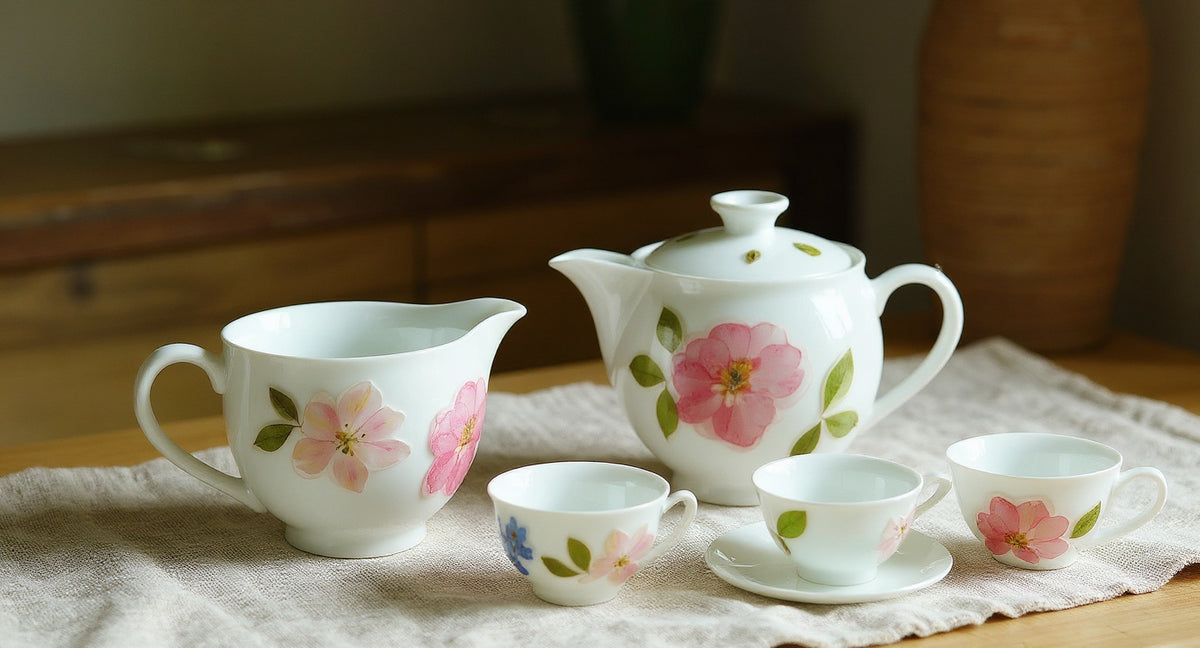
A gongfu tea set with embedded flowers can work for daily brewing when the preserved petals remain on the exterior, the liquid-contact surfaces stay smooth, and cleaning is done by hand. The practical trade-off is clear: this kind of set offers more character than ordinary porcelain, but it needs gentler care and shouldn't be treated like dishwasher-safe hotelware.
Why embedded flowers change the care routine
A conventional gaiwan is built around a simple job: hold hot tea, pour cleanly, and tolerate repeated washing. A floral version adds a second material system to that equation. The inside must behave like a normal tea vessel, while the outer decoration contains raised preserved petals and a sealing layer that can be damaged by heat, abrasion, soaking, or detergent.
That distinction matters. Preserved flowers are decorative material, not an ingredient. The petals should stay on the outside of the lid, bowl, and cups, away from tea and from direct contact with the mouth. The reference entry on flower preservation covers the broad methods used to retain botanical material, but it doesn't establish that every preserved flower or sealant is food-safe. A floral tea set therefore needs sensible separation: tea touches porcelain, not the petals.
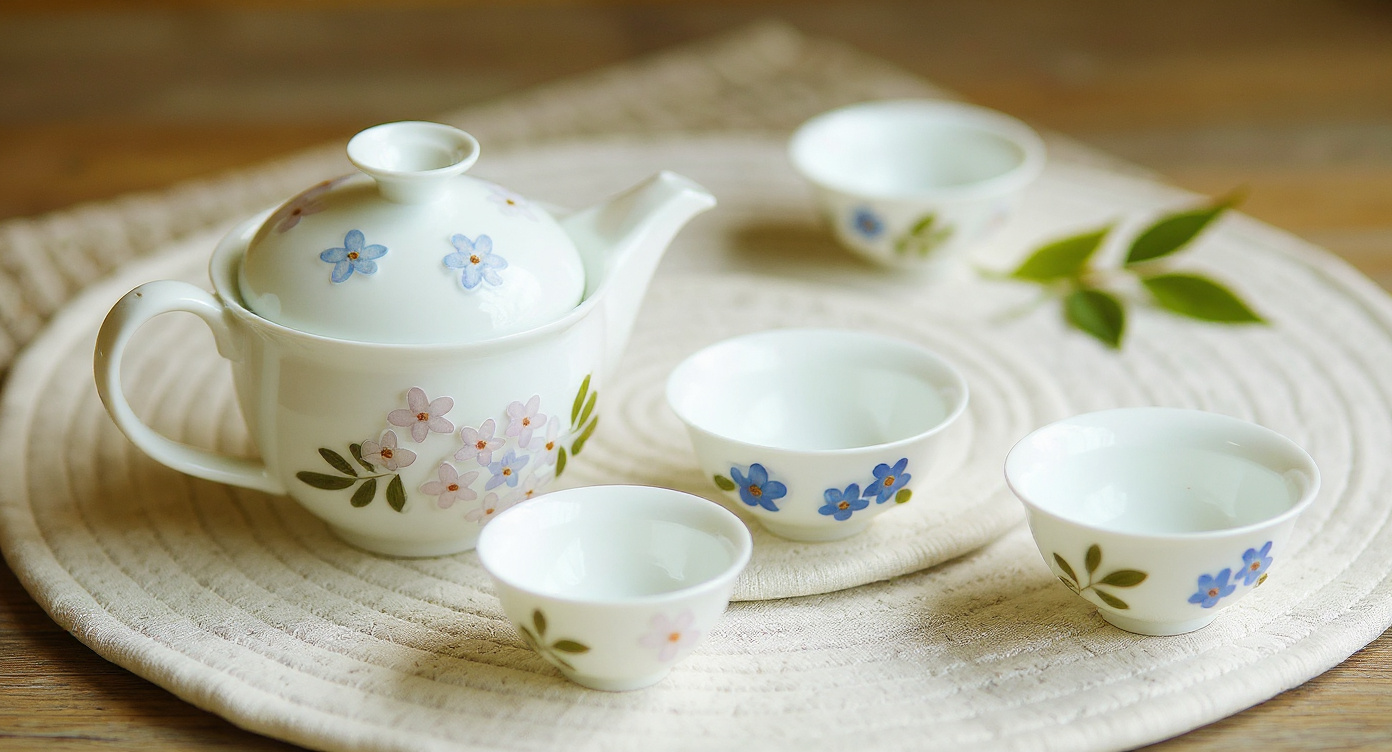
The Handmade Bone China Tea Set Preserved Flowers | Gongfu Gaiwan | Eco Floral Art uses hand-embedded botanical relief on the exterior of a semi-translucent Suet Jade, or mutton-fat, porcelain body. Its gaiwan is approximately 150ml, and its small cups are approximately 50ml each. Those are useful working dimensions for a single drinker or a small two-person session, but the raised flowers make the set a poor choice for rough, high-volume washing.
Is a 150ml gaiwan practical for one person?
Yes. A 150ml bowl sits in the useful middle ground for gongfu brewing. It gives one person enough volume to make short infusions without committing to a large pot of tea. The 50ml cups also encourage smaller pours, which suits gongfu service and keeps each serving fresh rather than leaving tea to cool in a large mug.
Gongfu brewing is built around repeated, relatively small infusions rather than one oversized serving. The Wikipedia entry on the gongfu tea ceremony describes the ceremony's emphasis on concentrated preparation, small vessels, and repeated pours. A gaiwan in this size range supports that rhythm without taking over a small tea table.
Capacity still needs to be read realistically. A nominal 150ml gaiwan won't deliver 150ml of drinkable tea after leaves occupy space and a little liquid remains in the bowl. With dense rolled oolong, compressed tea, or large leaves, the usable yield will be lower. That's not a defect. It gives the leaves room to open and makes timing easier to control.
The set is especially suited to:
1. One person brewing oolong, white tea, green tea, or ripe puer. 2. Short tasting sessions where each infusion needs a separate pour. 3. Gift recipients who want a ritual object rather than a large everyday mug. 4. A small tea table where 50ml cups prevent oversized servings. 5. Shelf display between uses, provided the flowers are kept dry and out of direct sun. 6. A quiet home ceremony where washing can be done carefully after the final infusion.
The Handmade Bone China Tea Set Preserved Flowers | Gongfu Gaiwan | Eco Floral Art matches that use case closely: approximately 150ml for the gaiwan, approximately 50ml per cup, and real preserved petals embedded into the exterior rather than a flat printed pattern.
Floral porcelain versus ordinary tea ware
The deciding issue isn't whether a floral set can brew tea. It can. The question is whether the added botanical work earns its place in the care routine and the budget.
| Option | Stated capacity or price | Main advantage | Main limitation |
|---|---|---|---|
| Handmade floral set | Gaiwan ~150ml; cups ~50ml each; $85.5214285714286 | Real preserved petals, Suet Jade porcelain, one-of-a-kind handmade character | Hand-wash-only care and a more delicate exterior |
| Mass-produced Chinese porcelain set | $30-$120 | Lower entry price and generally simpler replacement | Less individual botanical detail; materials and decoration vary by seller |
| Mid-range artisan set | $150-$350 | More handmade character and small-batch appeal | Higher cost without necessarily including preserved flowers |
| Boutique studio piece | $400-$900 | Strong decorative and craft focus | Can cost substantially more for a set used mainly as display |
| Plain porcelain gaiwan | Varies by seller | Easy to use, clean, and replace | No botanical relief or gift-focused presentation |
The listed product price is $85.5214285714286. That places this particular set below the supplied mass-produced range, while the broader product context positions comparable boutique studio pieces much higher. Because artisan construction, floral sealing, and included cups can vary, price alone doesn't prove durability or value.
Bone china also deserves a precise description. The reference entry on bone china identifies it as a porcelain type associated with bone ash and a translucent, strong body. The product context calls this material Suet Jade, or mutton-fat, porcelain, with a semi-translucent finish. Those terms describe the material character, but they don't make the set unbreakable. Thin porcelain can still chip, and a raised floral surface can catch on cloths, racks, or other dishes.
A plain gaiwan is the better buy for someone who wants maximum convenience, frequent office use, or a set that can be replaced without much thought. A floral version is more likely to pay off when the botanical work matters, the recipient values handmade objects, and hand-washing is a reasonable part of the ritual.
How to wash raised flowers without damaging them
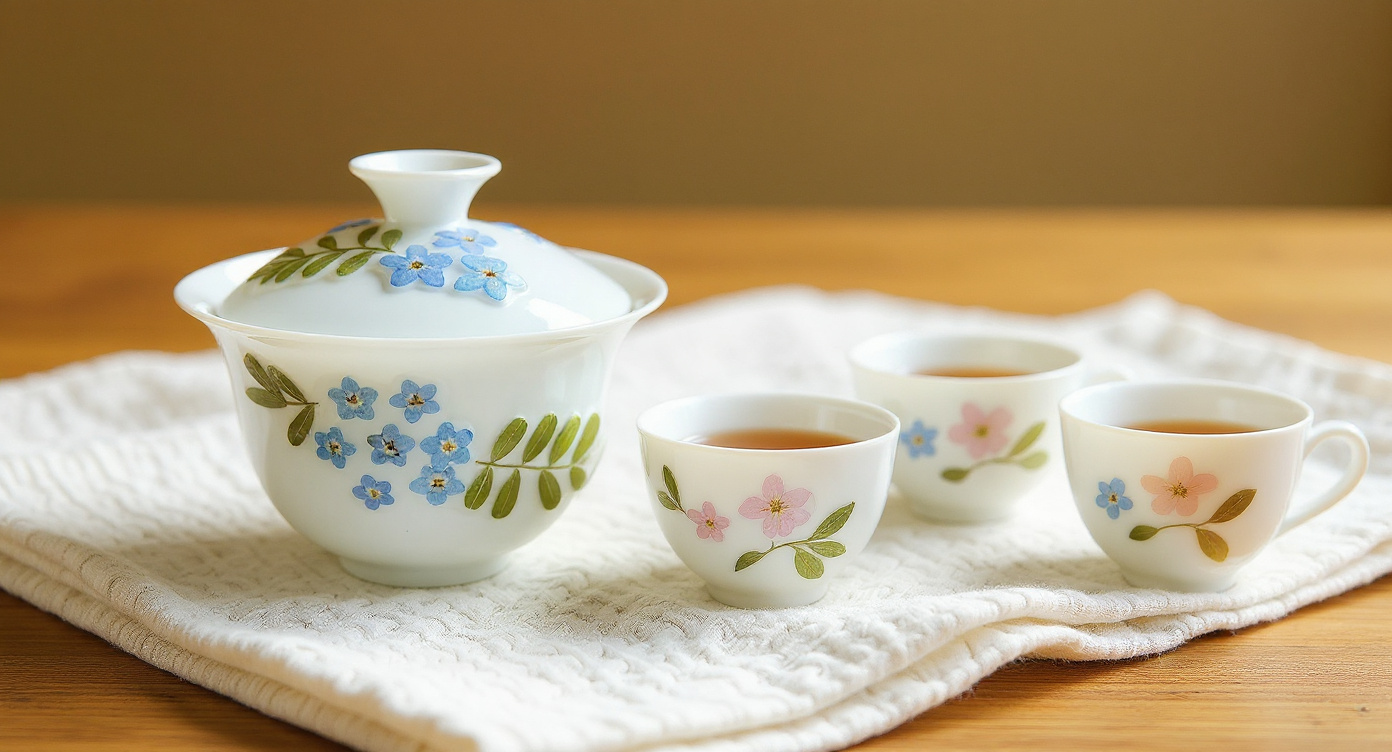
The safest routine is short, gentle, and boring. Boring is useful here. The seal around preserved petals doesn't benefit from experimentation with harsh cleaners, soaking, or scouring pads.
1. Empty the gaiwan and cups soon after the session so tea residue doesn't dry around the rim. 2. Rinse the porcelain interior with warm water, avoiding very hot-to-cold temperature changes. 3. Use a small amount of mild dish soap only when tea oils or fragrance remain. 4. Wash with a soft sponge or clean cotton cloth, keeping pressure away from raised petals. 5. Rinse thoroughly so soap doesn't remain in textured edges or around the lid. 6. Dry with a soft towel by pressing lightly rather than dragging fabric across the flowers. 7. Leave every piece fully dry before storing, with the lid slightly offset if moisture remains inside.
Don't scrub across the floral relief. A soft toothbrush may sound convenient, but bristles can catch an edge of the seal or work debris into a narrow gap. A soft cloth or sponge is easier to control.
Avoid prolonged soaking. Water can find weak points around a decorative seal, especially if the piece already has a hairline chip or a loose petal. Don't use bleach, abrasive powders, steel wool, melamine foam, or strongly fragranced cleaners. Those products are excessive for tea residue and introduce unnecessary stress to the exterior.
Thermal shock is another avoidable problem. Don't move a cold gaiwan directly under boiling water, and don't place a hot cup into cold water. The porcelain body and any attached decorative materials may respond differently to rapid temperature changes.
The floral surface also needs a storage policy. Keep the set separate from metal tools, rough ceramics, and crowded drawers. A shallow cloth-lined space is preferable to stacking cups where their rims or raised details can rub together.
Dishwasher, hot tea, and flower fading
A floral porcelain gaiwan should be treated as hand-wash only unless the maker explicitly states otherwise. Dishwashers combine high water pressure, prolonged heat, detergent, mechanical contact, and drying cycles. Every one of those conditions is less forgiving than a controlled sink wash, and the decorative seal is the first part likely to suffer.
The same caution applies to hot tea. Porcelain is appropriate for hot brewing, but the decoration shouldn't be treated as heatproof simply because the bowl holds hot liquid. Keep boiling water inside the vessel, pour steadily, and avoid splashing the outer flowers. If a recipe calls for a rolling boil, allow the water to settle briefly before pouring into a delicate, cool vessel.
Dry flowers also change over time. Direct sunlight, ultraviolet exposure, humidity, and repeated handling can alter their colour or make them brittle. The reference entry on Chinese ceramics provides useful historical context for the craft tradition, but it shouldn't be read as a care certification for modern decorative materials.
To slow fading:
- Store the set away from a bright windowsill. - Keep it out of steamy bathrooms and damp cabinets. - Handle the decorated exterior by the porcelain areas rather than the petals. - Remove dust with a very soft, dry brush or air blower, without pressing into the relief. - Don't apply furniture polish, oil, perfume, or household sealant to the flowers. - Keep the set away from candles, radiators, stovetops, and other concentrated heat sources.
No preservation method keeps botanical colour unchanged forever. The practical aim is to reduce avoidable exposure, not to promise permanent freshness.
What makes this set a good gift, and what doesn't
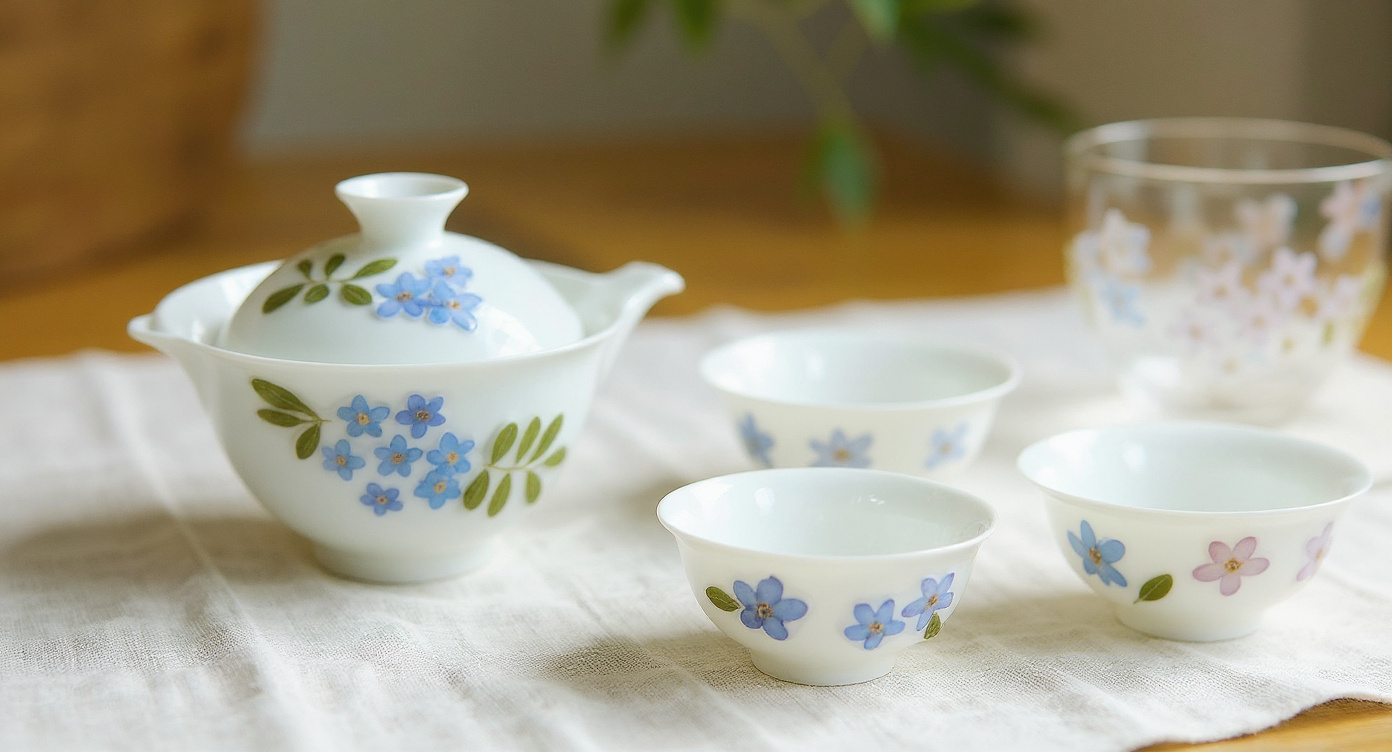
This type of tea set works best as a considered gift for someone who already enjoys tea rituals, handmade ceramics, botanical objects, or small-scale hosting. The approximate 150ml gaiwan and 50ml cups are specific enough for actual use, while the preserved petals give the set a keepsake quality that a plain starter gaiwan won't provide.
The appeal is also tied to variation. Hand-embedded real flowers won't produce identical arrangements from one set to the next. That makes the object feel personal, but it means a buyer shouldn't expect machine-perfect uniformity. Small differences in petal shape, position, tone, or relief are part of the material rather than evidence of a printing error.
The set is a sensible fit for an anniversary, birthday, housewarming, or a tea enthusiast who has outgrown basic accessories. It can also suit someone who wants a display piece that remains usable, rather than a purely decorative ornament.
It isn't the right present for a recipient who expects dishwasher convenience, leaves tea equipment in a sink overnight, or wants a rugged set for communal use. A plain porcelain gaiwan will be less stressful in those circumstances. Decorative value doesn't cancel out maintenance.
The environmental language also needs restraint. Using preserved botanical material and a reusable porcelain set can support a slower, less disposable ritual, but the available product details don't establish a full lifecycle assessment or a formal sustainability certification. The strongest claim is narrower: this is a reusable tea set with botanical craft built into its exterior, not a disposable novelty.
FAQ
Can you use a gaiwan every day?
Yes, provided the gaiwan is washed after use and handled according to its material and decoration. A 150ml gaiwan is practical for one-person gongfu sessions, but a floral version needs more care than plain porcelain. Daily use is reasonable when the set is hand-washed, dried fully, stored separately, and protected from knocks.
Are dried flowers safe on tea cups?
Only the maker can confirm the exact safety of a particular flower treatment and sealant. Preserved flowers should remain on the exterior and should not touch tea, lips, or food. If petals are loose, cracked, shedding, or close to the drinking rim, stop using that piece for serving until the material has been assessed.
How do you clean a tea set with raised flowers?
Rinse promptly with warm water, use mild soap when needed, and wash with a soft sponge or cloth. Avoid scrubbing directly over the petals, prolonged soaking, abrasive cleaners, and sudden temperature changes. Dry by pressing gently with a soft towel, then store the pieces without allowing them to rub together.
Can a floral porcelain gaiwan go in the dishwasher?
It shouldn't unless the maker expressly approves dishwasher use. High heat, spray pressure, detergent, and contact with other dishes can damage porcelain or loosen the floral seal. Hand washing is the appropriate default for raised preserved flowers.
What size gaiwan is best for one person?
A gaiwan around 100ml to 150ml is a useful range for one person making repeated infusions. The 150ml size gives more room for larger leaves and remains manageable at a small tea table. Actual drink volume will be lower than the stated capacity once tea leaves and headspace are accounted for.
Does a gaiwan change the taste of tea?
The gaiwan itself shouldn't add flavour when it is made from clean, suitable porcelain and rinsed properly. Its shape and lid can affect brewing control, however. Pour speed, leaf expansion, water temperature, and infusion time will have a more noticeable effect than exterior decoration.
Are bone china tea sets good for hot tea?
Bone china and other porcelain tea ware are commonly used for hot drinks, but the vessel still needs gradual temperature changes and careful handling. A delicate set can crack or chip if exposed to thermal shock or impact. Hot tea is suitable; careless temperature swings are not.
How do you keep dried flowers from fading on tableware?
Keep the set away from direct sunlight, ultraviolet exposure, steam, concentrated heat, and unnecessary handling. Dust it gently with a dry, soft brush and don't apply oils, polish, or household sealants. Some colour change remains possible because preserved botanical material is naturally less permanent than ceramic decoration.
So is a floral gongfu set worth the extra care?
A gongfu tea set with embedded flowers makes sense when the goal is a small, personal brewing ritual with genuine botanical detail. It makes less sense when dishwasher convenience, rough handling, or completely uniform decoration matters more than craft.
For someone drawn to preserved petals but frustrated by decorative pieces that can't be used, the Handmade Bone China Tea Set Preserved Flowers | Gongfu Gaiwan | Eco Floral Art offers a practical middle ground: an approximately 150ml gaiwan, approximately 50ml cups, and exterior floral relief that can take part in daily tea with careful washing. See the Handmade Bone China Tea Set Preserved Flowers | Gongfu Gaiwan | Eco Floral Art when the priority is a usable handmade set rather than another purely decorative object.