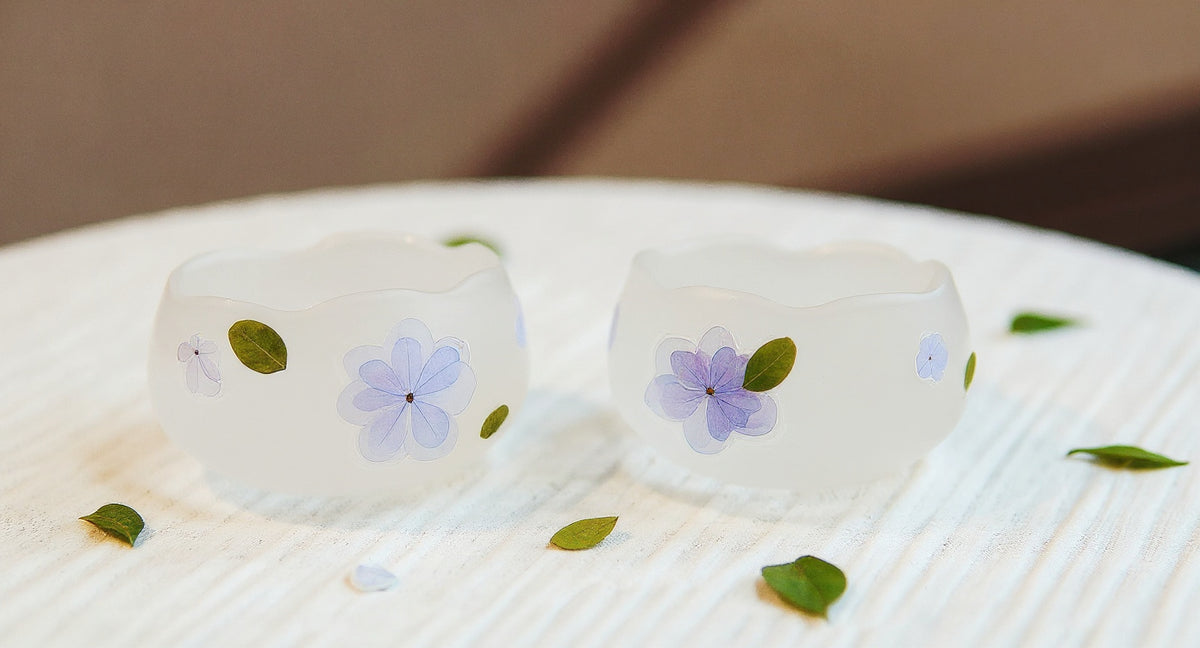
Choose a blue hydrangea resin teacup gift by checking where the real petals sit, what surface touches the tea, whether the capacity suits the recipient’s brewing style, and how much careful handling the piece will need. The best choice is rarely the busiest floral design. It’s the cup that makes the botanical work visible without compromising the practical ritual of drinking tea.
A flower cup can be meaningful because it preserves a seasonal detail that would otherwise be brief. Hydrangeas are especially suited to that idea: their clustered blooms are widely associated with ornamental gardens, as outlined in this reference entry on hydrangeas. For a gift, though, sentiment only goes so far. The recipient needs to know whether the flowers are real, whether hot tea belongs in the cup, and whether 40-60ml is a charming Gongfu size or an impractically small vessel for their daily habits.
Real petals should be visible as botanicals, not printed decoration
The first distinction is simple: a printed flower pattern is surface decoration, while a preserved-flower cup uses actual plant material. Real petals have irregular edges, slight variation in colour, and natural differences from one bloom to another. Those variations are a feature. A gift marketed as handmade should not look mechanically repeated from cup to cup.
Look closely at how the petals are presented. In a properly considered floral resin piece, the flowers should appear intentionally arranged rather than scattered at random. The petals need enough transparent material around them to remain visible, but they shouldn’t be buried so deeply that the botanical detail disappears. A layered placement can create depth and the impression that the flowers are suspended rather than pasted onto the surface.
The preservation approach belongs to a long lineage of botanical keepsakes. Pressed flower craft has long used dried plant material to retain a flower’s form beyond its growing season, though resin-embedded petals produce a different result from traditional flat pressing. The petals become part of an object meant to be handled, not simply framed.
A useful gift check is to ask five practical questions before choosing a cup:
1. Are the flowers identified as real preserved petals rather than printed, painted, or plastic decorations? 2. Is the floral material on the exterior, away from the drinking surface? 3. Can the petals still be seen clearly through the transparent layer? 4. Does the maker state the cup’s capacity rather than relying on a photograph that makes scale hard to judge? 5. Is the cup intended for a tea ritual, display, or both? 6. Are there care limits for heat, washing, and storage?
A cup with real flowers will never be perfectly identical to another one. That’s precisely why it can work as a birthday, Mother’s Day, or milestone gift. It has the character of a small functional art object rather than a generic floral mug.
Resin placement matters more than a blue hydrangea resin teacup gift label
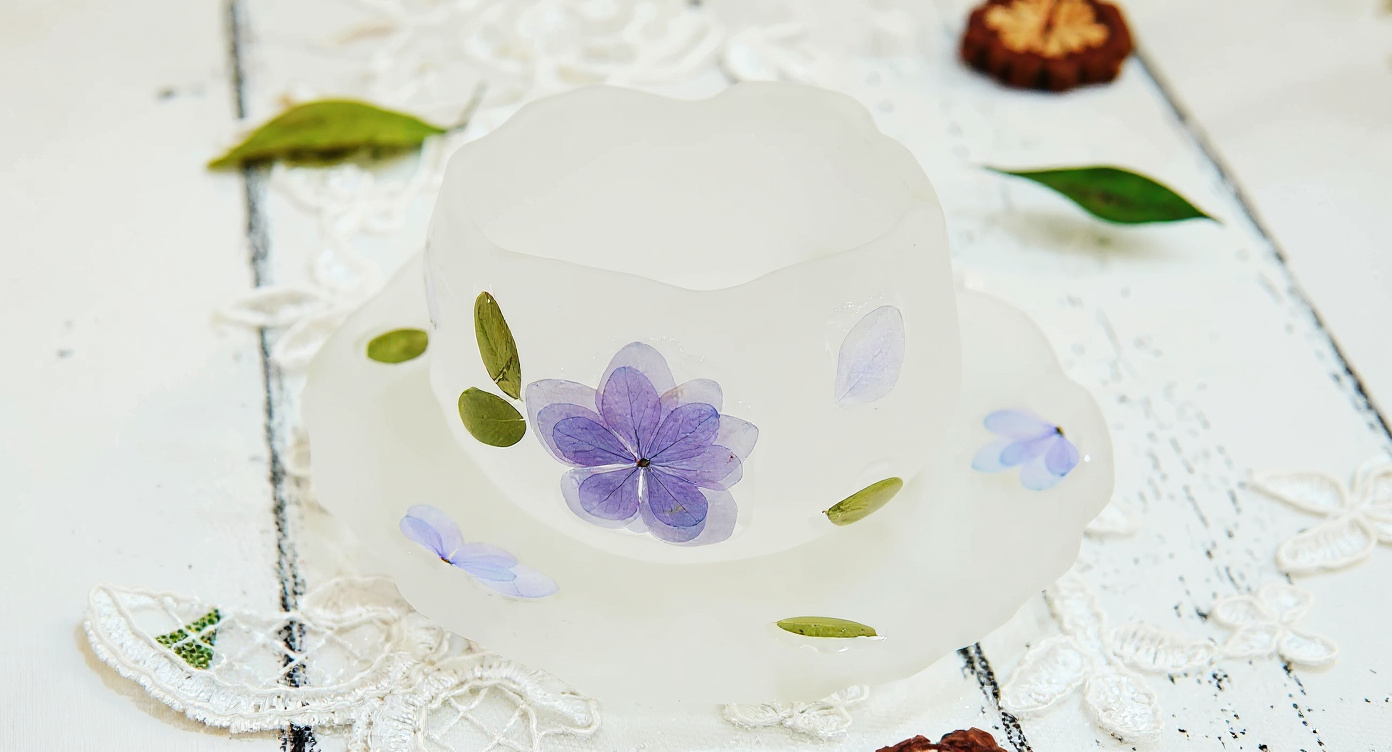
Resin is not a substitute for a well-made drinking vessel. Its location is what matters. For tea use, the liquid should contact the cup’s intended drinking surface, while the preserved flowers and resin remain on the exterior. This separation protects the visual work from direct washing friction and avoids turning decorative resin into the cup’s functional interior.
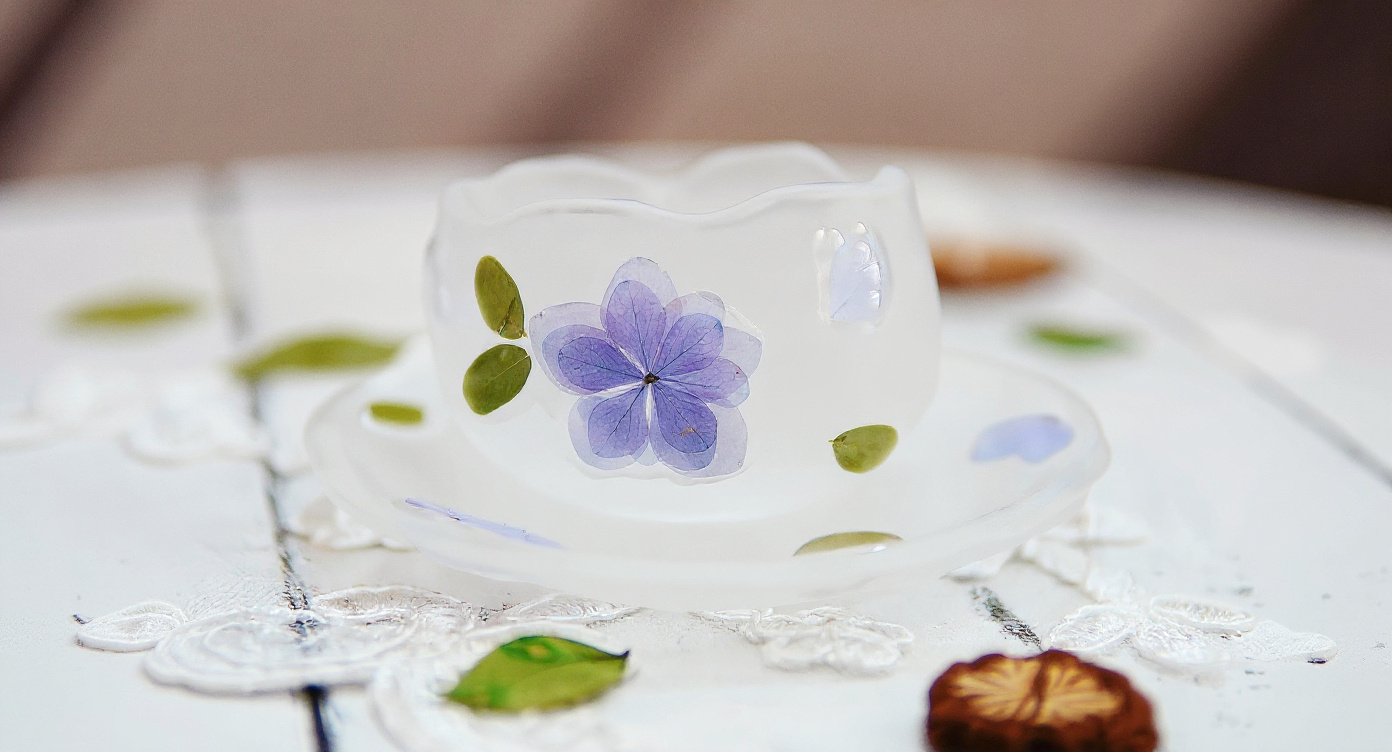
The Handmade Floating Flower Teacup Set | Frosted Glass & Real Blue Hydrangea | Gongfu Tea Gift uses real blue-purple double-petaled hydrangea petals hand-embedded beneath a smooth transparent resin layer on the exterior of a double-walled frosted glass cup. That construction is a stronger choice than a cup where the flower layer sits inside the drinking bowl or where the design is merely transferred onto ceramic.
The cup is described as having a 3D floating floral effect. That phrase should mean something concrete: the petals should appear at different visual depths beneath the transparent exterior layer, with the frosted glass diffusing light behind them. It shouldn’t mean thick, uneven resin blobs or flower pieces protruding where hands will repeatedly rub against them.
Resin is a broad category of material, as the general reference on resin explains. That is why vague claims such as “resin cup” aren’t enough. A responsible product description should identify whether the resin is decorative, where it is applied, and whether temperature limits are supplied. No temperature rating is stated for this cup, so it shouldn’t be treated as proof of suitability for boiling liquid, microwave heating, or dishwasher cycles.
For gifting, exterior resin placement also has a visual advantage. The recipient can turn the cup in hand and see the petals from different angles, while the tea itself remains the focus inside the glass.
A 40-60ml cup is made for Gongfu sessions, not oversized servings
Capacity decides whether a teacup becomes a daily favourite or stays in a display cabinet. This set holds approximately 40-60ml, which is a small master-cup size suited to Gongfu-style tea drinking. Gongfu tea is built around repeated short infusions and small pours rather than one large, long-steeped serving, as described in the Gongfu tea ceremony reference.
For someone who enjoys oolong, pu-erh, white tea, or other teas brewed through several infusions, 40-60ml can be exactly right. It encourages tea to be poured and drunk while fresh, then followed by the next infusion. It also makes sense with a small teapot or gaiwan, where a single steep may yield only enough tea for one or two cups.
It is not a Western breakfast mug. Someone expecting 250ml of black tea with milk will find this size frustrating. No floral treatment changes that.
The double-walled glass construction can make a small cup feel more substantial in the hand, and the matching textured floral saucer gives the set a defined place in a tea tray or display setting. Still, size should be the first compatibility check. A thoughtful gift isn’t one that asks the recipient to change every tea habit they already have.
| Gift option | Material and floral treatment | Stated capacity or format | Price information supplied | Best fit |
|---|---|---|---|---|
| Handmade Floating Flower Teacup Set | Double-walled frosted glass, real preserved hydrangea petals under exterior resin | Approx. 40-60ml | $71.3657142857143 | Gongfu tea, botanical display, milestone gifting |
| Mass-produced floral print ceramic cup | Ceramic with printed floral pattern | varies by seller | $15-$40 | Casual large-format tea or coffee use |
| Mid-range handmade ceramic set | Handmade ceramic | varies by configuration | $80-$150 | Recipients who prefer traditional ceramic teaware |
| Comparable real-flower resin artisan teacup | Varies by maker | varies by configuration | $60-$180 | Botanical-art collectors and gift buyers |
The table also shows why “handmade” alone isn’t enough to compare products. A $15 printed ceramic cup and a preserved-petal glass cup may share a flower motif, but the material, process, scale, and intended ritual are different.
Care should protect the glass, petals, and transparent finish
A preserved-flower cup needs gentler treatment than ordinary restaurant-grade ceramic. The real risk is not everyday use by itself. It’s abrasive cleaning, harsh heat exposure, sudden temperature change, and storage where the decorated exterior constantly rubs against hard objects.
Hand washing is the sensible default for a glass cup with exterior floral resin. Use a soft sponge or cloth, mild dish soap, and lukewarm water. Avoid scouring pads, powdered cleaners, and aggressive brushes around the flowered exterior. Dry the piece with a soft towel instead of leaving water to collect around the saucer or decorative surfaces.
Microwaving should be avoided unless the maker explicitly states that the entire assembled item is microwave-safe. The same caution applies to dishwashers. A dishwasher combines detergent, prolonged wet heat, spray pressure, and contact with other items. That is a poor environment for a hand-decorated object with preserved petals and a transparent exterior layer.
Hot tea needs a more precise answer. The cup is sold as teaware, and its floral resin is described as being on the exterior. Still, no maximum temperature is provided. It is safer to allow freshly boiled water to settle briefly before pouring, especially for teas that do not require full-boil brewing anyway. Green tea is commonly brewed below boiling point, while many oolongs and darker teas can be poured after a short cooling interval when needed. Don’t pour boiling water into a visibly cold glass straight from a winter windowsill or refrigerator.
Storage matters too. Keep the cup away from prolonged direct sunlight when it is not in use, and don’t stack it bare against heavy ceramics. The matching saucer is useful here, but it is not armour against scratches or drops.
Gift value comes from fit, not from floral detail alone
A preserved hydrangea cup is likely to pay off when the recipient values tea preparation as a small daily ritual, appreciates handmade botanical objects, and has room for a delicate 40-60ml piece in their routine. It is less suitable for someone who wants a dishwasher-safe work mug, needs one large drink before commuting, or prefers durable stoneware with no handling rules.
The strongest gifting occasions are personal rather than obligatory. A birthday gift works because the preserved petals feel specific and lasting. A Mother’s Day gift can suit someone who gardens, arranges flowers, or keeps a tea tray. It also makes sense for a housewarming, provided the recipient enjoys smaller decorative objects and actually drinks tea.
There is no need to pretend that every handmade floral cup is a practical essential. It isn’t. Its value lies in combining a usable drinking vessel with a preserved botanical composition. The trade-off is care. A plain porcelain cup will tolerate more neglect. This one asks for more attention because the petals, resin finish, frosted glass, and saucer are part of the point.
A buyer choosing between this style and conventional floral ceramics should take the more restrained option if daily durability is the priority. Choose preserved petals when the recipient will notice the difference between a printed pattern and a real flower held beneath a clear surface.
FAQ
Are the flowers in resin real flowers?
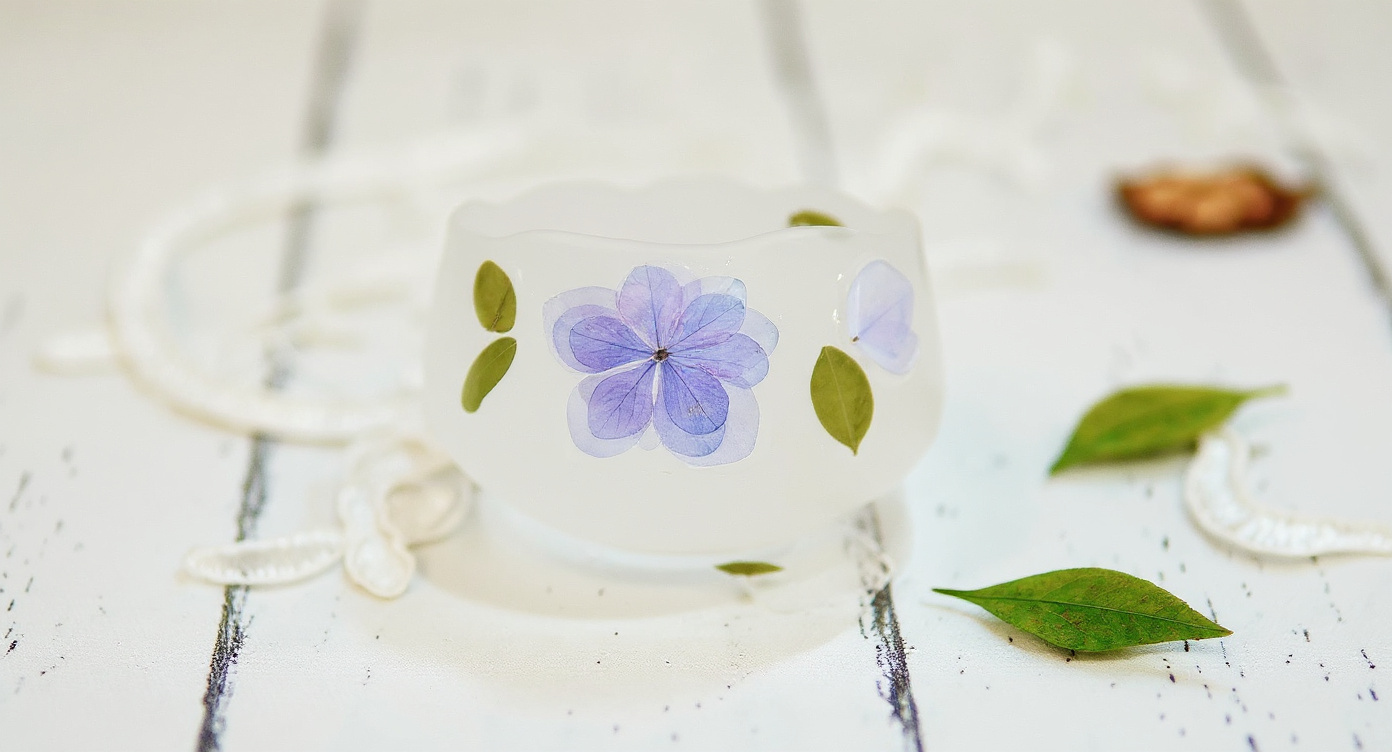
In this set, the flowers are described as real preserved blue-purple double-petaled hydrangea petals hand-embedded in eco-friendly resin on the cup’s exterior. Real preserved petals will have natural variation in shape and colour, unlike identical printed motifs or moulded plastic flowers.
Do preserved flowers fade in resin?
Preserved flowers can change over time, especially with prolonged exposure to strong direct light. The cup uses preserved petals beneath a transparent resin layer, which protects them from direct handling, but no decorative botanical material should be expected to remain unaffected by years of intense sun exposure. Store it out of persistent direct sunlight when it is not being used.
Can you drink from a resin flower cup?
The relevant question is where the resin sits. This cup’s petals and resin layer are described as exterior decoration, while the cup itself is double-walled frosted glass. That arrangement is more appropriate for a drinking vessel than resin lining the inside of the bowl. No separate food-contact certification or temperature rating is supplied, so don’t assume uses beyond ordinary tea service.
Are resin teacups safe for hot tea?
A cup with exterior resin decoration can be used differently from one with resin on the drinking surface. For this piece, the resin is described as being on the exterior. Since no maximum temperature is stated, avoid treating it as suitable for microwave use, dishwasher heat, or sudden boiling-water shock. Let very hot water settle briefly before pouring.
How do you clean a resin flower teacup?
Hand wash with mild soap, lukewarm water, and a soft cloth or sponge. Avoid abrasive scrubbers and harsh cleaners, particularly on the exterior resin and embedded petals. Dishwasher cleaning is not a sensible assumption for a handmade glass-and-resin floral piece unless the maker explicitly confirms it.
What size cup is best for Gongfu tea?
A 40-60ml cup is a practical range for many Gongfu sessions because tea is brewed in repeated short infusions and served in smaller amounts. It allows the drinker to taste each infusion while fresh instead of holding a large serving that cools while the next steep is prepared.
Is a 40-60ml teacup too small for everyday use?
It is too small for someone who thinks of tea as one large mug. It is not too small for a person who drinks several short infusions, shares tea at a small table, or uses a tea session as a deliberate pause. The capacity fits a Gongfu rhythm rather than an office-mug routine.
The right gift for a slower tea ritual
The main concern with preserved-flower teaware is reasonable: nobody wants a gift that looks delicate but cannot be used, or a decorative cup that turns out to be too small for the recipient’s habits. A 40-60ml frosted glass cup with real petals under an exterior resin layer makes most sense for someone who enjoys Gongfu tea, botanical objects, and careful daily rituals rather than oversized, low-maintenance drinkware. For that kind of gift, see the Handmade Floating Flower Teacup Set with real preserved blue hydrangea petals.