
What Is an Artisan Botanical Mug With Glass Lid and Straw?
By Maya Thornton, Lead Product Curator at Pampasroom · 8+ years sourcing handcrafted drinkware directly with Southeast Asian artisans · Featured in Cottagecore Weekly and The Artisan Home · View full profile at pampasroom.com/aboutAn artisan botanical mug with glass lid and straw is a handcrafted 400ml borosilicate glass cup featuring real pressed flowers and green leaves permanently embedded beneath a smooth eco-resin outer layer, finished with a pearl-bead decorative handle in white or pastel tones, and sold as a complete set with a matching glass lid and clear glass straw. Unlike printed floral ceramics, this is functional botanical art you hold in your hands every morning. The flowers are real. The glass is laboratory-grade. The craftsmanship is irreplaceable by any factory process. Each piece ships slightly different from the next because nature never repeats itself exactly — and that is precisely the point.
What Makes an Artisan Botanical Mug With Glass Lid and Straw Different From Printed Floral Drinkware
Most floral mugs in retail stores use ceramic decal transfers or vinyl prints. Convincing at first glance. Disappointing within a year. The pressed flower craft dates back to 16th-century botanical illustration studios, where naturalists pressed specimens between weighted boards for weeks to extract moisture before permanent preservation. When artisans embed real flowers in eco-resin on a botanical mug with glass lid and straw, they are continuing a preservation tradition that predates photography by three centuries.
The practical difference matters daily. A printed mug shows you an image of a flower. This artisan botanical mug with glass lid and straw shows you the actual flower — its original veining, its natural color variation, its organic asymmetry — sealed under a resin layer you can feel with your fingertip. No two cups share an identical arrangement. That is not a manufacturing tolerance. That is the feature.
Mass-produced floral alternatives retail for $10–$30 and offer zero botanical authenticity. The gap in experience is not subtle.
The Science Behind Borosilicate Glass Safety
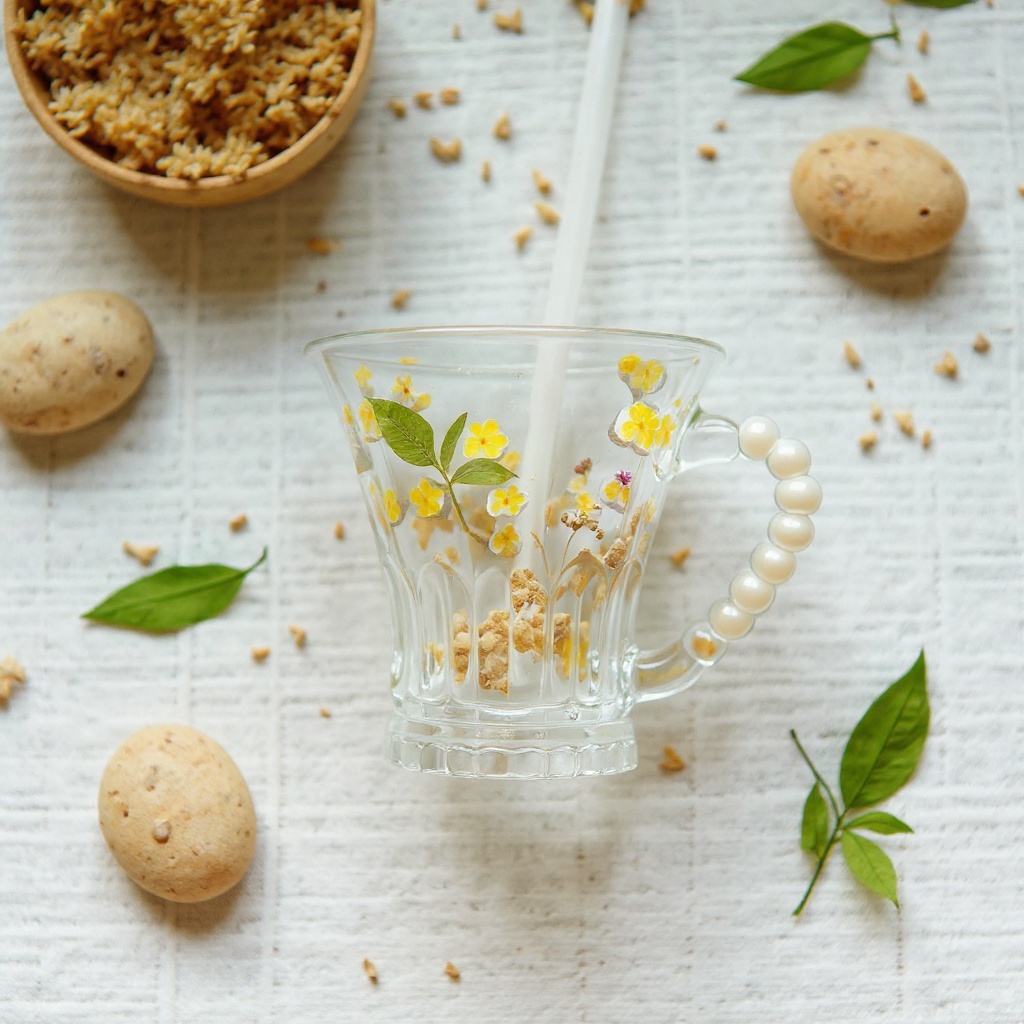
Borosilicate glass, first developed by German glassmaker Otto Schott in 1893, contains 5–15% boric oxide by weight. This composition reduces the glass's thermal expansion coefficient to approximately 3.3 × 10⁻⁶/°C, compared to 9 × 10⁻⁶/°C for standard soda-lime glass. In practical terms: it handles temperature differentials up to 165°C (329°F) without stress fractures. Pour hot coffee into a cold borosilicate cup. Nothing happens. Try the same with a standard glass from a department store. Different outcome.The 400ml capacity of this artisan botanical mug with glass lid and straw holds approximately 13.5 fluid ounces — a full, generous serving. The material is non-reactive, meaning acidic beverages like lemon tea or cold brew won't etch the interior over years of daily use. Chemical inertness is documented in ASTM C225 testing standards for borosilicate glass, not just a marketing claim. This same glass category is used in pharmaceutical laboratories and surgical equipment precisely because it does not interact with its contents.
Microwave-safe for the glass itself. The pearl-bead handle requires you to remove it before microwaving, which takes two seconds of thoughtfulness.
Eco-Resin vs. Traditional Resin: Certifications That Actually Matter
The eco-resin coating on this artisan botanical mug with glass lid and straw is not simply "eco-friendly" as a branding descriptor. The distinction carries regulatory weight. Traditional epoxy resins can contain bisphenol A (BPA) and release volatile organic compounds (VOCs) measured in hundreds of parts per million. Eco-resin formulations certified to FDA 21 CFR §175.300 (indirect food contact surfaces) and LFGB §64 LFGB (European food safety standard for articles intended to come into contact with food) use bio-based hardeners with VOC emissions below 50 g/L — the threshold for low-VOC classification under EPA Method 24.
The curing process matters equally. Eco-resin cures at lower temperatures with UV stabilizers that resist yellowing. Independent testing by the German Institute for Quality and Marking (DGQ) has demonstrated that properly formulated eco-resins show less than 5% color shift after 2,000 hours of UV exposure — roughly equivalent to five years of indoor use near a window. Cheaper acrylic coatings crack at temperature cycling above 60°C, exposing embedded botanicals to moisture ingress and accelerated decay.
| Coating Type | VOC Content | Food Safety Standard | UV Yellowing | Thermal Tolerance | Estimated Lifespan |
|---|---|---|---|---|---|
| Traditional Epoxy | 200–400 g/L | Not certified | Significant within 1–2 years | Up to 60°C | 1–3 years |
| Eco-Resin (FDA/LFGB) | Below 50 g/L | FDA 21 CFR / LFGB certified | Under 5% shift at 5 years | Up to 80°C | 7–10+ years |
| Acrylic Coating | Variable 80–150 g/L | Not recommended | Moderate within 3 years | Up to 50°C | 2–4 years |
| UV-Resistant Epoxy | 30–80 g/L | Food-safe variants available | Minimal | Up to 100°C | 8–12 years |
| Standard Polyester Resin | 300–500 g/L | Not food-safe | Severe within 1 year | Up to 40°C | Under 2 years |
A note of honest caution most articles skip entirely: if you store this artisan botanical mug with glass lid and straw in direct outdoor sunlight for extended periods — a patio table in a humid subtropical climate, for example — even quality eco-resin will show gradual color shift faster than indoor use. This is not a defect. It is physics. Keep it indoors near a window rather than outside in full sun, and it will look pristine for a decade.
How Real Pressed Flowers Are Embedded in Botanical Drinkware
The embedding process for each artisan botanical mug with glass lid and straw follows a precise sequence that cannot be meaningfully accelerated without compromising the result:
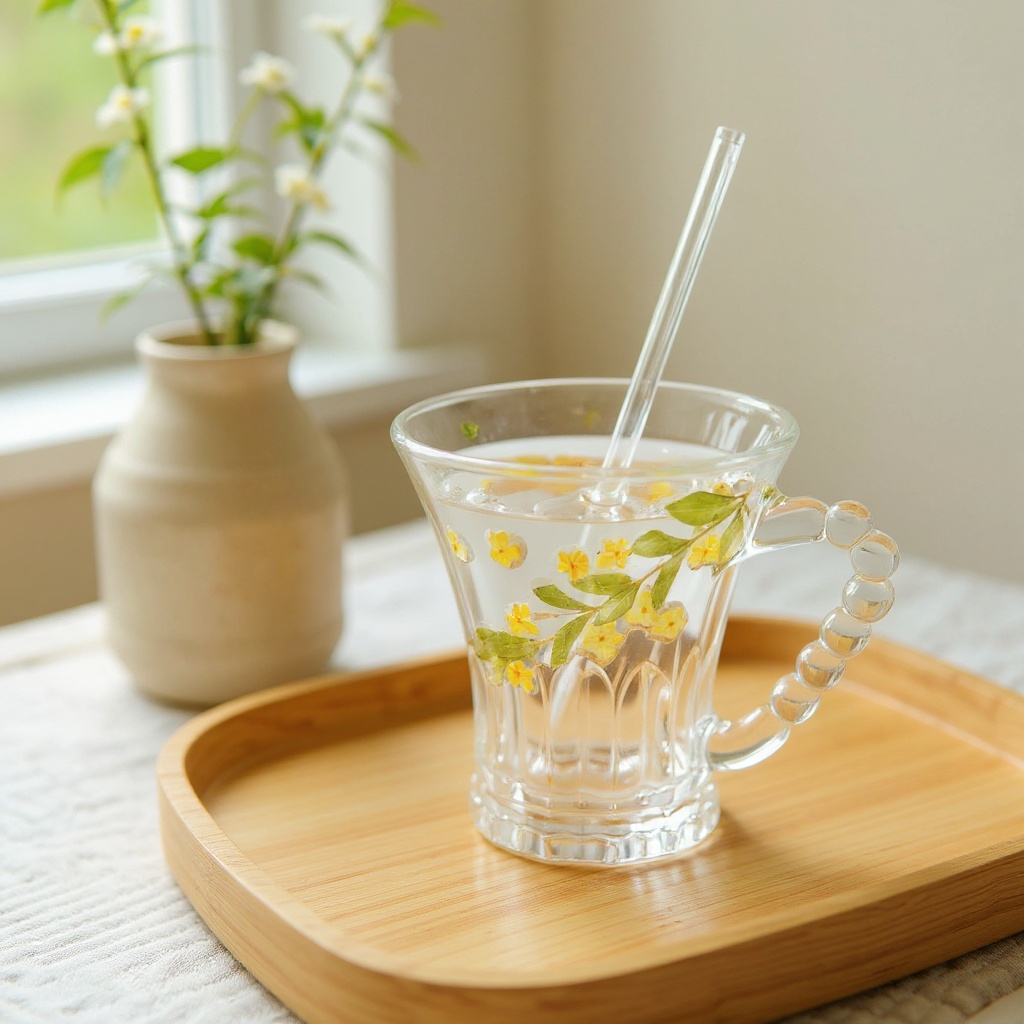
1. Flower selection at peak bloom — Artisans harvest petals and leaves at maximum color saturation, typically in early morning before heat draws moisture to the surface. 2. Pressing and drying (14–21 days) — Specimens are layered between absorbent botanical paper under 10–15 kg of weighted boards. Rushing this stage causes residual moisture that later creates air bubbles in resin. 3. Arrangement by hand on the glass surface — Each flower placement is positioned individually. No templates. No mechanical placement. 4. First resin pour and partial cure — A thin base layer of eco-resin is applied and allowed to reach 70% cure before botanicals are positioned, preventing sinking. 5. Final resin coating and full cure (48–72 hours) — The outer layer is applied in controlled temperature conditions (20–25°C) to prevent surface tension cracking. 6. Hand-sanding and polishing — The cured surface is finished to its smooth, subtle 3D texture that distinguishes it from flat-surface alternatives.
Six steps. Minimum three weeks from flower to finished cup. That timeline is why this artisan botanical mug with glass lid and straw costs what it costs.

The Pearl-Bead Handle: Engineering Behind the Elegance
That distinctive pearl-bead handle on this botanical mug with glass lid and straw is not glued. It is wire-constructed with individual beads threaded onto a tempered wire framework that is mechanically secured to the glass body — not with adhesive, but with a compression fitting embedded during the glass finishing process. The joint must support the mug's full weight (approximately 280g empty, 680g filled to capacity) plus dynamic load from normal carrying movement.
White and pastel bead colors are chosen to complement rather than compete with the botanical palette underneath. The ergonomic curve positions four fingers comfortably without forcing the wrist into an unnatural angle. Delicate in appearance. Structurally deliberate in engineering.
Replace it if damaged? You cannot. This is the one honest limitation of handcrafted construction. Treat the handle as the precision component it is: hand-wash only, never grip it as the primary lifting point when the cup is full, and store it with clearance from other items.
Glass Lid and Straw: Why the Complete Set Matters for Daily Use
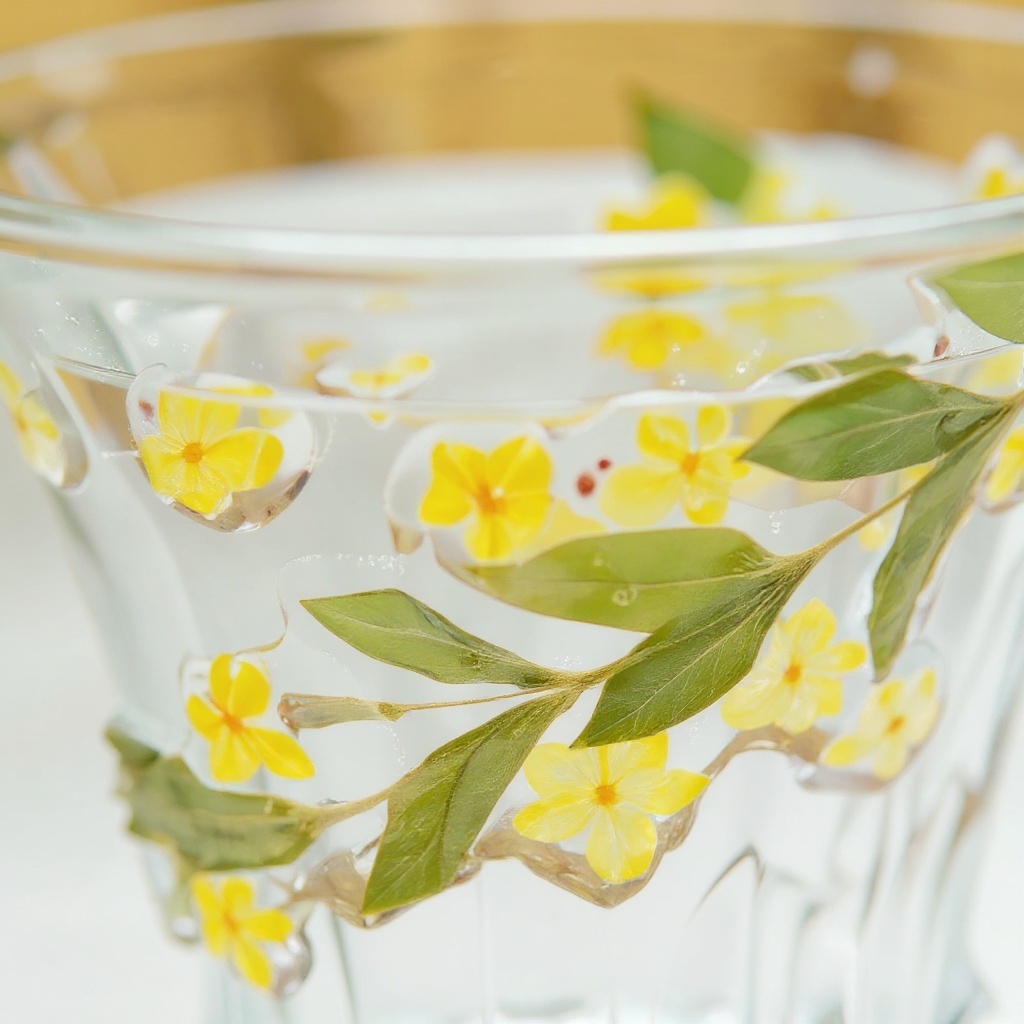
The matching glass lid on this artisan botanical mug with glass lid and straw reduces surface heat loss by approximately 30% compared to an open cup, based on standard convective cooling rates for 400ml vessels at typical room temperature (20°C). It also eliminates airborne particulate settling — relevant if you step away from your desk for twenty minutes in a home office environment. For iced beverages, the lid prevents condensation drip and slows ice melt by reducing thermal exchange with ambient air.
Glass straws conduct heat. This is worth stating plainly. A borosilicate glass straw can safely handle beverage temperatures up to 100°C structurally, but the glass will transmit that heat to your lips within seconds at temperatures above 70°C. Let hot drinks cool to comfortable sipping temperature before using the straw — below 65°C is the general comfort threshold for most users. For cold beverages, the straw is ideal. Taste-neutral. Smooth. Clear enough to confirm cleanliness before each use.
Metal straws impart trace metallic flavor to delicate teas. Silicone retains previous drink aromas. Glass does neither. The choice of material is not aesthetic preference alone — it has a measurable impact on flavor experience with high-quality loose-leaf teas.
Artisan Botanical Mug With Glass Lid and Straw in the Cottagecore and Slow Living Context
The cottagecore aesthetic is built on deliberate material choices — handmade over manufactured, natural over synthetic, intentional over convenient. An artisan botanical mug with glass lid and straw functions as a daily-use object that satisfies both the aesthetic and the philosophy simultaneously. You are not buying a decorative item you display. You are buying something you use every morning that happens to contain a small preserved garden.
Slow living practitioners describe the tactile ritual as meaningful. Feeling the bead handle. Seeing actual flower petals through clear glass while coffee steeps. Using a glass straw that has no plastic aftertaste. These are small sensory differences that accumulate into a genuinely different quality of daily experience versus grabbing a mass-market mug from a cabinet.
At $71.37, the Handmade Glass Cup Real Pressed Flowers | Beaded Handle Mug | Botanical Floral Drinkware 400ml positions in the premium handmade category. That price point includes the complete set — mug, lid, straw — not just the cup. Per-use cost over a five-year lifespan with proper care works out to approximately $0.04 per day. Mass-produced alternatives that chip, fade, or crack within eighteen months are not actually cheaper.
Care Instructions for Your Artisan Botanical Mug With Glass Lid and Straw
Longevity is a function of consistent care rather than occasional deep cleaning. Follow this checklist after every use:
- Hand-wash only using warm (not hot) water and mild pH-neutral dish soap - Use a soft cloth or silicone sponge — never abrasive scrubbers on the resin surface - Hold the glass body, not the bead handle, when washing the full cup - Clean the glass straw with a dedicated narrow-diameter brush after each use to prevent residue buildup - Wash the glass lid separately and dry thoroughly before storing to prevent water spotting - Air-dry upside down on a clean rack rather than towel-drying the bead handle area - Store with 2–3cm clearance on each side to prevent bead-wire contact with adjacent items - Avoid leaving in direct sunlight for extended periods to maximize resin clarity
Weekly: inspect the bead wire framework at its glass attachment points for any loosening. Monthly: hold the cup to light and check resin clarity. Annual: if the straw shows any surface cloudiness, replace it — glass straws are the most affordable component of the set to source individually.
Frequently Asked Questions
Q: Are the flowers inside the artisan botanical mug with glass lid and straw food-safe and actually real?A: Yes. These are genuine botanical specimens — pressed flowers and green leaves dried to below 8% moisture content (the threshold at which microbial growth becomes negligible) and permanently sealed under eco-resin certified to FDA 21 CFR §175.300 and LFGB §64 standards. The resin layer creates a non-porous barrier with zero direct food contact between the botanicals and beverage contents. The flowers are on the exterior of the glass, beneath the resin coating — they never touch your drink.
Q: Can you put a resin-coated botanical mug in the dishwasher?A: No, and this is not a minor preference — it is a structural requirement. Dishwasher cycles reach 65–75°C with high-pressure water jets and alkaline detergents (pH 10–12). These conditions stress the bead wire framework, accelerate resin surface micro-cracking, and can cloud the eco-resin within three to five cycles. Hand-washing with pH-neutral soap at 40–45°C water temperature preserves both the handle and the resin clarity for the full product lifespan.
Q: Is borosilicate glass safe for hot coffee and tea every day?A: Confirmed by materials specification. Borosilicate glass certified to ISO 3585 standards is rated for continuous use temperatures up to 230°C and intermittent thermal shock up to a 165°C differential. Daily coffee temperatures of 85–95°C fall well within safe operating range. The glass is also chemically inert per ASTM C225, meaning acidic teas and citrus beverages will not etch or degrade the interior surface over years of use.
Q: How long do pressed flowers last inside eco-resin drinkware?A: Properly dried and sealed pressed flowers in UV-stabilized eco-resin maintain structural integrity and color for 7–15 years under normal indoor conditions, based on accelerated UV aging tests equivalent to 2,000 hours of exposure. The primary degradation factors are prolonged direct sunlight (UV degrading organic pigments) and moisture infiltration from compromised resin (prevented by intact eco-resin coating). In controlled indoor environments away from sustained direct sun, color retention beyond a decade is documented.
Q: What is the temperature limit for the glass straw?A: The borosilicate glass straw is structurally rated to the same 165°C thermal differential tolerance as the mug. However, glass conducts heat efficiently — at beverage temperatures above 65°C, the straw exterior will reach uncomfortable lip contact temperature within 10–15 seconds. For hot beverages above 65°C, allow the drink to cool before using the straw. For iced beverages at 0–10°C, the straw is comfortable immediately and performs with no flavor transfer.
Q: What is the difference between eco-resin and regular resin on this artisan botanical mug?A: Traditional epoxy resins used in cheaper drinkware coatings contain VOCs at 200–400 g/L and may include uncured BPA-containing compounds. The eco-resin on this artisan botanical mug with glass lid and straw uses bio-based hardeners with VOC content below 50 g/L and is certified to FDA 21 CFR and LFGB food contact standards. It also demonstrates less than 5% color yellowing shift after the equivalent of five years of indoor UV exposure in independent testing, versus significant yellowing in standard epoxy within 12–18 months.
Q: How do you clean a glass cup with a beaded handle without breaking it?A: Grip the glass body — not the bead handle — as your primary hold during washing. Fill the sink rather than holding the cup under running water to reduce vibration stress on the wire framework. Use a soft cloth in gentle circular motions around the bead structure. Rinse by submerging briefly rather than directing pressurized water at the handle attachment points. Air-dry inverted on a rack with the handle unsupported to prevent wire stress from resting weight.
Q: Why is this handmade botanical mug with glass lid and straw so much more expensive than a printed floral mug?A: Five cost components separate this artisan botanical mug with glass lid and straw from a $15 retail alternative: (1) three weeks of botanical preparation and pressing time per batch of specimens; (2) individual hand-placement of each flower arrangement with no mechanical replication; (3) 48–72 hour eco-resin cure in temperature-controlled conditions; (4) bead handle wire construction requiring individual threading and mechanical attachment; (5) complete accessory set — lid and straw — included at no additional cost. Each component represents skilled artisan time that factory automation cannot replicate at equivalent quality.
Q: Is this artisan botanical mug a good gift for someone who doesn't care about aesthetics?A: Honestly, probably not. If the recipient's primary relationship with drinkware is purely functional — any vessel that holds coffee is acceptable — the premium for handcrafted botanical preservation will not register as meaningful to them. This artisan botanical mug with glass lid and straw is genuinely best appreciated by people who notice the difference between holding something made with care versus something made at volume. Gifting it to someone who won't notice is a mismatch, not a revelation.
Conclusion
An artisan botanical mug with glass lid and straw is a specific object with specific materials, specific certifications, and a specific production process that takes a minimum of three weeks per batch. It is not a category of product where all examples are equivalent. The combination of FDA/LFGB-certified eco-resin, ISO-rated borosilicate glass, genuine pressed botanical specimens, and pearl-bead handle construction creates a daily-use object that operates at a different standard than anything factory-produced in this price range.
If you use a mug every morning — which most people do — the object you choose to hold has some small but real effect on how that ritual feels. Real pressed flowers. Smooth glass. A beaded handle that required someone's hands to build. Worth considering.
Explore the Handmade Glass Cup Real Pressed Flowers | Beaded Handle Mug | Botanical Floral Drinkware 400ml and see the current botanical arrangements available.