































Chinese Celadon Teapot and Cups Set: A Full Guide
Chinese Celadon Teapot and Cups Set: The Complete Buyer's Guide
By pampasroom, founder of Pampasroom · 8+ years studying East Asian ceramic traditions and tea culture · Trained alongside Longquan celadon studio potters in Zhejiang Province · Research referenced by ceramic collectors across North America and EuropeA chinese celadon teapot and cups set is one of the few purchases that rewards you every single morning. Not just aesthetically — functionally. Real celadon is fired at temperatures exceeding 2,200°F, producing a porcelain body that is denser, harder, and more heat-retentive than standard stoneware. The glaze develops from iron oxide reacting in a reduction kiln atmosphere, which is why that signature jade-green color cannot be replicated with paint or surface decoration. If you want the short answer: authentic celadon outperforms most tea ceramics and outlasts them by decades. The longer answer is below.
This guide covers what makes a chinese celadon teapot and cups set worth buying, how to tell handmade from factory pieces, which glaze styles suit different aesthetics, and how embedded botanicals like real winter jasmine petals change both the look and the craftsmanship story.
What Is a Chinese Celadon Teapot and Cups Set, Exactly?
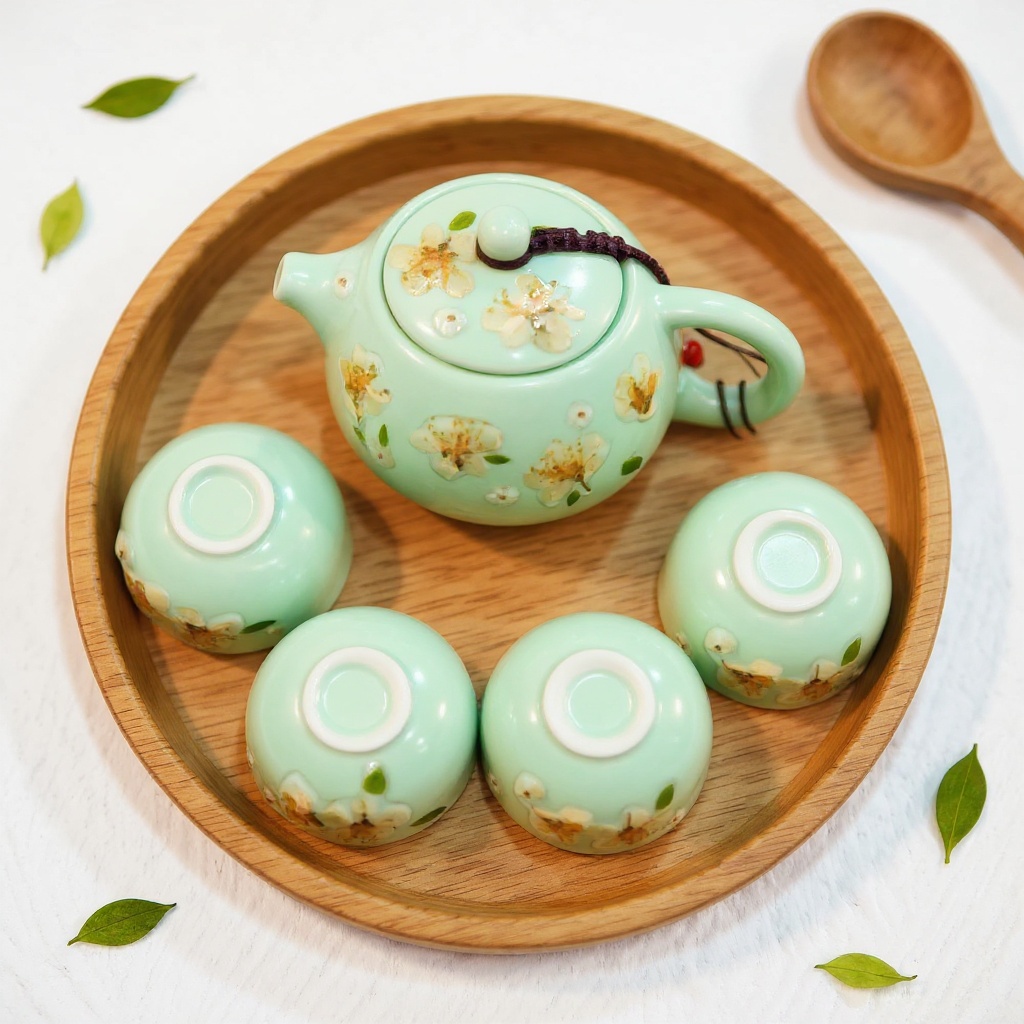
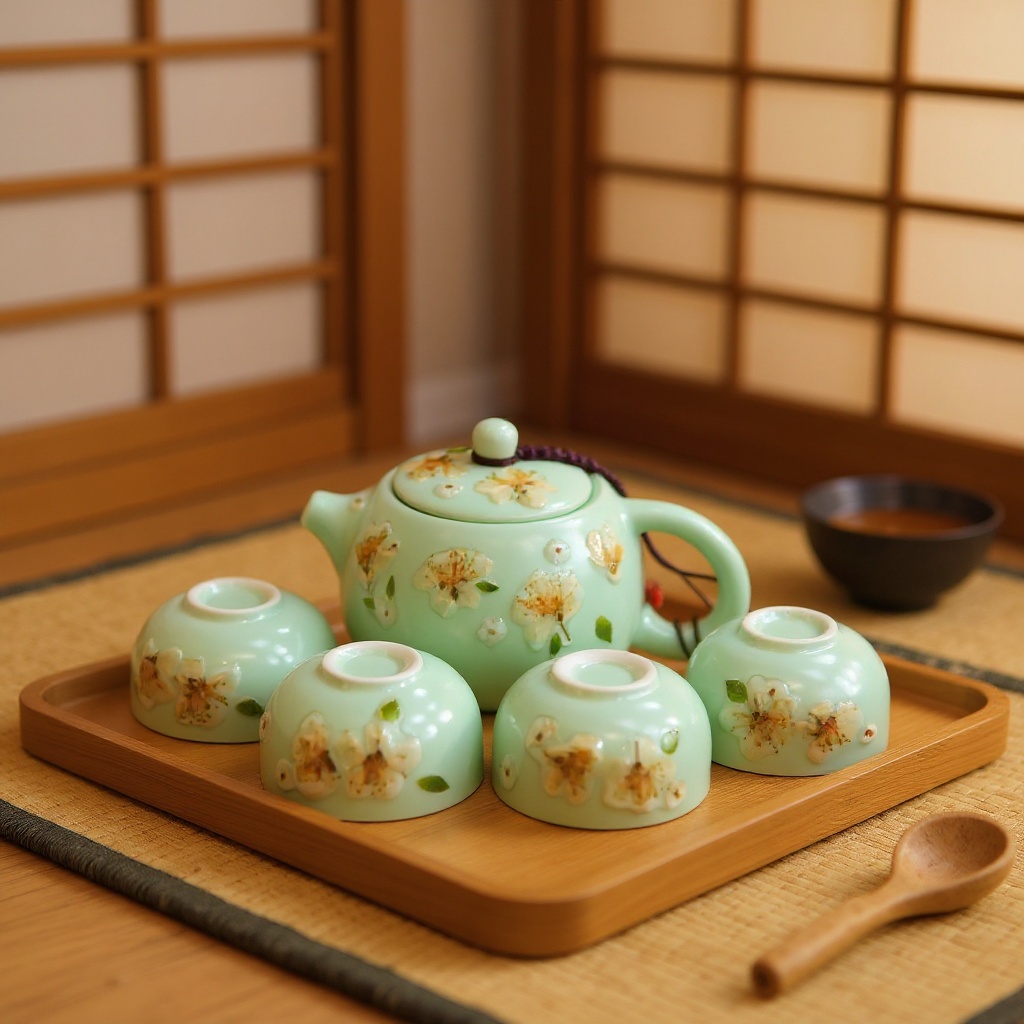
Celadon pottery has a documented history spanning more than 2,000 years, with origins traced to China's Eastern Han Dynasty. Potters in Zhejiang Province discovered that clay with an iron oxide content between 1% and 3%, fired in oxygen-reduced kilns at high temperatures, produced a distinctive jade-green glaze unlike anything achievable through other methods. The technique spread to Korea, Japan, and Southeast Asia — but Chinese celadon, particularly from the Longquan tradition, remains the benchmark that serious collectors and tea practitioners reference.A complete chinese celadon teapot and cups set typically includes one teapot (ranging from 150ml to 250ml depending on intended use), four small cups (40–50ml each for gongfu-style brewing), and often a natural wood or bamboo tea tray. The glaze should display a smooth, luminous surface with a subtle green gradient — lighter where the glaze runs thin near edges, deeper jade where it pools in curves. That gradient is not a manufacturing defect. It is proof the piece was genuinely hand-glazed.
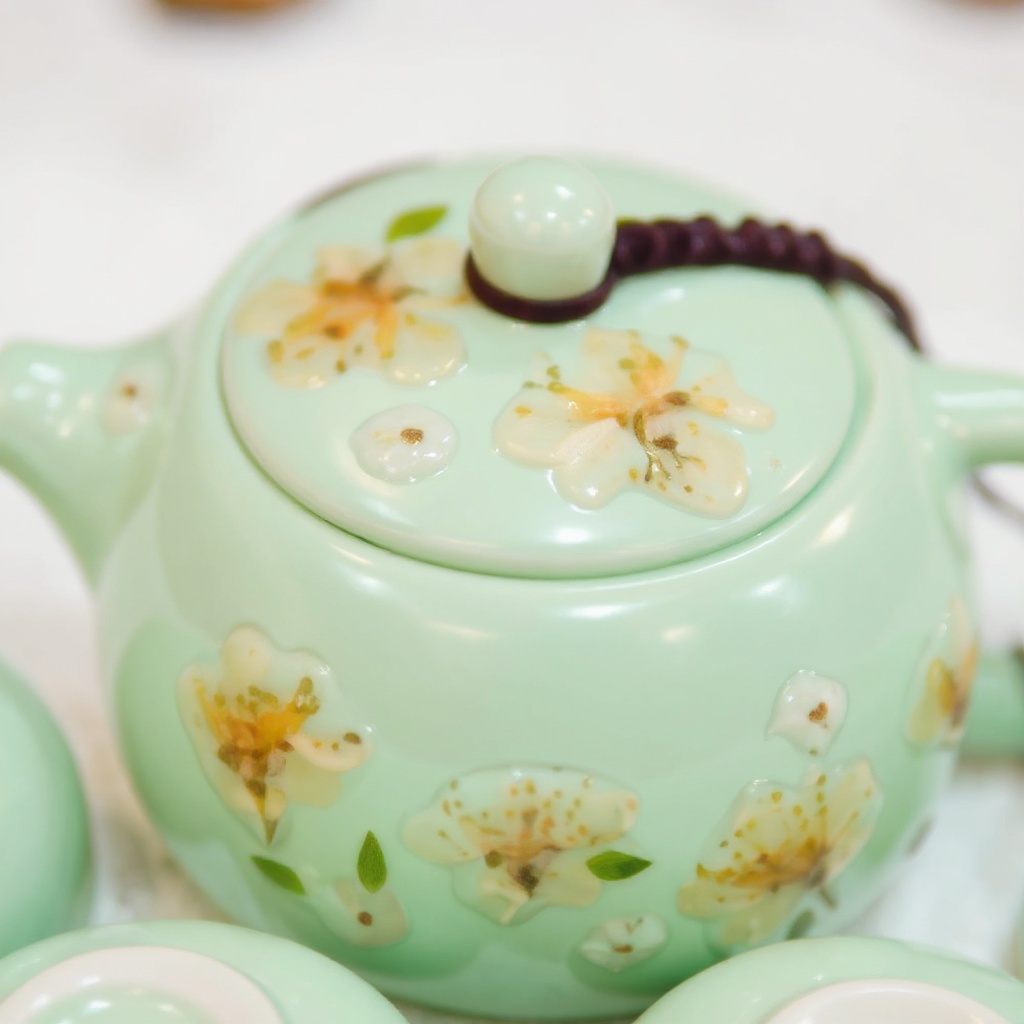
The best sets also feature real botanical elements embedded before firing. Real winter jasmine petals, slightly raised on the surface. Visible. Tactile. Permanent.
The Ceramic Science Behind Celadon Glaze
Most articles skip the chemistry. This one won't, because understanding it helps you identify fakes.
Celadon's color comes from ferrous iron (Fe²⁺) formed when iron oxide in the clay body is reduced during firing — meaning the kiln is starved of oxygen at the critical temperature window. According to research documented by the Victoria and Albert Museum's ceramic collection records, authentic Longquan-style celadon requires sustained temperatures between 1,250°C and 1,280°C (approximately 2,280–2,340°F) to achieve full vitrification of both the clay body and glaze layer. This matters because vitrification is what creates celadon's characteristic density and near-zero porosity.
The glaze on genuine high-fired celadon tends to sit between 0.8mm and 1.2mm thick — thicker than standard earthenware glazes, which typically measure 0.3–0.5mm. This thickness is why celadon glaze has visual depth rather than sitting as a flat surface coating. When light enters the glaze layer, it refracts slightly before reflecting back. That is the luminous quality collectors describe as "jade-like." It is not a poetic metaphor. It is optics.
Factory-produced pieces are fired at lower temperatures — often around 1,100–1,150°C — to reduce production time and energy costs. The resulting glaze is thinner, the clay body less dense, and the green color typically achieved through added colorants rather than iron reduction chemistry. You can feel the difference in your hands.
Sizing and Proportions That Actually Determine Brewing Quality
Proportions matter more than most buyers realize. A chinese celadon teapot and cups set sized incorrectly for gongfu brewing produces inferior tea regardless of how beautiful the glaze looks.
Gongfu tea ceremony traditions evolved specifically around small-volume, short-steep brewing — multiple infusions of 15–30 seconds each, rather than one long steep. This method extracts layered flavor complexity impossible to achieve in large Western-style mugs. The teapot should hold enough water to fill 3–4 cups simultaneously without excess sitting too long.Here is what to look for in a properly proportioned set:
1. Teapot capacity: 180–220ml for 2–4 people; 150ml for solo brewing or gongfu precision 2. Cup volume: 40–50ml to maintain tea temperature through rapid sequential pours 3. Spout length: 2.5–3 inches to produce a clean arc without dripping 4. Handle clearance: At least 1.5 inches from the pot body so knuckles clear during pouring 5. Lid fit: Snug with a small vent hole — airtight lids create pressure issues, while loose lids rattle during pouring 6. Wall thickness: 3–5mm balances heat retention against weight; thinner walls cool too fast, thicker walls become heavy 7. Base diameter: Wide enough that the fully loaded pot — water plus leaves — does not tip on a smooth tray surface
The spout angle deserves specific attention. The spout tip should sit at or slightly above the level of the lid rim. If it sits below, liquid creeps back toward the pot body when you tip it forward, causing dripping. This is a functional detail that separates well-designed celadon sets from decorative-only pieces.
How to Authenticate a Chinese Celadon Teapot and Cups Set
The market contains a large volume of celadon-colored ceramics that are not authentic celadon. Knowing how to distinguish them protects your investment. Here is a practical authentication process:
1. Check the color gradient: Genuine hand-glazed celadon shows lighter coloring at raised edges and rims where glaze runs thin, and deeper green in recessed curves where it pools. Uniform color across the entire surface suggests spray-applied glaze on a factory piece. 2. Examine the interior: Wheel-thrown pieces show faint spiral marks inside the pot body. Slip-cast factory pieces have smooth, featureless interiors with identical surface texture throughout. 3. Look at the base: Handmade pieces often show a slightly recessed foot ring with glaze stopping unevenly near the base. The unglazed clay visible at the foot ring should appear dense and gray-white, not chalky or tan — indicating high-temperature firing. 4. Feel the weight: High-fired celadon feels noticeably heavier than factory ceramics of similar size. Hold the teapot fully in one hand. It should feel solid, almost lapidary, not hollow. 5. Inspect symmetry from above: Look straight down at the teapot opening. Wheel-thrown pieces show subtle asymmetry — not dramatic warping, but organic variation. Machine-cast pieces are geometrically perfect.
One honest fact most celadon guides won't print: if you are browsing celadon sets under $60, you are almost certainly looking at factory-produced ceramics fired at lower temperatures with colorant-tinted glazes. Authentic handmade high-fired celadon with hand-embedded botanical elements requires skilled labor that cannot price below that threshold without compromise. That is not snobbishness. That is manufacturing economics.
Celadon Glaze Styles: A Regional Comparison
Not all celadon glaze looks or performs the same. Chinese ceramics scholarship identifies several major regional traditions, each with distinct visual characteristics and historical contexts:
- Longquan celadon: Deep jade green, high gloss finish, thick glaze application, from Zhejiang Province — the dominant style for contemporary tea sets - Ru ware: Pale blue-green, intentional crackle network (called crazing), historically reserved for imperial use — extremely rare in authentic form - Yaozhou celadon: Olive green tones, often featuring carved floral decoration beneath the glaze, from Shaanxi Province - Guan ware: Thin clay body with unusually thick glaze, producing pronounced crackling — valued more for sculptural quality than functional use - Jun ware: Purple-blue streaks appearing within the green base due to phosphoric acid additions to the glaze chemistry
For a functional chinese celadon teapot and cups set used daily, Longquan-style glaze is the practical choice. It offers the deepest, most visually consistent jade-green appearance, and the thick glaze layer handles regular thermal cycling better than thin-bodied alternatives like Ru or Guan styles.
| Celadon Style | Color | Glaze Finish | Best Use Case | Relative Rarity |
|---|---|---|---|---|
| Longquan | Deep jade green | High gloss | Daily brewing, collecting | Common in quality artisan work |
| Ru ware | Pale blue-green | Matte with crazing | Display collecting | Extremely rare authentic pieces |
| Yaozhou | Olive green | Semi-gloss | Decorative carved pieces | Moderate |
| Guan | Blue-green | Heavy crazing | Sculptural display | Rare |
| Jun | Green with purple streaks | Variable | Artistic statement pieces | Moderate |
| Contemporary botanical | Jade green with embedded flora | Luminous smooth | Daily use and gifting | Available from artisan studios |
How Botanical Elements Are Embedded in Celadon Porcelain
The process of embedding real flowers into celadon is more technically demanding than it appears. This is not a craft project — it is a specific ceramic technique requiring precise timing within the forming process.
Winter jasmine (Jasminum nudiflorum) blooms before other flowers in late winter, producing bright yellow petals on bare stems. The petals are harvested and preserved through controlled drying to remove moisture while maintaining structural integrity. Then comes the critical step.When the clay body reaches leather-hard stage — firm enough to hold shape but still containing some moisture — artisans place individual petals directly onto the surface, pressing gently so they adhere and create slight topographic relief. The petals must be positioned before the piece dries completely because dry clay will not bond with them. Once placed, a food-safe sealant compound is applied over the petals before the glaze layer goes on. The final glaze application covers everything, preserving the petals beneath while allowing their raised profile to remain visible through the glaze surface.
When fired, the organic material burns away — but the impression and raised form remains locked into the glaze layer permanently. What you see and feel on the finished piece is the glaze itself, shaped over where the petal once sat. The result: real winter jasmine petals visibly embedded and slightly raised on the surface of fired porcelain. Not painted. Not applied after firing. Structurally part of the ceramic.
This process cannot be automated. Each petal placement is individual. Which is why genuine botanical celadon sets carry higher price points than plain glazed alternatives.
Comparing Celadon to Other Tea Ceramics
A chinese celadon teapot and cups set competes in a crowded field. Understanding how it stacks up against alternatives helps clarify when celadon is the right choice — and when it might not be.
| Material | Firing Temp | Porosity | Heat Retention | Flavor Impact | Best For |
|---|---|---|---|---|---|
| Authentic high-fired celadon | 2,250–2,340°F | Near zero | Strong | Neutral — does not absorb tea oils | Green tea, white tea, light oolong |
| Yixing zisha (purple clay) | 2,100–2,200°F | Low | Moderate | Absorbs tea oils over time — seasons to specific tea | Pu-erh, dark oolong, aged teas |
| Standard stoneware | 1,800–2,100°F | Low-medium | Moderate | Minimal impact | General everyday use |
| Earthenware / terracotta | 1,600–1,900°F | High | Low | Can impart earthy notes | Rustic aesthetic, certain herbal teas |
| Glass | N/A | None | Low | None | Visual brewing display |
| Bone china | 2,200–2,300°F | Near zero | Low (thin walls) | Neutral | Western-style tea service |
Honest assessment most celadon articles avoid: if you exclusively drink heavily oxidized teas like aged pu-erh or roasted oolongs, a Yixing clay teapot will serve you better over time because the clay seasons to your preferred tea. Celadon's non-porous surface excels precisely because it doesn't absorb — which is ideal for delicate teas you switch between frequently, but a disadvantage if seasoning a single tea type is your goal.
Caring for Your Chinese Celadon Teapot and Cups Set
Proper care extends the functional life of celadon by decades. The rules are simple.
Never use abrasive pads or powdered cleaners. The glaze surface is hard but not invulnerable to scratching, and green glaze shows surface marks more obviously than patterned ceramics. Warm water and a soft cloth handle all routine cleaning. Stubborn tea staining inside the pot responds to a short soak with a diluted baking soda solution — not bleach, which can damage glaze chemistry over time.
Thermal shock is the primary risk factor. Do not pour boiling water into a cold teapot pulled from a winter cabinet. Pre-warm the pot first: add lukewarm water, swirl, discard, then add your hot water for brewing. This takes thirty seconds and eliminates almost all thermal cracking risk.
For sets with embedded botanical elements, the petals themselves are protected within the glaze layer and are not vulnerable to moisture. What they can suffer is edge chipping if cups or the teapot are knocked against hard surfaces. Store pieces with adequate spacing. Felt pads between stacked cups prevent surface contact abrasion.
Dishwashers are technically tolerable for plain celadon, but hand washing is strongly recommended for botanical sets. The combination of high heat, aggressive detergents, and contact with other dishes creates cumulative risk not worth taking on irreplaceable handmade pieces.
FAQ
Is celadon glaze food-safe for daily tea use?Yes. Properly fired celadon — kiln temperatures above 2,100°F with full vitrification — produces a non-porous, non-leaching surface. The iron oxide that creates the green color is chemically stable at these temperatures and does not migrate into liquids. Confirm with any manufacturer that no lead compounds were used in glaze formulation, which is standard practice for reputable artisan studios.
What is the difference between Longquan celadon and Ru ware?Longquan celadon displays deep jade-green tones with a high-gloss finish and thick glaze application. Ru ware presents in pale blue-green with a matte surface and intentional crackling (crazing). Historically, Ru ware was produced exclusively for imperial courts and is now extremely rare in authentic form. For functional tea use, Longquan-style celadon is the practical choice — it handles thermal cycling better and offers the most visually characteristic jade-green appearance.
Can I use a celadon teapot in the microwave or dishwasher?Avoid microwaves. The iron content in celadon clay can create uneven heating and thermal stress at microwave frequencies. Dishwashers are technically safe for plain celadon, but hand washing is recommended for all botanical sets. Aggressive detergent cycles and contact with other dishes during washing create cumulative risk — and these pieces are worth protecting.
Why does my celadon teapot look slightly different from product photos?Handmade celadon varies naturally because each piece is glazed and fired individually. The glaze pools differently depending on the exact wall curvature of each pot, producing slightly different color depth even within the same production batch. Lighting conditions also shift how celadon reads — warm incandescent light pulls it toward golden-green, while cool natural daylight reveals deeper jade tones. This variation is authentication, not defect.
How do I know if a celadon set is genuinely handmade or factory-produced?Check for four things: subtle asymmetry when viewed from above, spiral wheel marks visible inside the pot body, a foot ring showing uneven glaze stopping rather than a clean machined edge, and natural color gradient across the surface rather than uniform coloring. Factory pieces show geometric symmetry, smooth featureless interiors, and uniform glaze distribution from spray application.
What teas perform best in celadon porcelain?Celadon's non-porous surface makes it best suited to teas where you want to taste the tea itself without clay influence — green tea, white tea, light oolongs, and high-mountain teas with delicate floral or vegetal notes. The neutral surface does not absorb or impart flavors between sessions, which also makes celadon practical if you rotate between different tea types frequently.
Are the jasmine flowers actually embedded in the clay or applied after firing?In quality botanical celadon, real preserved petals are placed onto the leather-hard clay before glazing and firing. The organic material burns away during the kiln process, but the raised impression and the glaze that formed over it remains permanently. The result is a three-dimensional relief you can feel with your fingertip — structurally part of the ceramic, not applied decoration that can wear or peel.
How fragile is high-fired celadon compared to standard ceramic teapots?High-fired celadon is more chip-resistant than most earthenware and standard stoneware due to the denser clay body achieved through vitrification. The primary risk is thermal shock from rapid temperature changes — not impact resistance in the way most people imagine fragility. Handle the set with normal care, avoid sudden temperature swings, and quality celadon will outlast most ceramics in a household context by years.
Does the wood tea tray require separate maintenance?Natural wood tea trays benefit from periodic treatment with food-safe mineral oil or beeswax to prevent drying and cracking — particularly in low-humidity environments. Wipe the tray dry after each tea session rather than leaving standing water on the surface. Well-maintained natural wood trays develop a richer patina over time that complements the celadon glaze in the way an aged thing complements a refined one.
Is a chinese celadon teapot and cups set appropriate as a gift for someone who doesn't practice gongfu brewing?Absolutely. The set works as conventional teaware regardless of brewing method — the small cups can be treated as individual servings from a concentrated pot, or the teapot used with a simple infuser for Western-style steeping. The aesthetic value stands independently of ceremony. The botanical elements and jade-green glaze read as intentional design choices in any context, not as esoteric equipment requiring specialist knowledge.
Conclusion
A chinese celadon teapot and cups set is one of the few objects that holds up under sustained examination. The glaze is technically interesting. The history is long and documented. The function — for the teas it suits — is genuinely superior to lower-fired alternatives. And when the set includes real winter jasmine petals embedded and slightly raised on the surface, there is a craft dimension that factory production simply cannot replicate.
Buying well here means looking for authentic high-fired porcelain, hand-applied glaze with visible gradient, properly proportioned volumes for gongfu or everyday brewing, and botanical elements that are structurally embedded rather than painted on.
The Handmade Celadon Tea Set Real Pressed Jasmine meets these criteria — jade-green celadon porcelain, four small cups on a natural wood tea tray, and real yellow winter jasmine petals preserved within the glaze layer. For those who want related reading on tea preparation methods, our guide on gongfu tea brewing techniques covers steeping ratios and vessel selection in detail, and our overview of natural botanical home objects explores how other embedded-flora ceramics compare across styles.
Choose a set you will use every day. Then use it every day.


