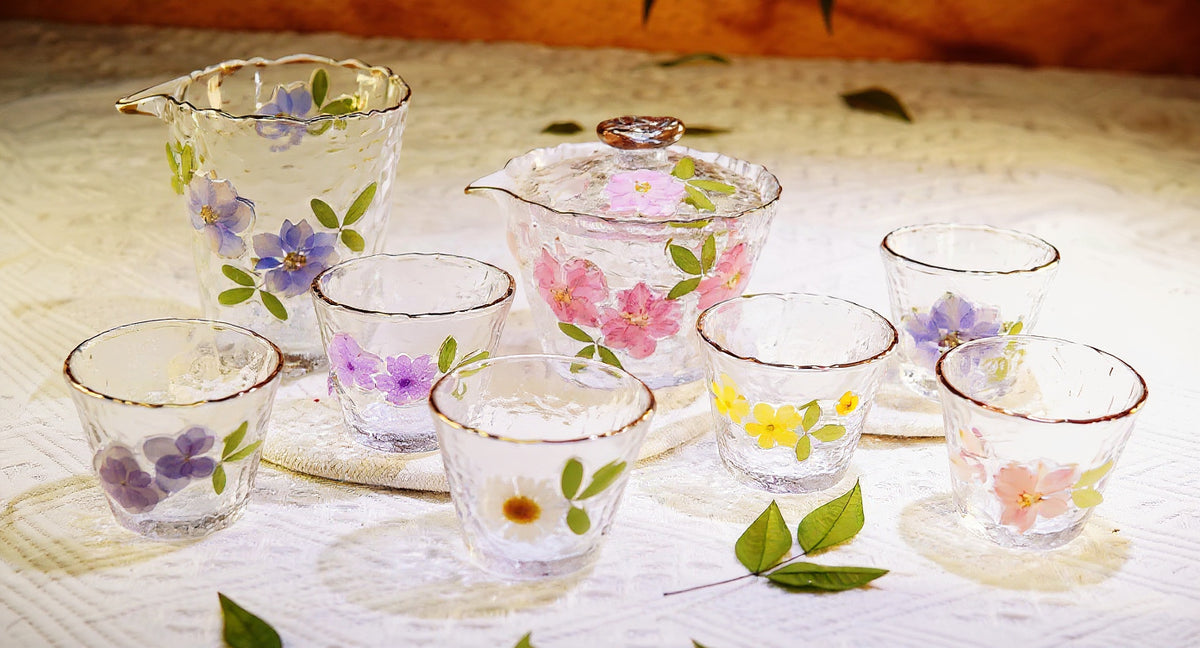
Choose a unique floral gaiwan and fair cup set by starting with brewing volume, then checking where the botanical decoration and resin sit in relation to the tea-contact surfaces. A 160 ml gaiwan paired with a 210 ml fair cup is a practical Gongfu format for small sessions, but it isn't automatically the right choice for every tea table.
The floral element should be treated as preservation craft, not as a substitute for sound tea ware. Real pressed flowers make every set individual, while borosilicate glass, sensible pouring capacity, a usable lid, and careful cleaning determine whether it earns a place in a regular tea routine.
Botanical preservation belongs outside the brewing path
Pressed-flower work is an old craft with modern applications. The basic method involves flattening and drying botanical material to preserve its form, as outlined in this reference on pressed flower craft. In tea ware, the important question isn't whether flowers are real. It is whether they are sealed securely and kept out of the path of hot tea.
A floral gaiwan works best when the decorative relief is an exterior detail, leaving the interior brewing surface smooth and easy to rinse. This matters because a gaiwan is handled constantly: lid lifted, leaves held back with the lid edge, liquor poured in short bursts, then the bowl rinsed before the next tea. Raised decoration inside the bowl would complicate that work. Exterior relief can add texture without trapping leaf dust or tea residue where it matters most.
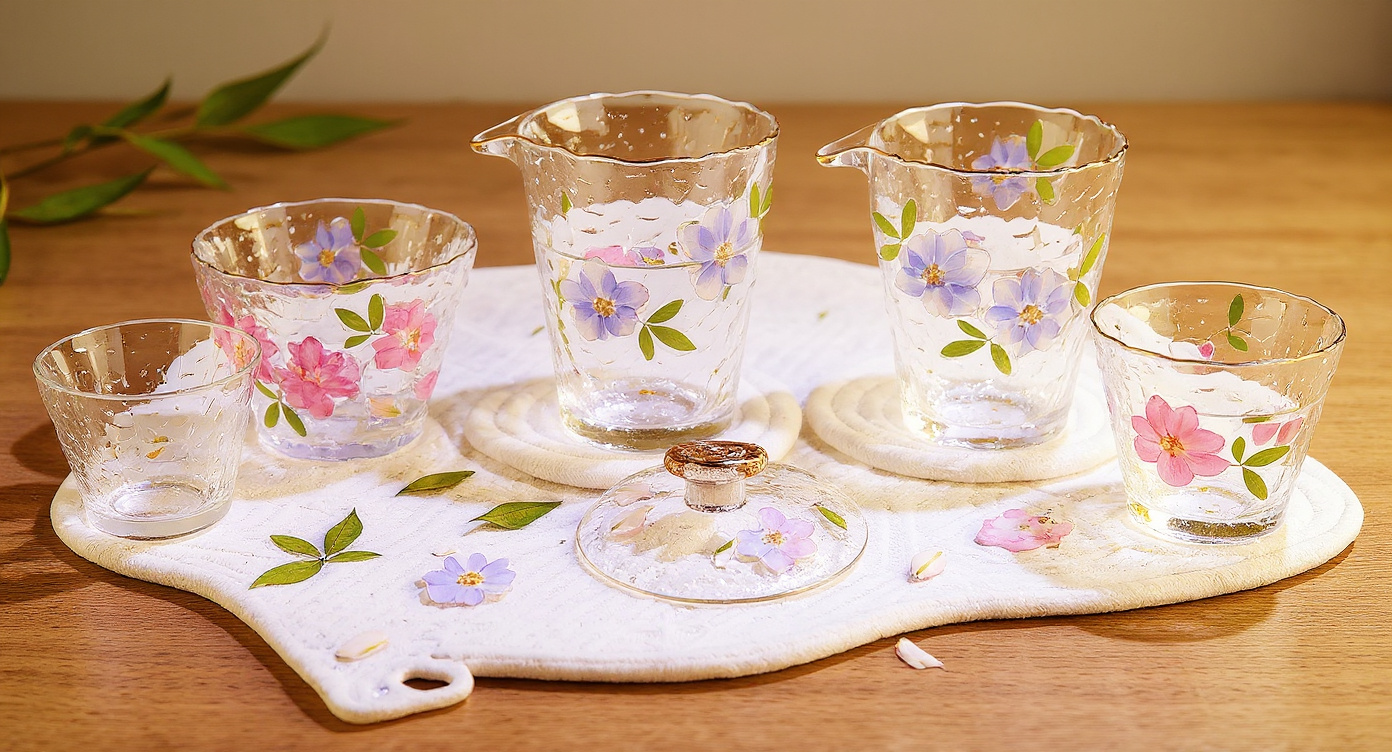
The Handmade Hammered Glass Tea Set Real Pressed Flowers | Gold Rim Gaiwan 8-Piece Gongfu Set uses real dried daisies, pansies, and cherry blossoms in a sealed exterior relief. The set is made from hammered borosilicate glass and includes one gaiwan, one fair cup, and six tasting cups. Each arrangement differs because natural flowers don't repeat precisely from one set to another.
That distinction has practical value for gifting. A printed floral pattern can be reproduced by the thousand. Preserved botanical material cannot be arranged in exactly the same way twice. For a wedding, housewarming, or tea-table gift, that individual variation is often more meaningful than a generic luxury finish.
Capacity decides whether the set will actually be used
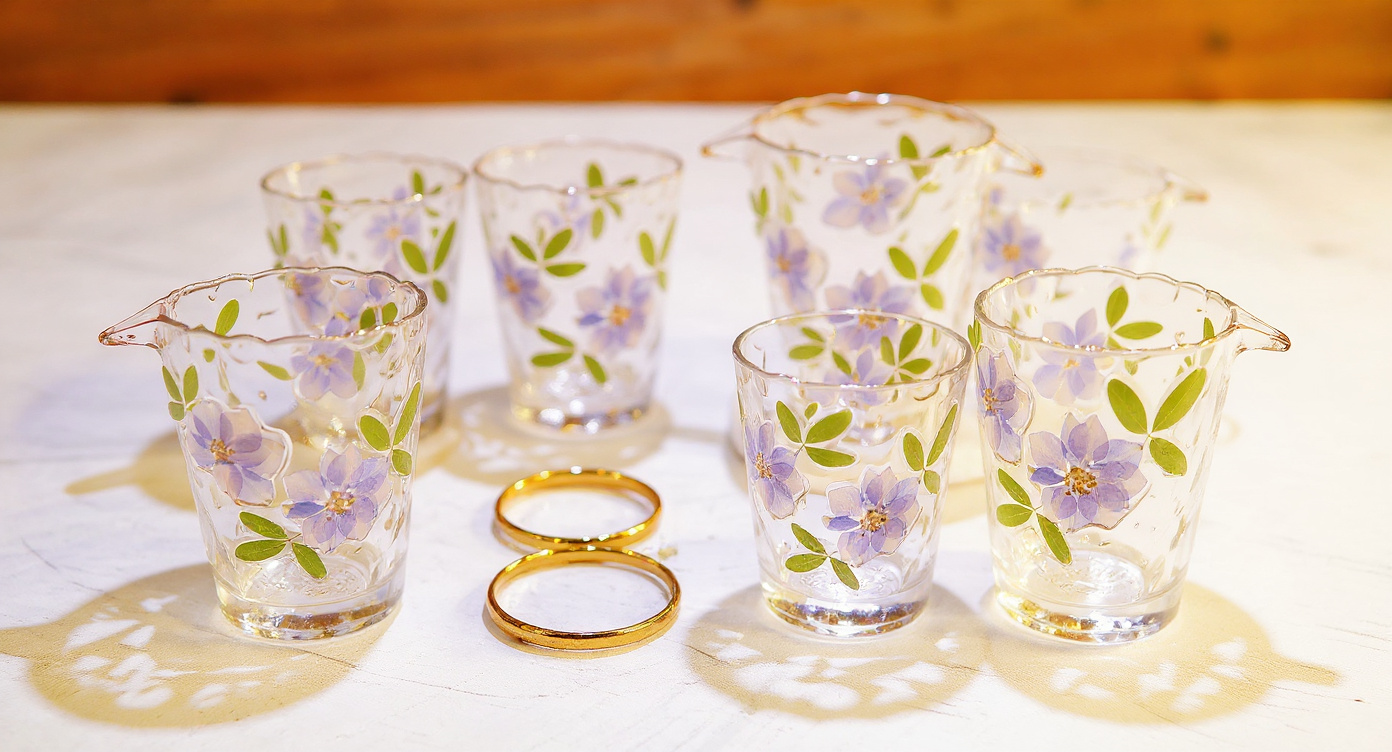
A 160 ml gaiwan is designed for focused Gongfu brewing, not for filling six cups to the brim in one pour. It will usually produce enough liquor for a small shared tasting, particularly when cups are filled partially and tea is brewed through several infusions.
Gongfu tea is built around repeated short steeps in a compact brewing vessel, followed by decanting into a shared pitcher. The Gongfu tea ceremony reference describes the style as a method centered on concentrated preparation and small cups. The fair cup, also called a cha hai or sharing pitcher, evens out the brew before serving so the first cup and last cup receive liquor of similar strength.
The numbers in this eight-piece format make sense together:
1. The gaiwan holds about 160 ml, enough for roughly 80 to 130 ml of finished tea after allowing room for leaves and the lid. 2. The fair cup holds about 210 ml, giving it a useful buffer over the gaiwan's stated capacity. 3. Six tasting cups hold about 50 ml each, for a total nominal cup capacity of 300 ml. 4. Six people can share a brew, but each person will receive a modest 15 to 25 ml pour from a single infusion. 5. A two-to-four-person session gives more generous pours while still making full use of the six cups over several rounds. 6. The larger fair cup prevents the usual annoyance of decanting a full gaiwan into a pitcher that's too small.
For solo tea, 160 ml is slightly larger than the 80 to 120 ml gaiwans many people choose for tightly controlled brewing. It can still work well with rolled oolong, white tea, floral black tea, and medium-leaf puerh, especially when the drinker wants enough liquor for two small cups per infusion. It is less ideal for a person chasing ultra-concentrated 60 to 80 ml sessions.
For a household that regularly serves four people, this is a capable format. The eight-piece pressed-flower Gongfu set has the right vessel sequence: brew in the gaiwan, decant into the 210 ml fair cup, then distribute across six 50 ml cups. No extra pitcher is needed.
Food-contact surfaces deserve more scrutiny than decorative claims
“Food safe” is often used loosely in decorative drinkware, so it needs unpacking. Food-safe resin is not the same claim as a general craft resin, and a food-safe ingredient designation is not automatically a blanket approval for every finished object, temperature, cure schedule, or use condition. The FDA explains the narrower meaning of generally recognized as safe, or GRAS, which concerns intended uses of substances in food rather than serving as a universal certification label for finished tea ware.
For this set, the maker specifies food-safe eco-resin sealing the pressed botanical relief. The more reassuring construction detail is that the flower relief is on the outer surface. Hot tea belongs against the glass interior, not against raised petals or decorative resin.
A careful buyer should still use ordinary good sense. Don't use any decorative glass set if resin has cracked, lifted, become sticky, or developed a rough damaged edge near a drinking surface. Don't soak it for hours in very hot water. Don't use abrasive pads around decorative areas. Resin can be suitable for a stated purpose and still be vulnerable to mechanical damage from harsh treatment.
Borosilicate glass is a sensible material for a hot-tea vessel because it is formulated with boron trioxide, giving it better resistance to thermal shock than ordinary soda-lime glass. The material's composition and heat-resistance characteristics are summarized in this borosilicate glass reference. Better thermal resistance does not mean indestructible. A hard knock against a stone sink, a chipped rim, or a sudden transition from refrigerator-cold glass to near-boiling water can still cause failure.
Gold-rimmed tea ware also needs a more conservative cleaning routine. Hand-painted rim work should be regarded as a finish requiring hand washing, not as a dishwasher-safe promise unless the seller specifically says so.
A premium floral set should be compared by function, not just decoration
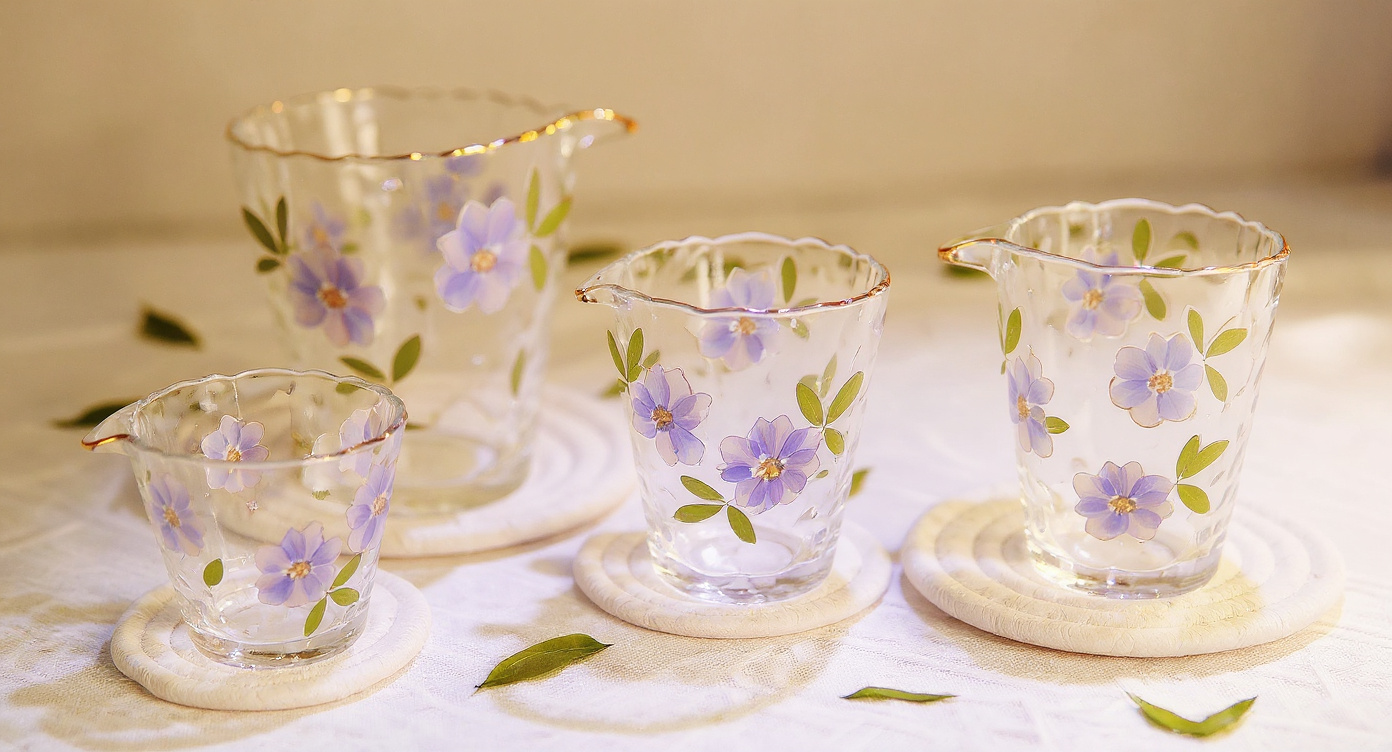
The market spans inexpensive ceramic sets, plain handmade glass, and highly decorative artisan pieces. Price alone is a poor guide because the contents vary dramatically. Some sets include only a gaiwan and two cups. Others include a tray, strainer, tea pets, or a larger serving pitcher. Compare vessel count, capacity, brewing material, and decorative technique before comparing totals.
| Set category | Typical contents or construction | Price information supplied | Main trade-off | |
|---|---|---|---|---|
| Mass-produced ceramic Gongfu set | Usually ceramic, often standardized patterns and vessel sizes | $30–$120 | Lower cost, but less transparency during brewing and less individual variation | |
| Handmade glass Gongfu set | Glass brewing vessels, configurations vary | $150–$350 | Better leaf visibility, though many sets do not include preserved botanicals | |
| Pressed-flower glassware on Etsy | Smaller handmade floral glass sets | $200–$500 | Decorative craft focus, but often fewer pieces than a full six-cup service | |
| Handmade Hammered Glass Tea Set Real Pressed Flowers \ | Gold Rim Gaiwan 8-Piece Gongfu Set | 160 ml gaiwan, 210 ml fair cup, six 50 ml cups, pressed-flower relief, food-safe eco-resin sealing | $114.264285714286 | Requires careful hand washing and isn't the best choice for rough daily handling |
The listed price sits well below the supplied range for many smaller pressed-flower glass sets. That makes the deciding factor less about status and more about intended use. Someone who wants a plain workhorse gaiwan for daily ripe puerh may be better served by an inexpensive porcelain bowl. Porcelain is easier to replace, less visually busy, and more forgiving if it chips.
A unique floral gaiwan and fair cup set is more likely to pay off when the ritual itself matters: shared tea, a display shelf, a gift with a personal feel, or a slower weekend brewing practice. It isn't the obvious pick for a crowded office kitchen, travel brewing, or a household where dishwashers and stacked cupboards are unavoidable.
Care habits that protect glass, flowers, and the gold rim
The set should be treated as hand-finished functional ware. That means using it often enough to enjoy it, while avoiding the cleaning and storage habits that shorten the life of decorative surfaces.
Start with warm water, not extreme temperature changes. Preheat the gaiwan with moderately warm water before brewing hot tea, especially if the set has been stored in a cool room. Empty it before the water goes cold. This reduces stress on the glass and makes residual tea easier to rinse away.
Use a soft sponge or microfiber cloth with mild dish soap. Tea oils can usually be removed without scrubbing powders, scouring pads, melamine sponges, or concentrated citrus cleaners. Those products may scratch glass and dull or wear hand-painted metallic rim work.
Avoid the dishwasher. Dishwasher heat, detergent concentration, water pressure, and contact with other dishes are all unnecessary risks for a gold-rimmed, resin-sealed floral set. Hand washing takes little time with a 160 ml gaiwan, 210 ml fair cup, and six small 50 ml cups.
Dry each piece with a soft cloth or leave it upright on a padded drying mat. Don't stack the tasting cups if their rims can touch. Don't place the gaiwan lid face-down on a hard counter. The lid knob and edge are the parts most likely to meet the table during a rushed tea session.
Storage matters too. A cabinet shelf lined with cork, felt, or a folded tea towel is safer than bare wood or stone. Keep the pieces away from direct, sustained sunlight if preserving the flower tones is a priority. Pressed flowers are organic material, and prolonged UV exposure can gradually reduce color intensity even when they are sealed.
FAQ
What is a gaiwan and a fair cup used for?
A gaiwan is a lidded brewing bowl used to steep tea leaves and control the pour. The lid holds leaves back while tea is poured. A fair cup receives the brewed tea before serving, which helps equalize strength and temperature across the tasting cups. The basic form of the gaiwan is described in this gaiwan reference entry.
Can you use a glass gaiwan for Gongfu tea?
Yes. Glass gaiwans work well for Gongfu tea because they make leaf expansion and liquor color easy to observe. Borosilicate glass is particularly appropriate for hot tea, though it can feel hotter in the hand than thick porcelain. Use a confident lid grip, avoid filling to the absolute rim, and preheat gently rather than shocking cold glass with boiling water.
Does a 160 ml gaiwan serve six people?
It can serve six people in a tasting format, but not with six full 50 ml cups from one infusion. A 160 ml gaiwan typically yields enough liquor for six small shared pours of about 15 to 25 ml after accounting for leaves and brewing headspace. For fuller servings, brew multiple short infusions and refill each cup in rotation.
Are pressed flowers in resin food safe?
They can be suitable when a maker uses a properly cured resin intended for the stated food-contact application. The Handmade Hammered Glass Tea Set Real Pressed Flowers | Gold Rim Gaiwan 8-Piece Gongfu Set specifies food-safe eco-resin sealing its floral relief. Because the flowers are arranged on the exterior, the hot tea is not intended to brew directly against the botanical decoration. Stop using decorative ware if the resin becomes damaged or detached.
Do pressed flowers fade in glass?
They can fade gradually with long-term UV exposure. Sealing slows exposure to air and handling, but no natural botanical material should be expected to remain unchanged after years in strong direct sunlight. Store the set away from sunny windows and use gentle cleaning methods to preserve the finish.
How do you clean a gaiwan with a gold rim?
Wash it by hand with warm water, mild dish soap, and a soft cloth or sponge. Avoid dishwasher cycles, abrasive powder, steel wool, scouring pads, and harsh chemical cleaners. Dry the rim carefully rather than leaving it in standing water or stacking it against other cups.
Is glass tea ware safe to ship?
Glass tea ware can ship safely when each part is individually protected, immobilized inside the carton, and separated from other pieces. No glass item is immune to carrier damage, so inspect the package promptly after delivery. Photograph any visible carton damage before opening, retain the packing materials, and follow the seller's stated damage-reporting process if a piece arrives cracked or chipped.
The right set for a slower tea table
The real hesitation with floral glass tea ware is reasonable: glass can break, natural flowers need protection, and resin claims deserve a closer look. A set like this makes the most sense for someone who will hand wash it, keep it out of harsh sunlight, and use its 160 ml brewing capacity for intentional small-group tea rather than rough everyday service.
For that kind of tea ritual, the Handmade Hammered Glass Tea Set Real Pressed Flowers | Gold Rim Gaiwan 8-Piece Gongfu Set brings together a 210 ml fair cup, six 50 ml tasting cups, borosilicate glass, and individually preserved floral work without asking the tea drinker to assemble a ceremony piece by piece. Those concerned about fragility or long-term care can see the complete pressed-flower tea set and decide whether its hand-finished construction fits the way tea is actually served at home.