
Handcrafted Glass Cup for Fruit Drinks and Tea
By pampasroom, founder of Pampasroom · 8+ years working directly with Southeast Asian rattan and glass artisans · Product design research informed by ISO 3585 borosilicate glass standards and food-grade resin compliance documentationA handcrafted glass cup for fruit drinks and tea built from borosilicate glass withstands thermal differentials of 150°C or more—a specification defined by ISO 3585, the international standard governing borosilicate glass composition and performance. The key differentiator isn't aesthetics alone. It's the combination of verified thermal resistance, real preserved roses hand-embedded in raised relief on the exterior surface, and a complete set ecosystem—matching saucer, dust-proof lid, and glass straw—that separates genuine artisan pieces from mass-produced imitations. A complete handcrafted glass cup for fruit drinks and tea set typically ranges from $50 to $150 for mid-tier artisan work, with complexity and materials determining final pricing.
Why Borosilicate Glass Changes Everything for Hot and Cold Beverages
Borosilicate glass contains 10–15% boric oxide by weight. That single compositional fact changes how the material behaves under thermal stress. According to Wikipedia's entry on borosilicate glass, borosilicate expands only one-third as much as standard soda-lime glass when heated—a property that directly prevents the micro-fractures that cause ordinary glassware to shatter when temperatures shift. Pour hot tea at 85°C into a borosilicate handcrafted glass cup for fruit drinks and tea, then follow immediately with ice water. The glass holds. That's not marketing language—it's a measurable thermal expansion coefficient of approximately 3.3 × 10⁻⁶/K, compared to soda-lime glass at roughly 9 × 10⁻⁶/K, a difference documented by borosilicate manufacturer Schott AG in their DURAN product technical data sheets.
The 400ml capacity is the practical sweet spot for most tea and fruit drink servings. Large enough for a full cup. Small enough that cold drinks stay cold before you finish. The transparency of a quality handcrafted glass cup for fruit drinks and tea also showcases layered fruit-infused waters and gradient cold brews in a way opaque ceramics simply cannot, while the thin walls keep heat transfer to hands comfortable for both hot and cold contents.
Here's what the thermal performance data actually looks like when comparing glass types side by side:
| Property | Borosilicate Glass | Soda-Lime Glass | Ceramic |
|---|---|---|---|
| Thermal expansion coefficient | ~3.3 × 10⁻⁶/K | ~9 × 10⁻⁶/K | ~5–7 × 10⁻⁶/K |
| Safe temperature differential | 150°C+ | 30–50°C | 150°C+ (unglazed) |
| Flavor neutrality | Completely non-reactive | Completely non-reactive | Depends on glaze |
| Clarity for visual presentation | High | High | None |
| Weight for 400ml cup | Light (approx. 180–220g) | Light | Heavy (approx. 350–500g) |
| Dishwasher safe (base glass only) | Yes | Yes | Usually yes |
Contrarian note that most buying guides won't tell you: if you run a dishwasher at temperatures above 70°C and plan to wash your handcrafted glass cup for fruit drinks and tea with the resin floral elements in it, the piece will degrade faster than the manufacturer's estimate regardless of how premium the resin is. Hand wash only. That's not a flaw—it's an honest maintenance reality for any resin-decorated drinkware.
Real Preserved Flowers vs. Printed Designs: The Craftsmanship Difference
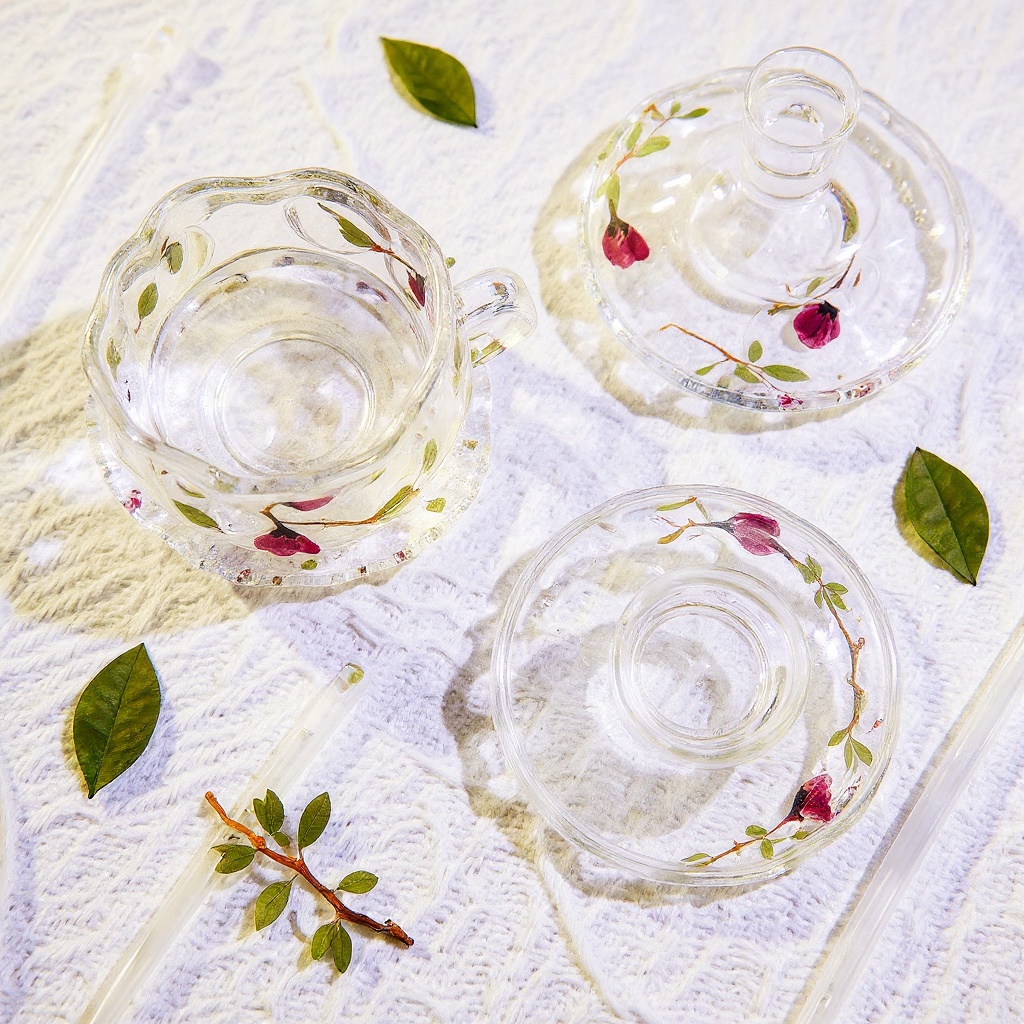
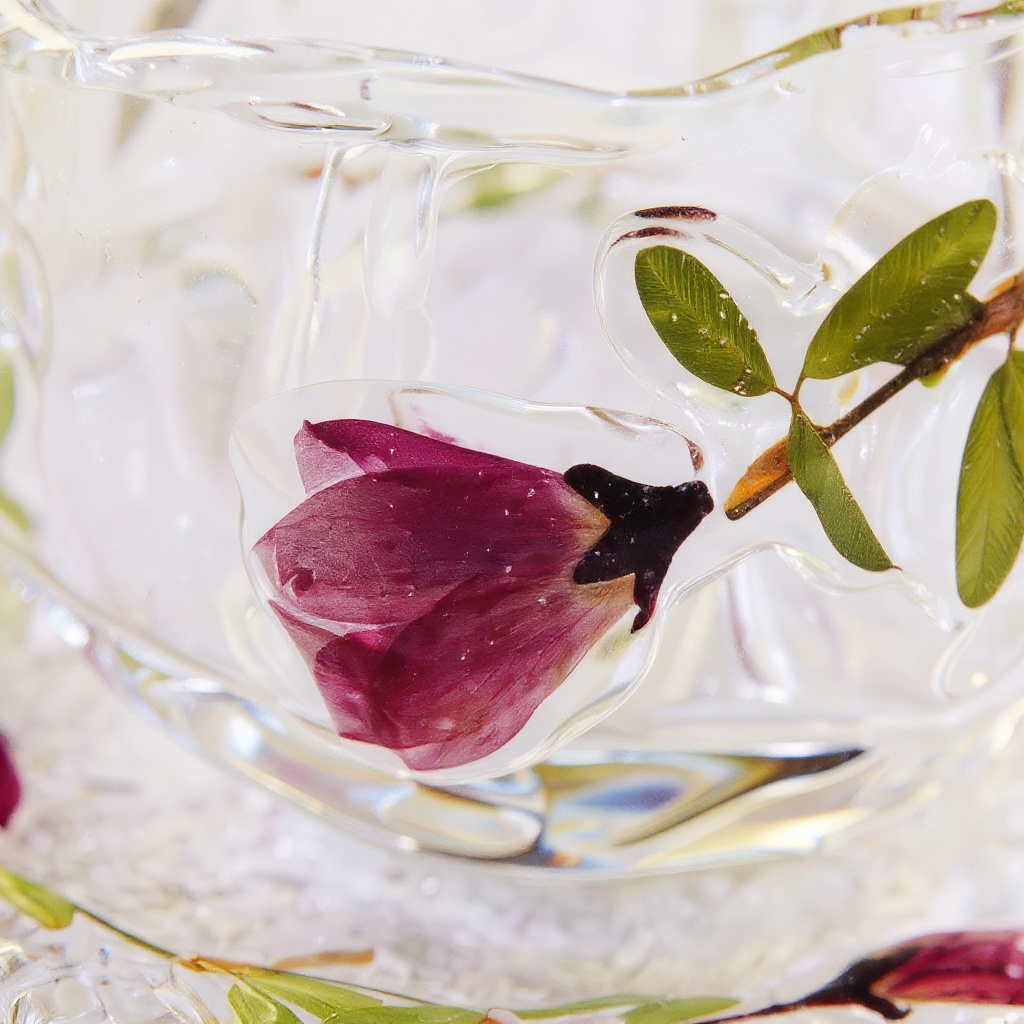
Authentic preserved flower craftsmanship involves a multi-step glycerin treatment process, color stabilization, and careful hand-placement of individual petals within food-grade eco-resin during the glass finishing stage. Each handcrafted glass cup for fruit drinks and tea requires a minimum of three working days to complete—one day for flower preparation and positioning, one day for initial resin pour and cure, and one day for final surface finishing and quality inspection. The result is tactile raised relief on the outer surface. You can feel the petal edges when you hold the cup.
Mass-produced versions use screen-printed or heat-transfer floral motifs. Flat. Fadeable. Gone within 12 months of regular washing. The raised relief on a genuine handcrafted glass cup for fruit drinks and tea cannot be replicated by printing—it's a physical dimensional difference, not a subjective quality judgment.
| Feature | Handcrafted Preserved Flower | Mass-Produced Printed Motif |
|---|---|---|
| Tactile texture | Raised relief, physically felt | Flat surface only |
| Color source | Naturally preserved pigments | Synthetic inks |
| Longevity estimate | 5+ years under indoor UV conditions | 6–18 months before visible fading |
| Uniqueness | Each piece varies slightly | Batch-identical |
| Minimum production time | 3 days per piece | Hours per batch |
| Price range | $50–$400 | $12–$45 |
| Food contact risk | Resin on exterior only—no contact | Ink on exterior only—no contact |
Our Handcrafted Glass Teacup Saucer Set with Real Preserved Roses places real pink and red roses in raised relief on the exterior surface. Not printed. Not painted. Embedded.
How to Verify Handcrafted vs. Mass-Produced Glass: 5 Steps
Not every product labeled "handcrafted" actually is. Here's a concrete verification process for any handcrafted glass cup for fruit drinks and tea before purchasing:
1. Run your finger across the floral surface. Genuine raised relief has dimensional texture—your fingertip should catch on petal edges. A printed design feels uniformly smooth regardless of the visual detail. 2. Ask for the production timeline. Authentic artisan pieces take 3+ days per unit minimum. Any manufacturer claiming same-day or next-day production at scale is producing machine-assisted work, not hand-finishing. 3. Request the resin specification. Legitimate sellers can name the resin product or cite FDA compliance documentation. Vague phrases like "eco-friendly resin" without a specific standard cited are a warning sign. 4. Examine photos for batch variation. Real handcrafted pieces show slight differences between units—petal placement, minor color variation, small differences in relief height. Identical-looking units across dozens of product photos suggest mold production. 5. Check the base glass specification. Borosilicate should be explicitly stated, not implied. "Heat-resistant glass" without specifying borosilicate may mean tempered soda-lime glass, which has a lower thermal differential tolerance.
The Complete Set: Glass Straws, Lids, and Matching Saucers
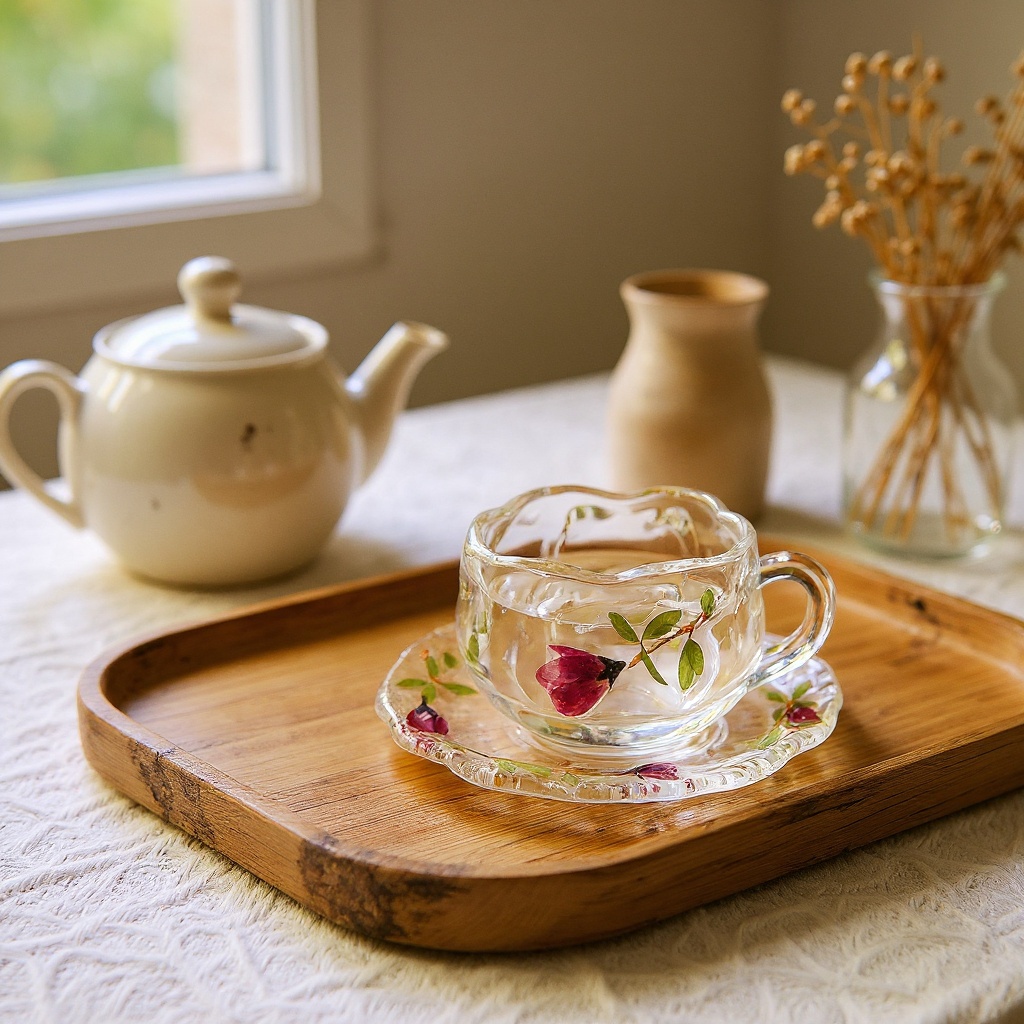
A complete handcrafted glass cup for fruit drinks and tea set includes more than the vessel itself. Quality sets come with a matching saucer, a dust-proof lid, and a reusable glass straw. The glass straw diameter typically measures 8–10mm—wide enough for smoothies and bubble tea, narrow enough for standard beverages, and transparent enough to show when cleaning is complete.
The saucer does three jobs simultaneously. It protects surfaces from condensation and heat transfer. It provides a resting place for the glass straw between sips. It creates visual balance in the presentation that a lone cup lacks. For tea culture traditions that emphasize the full ritual of preparation and serving, this completeness matters beyond aesthetics.
The dust-proof lid maintains beverage temperature and prevents contamination for fruit drinks with pulp or loose-leaf teas that continue steeping. A lidded handcrafted glass cup for fruit drinks and tea also makes the piece viable for desk use, travel to a nearby workspace, or outdoor table settings where insects are a concern. Complete sets eliminate the sourcing problem of trying to match accessories separately—and separate sourcing almost never achieves the same visual cohesion.
Material Safety and Food-Grade Standards
The eco-resin used in quality handcrafted glass cup for fruit drinks and tea production is applied exclusively to exterior surfaces. No resin contacts the interior of the drinking vessel or the rim. This design choice is not incidental—it's a deliberate separation of decorative and functional surfaces that maintains complete food safety compliance.
Properly cured food-grade resin meets FDA 21 CFR (Code of Federal Regulations) standards for indirect food contact materials when fully polymerized. The curing process requires 24–48 hours at controlled temperatures—incomplete curing is the primary risk factor for any potential chemical migration, which is why production timeline matters. A rushed 12-hour cure is not equivalent to a verified 48-hour cure under controlled temperature conditions.
Borosilicate glass itself is completely non-reactive. No metallic taste. No flavor absorption. No chemical leaching. The tea culture emphasis on material purity has a measurable basis here—borosilicate glass preserves the true taste profile of high-quality teas and fruit-infused drinks without the mineral interference that can occur with some unglazed ceramics.
Top 5 safety features to verify before purchasing any handcrafted glass cup for fruit drinks and tea:
1. Lead-free borosilicate certification — Request documentation, not just a label claim. 2. ISO 3585 or equivalent thermal shock resistance rating — Should confirm 150°C+ differential tolerance. 3. FDA 21 CFR or CE-compliant resin specification — For exterior decorative elements only. 4. Smooth rim finish inspection — No sharp edges, chips, or rough grinding marks. 5. Stable base geometry — Flat base with adequate diameter-to-height ratio prevents tipping with varying liquid densities.
Care Instructions That Preserve the Investment
Handcrafted glass cups for fruit drinks and tea require deliberate care to maintain both function and beauty. Hand wash only, using lukewarm water and mild pH-neutral dish soap. Avoid temperature-shocking the piece during cleaning—don't rinse a hot cup under cold tap water immediately after use. The glass can handle it; the resin bond over years of thermal cycling is the variable worth protecting.
The flower preservation process used in quality pieces—glycerin treatment followed by resin encapsulation—creates stable, colorfast results under normal indoor lighting. Direct UV exposure over months accelerates color shift in any preserved botanical material. Keep the handcrafted glass cup for fruit drinks and tea away from south-facing windowsills with prolonged daily sun exposure.
For daily maintenance, a simple three-step process:
1. Rinse immediately after use to prevent tannin staining from tea or fruit juice pigment buildup on interior walls. 2. Clean the glass straw with a pipe cleaner or included brush after every use—residue inside a narrow tube harbors bacteria faster than an open vessel. 3. Dry the exterior resin surface completely before storage, especially if the cup sits inside a cabinet where trapped moisture could affect the resin-glass bond over extended periods.
A baking soda paste removes stubborn interior staining without scratching the glass surface. Use a soft cloth. Not a scouring pad. Ever.
Gifting Appeal and the Photography Factor
A handcrafted glass cup for fruit drinks and tea at the $50–$150 price point occupies a specific gifting position: substantial enough to feel considered, accessible enough not to create obligation. The preserved rose design appeals to a wide recipient demographic while remaining specific enough to feel intentional rather than generic.
The transparent walls showcase beverage color and layering for content creation. Pink hibiscus tea. Layered citrus water. Golden turmeric drinks. All photograph with more visual depth in a borosilicate handcrafted glass cup for fruit drinks and tea than in ceramic or metal alternatives. The floral relief adds foreground texture in flat lay compositions without requiring additional props.
Boutique cafés increasingly use artisan glassware for signature drink service. The tactile and visual differentiation supports premium beverage pricing—a drink served in a handcrafted glass cup for fruit drinks and tea communicates care about the guest experience in a way that a standard commercial glass does not.
Conclusion
A genuine handcrafted glass cup for fruit drinks and tea combines ISO 3585-compliant borosilicate thermal performance with real preserved rose craftsmanship that takes a minimum of three days to produce per piece. The tactile raised relief, complete set ecosystem, and food-safe material separation between decorative resin and drinking surfaces justify the price premium over mass-produced printed alternatives. Not every piece labeled handcrafted meets these standards. The verification steps above exist for that reason.
When you're ready to invest in a handcrafted glass cup for fruit drinks and tea that functions as both daily drinkware and decorative art, browse our Handcrafted Glass Teacup Saucer Set with Real Preserved Roses. Each complete set includes the cup, matching saucer, dust-proof lid, and glass straw—every element of the beverage ritual, cohesive by design.
Frequently Asked Questions
Is borosilicate glass safe for both hot tea and iced drinks in the same handcrafted glass cup for fruit drinks and tea?Yes. Borosilicate glass has a thermal expansion coefficient of approximately 3.3 × 10⁻⁶/K, compared to soda-lime glass at roughly 9 × 10⁻⁶/K—a difference documented in Schott AG's DURAN technical data sheets and covered under ISO 3585 standards. This low expansion rate allows the glass to handle temperature differentials of 150°C or more without micro-fracturing. You can pour hot tea at 85°C and follow with iced beverages without cracking risk.
How long do real preserved roses in eco-resin actually last on a handcrafted glass cup for fruit drinks and tea?Glycerin-treated preserved roses encapsulated in fully cured food-grade resin maintain color and structural integrity for approximately 5 or more years under normal indoor conditions—meaning no prolonged direct UV exposure and no dishwasher use. UV exposure is the primary degradation factor for any preserved botanical material; a piece kept away from south-facing windows will outlast one placed in direct daily sunlight significantly. Durability claims beyond 5 years exist in the market but lack independent testing data.
Can I put a handcrafted glass cup for fruit drinks and tea with resin flowers in the dishwasher?No. Hand washing only, with lukewarm water and mild soap. Dishwasher temperatures above 70°C, combined with harsh detergent chemistry, accelerate resin degradation and can compromise the bond between the resin layer and the glass exterior over repeated cycles. The base borosilicate glass is dishwasher-safe on its own—the decorative resin element is the constraint.
What is the difference between preserved roses and dried roses embedded in glass drinkware?Preserved roses undergo glycerin treatment that replaces cellular water content with glycerin, maintaining pliability, color, and dimensional structure. Dried roses lose moisture completely, becoming brittle and prone to color fading within months. In a resin application, glycerin-preserved roses hold their petal shape and pigment under encapsulation far longer than dried alternatives, which can become visibly brown or fragile within one to two years.
Are glass straws included in artisan sets genuinely safer than plastic straws?Borosilicate glass straws offer complete flavor neutrality—no plastic taste transfer, no metal ion flavor—and full cleaning visibility so you can confirm the straw interior is clear. They are more fragile than stainless steel alternatives; dropping a glass straw on tile typically ends its lifespan. For stationary home or café use, glass straws are the cleanest-tasting option. For travel or bags, stainless steel is more practical.
Is the eco-resin on the outside of a handcrafted glass cup for fruit drinks and tea food-safe?When cured to FDA 21 CFR standards for indirect food contact and applied only to exterior surfaces with no contact to the rim or interior drinking surface, properly specified eco-resin poses no food safety concern. The critical variables are cure completeness (48 hours at controlled temperature) and application placement (exterior only). Request FDA 21 CFR or CE compliance documentation from any seller making food-safety claims about their resin.
What is a realistic price range for a genuine artisan handcrafted glass cup for fruit drinks and tea with real flowers?Authentic handcrafted glass cup for fruit drinks and tea sets with real preserved roses typically range from $50 to $150 for quality mid-tier artisan work. Sets priced below $40 with flower elements are almost universally mass-produced with printed or artificial motifs rather than genuine preserved botanicals embedded in raised relief. Premium European-sourced artisan pieces can reach $300 to $600 depending on provenance and complexity.
How do I identify whether a 'handcrafted' glass cup for fruit drinks and tea is genuinely hand-finished or just marketed that way?Five concrete indicators: tactile raised relief you can feel with a fingertip (not smooth printed surface); documented 3+ day production timeline per piece; named resin specification with FDA or CE compliance cited; visible slight variation between individual units in product photography; and explicit borosilicate glass specification rather than generic "heat-resistant glass" language. If a seller cannot provide the resin name or production timeline, treat the "handcrafted" claim as unverified marketing copy.