































Vintage European Floral Glass Tumblers Explained
Vintage European Style Floral Glass Tumbler: History, Craft & Everything Explained
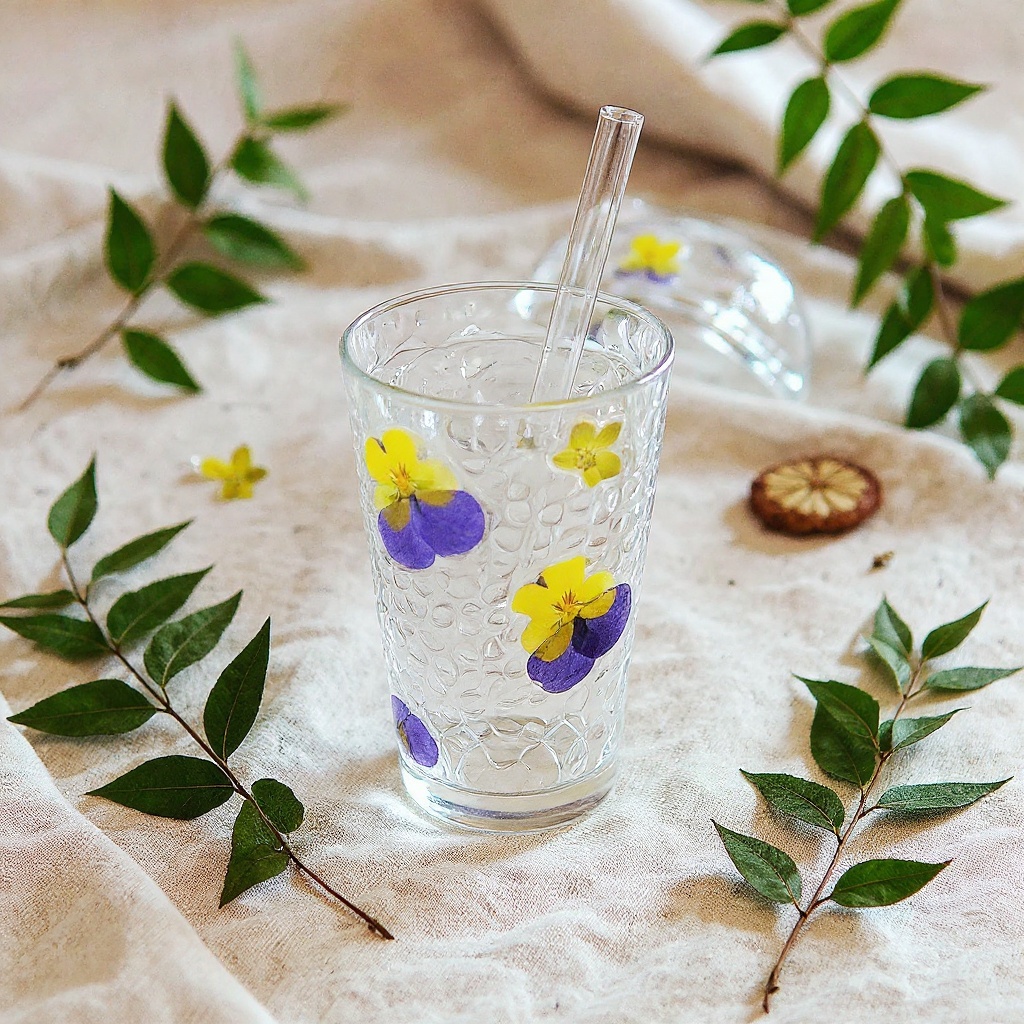
By pampasroom, founder of Pampasroom · 8+ years sourcing and studying handcrafted botanical artisan goods across Southeast Asia and Europe · Contributor to Botanical Living Quarterly and The Slow Home JournalA vintage european style floral glass tumbler is a clear glass drinking vessel with real dried flower petals and green leaves raised directly onto the exterior glass surface in three-dimensional relief — not printed, not painted, not decal-applied. You can feel the petals. That tactile quality is the entire point. Each cup typically holds 400ml, pairs with a matte dust-proof lid and a clear glass straw, and presents a warm cottagecore or airy botanical aesthetic that photographs beautifully on linen or marble. Here is what defines one, how it is made, and what separates the genuine article from the flood of imitations.
At a glance: - Real dried petals and leaves fused to exterior glass — raised, touchable, three-dimensional - 400ml capacity with dust-proof lid and clear glass straw included - Yellow and blue floral tones most common; no two pieces identical - Aesthetic category: cottagecore, botanical flat-lay, airy bright styling - Craft origin: European botanical decorative arts traditions, adapted into contemporary handmade drinkwareWhat Defines a Vintage European Style Floral Glass Tumbler?
The definition is precise. It is not a glass with a flower motif. It is not a printed botanical pattern. A genuine vintage european style floral glass tumbler has physical, raised botanicals — actual dried petals, actual leaf fragments — that are embedded into or fused onto the exterior glass wall so they protrude from the surface in three dimensions. Run your finger across the outside. You feel bumps, ridges, the curved edge of a petal. That is the test.
The "vintage European" framing refers to an aesthetic language borrowed from 19th- and early 20th-century European decorative glass traditions, particularly the German and Austrian Jugendstil and British Arts and Crafts movements, which championed nature-derived ornament on functional objects. Contemporary makers draw on this visual heritage — the soft botanical palette, the romantic relationship between glass clarity and organic matter — rather than claiming direct lineage to specific historical workshops. Honest disclosure: much of what circulates as "ancient technique" in product copy is marketing language. The aesthetic is genuinely European in inspiration; the craft execution today is primarily based in skilled artisan workshops across East and Southeast Asia.
How a Pressed Flower Glass Tumbler Is Actually Made
The production process involves more steps than most buyers realize. Each one matters.
1. Botanical selection and drying. Artisans select flower heads, individual petals, and leaf cuttings. These are dried using silica gel or air-drying methods that preserve color and structural integrity without making petals brittle. Yellow blooms — marigold, chrysanthemum, small sunflower varieties — and blue flowers like larkspur or bachelor's button are most commonly chosen for their color stability. 2. Glass base forming. The clear glass tumbler is blown or mold-formed from borosilicate glass, chosen for its lower thermal expansion coefficient compared to standard soda-lime glass. 3. Botanical application to exterior surface. Dried botanicals are arranged on the outer wall and fixed using a clear resin or secondary glass layer. This is the critical distinction: the flowers sit on the exterior surface in raised relief, encased and protected, not floating inside the glass walls. The result is a surface you can feel but cannot scratch the flowers from in normal handling. 4. Sealing and curing. A protective clear coat or additional glass layer locks the botanicals in place. This layer must be food-safe on any interior-facing surfaces, though the botanicals themselves are always on the exterior. 5. Finishing and quality check. Each piece is examined for bubble inclusions, unintended gaps in the botanical layer, and structural integrity. Lids are fitted; straws are matched.
No two pieces come out identical. The flowers shift slightly during application. Petals break at different points. This is not a defect. It is evidence.
Vintage European Style Floral Glass Tumbler vs. Printed Alternatives
| Feature | Vintage European Style Floral Glass Tumbler | Printed Floral Glass |
|---|---|---|
| Surface texture | Raised, 3D — petals physically protrude | Completely flat |
| Flower material | Real dried botanicals | Ink or decal image |
| Uniqueness | No two identical — hand-placed | Thousands of copies from same template |
| Tactile experience | Fingertips feel petal edges and ridges | Smooth throughout |
| Durability of design | Sealed under clear layer; does not peel | Ink can fade; decals lift at edges |
| Price range | $45–$180 for contemporary handmade | $12–$35 |
| Aesthetic category | Cottagecore, botanical art, slow living | Generic giftware |
Price note: The $200–$800 figures sometimes cited for vintage botanical glass refer to antique auction results for 19th-century European decorative glass at specialist auction houses such as Rago Arts or Bonhams — a different category entirely from contemporary handmade drinkware. Contemporary pieces sit at $45–$180. Do not conflate the two markets.
What Differentiates the Yellow and Blue Floral Versions
Color choice is not purely aesthetic. It reflects flower selection, which affects the texture profile of the finished piece.
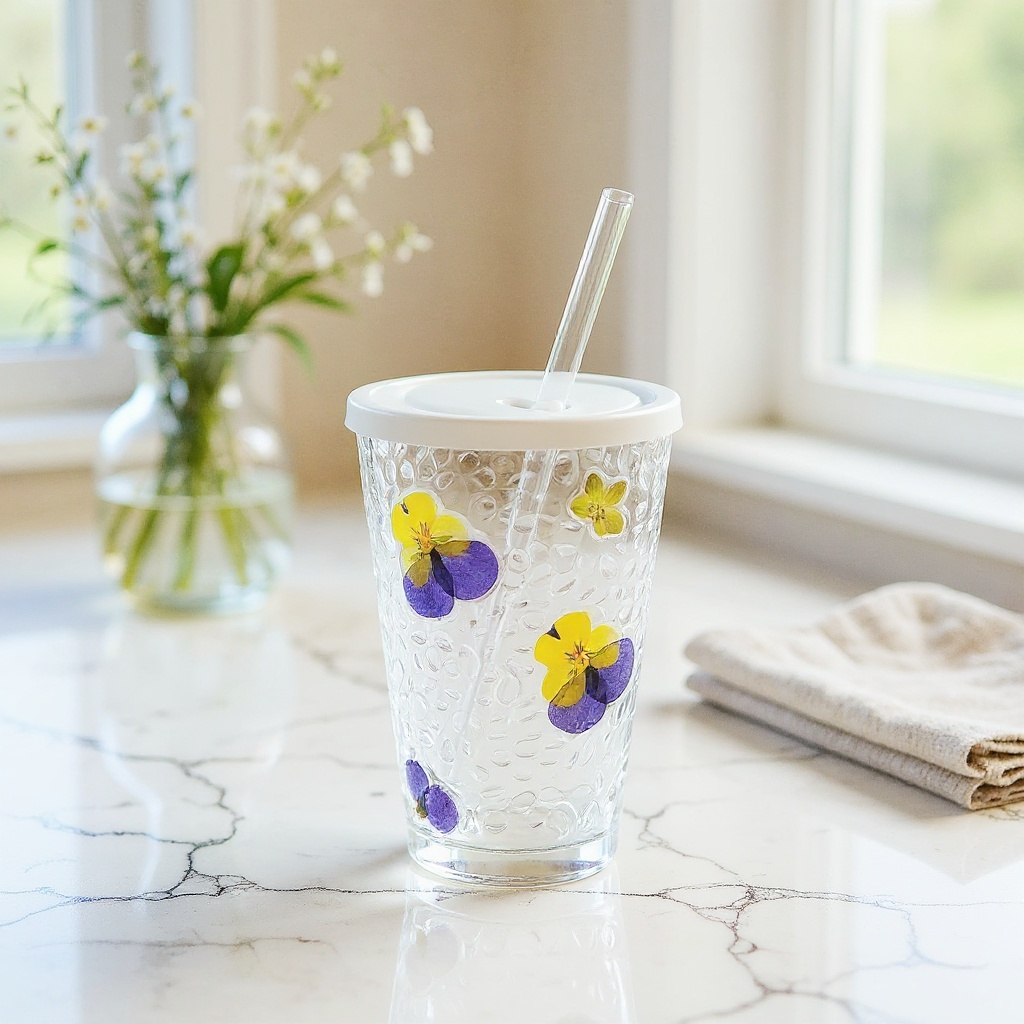
Yellow floral tumblers typically use marigold petals, pressed chamomile heads, or small chrysanthemum varieties. These flowers have layered, multi-petal structures that create more complex surface topography — more ridges, more depth variation when you run a finger across the glass. The warm golden tones photograph well against cream linen and aged marble in flat-lay compositions. Blue floral tumblers most often feature larkspur, delphinium petals, or bachelor's button. These have flatter individual petals with more graphic, defined edges. The result is a cleaner visual line and a slightly smoother raised texture. Cool-toned botanicals contrast against warm backgrounds. Striking on white marble. Different mood entirely.Some sets include both color families. Displayed together, the contrast between warm and cool botanical palettes is one of the more genuinely beautiful things a glass tumbler can do on a shelf.
The Lid and Straw: Why They Matter More Than They Should
The matte dust-proof lid is not decorative afterthought. Practical function first. It keeps surface dust off the rim between uses, which matters when the cup is displayed rather than stored in a cabinet. The matte finish on the lid reads as intentionally understated — it does not compete with the botanical surface detail beneath it. A glossy lid would be wrong aesthetically. The choice of matte is considered.
The clear glass straw is structural to the visual identity of this product. A metal straw changes the aesthetic completely. A paper straw reads as disposable and undercuts the artisan positioning. Clear glass maintains the visual continuity — the transparency carries through from tumbler to straw, keeping the botanical surface as the only visual interruption. Glass straws are also reusable, dishwasher-safe in most cases, and do not leach anything into the beverage.
Honest statement most product articles will not say: if you are the type of person who loses or breaks small accessories regularly, glass straws will frustrate you. They are fragile in ways a silicone or metal straw is not. Know yourself.
Identifying Authentic Botanical Embedding vs. Resin Imitation
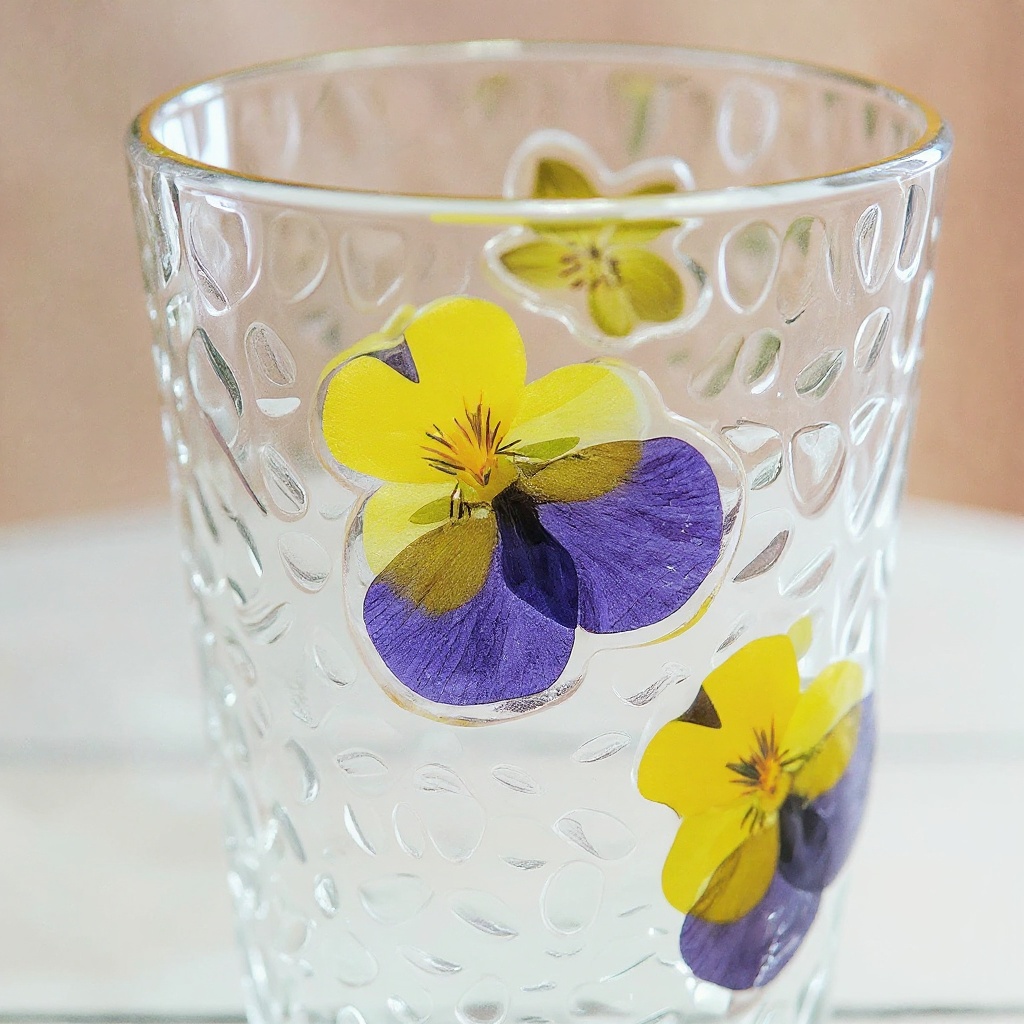
Not all raised-texture floral glasses use real botanicals. Some use resin molds with artificial flower shapes cast into a polymer layer applied to the glass exterior. Here is how to tell the difference:
- Color variation within a single petal. Real dried flowers have subtle tonal variation — a petal is not one flat color. Resin casts tend toward uniform color fill. - Irregular edges. Real petals have torn, irregular, or naturally curved edges. Molded resin produces crisp, consistent outlines. - Translucency. Thin real petals allow some light transmission. Opaque raised texture suggests polymer casting. - Imperfect placement. Hand-placed real botanicals sit at slightly varying angles and heights. Patterned resin repeats exactly.
The difference matters for more than authenticity. Real botanicals sealed in a food-safe clear layer perform differently — they age differently, interact with light differently, and carry a material honesty that affects how the object feels to own.
Caring for a Botanical Glass Tumbler Without Destroying It
Hand washing only. Every time. Non-negotiable.
The reasoning: dishwasher heat cycles — typically 140–160°F in the wash phase — do not crack the glass, but the prolonged moisture exposure combined with alkaline detergent chemistry degrades the seal around the botanical layer over time. The flowers yellow. The clear coat clouds at the edges. You will not notice it happening until it has already happened.
For daily cleaning: lukewarm water, a drop of mild dish soap, a soft cloth. Do not use abrasive scrubbers near the raised botanical areas. For mineral buildup from hard water, a 15-minute soak in a solution of one part white vinegar to three parts water clears deposits without affecting the botanical layer.
Storage: wrap pieces individually in soft cloth if stacking or transporting. Glass-on-glass contact at raised botanical points creates leverage that can chip the surrounding clear layer. The lid, when not in use, protects the rim from dust and impact. Use it as intended.
Direct sunlight over months will fade real flower pigments. Yellows hold longer than blues in UV exposure. Display near natural light for the aesthetic — just not in a south-facing window with six hours of direct sun daily.
Botanical Glass in the Cottagecore Flat-Lay Aesthetic
This matters if you style products or curate a visual-forward living space.
The vintage european style floral glass tumbler is a natural object for botanical flat-lay photography because it brings three visual qualities simultaneously: transparency (the glass itself), texture (the raised petals), and color (the flower tones). Most props bring one or two of these. This brings all three.
Styling notes that work: - Linen fabric backdrops in undyed cream or sage — the texture echoes the botanical surface - White or aged grey marble — the coolness contrasts with warm yellow florals specifically - Dried pampas, eucalyptus sprigs, or pressed flowers as surrounding props — the tumbler becomes part of a botanical scene rather than a standalone product - Soft side lighting rather than overhead flash — angled light catches the raised petal edges and shows the three-dimensional quality that makes this object worth photographing
Overhead flat lighting erases the raised texture entirely. The piece looks flat and uninteresting. Wrong light is the most common styling mistake made with these glasses.
Where This Fits in the Handmade Drinkware Market
The handmade pressed flower glass tumbler occupies a specific position: it is functional art priced above everyday glassware but below gallery ceramic or studio blown glass. The Handmade Pressed Flower Glass Cup Set 400ml | Real Floral Drinkware with Lid & Straw | Vintage Boho Gift sits within this category — real embedded botanicals, borosilicate construction, dust-proof lid, glass straw included.
For collectors of handmade botanical objects, it pairs naturally with pressed flower bookmarks, dried floral wreaths, and other pieces in the cottagecore decorative arts space. The language it speaks — transparency, natural materials, handwork evidence — is consistent across the category.
What it is not: a purely utilitarian drinking glass. If you want a glass that disappears into use, buy something plain. This object asks to be noticed. It is designed to be noticed. Buy it understanding that.


