Chinese Porcelain Tea Set with Floral Relief: Complete Guide
By Lin Mei, ceramic researcher and gongfu tea practitioner · 12+ years studying Chinese kiln traditions and Jingdezhen porcelain techniques · Contributor to the Asian Ceramic Society Newsletter and the International Tea Culture JournalA chinese porcelain tea set with floral relief features raised floral elements physically embedded or sculpted into the porcelain surface, creating a three-dimensional texture you can feel with your fingertips. This differs entirely from painted or printed designs. The flowers are either pressed into the clay before firing or created through hand-sculpting, a distinction that matters enormously when you are spending real money. Chinese ceramics have used relief decoration for over a millennium, with the finest examples showcasing delicate botanical motifs that catch light and shadow in ways flat-painted designs never can. True relief work requires exceptional craftsmanship, since the artisan must embed the design while the clay remains workable, then fire it at temperatures reaching 1280–1320°C without losing petal detail or cracking the raised forms.
The Ancient Art of Relief Decoration in Chinese Porcelain
Relief decoration in Chinese porcelain traces back to the Tang Dynasty (618–907 CE), when potters first experimented with raised surface textures on stoneware and early white wares. The technique matured during the Song Dynasty and reached extraordinary refinement during the Ming and Qing dynasties, particularly in the imperial kilns of Jingdezhen, which the Palace Museum in Beijing documents as the center of Chinese ceramic production for over six centuries. Unlike flat painted designs, relief work creates depth and dimension that transforms as light shifts throughout the day.
The process involves either carving away clay around floral motifs to create recessed backgrounds, or applying additional clay to build the design upward from the body. Master artisans use tools made from bamboo, bone, or fine wire to achieve detail in individual petals and leaf veins. Each piece requires multiple controlled drying stages. Too fast, and the raised elements crack at the join. Too slow, and differential shrinkage between the applied clay and the body produces warping that ruins the piece before it ever reaches the kiln.
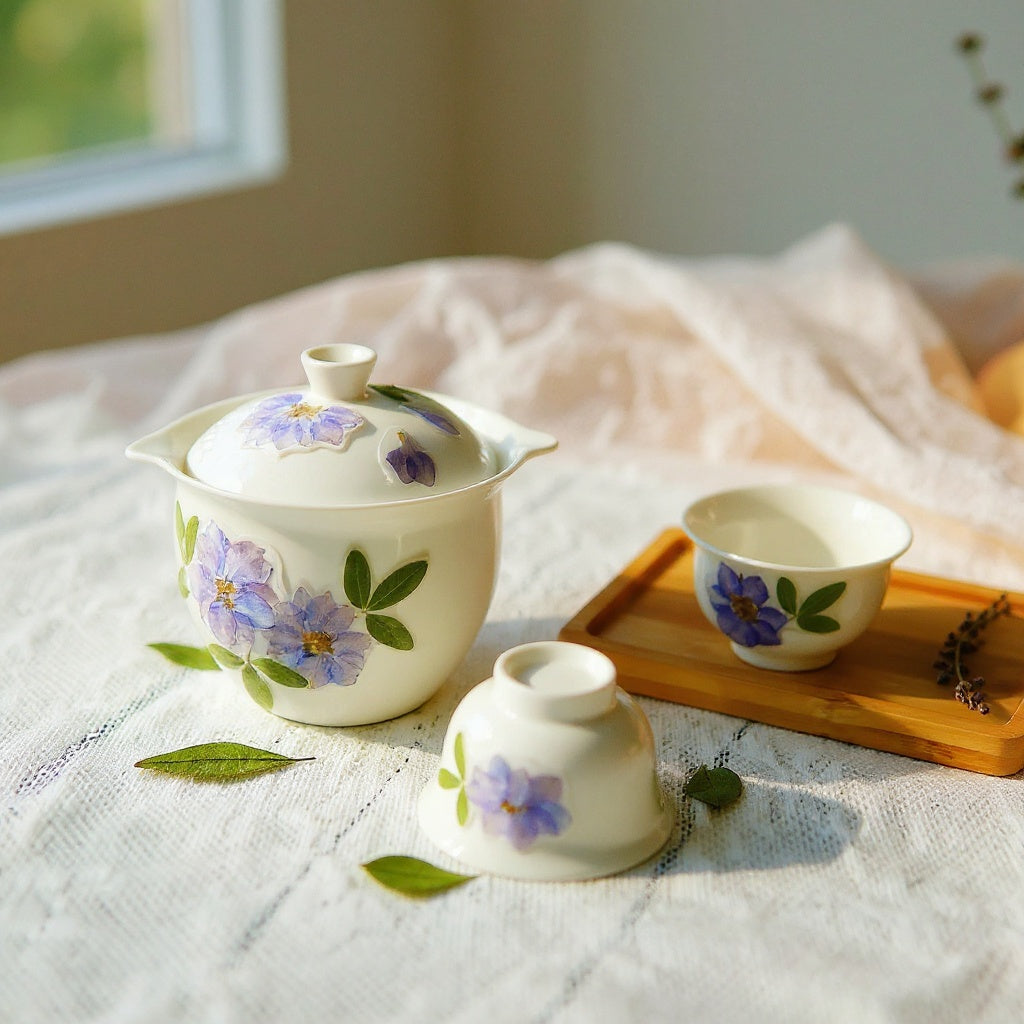
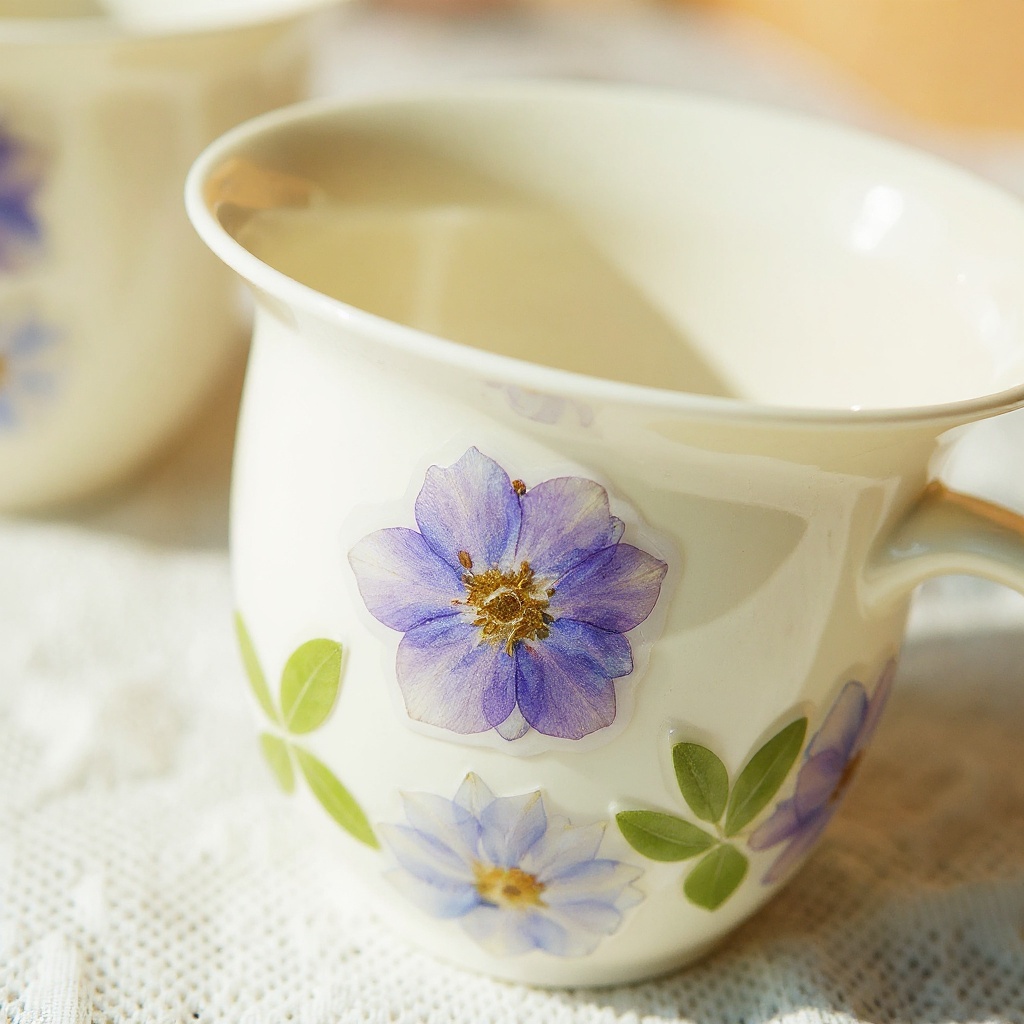
Modern techniques have expanded to include real botanical materials. Some contemporary artisans now embed actual pressed flower craft petals directly into the porcelain body, fusing genuine organic material with ceramic during firing. The result is a surface where soft pinks, lavenders, and creams from real dried petals sit visibly beneath the glaze, slightly raised, undeniably alive.
Not just decoration. A record of something that grew.
Understanding Suet Jade Porcelain: Quality Markers and Characteristics
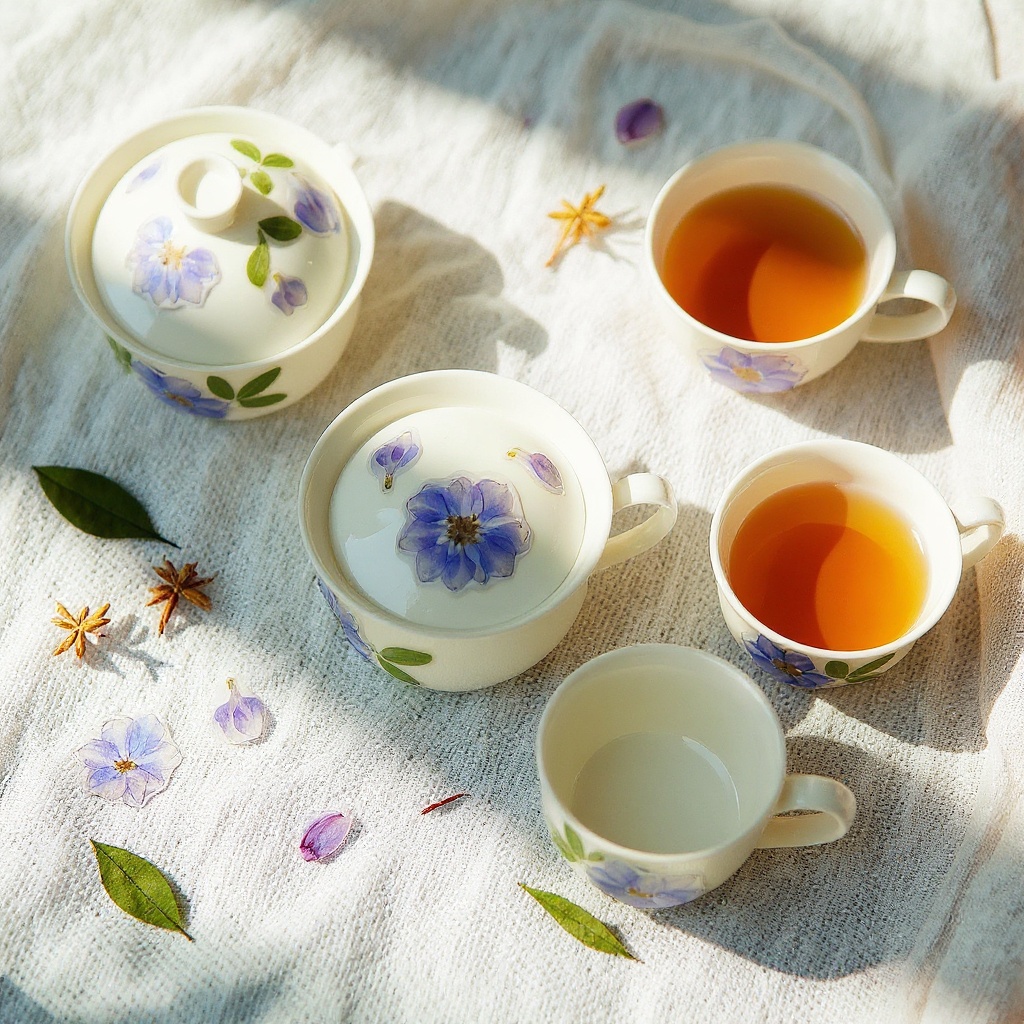
Suet jade porcelain is named for its resemblance to mutton fat jade — a warm, semi-translucent white with a smooth, jade-like gloss finish that catches soft light without harsh reflection. Producing this material requires specific kaolin clay compositions, precise kiln atmosphere control, and firing temperatures in the 1280–1320°C range, as documented by the Jingdezhen Ceramic Institute in their published kiln studies. Wall thickness on premium teacups typically measures 1.5–2.5mm, thin enough to allow light transmission without structural compromise.
The translucency test is simple and reliable. Hold a genuine suet jade piece against a single light source, and you will see a soft, even warm glow moving through the walls with no dark patches or thick spots. Inferior pieces show uneven density. Premium pieces also produce a clear, sustained ring when tapped — a sign of complete vitrification during firing, meaning zero porosity and a surface that absorbs nothing.
Here is something most guides will not tell you honestly: the semi-translucent quality that makes suet jade porcelain beautiful also means the walls are genuinely thin, and thin walls chip. If you keep your teaware in a cabinet where pieces knock against each other, or if children are frequently in your kitchen, this is not the right set for daily casual use. Buy it because you will handle it with intention. Not because you want something that survives a drop.
Our Handmade Suet Jade Porcelain Teapot Set exemplifies these markers, featuring real preserved flower petals embedded in relief across the surface. Each gaiwan holds approximately 150ml; the accompanying teacups measure around 50ml each — proportions calibrated for traditional gongfu brewing.
Gongfu Tea Ceremony and Equipment Requirements
The Gongfu tea ceremony is China's most technique-focused brewing method, emphasizing multiple short steepings that extract tea's layered complexity across six to ten rounds. Western brewing uses large vessels and single long steeps. Gongfu inverts that entirely. Small volumes, high leaf-to-water ratios, and timed steepings of 10–30 seconds per round allow tea drinkers to experience how a single handful of leaves evolves from bright and floral to deep and honeyed across a full session.
A proper gongfu setup requires vessels sized for this concentrated method. The gaiwan serves as both brewing vessel and server, its 120–180ml capacity allowing precise control. Porcelain gaiwans are preferred by practitioners who work across multiple tea types because the material absorbs no residual flavor between sessions, unlike unglazed clay pots that develop character tied to a single tea.
Essential Gongfu Tea Equipment: 1. Gaiwan (150ml ideal capacity) 2. 4–6 tasting cups (30–50ml each) 3. Fairness pitcher (200–300ml) 4. Tea tray with drainage 5. Bamboo tea tools (scoop, needle, tongs) 6. Timer for precise steeping control 7. Temperature-controlled kettleThe ceremony follows a consistent sequence: rinse gaiwan and cups with hot water to warm them, measure 6–8 grams of leaf, perform one brief rinse steep to open the leaves, then brew successive steepings with durations starting at 15 seconds and increasing by 5–10 seconds per round. Each participant receives a small pour to track the tea's evolution. The ritual itself. That is the point.
Tea Type Suitability for Porcelain Gaiwan Brewing
| Tea Type | Porcelain Suitability | Water Temp (°C) | First Steep (sec) | Notes |
|---|---|---|---|---|
| Green Tea | Excellent | 75–80 | 20–30 | Porcelain prevents bitterness from over-extraction |
| White Tea (Silver Needle) | Excellent | 80–85 | 30–45 | Clean porcelain showcases delicate sweetness |
| Light Oolong (Tie Guan Yin) | Excellent | 90–95 | 15–20 | Most dramatic flavor evolution across steepings |
| Roasted Oolong (Da Hong Pao) | Good | 95–98 | 20–30 | Some practitioners prefer clay for heavier roasts |
| Sheng Pu-erh | Good | 90–95 | 10–15 | Porcelain shows clean floral-mineral character |
| Black Tea (Dianhong) | Good | 90–95 | 15–25 | Works well; clay preferred by some for body |
| Shou Pu-erh | Fair | 95–100 | 10–15 | Strong earthy notes compete with delicate vessel |
Identifying Handmade vs. Mass-Produced Floral Relief
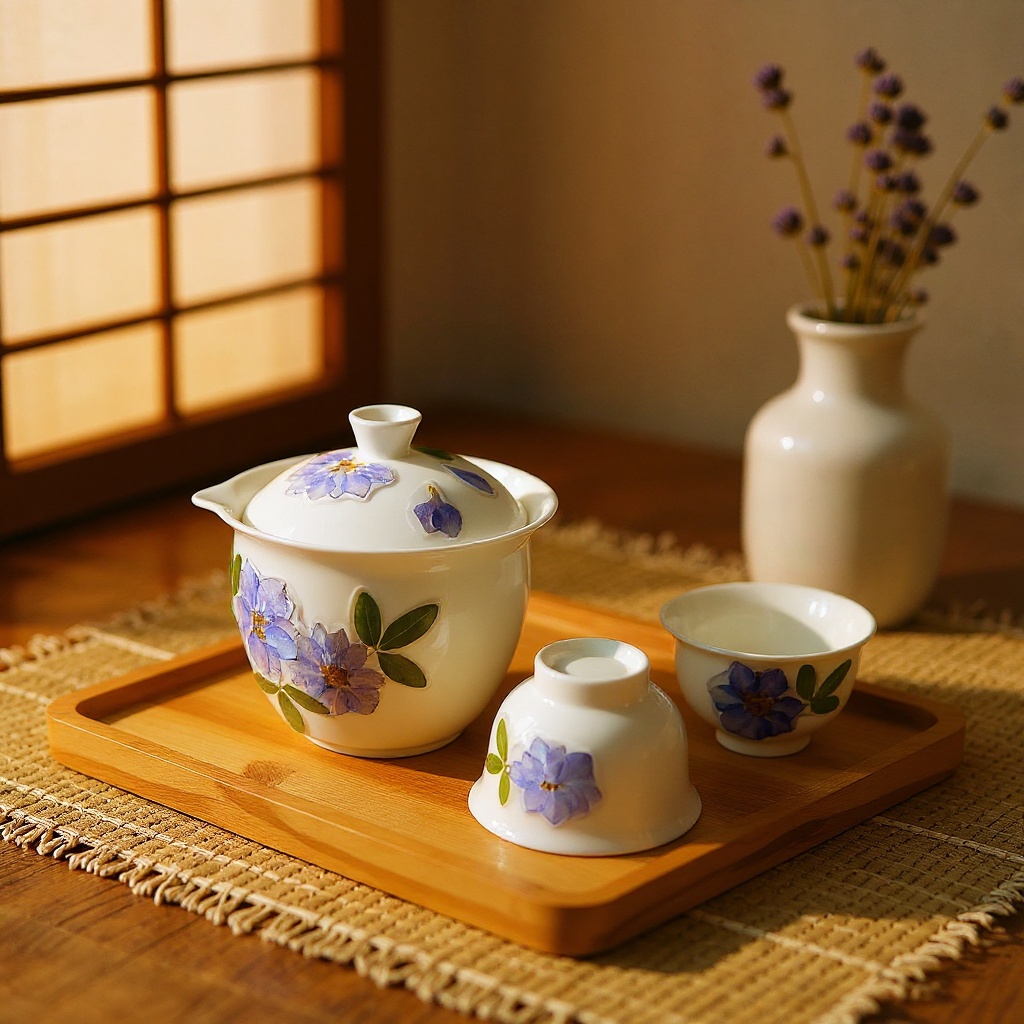
Distinguishing handmade relief from factory production requires examining several physical indicators. Handcrafted pieces show subtle irregularities in flower placement, slight variations in petal thickness, and the kind of organic randomness that molds cannot reproduce. Mass-produced items display exact symmetry and millimeter-consistent spacing — the signature of tooling, not hands.
| Feature | Handmade | Mass-Produced |
|---|---|---|
| Flower Placement | Organic, subtly asymmetrical | Perfectly symmetrical, molded |
| Petal Detail | Varied thickness, natural edge flow | Uniform profile, sharp edges |
| Price Range | $380–900+ | $25–150 |
| Weight Variation | Slight differences between pieces | Identical across all units |
| Base Marks | Hand-carved or painted signatures | Molded factory stamps |
| Surface at Junctions | Seamless clay integration | Faint seam lines sometimes visible |
| Production Time | 12–18 hours per piece (artisan estimate, Jingdezhen workshop documentation) | Minutes per unit |
Authentic handmade relief includes what restorers call "tool memory" — microscopic traces of the implement used to shape each petal, visible under magnification and felt as the softest variation under a fingernail. Factory pieces feel uniform because they are. Not wrong, just different. But the price should reflect which one you are buying.
Look closely at the junction between raised elements and the main body. Handmade pieces show seamless integration where the clay was worked together as a single material. Machine-made items often reveal faint seam lines where separate pressed components were joined before firing.
Caring for Your Chinese Porcelain Tea Set with Floral Relief
Proper care ensures your chinese porcelain tea set with floral relief remains functional and beautiful across years of use. High-fired vitrified porcelain is more durable than its appearance suggests. The risk is not pressure — it is thermal shock.
Never pour boiling water directly onto cold porcelain. Warm the vessel with water at 60–70°C first, then introduce your brewing temperature. This simple step prevents stress fractures that begin invisibly and develop into visible cracks over months of use. Equally, do not place a hot gaiwan directly onto cold marble. The temperature differential is enough to cause a crack that ruins the piece without any impact at all.
Daily Care Routine: 1. Rinse immediately after use with warm water 2. Use soft cloth or silk sponge only — no abrasive pads 3. Dry thoroughly to prevent mineral deposits from hard water 4. Store pieces separated by soft cloth or padded dividers 5. Handle relief areas with fingertip care during cleaning 6. Inspect monthly for hairline fractures at relief junctions 7. Warm new porcelain with plain hot water for three sessions before first tea useFor stubborn tea stains, a paste of baking soda and water applied for 20 minutes before gentle rinsing removes tannin buildup without abrasion. White vinegar diluted 1:4 with water dissolves mineral deposits. Rinse thoroughly and completely afterward — residual acid etches glaze over time.
A vessel that lasts decades. Worth those two minutes of careful washing.
Pricing and Value in the Chinese Porcelain Tea Set Market
The chinese porcelain tea set market spans a wide range, from $25 factory sets to museum-acquisition-level pieces priced above $2,000. Understanding the drivers behind these differences protects you from overpaying for mass-produced items marketed as handcrafted.
Entry-level sets ($25–80) use lower-grade porcelain with printed or transfer-applied surface decoration. Functional. No artistic merit. Mid-range options ($150–350) offer better clay bodies and may include molded relief elements and some hand-painted detail, but the relief at this price point is pressed from molds, not sculpted.
Premium handcrafted sets ($380–900) justify their cost through superior clay sourcing, individual artisan labor documented at 12–18 hours per piece in Jingdezhen workshop records, and techniques like real botanical embedding that require precise staging to prevent petal combustion or displacement during firing. Collector-grade pieces above $1,000 typically come from documented kilns or named individual artists and carry provenance that gives them secondary market value.
The real botanical element work in sets like our Handmade Suet Jade Porcelain Teapot Set involves individually placing dried petals in soft pinks, lavenders, and creams into the clay body at the leather-hard stage, then managing firing conditions to preserve color and form through temperatures that would incinerate unprepared organic material. One miscalculation and the piece is lost.
Recommended Products
For practitioners seeking a complete gongfu setup featuring authentic suet jade porcelain with real embedded botanical relief, our Handmade Suet Jade Porcelain Teapot Set | Real Pressed Flowers | Gongfu Tea Gift includes a 150ml gaiwan and matched teacups with real dried flower petals in soft pinks, lavenders, and creams visibly embedded and raised on the semi-translucent surface.
FAQ
What is the difference between floral relief and painted floral decoration on a chinese porcelain tea set with floral relief?Floral relief creates raised, three-dimensional designs that you can feel with your fingertips, while painted decoration remains flat on the porcelain surface. Relief work involves embedding or sculpting flowers into the clay body before firing, creating permanent physical depth. Painted flowers are applied as glazes or mineral pigments on top of the finished surface. Relief catches and redirects light depending on the angle of illumination, changing its visual weight throughout the day. A painted flower looks identical at dawn and noon. A relief petal does not.
Is suet jade porcelain durable enough for everyday use, or is it primarily display-grade?Suet jade porcelain fired at 1280–1320°C becomes fully vitrified and non-porous, making it structurally stronger than its thin walls suggest. The primary risk is thermal shock from rapid temperature change, not impact from normal handling. With proper warming technique — pre-rinsing with 60–70°C water before introducing boiling water — quality suet jade pieces withstand daily gongfu sessions across years of use. Many serious tea practitioners use their finest porcelain daily, on the principle that beautiful functional objects should be used, not stored.
Can you put a porcelain gaiwan in the dishwasher?High-quality porcelain is technically dishwasher-safe in terms of the ceramic body, but machine washing is not recommended for gaiwans with floral relief or embedded botanical elements. Dishwasher detergents contain alkaline compounds that dull glazes with repeated exposure. High-pressure spray can dislodge or erode raised relief details over time. The confined dishwasher environment also creates impact risk from contact with other items. Hand washing with warm water and a soft cloth preserves both the glaze integrity and the botanical relief far better than machine cycles.
How do I know if a floral relief tea set is genuinely handmade?Handmade relief shows organic irregularities — slightly different flower sizes across the same piece, asymmetrical placement, and natural variation in petal thickness that molds cannot reproduce. Look for subtle tool marks at petal edges, minor weight differences between individual cups in the same set, and hand-painted or carved artist marks rather than molded factory stamps. At the junction between relief elements and the body, handmade work integrates seamlessly because the clay was worked as one material. Machine-made versions frequently show faint seam lines. Genuine handmade relief from Jingdezhen workshops typically costs $380 or more, reflecting 12–18 hours of documented skilled labor per piece.
Are the flowers in botanical porcelain tea sets real petals or ceramic reproductions?This depends entirely on the production method, and the difference is significant. Most traditional floral relief uses carved or slip-cast ceramic elements shaped to mimic flower forms — durable and precise, but not botanical. Contemporary artisans working in the embedded botanical tradition press actual dried flower petals into the clay body at the leather-hard stage, then fire under carefully controlled atmospheric conditions to preserve color and organic structure through vitrification. The petals in our suet jade sets are real dried flowers — soft pinks, lavenders, and creams from actual botanicals — permanently fused into the porcelain surface and visible beneath the glaze.
What does a complete gongfu tea set include, and how many cups are standard?A complete gongfu set includes a gaiwan (150ml is the practical standard for 2–4 people), four to six tasting cups of 30–50ml each, a fairness pitcher at 200–300ml for distributing tea evenly before serving, and a set of bamboo or wood tea tools including a scoop, needle for unclogging the gaiwan lid, and tongs for handling hot cups. A tea tray with drainage handles rinse water and spills. Most artisan sets include four cups, which suits intimate sessions. Six-cup configurations serve small group ceremonies. The gaiwan is the functional center of the entire setup.
Why are some chinese porcelain tea sets with floral relief so much more expensive than others?Price reflects four compounding factors: clay quality, production method, artistic execution, and provenance. Factory sets at $25–80 use standardized porcelain with printed surface decoration produced in minutes per piece. Mid-tier sets at $150–350 offer better clay but still rely on molded relief and mechanized shaping. Premium handcrafted sets at $380–900 require superior kaolin sourcing, individual artisan labor of 12–18 hours per piece, and specialized techniques like real botanical embedding that involve precise firing management to preserve organic material through high-temperature vitrification. Collector-grade pieces above $1,000 carry named artist or documented kiln provenance with secondary market value. The labor investment alone explains the price gap.
What type of tea benefits most from brewing in a porcelain gaiwan?Oolong teas show the most dramatic benefit from porcelain gaiwan brewing, because the material's neutrality allows the full flavor evolution across multiple steepings to register without interference. Light oolongs like Tie Guan Yin reveal floral-to-honey progression across six or seven rounds that is genuinely impossible to experience in a single long Western-style brew. Green teas benefit from porcelain's quick, even heat transfer, which prevents the bitterness caused by over-extraction. Delicate white teas like Silver Needle or Moonlight White express their quiet sweetness cleanly in a porcelain environment. For robust shou pu-erh, however, many experienced practitioners prefer aged clay, where the earthy character of the vessel complements rather than contrasts the tea.
Conclusion
Choosing the right chinese porcelain tea set with floral relief means balancing aesthetic intention with honest practical expectations. The artistry involved in genuine relief work — whether through traditional clay sculpting or the more demanding technique of embedding real dried botanicals in soft pinks, lavenders, and creams into semi-translucent suet jade porcelain — represents centuries of ceramic knowledge concentrated into objects small enough to hold in one hand.
For tea practitioners who brew with attention, the investment in quality handmade porcelain transforms each session. The vessel becomes part of the ritual. Not just a container, but a collaborator.
If you are ready to experience that difference, browse our Handmade Suet Jade Porcelain Teapot Set | Real Pressed Flowers | Gongfu Tea Gift. Each set features real preserved flower petals embedded in three-dimensional relief against a warm, semi-translucent white porcelain body — a one-of-a-kind tea ceremony object that honors both the botanical and the ceramic tradition.