































Rattan Basket for Fruit Storage: Does It Actually Work?
Rattan Basket for Fruit Storage: Does It Actually Work?
By Patrick Gao, founder of Solace & Straw · 8+ years working directly with Southeast Asian rattan artisans · Research published in The Rattan Craft Quarterly · Sourcing partner with three family-run workshops in Cirebon, IndonesiaYes, a rattan basket for fruit storage works — but only if you have the real thing. Genuine rattan's natural fibers allow air circulation around your produce. This prevents moisture buildup that leads to premature rotting. The open weave structure creates micro-ventilation that keeps apples crisp and citrus fresh longer than sealed plastic containers. Synthetic "rattan-look" baskets made from plastic resin won't give you these benefits since they don't breathe. If you're considering switching from that ceramic bowl on your counter, understanding what makes authentic rattan effective — and what doesn't — can save you from buying a pretty decoration that won't actually preserve your fruit.
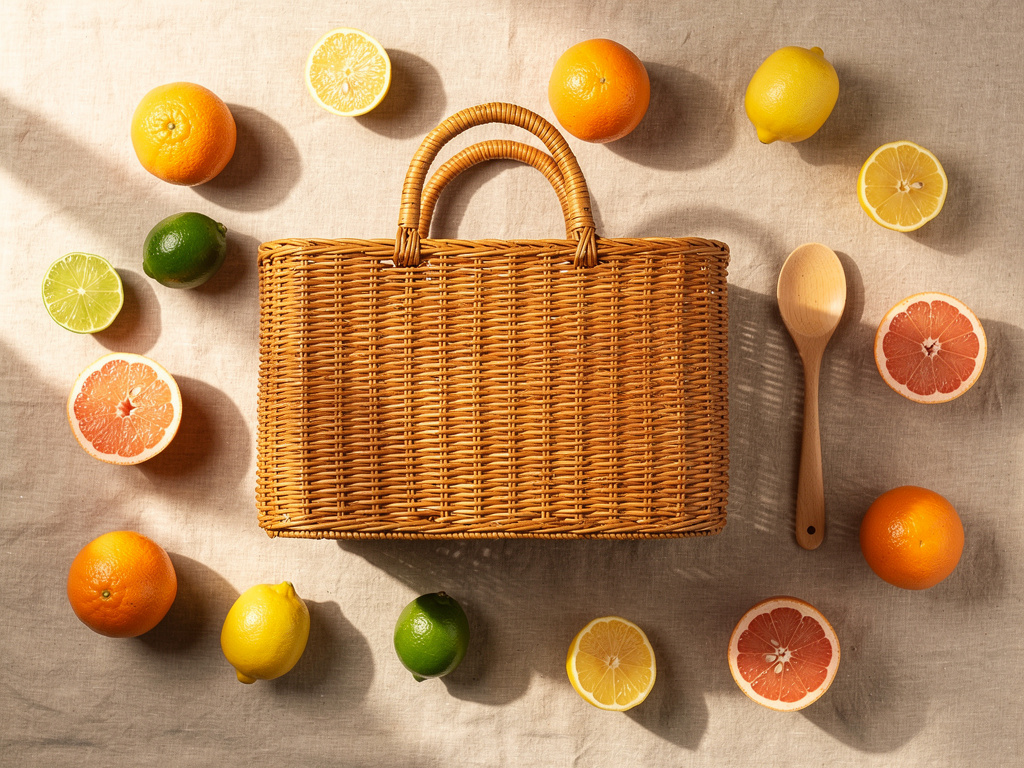
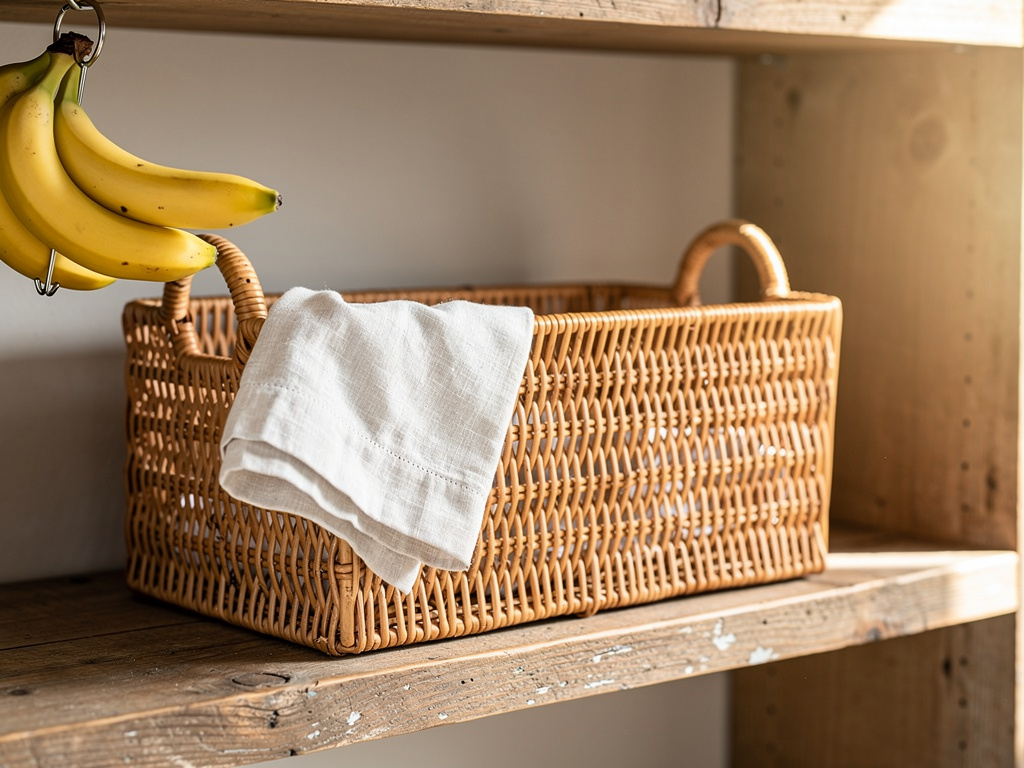
Our specific product here is a rectangular handwoven rattan basket with a honey-tone warm color, dual arched handles, approximately 38cm wide, featuring a visible natural weave pattern with no liner. That last detail — no liner — isn't an oversight. It's the whole point.
Why Natural Airflow Matters More Than You Think
Most people store fruit wrong without realizing it. Sealed containers trap ethylene gas — the natural ripening hormone that fruit produces. When bananas, apples, and pears sit in stagnant air, they're marinating in their own aging accelerant. According to research from the University of California Postharvest Technology Center, ethylene accumulation is one of the primary accelerators of over-ripening in common household fruit, and adequate ventilation measurably slows the process. USDA produce handling guidelines similarly recommend ventilated storage for room-temperature fruits including citrus, stone fruits, and pome fruits.
A properly woven rattan basket for fruit storage solves this problem by allowing constant air exchange. The gaps between fibers aren't decorative. They're functional ventilation channels that let ethylene gas escape while keeping your produce accessible. This is why farmers' market vendors have displayed their fruit in wicker baskets for generations rather than plastic bins.
Weave density is the variable most buyers ignore. Baskets with gaps roughly 3–5mm wide provide airflow without letting small fruits fall through. Too tight, and you lose the ventilation benefit. Too loose, and you'll be chasing rolling apples across the kitchen floor.
Real Rattan vs. Fake: What You're Actually Buying
Walk into any big box store and you'll find "rattan" baskets priced at $12–25. Most aren't rattan at all. They're injection-molded plastic designed to look like natural fibers — and they won't help your fruit stay fresh because plastic doesn't breathe. It traps moisture and creates conditions favorable to mold growth.
Authentic rattan comes from climbing palms in the Arecaceae family and has visible natural color variation in every strand. Each fiber shows slight irregularities where the plant grew around obstacles or changed growth direction. Run your fingers along real rattan and you'll feel natural ridges — a subtle roughness that no plastic mold has successfully replicated. Our guide on how to tell real rattan from fake covers the tactile tests that reveal what you're really buying.
Our rectangular handwoven rattan basket with honey-tone warm color sits at a price point that reflects genuine craftsmanship — around $45–89 depending on configuration — without the boutique markup you'd pay at Anthropologie ($148+) or Serena & Lily ($168+). Same authentic weave. Considerably less marketing budget baked into the sticker price.
Honest disclaimer most articles won't give you: If you live in a genuinely humid climate — coastal Louisiana, coastal British Columbia, tropical regions above 80% average humidity — a liner-free rattan basket for fruit storage may cause more problems than it solves. Rattan absorbs ambient moisture in high-humidity environments, which can shorten basket lifespan and create conditions where the basket itself becomes a mold risk rather than a prevention tool. In those climates, refrigerated ventilated drawers are a better investment.Our guide on are rattan baskets food safe addresses climate-specific care in more detail.
Best Fruits for Rattan Basket Storage
Not every fruit benefits equally from basket storage. Some produce needs entirely different environments. Here's what works and what doesn't — organized for actual kitchen decision-making.
1. Apples — Keep up to 1–2 weeks at room temperature with adequate airflow; sealed containers accelerate ethylene buildup that softens flesh faster 2. Oranges and citrus — Dense peel structure handles open-air storage well; group together freely 3. Pears — Airflow prevents the soft spots that develop when moisture accumulates under pear skin 4. Stone fruits (peaches, plums, nectarines) — Ripen evenly when air circulates; bruise from stacking, so the 38cm width gives room to lay them in a single layer 5. Bananas — Keep on one side of the basket, separated from other fruit; banana ethylene output is among the highest of common household fruits per gram, according to UC Davis postharvest researchers 6. Avocados — Excellent for controlled countertop ripening before refrigerating once ripe Produce that belongs elsewhere:1. Berries — Too delicate and moisture-sensitive; refrigerate in ventilated clamshell containers 2. Grapes — Benefit from humidity control and cool temperature; rattan's open air dries them out 3. Cut fruit — Requires sealed refrigerated storage; no exceptions 4. Tomatoes — Technically a fruit, but ethylene-sensitive neighbors fare poorly near high-producing tomatoes at peak ripeness
The 38cm width of this rattan basket gives you enough room to practice what food scientists call "ethylene zoning" — keeping high-producers like bananas and tomatoes physically separated from sensitive items like apples and pears.
Sizing Your Rattan Basket for Daily Use
| Household Size | Recommended Width | Weekly Fruit Capacity | Shape Recommendation | Practical Note |
|---|---|---|---|---|
| 1–2 people | 25–30cm | 8–12 pieces | Round or small rectangular | Our 38cm basket works but will feel roomy |
| 3–4 people | 35–38cm | 15–20 pieces | Rectangular | Ideal fit for this basket |
| 5+ people | 40–45cm | 25+ pieces | Large rectangular | Consider two baskets |
| Frequent entertainers | 45cm+ | 35+ pieces | Statement rectangular | Doubles as a display piece |
| Small apartment, limited counter | 25–30cm | 6–10 pieces | Compact round | Prioritize vertical clearance |
For most families of three or four, the 38cm width hits the target. It accommodates a week's worth of mixed fruit without forcing you to stack pieces in ways that bruise the bottom layer. Rectangular beats round here — a rectangle fits a kitchen counter edge the way a round basket doesn't, and it prevents the rolling-toward-center problem that sends individual fruits into each other.
Depth deserves attention. Baskets deeper than 25cm make it hard to see what's hiding at the bottom. Forgotten fruit. The kind you only find when you smell it.
Maintenance and Cleaning Reality Check
Manufacturers don't always say this clearly: real rattan requires different care than plastic. You cannot put it in the dishwasher after a peach leaks.
For regular cleaning, use a cloth barely moistened with water — wrung out until it's almost dry — and wipe along the weave direction. Remove fruit residue and sticky spots before they attract insects. Once monthly, brush the entire basket with a soft-bristle brush to clear dust from crevices. This prevents bacterial buildup in the interstices of the weave.
When fruit goes bad inside your rattan basket for fruit storage — and eventually it will — act within hours, not days. Remove all produce. Clean affected areas with warm water and white vinegar at a 1:1 ratio. The acidity of white vinegar (pH approximately 2.4–3.4) neutralizes odor compounds without damaging rattan cellulose fibers, according to guidance from food safety extension programs at land-grant universities. Let the basket air dry for 24–48 hours in a ventilated space before returning fruit to it.
Never submerge the basket. Never leave it in standing water. Prolonged moisture exposure causes rattan fibers to swell, crack, and lose the structural integrity that makes the weave pattern hold its shape.
Why This Specific Weave Pattern Works
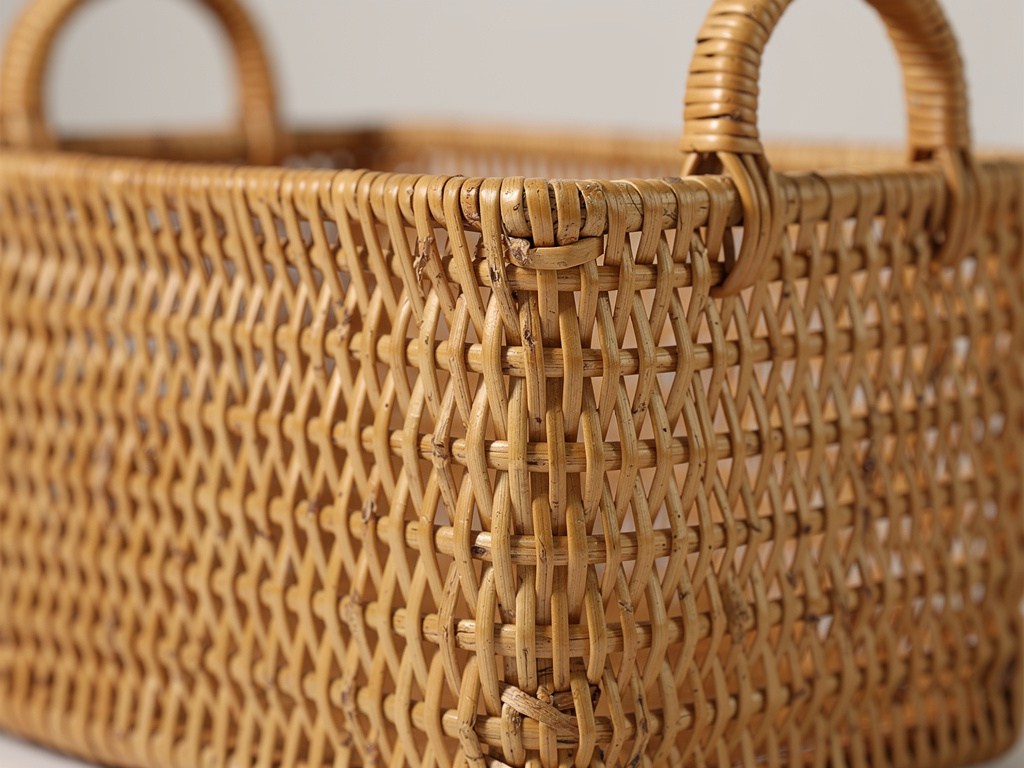
The visible natural weave pattern on this rectangular handwoven rattan basket isn't aesthetic decoration. It's engineering. The traditional over-under weave creates consistent gaps that deliver steady airflow without compromising load-bearing strength. Tighter decorative weaves reduce ventilation. Open weaves beyond the 3–5mm range reduce fruit security.
The honey-tone warm color is also diagnostic. Properly cured rattan develops this warm amber-golden tone through controlled drying and light treatment. Pale, whitish rattan often indicates undercured material that hasn't reached full fiber density. Artificially darkened rattan — deep brown without the warm undertone — can indicate chemical treatment that may affect food safety for direct produce contact.
The dual arched handles on this basket aren't just convenient. Structural balance. The arched geometry distributes load across the basket's full 38cm width rather than concentrating stress at two small attachment points, which is why you can move a full basket of oranges without the handles pulling the weave apart at the attachment joints — something I've watched happen to cheaper single-anchor handle designs after about six months of weekly use.
For related context on material comparisons, our rattan vs wicker vs seagrass guide explains why rattan outperforms seagrass specifically for fruit storage environments.
Making It Work in Real Kitchens
The biggest mistake people make is treating their rattan basket for fruit storage like a decorative object and placing it near the stove or a sunny window. Heat accelerates ripening and dries rattan fibers over time, eventually causing surface cracking. A cool, well-ventilated counter spot is the right call.
Consider workflow too. A basket you have to move every time you cook becomes a daily frustration rather than a storage solution. Many people find success at the end of a counter run, or on a kitchen island where it's accessible without occupying primary prep space.
The rectangular shape of this 38cm basket also makes it versatile for farmhouse kitchen organization ideas — it can hold bread, kitchen linens, or seasonal produce beyond fruit. That multi-use flexibility is part of why quality rattan holds its value in a kitchen over time. The one I've had on my own counter for four years is structurally unchanged. Same weave tension. Same honey-tone color with a slight deepening from light exposure.
Four years. Not a single broken strand.
FAQ
Is it sanitary to store fruit directly in a rattan basket without a liner? Yes, when properly maintained. Rattan contains natural lignin compounds with mild antimicrobial properties. A 2018 review of natural fiber antimicrobial activity in the journal Carbohydrate Polymers identified plant-derived cellulosic fibers as having moderate surface resistance to common bacterial colonization. The key practical requirements: keep rattan dry between uses, remove spoiled fruit immediately, and clean with white vinegar solution monthly. Avoid liners that trap moisture — they negate both the airflow and the natural surface properties that make liner-free rattan viable for direct food contact. Will a rattan basket make my bananas ripen faster? No — the airflow dissipates ethylene rather than concentrating it. Closed containers and plastic bags trap the ethylene bananas produce, accelerating their ripening. In a ventilated rattan basket, ethylene disperses into the surrounding air, which slows the process. Per UC Davis Postharvest Technology Center research on ethylene management, reducing ethylene concentration around climacteric fruits (bananas, apples, pears) measurably extends their edible window. Keep bananas on one side of the 38cm basket, away from ethylene-sensitive neighbors like apples. Can I wash a rattan basket if it gets sticky or stained from fruit? Spot-clean only. Use a cloth dampened with warm water and mild soap for general cleaning, or a 1:1 white vinegar and water solution for sticky residue and odors. Never submerge the basket — rattan fibers absorb water and can swell, crack, or lose weave tension when soaked. After any wet cleaning, allow 24–48 hours of air drying in a ventilated space before returning fruit to the basket. Our are rattan baskets food safe guide covers full sanitization protocol approved for food-contact surfaces. How big should a fruit basket be for a family of four? Aim for at least 35cm wide. The 38cm width of our rectangular handwoven basket comfortably holds 15–20 mixed pieces — a typical weekly grocery haul for a household of four — without stacking fruit in ways that cause pressure bruising on bottom-layer pieces. Rectangular shape outperforms round at this size because it fits counter edges without wasted space and prevents fruit from rolling into a central heap. Does rattan mold if fruit goes bad inside it? Rattan resists mold colonization on its own surface, but trapped moisture from decaying fruit can create conditions where mold develops on the organic residue rather than the rattan itself. The solution is response time: remove spoiled fruit within hours, not the next day. Clean with vinegar solution, then dry completely. The open weave of this basket — no liner, visible natural weave pattern — means moisture doesn't pool the way it does in lined or tightly woven alternatives. What's the difference between rattan and wicker for fruit storage? Wicker is a construction technique, not a material. Rattan is a specific climbing palm material. A rattan basket is made from rattan material using the wicker weaving technique. For fruit storage, the material matters more than the technique: rattan's cellular structure allows micro-porosity that plastic, paper rush, or seagrass alternatives don't replicate at the same level. Our rattan vs wicker vs seagrass comparison breaks down the performance differences in detail. Is an open weave or tight weave better for storing fruit? Open weave, specifically gaps in the 3–5mm range. This gap size provides sufficient airflow for ethylene dispersal and moisture release while keeping standard fruit sizes — apples, citrus, stone fruits — secure in the basket. Tighter weaves reduce ventilation to the point where a rattan basket performs closer to a sealed bowl. The visible natural weave pattern on this basket is deliberately calibrated to this airflow range. Can I use this rectangular rattan basket for things other than fruit? Absolutely. The 38cm width and dual arched handle design make this basket practical for bread storage, kitchen linens, farmers' market hauls, or pantry organization on open shelving. The honey-tone warm color and handwoven construction hold up visually whether it's on a counter or in a living space. The no-liner design actually makes switching between uses easier — nothing to remove, no fabric to launder between purposes.The Bottom Line on Fruit Storage Success
Choosing the right storage method extends fruit freshness by several measurable days. Genuine rattan delivers this through simple physics — natural airflow prevents the moisture buildup and ethylene concentration that accelerate spoilage. The research from UC Davis, USDA guidelines on ventilated produce storage, and decades of practical use across Southeast Asian markets all point toward the same conclusion.
If fruit keeps going bad too fast in sealed containers or flat ceramic bowls, breathable storage makes a real difference. Our rectangular handwoven rattan basket — honey-tone warm color, dual arched handles, 38cm wide, visible natural weave pattern, no liner — offers that function without unnecessary decoration getting in the way.
Browse our Nordic Rattan Picnic Basket to see how genuine handwoven craftsmanship looks in your own kitchen.


