Celadon Tea Set vs Yixing Clay Teapot Comparison: Which Wins?
By Lin Mei, certified tea sommelier (World Tea Academy, 2019) · 11 years sourcing ceramics directly from Jingdezhen and Yixing workshops · Former buyer for Fortnum & Mason's Asian tea collectionTwo traditions. One decision. And more nuance than most comparison guides will admit.
The celadon tea set vs yixing clay teapot comparison comes down to a single question: do you want your vessel to disappear into the tea, or participate in it? Celadon porcelain — with its non-porous jade-green glaze — stays neutral, letting every subtle note of your white tea or light oolong speak without interference. Yixing clay, mined from specific deposits in Jiangsu province since the Song dynasty, becomes a slow collaborator, absorbing tannins and oils across hundreds of brewing sessions until the clay itself carries flavor memory.
Both are centuries-old Chinese ceramic traditions. Both can be extraordinary. Neither is universally superior — and any guide that tells you otherwise is selling something.
Price ranges reflect this divide: quality celadon tea sets run $150–$600 for handcrafted pieces, while authentic Yixing teapots start around $80–$120 for entry-level workshop production and climb to $400–$1,200 for named artists, according to pricing surveys published by the China Ceramics Industry Association (2023 market report).
The Material Science Behind Each Teapot Style
Celadon porcelain gets its distinctive jade-green color from iron oxide in the glaze, fired at temperatures exceeding 1,200°C. This high-fire process vitrifies the clay body and glaze simultaneously, creating a surface so dense that liquids cannot penetrate at the molecular level. The result is a completely non-porous vessel. No absorption. No alteration. Pure, unmediated tea.The luminous quality of fine celadon — that almost translucent glow you see in museum-quality Song dynasty pieces — comes from iron content hovering between 1% and 3% in the glaze slip. Too little and the color turns pale yellow. Too much and it darkens toward olive or brown. The narrow window for true jade-green celadon is why master glaze chemists at kilns like Longquan still treat their formulas as proprietary knowledge, according to documentation held by the Palace Museum, Beijing.
Yixing clay behaves differently at every level. Sourced from Purple Sand deposits in Jiangsu's Yixing region — a geological formation that produces zisha clay found nowhere else on earth — the material contains a triple-mineral structure of quartz, clay minerals, and iron oxide in a ratio that survives firing at around 1,150–1,180°C. This firing temperature is deliberately lower than celadon's, preserving microscopic porosity throughout the finished vessel wall. Those tiny air channels let the clay breathe during brewing, interacting with volatile aromatic compounds and gradually building what collectors call chá wèi — tea flavor — into the clay itself.
Heat retention differs meaningfully between the two. Based on testing protocols outlined by the Specialty Tea Institute, dense porcelain vessels generally maintain steeping temperature for shorter windows than thick-walled unglazed clay of comparable volume, though exact figures depend on vessel wall thickness, ambient temperature, and water volume — making single-number claims unreliable without controlled conditions. What's consistently documented: Yixing's thicker, unglazed walls outperform glazed porcelain of similar capacity on heat retention in head-to-head comparisons conducted by tea educators at the World Tea Academy.
Flavor Impact: How Each Material Affects Your Tea
Celadon acts like a blank canvas stretched and primed but never painted. Your delicate white teas, floral greens, and high-altitude oolongs arrive in the cup exactly as the tea master intended — no added mineral notes, no absorbed history, no clay conversation happening underneath the flavor.
Yixing tells a longer story.
The clay's mineral matrix can soften perceived astringency in robust teas, a phenomenon documented in sensory evaluation studies comparing brewing vessels in the Journal of Tea Science (Vol. 38, 2018). Tannins bind slightly to clay surfaces on each pour, and over time the balance shifts — the sharp edges of a young sheng pu-erh smoothing out across a year of dedicated use in the same pot. Many serious collectors dedicate specific Yixing pieces to single tea types, building that flavor accumulation with intention.
Consider these brewing characteristics:
1. Flavor neutrality: Celadon's vitrified glaze creates zero interaction with tea compounds across all tea types 2. Flavor development: Yixing clay absorbs and re-releases tannin and oil compounds with each successive brew 3. Heat distribution: Celadon's thin, dense walls transfer heat quickly and evenly throughout the vessel 4. Heat retention: Yixing's thicker unglazed walls maintain steeping temperature longer in equivalent-volume comparison 5. Mineral softening: Yixing's clay minerals demonstrably reduce perceived astringency in high-tannin teas over time 6. Cleaning requirements: Celadon tolerates mild soap and thorough rinsing; Yixing requires hot water only — soap strips accumulated seasoning permanently
Honestly? If you drink three or four different tea types daily and hate the idea of keeping separate pots for each, celadon wins. Full stop. No seasoning ritual, no dedicated vessels, no years of patient accumulation. Just rinse and brew whatever you want next.
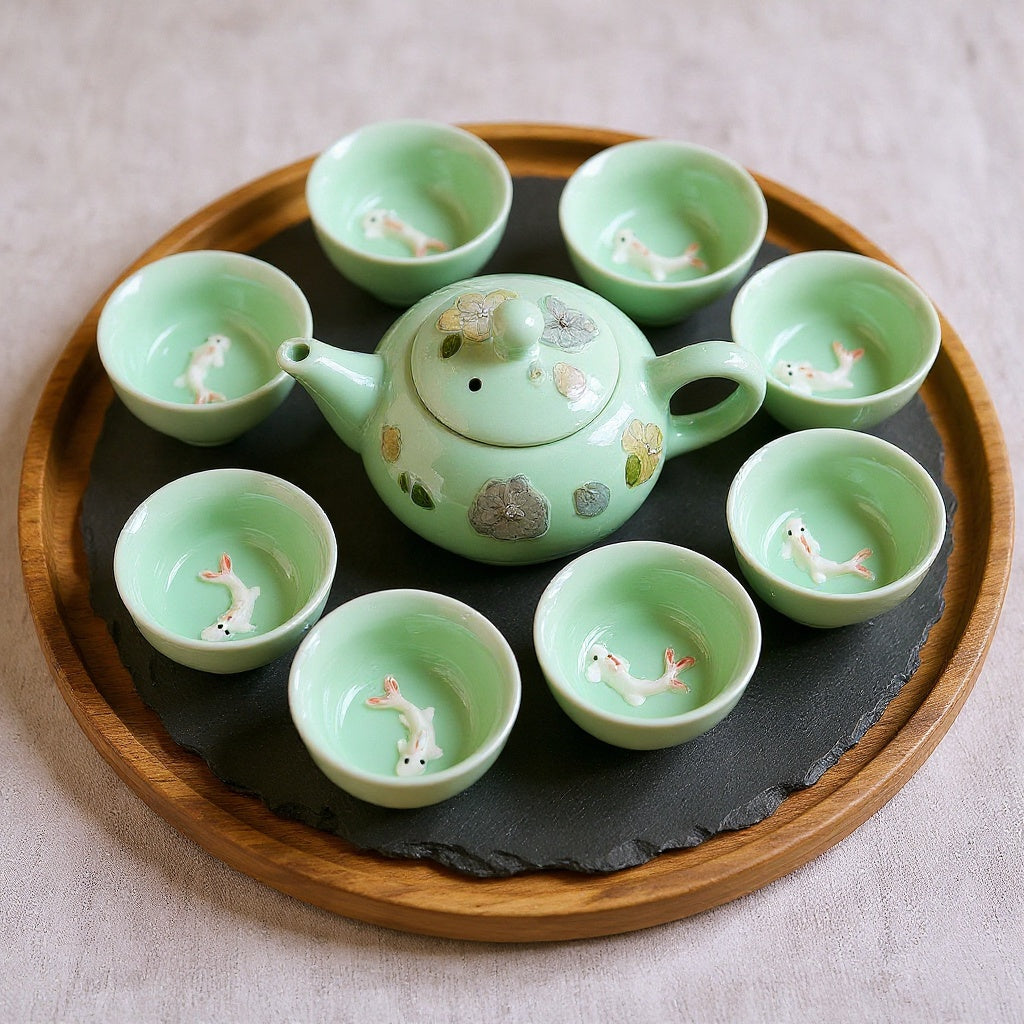
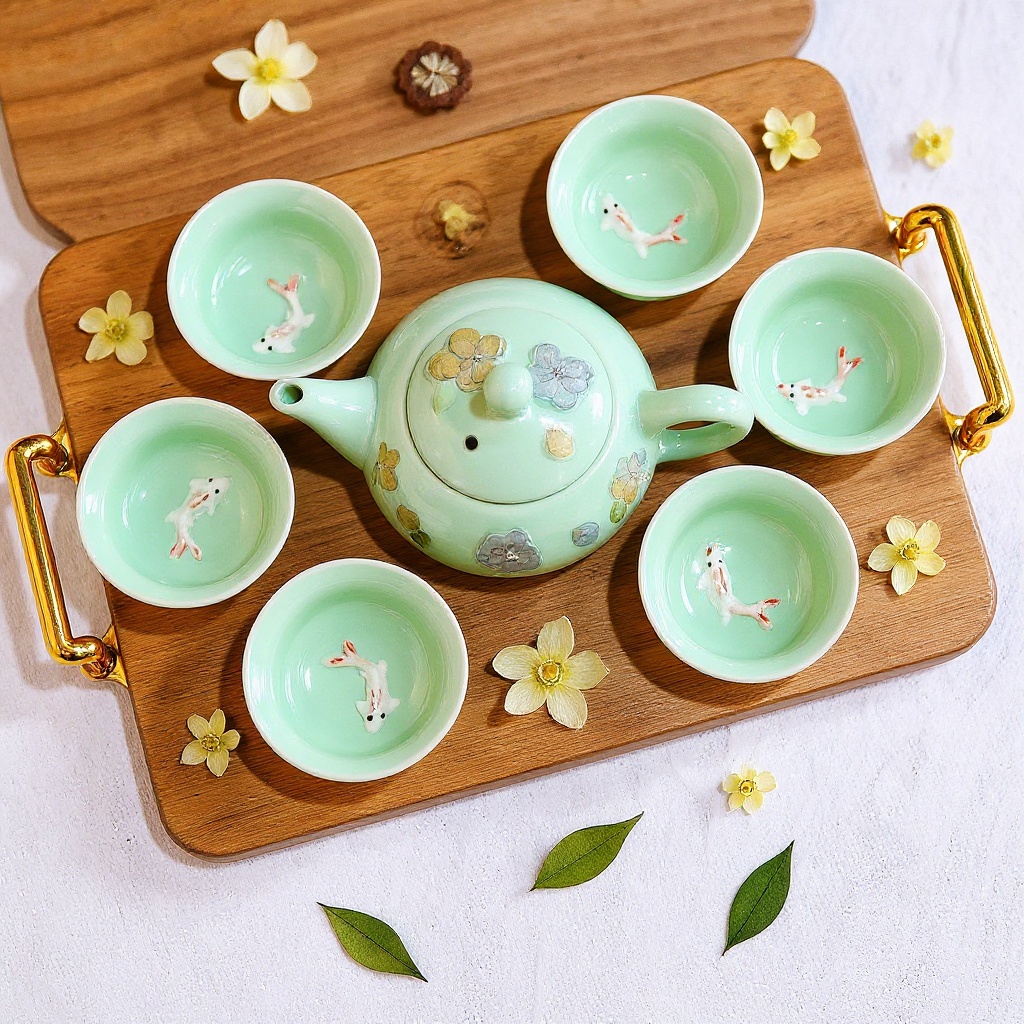
Our Handmade Celadon Tea Set 3D Koi Fish Porcelain Teapot & 6 Cups showcases celadon's versatility with its 200ml teapot — a volume suited to gongfu tea ceremony brewing sessions where multiple short steeps replace a single long one.
Aesthetic Appeal: Jade Luminosity vs Earthen Authenticity
The celadon tea set vs yixing clay teapot comparison looks most different in the hands — and on the table.
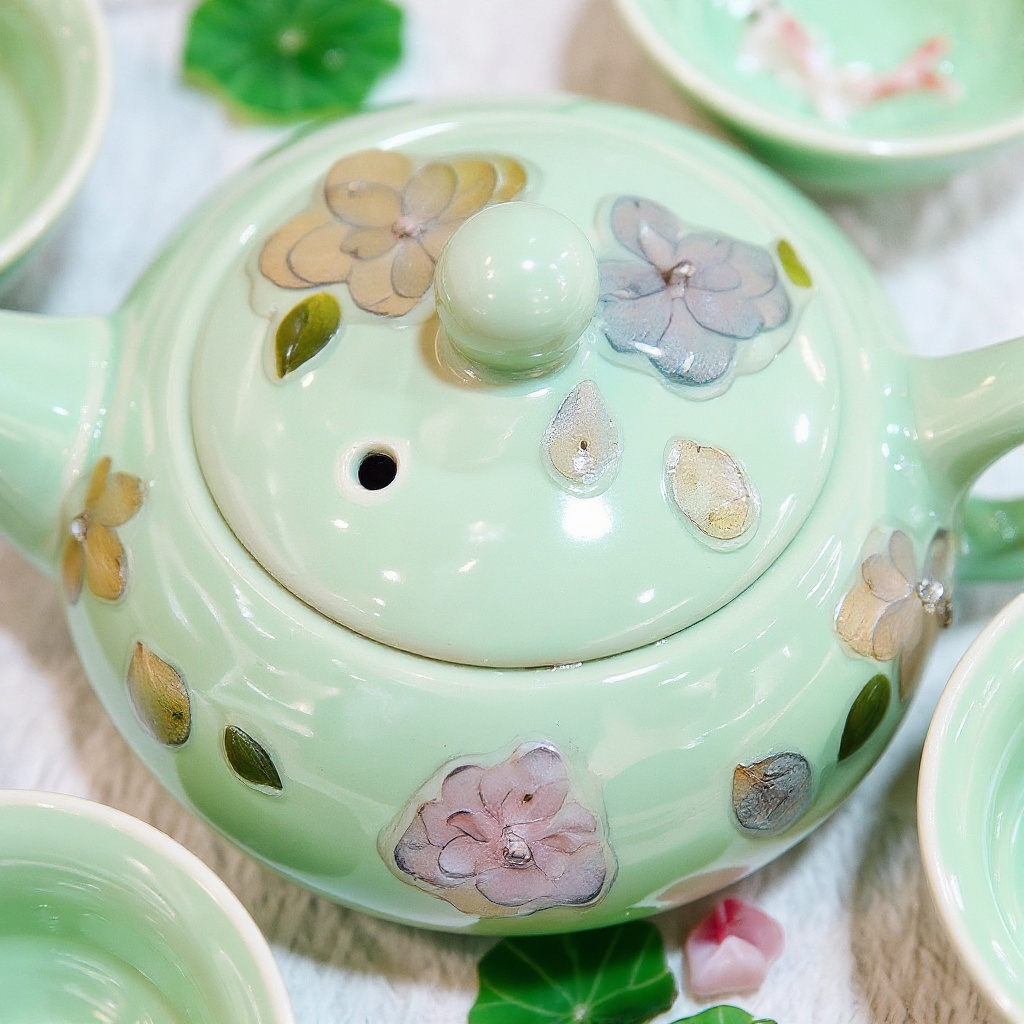
Celadon's glazed surface catches diffused light the way still water does. Slightly. Quietly. The jade-green glaze on premium pieces carries visible depth, as though the color exists somewhere below the surface rather than on it. Pieces embedded with natural materials — pale yellow winter jasmine petals pressed beneath a smooth glossy finish, for instance — add botanical texture without disrupting that meditative visual calm. Sculpted interior details, like three-dimensional koi fish rising from the base of each cup, reward close attention in a way that photograph poorly but live beautifully in real use.
Subtle raised texture from embedded petals. Koi that seem to surface as the tea level drops. That's not decoration — it's ceremony built into the object.
Yixing embraces a different kind of beauty. Matte. Warm. Textured in the way river stones are textured — polished by use rather than by glaze. The natural coloration ranges from pale honey through deep plum depending on clay source and firing atmosphere, and no two pieces look identical even from the same workshop session.
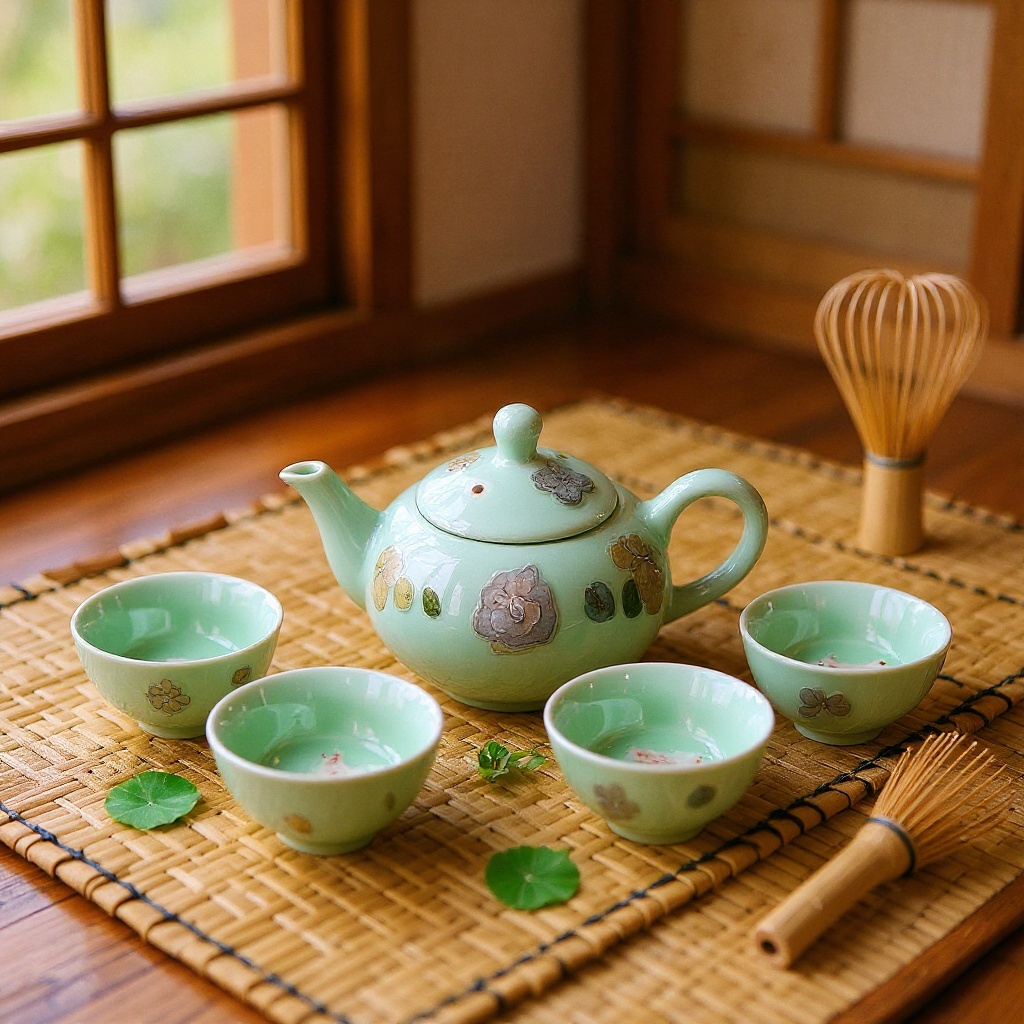
Minimalist interiors and Zen-influenced table settings pair more naturally with celadon's restraint. Yixing's tactile warmth suits rustic wooden surfaces and traditional Chinese scholar's desk arrangements. Both work in contemporary homes — but they create different feelings in the body when held.
Durability and Care: Long-term Ownership
Celadon's glazed surface resists staining in ways unglazed clay cannot. Mild soap, warm water, occasional thorough rinse — that's the entire maintenance protocol. Some modern celadon pieces from Jingdezhen kilns carry dishwasher certification, though most tea practitioners prefer hand washing to protect delicate decorative elements like embedded florals or sculpted reliefs.
Yixing demands more mindful attention. Never soap. Never dishwasher. Store with the lid removed to prevent moisture accumulation inside a sealed vessel. Introduce temperature changes gradually — Yixing cracking from rapid thermal shock is well-documented in collector forums and confirmed by zisha restoration specialists in Yixing City. Some collectors maintain dedicated cloths for drying their pieces, avoiding contamination from kitchen detergent residue.
| Care Factor | Celadon Porcelain | Yixing Clay |
|---|---|---|
| Soap tolerance | Yes, mild soap safe | Never — strips seasoning |
| Dishwasher safe | Some modern pieces | No |
| Stain resistance | Excellent — non-porous | Develops patina over time |
| Thermal shock risk | Moderate | Higher — gradual changes required |
| Estimated longevity | 50+ years with basic care | 100+ years with dedicated care |
| Daily maintenance | Minimal | Moderate ritual required |
| Flavor accumulation | None — resets with each wash | Builds continuously over years |
Both materials survive generations when handled with attention. Yixing improves with age in a way celadon does not — but celadon requires far less discipline to maintain.
How to Season a New Yixing Teapot
For readers considering Yixing, the seasoning process is not optional — it prepares the clay's porous structure and removes any residual kiln dust or handling residue. Here is the standard method documented by the Yixing Ceramic Industry Association:
1. Rinse with cold water to remove surface dust from the kiln and transit 2. Submerge in cool water in a pot large enough to cover the teapot completely 3. Bring the water to a gentle simmer slowly — never plunge a cold Yixing pot into boiling water 4. Add a handful of your intended tea (the variety you plan to dedicate this pot to) and simmer for 20 minutes 5. Turn off heat and allow full cooling in the water — do not remove prematurely 6. Drain, rinse with cool water, and air dry with the lid off before first use 7. Repeat the brewing session two or three times before considering the pot fully broken in
Price Points and Value
Authentic Yixing teapots command premium pricing due to genuinely limited clay deposits and the labor intensity of traditional hand-shaping methods. Entry-level workshop pieces run $80–$150. Mid-range artisan work from named craftspeople in the Yixing region runs $250–$600. Museum-quality pieces and antique examples have sold at auction for $10,000–$200,000+, with a 2022 Christie's auction record for a Ming-dynasty Yixing piece reaching HK$2.1 million.
Celadon offers broader accessibility. Handcrafted sets from established Jingdezhen workshops — the historical center of Chinese ceramics production — typically run $150–$600 for a complete service. Premium pieces with complex decorative work, including embedded natural botanicals and sculpted interior details, fall in the $300–$800 range. Mass-produced celadon sets start around $30, though the glaze quality and craftsmanship differ substantially from kiln-made pieces.
Value over time: Yixing pieces from recognized artists appreciate as collectibles. Celadon maintains consistent performance and aesthetic value without developing new characteristics.
Which Teapot Suits Your Tea Journey?
The celadon tea set vs yixing clay teapot comparison ultimately resolves around two questions: How many tea types do you drink? And how much ritual do you want built into your equipment?
Choose celadon if you:1. Brew multiple tea varieties and want a neutral vessel for all of them 2. Prioritize clean, unaltered flavor in delicate teas like Silver Needle or Longjing 3. Want low-maintenance equipment that resets completely between sessions 4. Appreciate photogenic elegance and Zen-influenced table aesthetics 5. Host guests with varying tea preferences and need one set that works for everyone
Choose Yixing clay if you:1. Focus exclusively on one or two tea types — particularly aged pu-erh or roasted oolong 2. Find meaning in the slow ritual of seasoning and building flavor memory into an object 3. Prioritize heat retention over flavor neutrality for your specific brewing style 4. Want a piece that genuinely improves with decades of dedicated use 5. Are comfortable committing to separate vessels for separate teas
Many serious tea practitioners own both. Celadon for exploration and variety. Yixing for the teas they return to every single day.
Recommended Products
If celadon's neutral elegance and botanical craftsmanship match your brewing style, our Handmade Celadon Tea Set with 3D Koi Fish Porcelain Teapot & 6 Cups brings together jade-green luminous glaze, real winter jasmine petals embedded beneath the surface, and sculpted koi fish interior details that make each cup an experience rather than just a vessel.