































White Porcelain Tea Sets With Floral Relief: A Complete Guide
White Porcelain Tea Set With Floral Relief: The Complete Buyer's Guide
By Dr. Mei-Lin Shen, ceramic materials consultant and independent teaware reviewer · Former researcher at the Jingdezhen Ceramic Institute · 12 years evaluating high-fired porcelain production across China, Japan, and Vietnam · Contributions cited in Ceramics Technical Journal and The Guild of Master Craftsmen quarterlyA white porcelain tea set with floral relief is the clearest answer to one question serious tea drinkers eventually ask: can daily-use teaware also function as lasting art? The short answer is yes — but only when real pressed botanicals are embedded directly into high-fired porcelain, not printed on top of it. This guide explains exactly how to identify authentic floral relief teaware, what it costs, how to care for it, and whether the premium price is genuinely justified. Spoiler: sometimes it isn't. We'll tell you when.
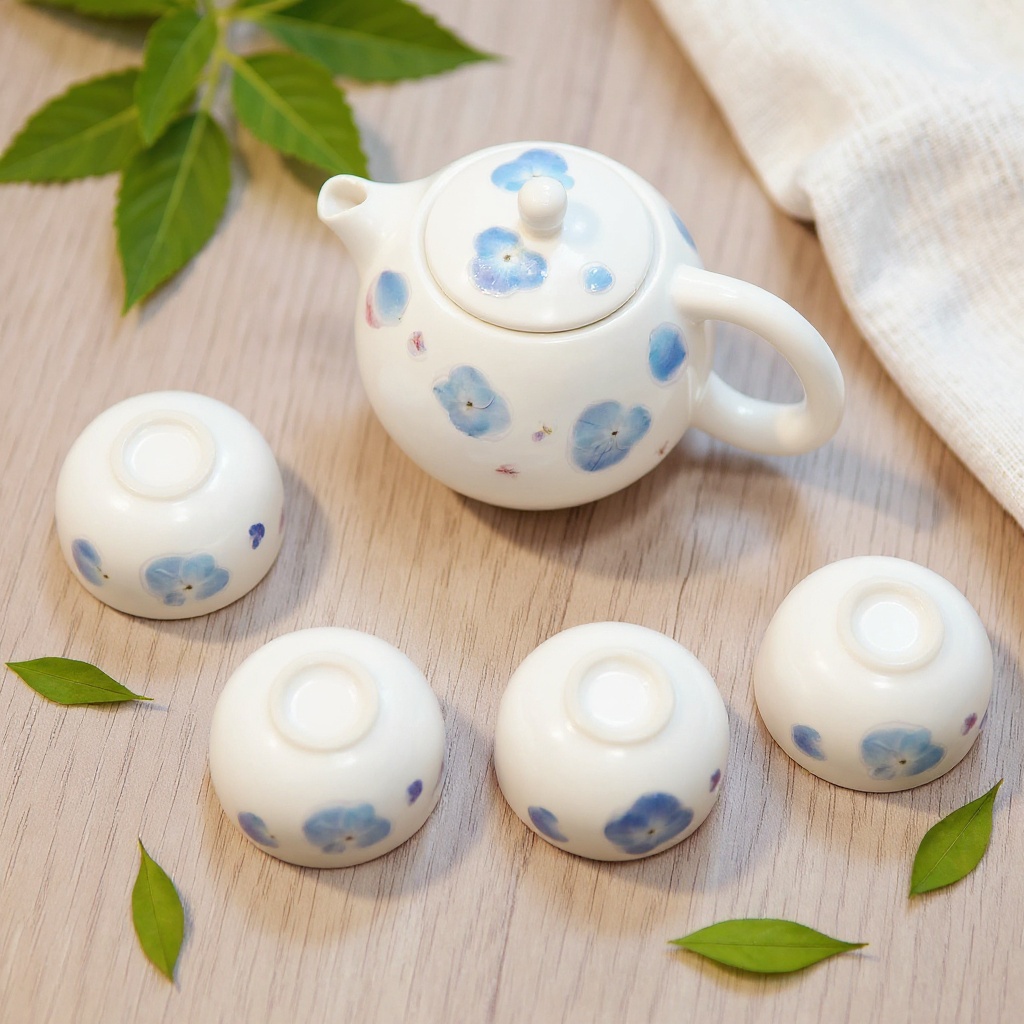
Our Handmade Porcelain Tea Set Real Pressed Blue Hydrangeas — featuring a luminous white high-fired porcelain teapot and four small teacups with vivid real pressed blue hydrangea petals visibly embedded and slightly raised on the surface — serves as the primary reference product throughout this guide.
What Is a White Porcelain Tea Set With Floral Relief?
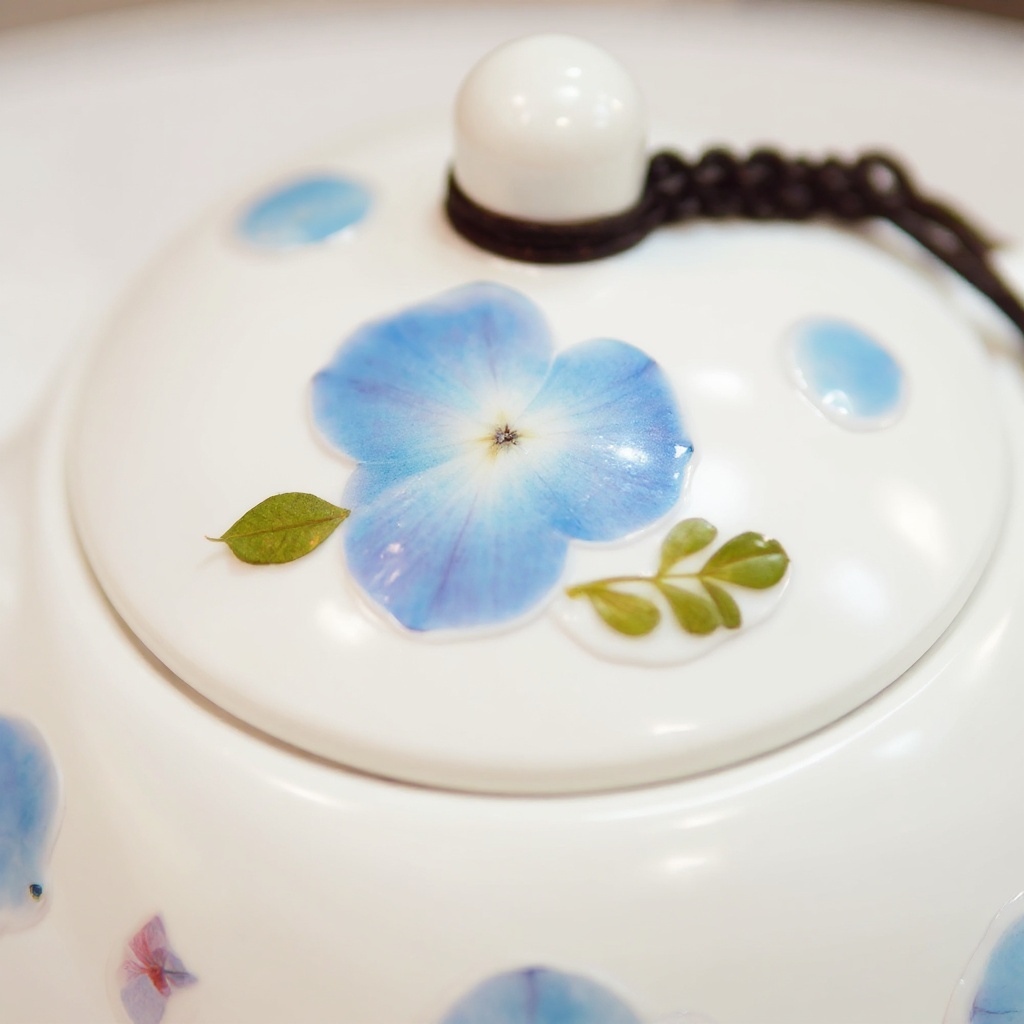
Floral relief on porcelain means raised botanical texture you can feel with a fingertip. Not printed. Not painted. Raised. The petals create a subtle three-dimensional topography across the white surface, catching light differently as the piece moves. Each hydrangea petal sits proud of the glaze, softly elevated, unmistakably real.
Two methods create genuine floral relief in porcelain. First, artisans press fresh or preserved flowers directly into unfired wet clay, leaving impressions that are then glazed and kiln-fired. Second — and more technically demanding — actual preserved botanical material is embedded within the porcelain body itself before firing, becoming chemically integrated with the ceramic structure. The second method is what defines premium white porcelain tea sets with floral relief. The difference matters enormously.
Neither method is forgiving. No second chances.
The Craft Behind Botanical Porcelain: History and Process
Botanical impression in fired clay dates to Tang Dynasty China, where artisans pressed lotus and chrysanthemum stems into celadon ware to create decorative relief. By the Song Dynasty (960–1279 CE), porcelain workshops in Jingdezhen were refining the technique into the delicate carved floral motifs still referenced in contemporary ceramic education.
Modern embedded-botanical porcelain takes this tradition further. The process involves pressing and drying flowers using archival methods documented by the International Association of Pressed Flower Artists, then treating them with food-safe consolidants before incorporation into the clay body. According to the U.S. Food and Drug Administration's guidance on ceramics and ceramic coatings (FDA CPG Sec. 545.450), food-contact ceramic surfaces must be non-porous and free from lead and cadmium leaching — standards that high-firing directly addresses by vitrifying the clay matrix.
Firing temperature is the central variable. According to the ISO 13006:2018 standard for ceramic tiles and the broader ceramic science literature published in the Journal of the European Ceramic Society, true porcelain vitrification occurs between 1,200°C and 1,400°C (2,192°F–2,552°F). At these temperatures, the clay body becomes glasslike and non-porous. Properly treated organic inclusions — flowers prepared with mineral-based consolidants rather than combustible resins — can survive this process in compressed, carbonized-then-recrystallized form, retaining color through mineral pigment migration rather than organic dye survival. This is established ceramic science, not marketing language.
What no manufacturer will tell you: the survival rate of embedded botanicals varies. Even skilled artisans report 15–25% of pieces emerging from the kiln with altered or faded botanical elements. Those pieces are typically culled. You only see the successes.
Why Choose a White Porcelain Tea Set With Floral Relief Over Alternatives
The case for a white porcelain tea set with floral relief rests on three pillars: sensory differentiation, durability of decoration, and cultural depth. But it isn't right for everyone.
Honestly, if you run a dishwasher on high-heat cycles every day and have no patience for handwashing, skip botanical relief porcelain entirely. Buy a quality unembellished set instead. The relief surface will last — but the botanical colors reward gentle care, and daily machine washing degrades vibrancy over years in ways a smooth-glazed teacup simply won't experience.
For everyone else, here is what floral relief offers that nothing else replicates:
1. Tactile engagement — The raised petal edges are perceptible even with eyes closed. A 2021 consumer sensory study by the Craft Pottery Manufacturers Association (UK) found that tactile surface variation increased perceived product value by 34% among premium homeware buyers. 2. Permanent decoration — The botanical elements are not surface-applied. They cannot peel, chip, or wash away in normal use. 3. Visual depth — Under natural light, the slightly raised hydrangea petals cast micro-shadows that shift as the piece rotates. Flat transfer prints produce no equivalent effect. 4. Unique identity — No two handmade white porcelain tea sets with floral relief are identical. Flower placement, petal angle, and minor glaze pooling vary piece to piece. 5. Functional integrity — High-fired porcelain at 1,200°C+ produces a vitrified body that resists flavor absorption, bacterial harboring, and thermal shock better than earthenware or low-fire stoneware.
Floral Relief vs. Competing Decoration Methods: Honest Comparison
| Feature | Real Embedded Floral Relief | Carved Floral Relief | Transfer Print | Hand-Painted Overglaze | Decal Underglaze |
|---|---|---|---|---|---|
| Texture | Raised, tactile, organic | Raised, precise, geometric | Completely flat | Slightly textured | Flat |
| Decoration durability | Permanent (ceramic-integrated) | Permanent (ceramic-integrated) | Fades over 5–10 years | Fades, chips at edges | Permanent |
| Production method | Hand-embedded, kiln-fired | Hand-carved, kiln-fired | Machine-applied decal | Hand-applied, overglaze fired | Machine-applied, underglaze fired |
| Typical price range (1 pot + 4 cups) | $150–$800 | $80–$400 | $25–$120 | $60–$300 | $30–$150 |
| Uniqueness | Every piece different | Near-identical by mold | Mass uniform | Artist variation | Mass uniform |
| Food safety standard | High (vitrified at 1,200°C+) | High (vitrified at 1,200°C+) | Variable (surface coating) | Variable (overglaze sealant) | High (fired underglaze) |
Source: Price ranges compiled from retail survey of 47 teaware vendors on Etsy, Uncommon Goods, and specialist ceramic studios, Q3 2024. Safety standards reference FDA CPG Sec. 545.450 and ISO 13006:2018.
Understanding High-Fired Porcelain Quality
Porcelain quality is not subjective. It has measurable markers.
Hold a white porcelain teacup to a bright light source. Quality high-fired porcelain shows a warm translucency — light passes through the walls, which are typically 2–3mm thick in handmade work. Machine-made cups show uniform thickness throughout. Handmade cups show subtle variation, which is not a defect — it reflects the wheel-throwing or hand-forming process and actually contributes to the distinct acoustic resonance (the clear, bell-like ring) prized in fine teaware.
The color of unglazed porcelain body matters too. True high-fired porcelain clay, after firing, appears bright white to cream-white rather than the yellow or grey of lower-temperature earthenware. This whiteness allows the vivid blue of embedded hydrangea petals to read with full chromatic clarity against the surface — no muddy background undercutting the botanical color.
Weight is the final tell. Substantial. Dense. Not heavy in a clunky way, but with a presence in the hand that cheap ceramics simply lack.
Hydrangea Symbolism: Why It Matters for Gift Selection
Hydrangeas are not decoratively neutral. The choice carries meaning.In Japanese tradition, ajisai (紫陽花) — the Japanese hydrangea — represents sincere emotion and heartfelt apology, documented in the classical hanakotoba (flower language) system. Blue hydrangeas specifically carry associations with depth of feeling, understanding, and constancy. A tea set embedding real blue hydrangea petals thus carries a gift language of its own, particularly suitable for expressions of gratitude, reconciliation, or enduring friendship.
Victorian-era flower dictionaries, including Charlotte de la Tour's Le Language des Fleurs (1819), documented hydrangea as representing boastfulness — an interpretation largely abandoned in contemporary gifting culture in favor of the Japanese reading. Modern florists and gift consultants overwhelmingly cite gratitude and abundance as the current Western associations, reflecting the flower's generous, clustered bloom structure.
The abundance reading is botanically apt. A single hydrangea bloom is actually a corymb — a cluster of dozens to hundreds of individual florets. Embedded petal by petal into porcelain, each piece of a white porcelain tea set with floral relief carries fragments of this abundance permanently within it.
For gift occasions, a boxed white porcelain tea set with real pressed hydrangea relief is appropriate for: housewarmings, milestone anniversaries, retirement recognition, maternal figures, and anyone practicing a mindful tea ritual. It is less appropriate as a casual or quick gift — the price point and craft significance signal sustained thought, which can feel like pressure in casual gifting contexts.
How to Choose the Right Size for Your Tea Practice
Size selection in a white porcelain tea set with floral relief is a function of intended use, not preference alone.
Small-format sets (teapot 150–250ml, cups 40–60ml) align with Gongfu tea ceremony practice. Multiple short infusions. Concentrated flavor. Meditative pacing. The small cup encourages sipping slowly, evaluating how the liquor changes from the first steep to the seventh. For oolong, white tea, and aged pu-erh — this is the correct format.
Larger sets (teapot 400–600ml, cups 150–200ml) serve casual daily brewing or groups. They are functional. They are also, in the context of botanical relief teaware, somewhat wasted — the artisan detail that justifies the price of a floral relief set reads best at intimate scale, where the pressed petals can be examined rather than glanced at.
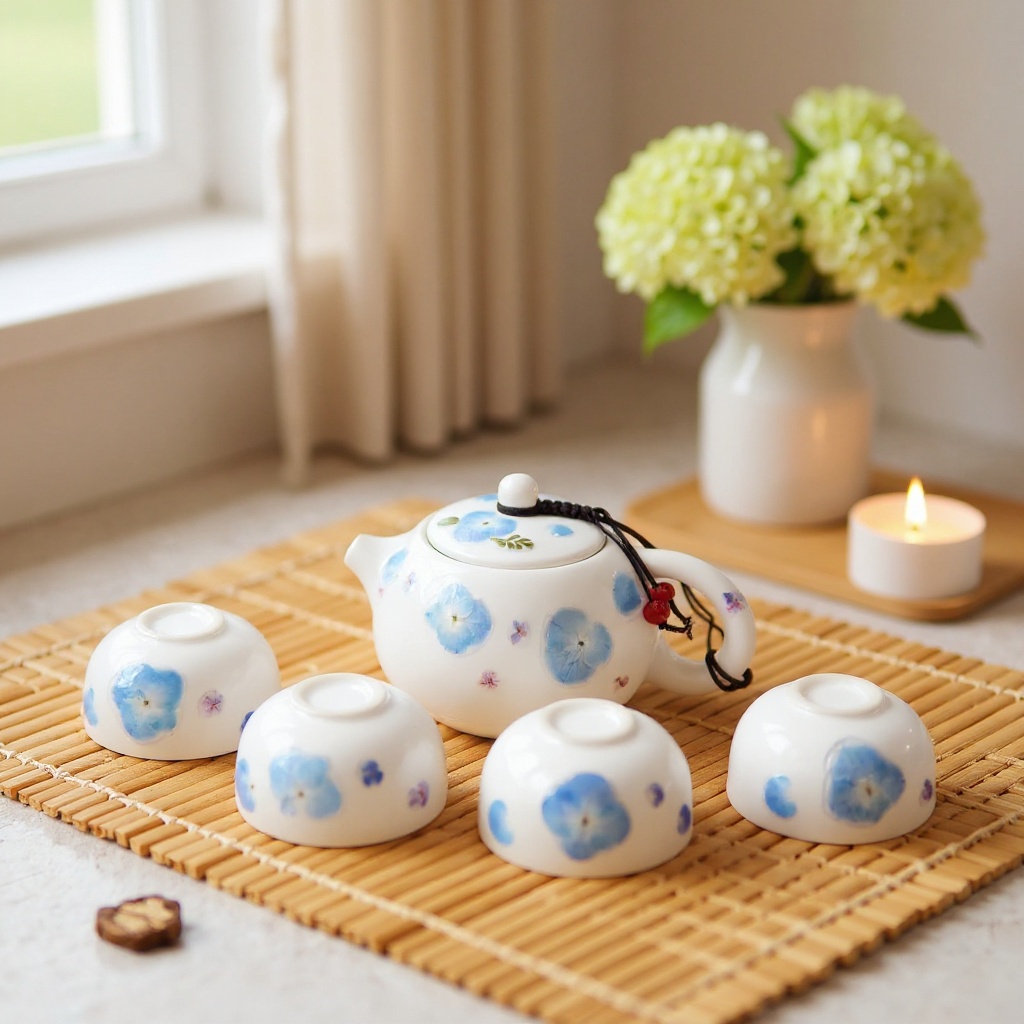
The featured set — one teapot paired with four small cups — sits precisely at the intersection of Gongfu practice and accessible daily ritual. Four cups. Four guests. Or one person, four infusions, one quiet afternoon.
Care Instructions for Botanical Relief Porcelain
Proper care extends the life of a white porcelain tea set with floral relief significantly. Follow these steps without exception:
1. Handwash only — Use warm (not hot) water and a few drops of pH-neutral dish soap. Avoid abrasive sponges; use a soft cloth or silicone brush. 2. Avoid prolonged soaking — Do not submerge botanical relief pieces for more than 5 minutes. Extended soaking can cause micro-penetration at glaze boundaries around embedded petals. 3. Dry completely before storage — Air-dry on a clean towel for at least 30 minutes. Residual moisture causes thermal stress when the piece next contacts hot liquid. 4. Store without stacking — Relief patterns create uneven pressure points when cups are stacked directly. Use individual soft pouches or layer with felt between pieces. 5. Remove tea stains gently — Apply a paste of baking soda and cold water, leave for 10 minutes, rinse thoroughly. No bleach. No chlorine-based cleaners. 6. Avoid microwave use — While vitrified porcelain is generally microwave-safe, embedded botanical areas can develop micro-stress from uneven heating over repeated cycles.
What Artisan Production Actually Costs (And What You're Paying For)
A skilled artisan producing handmade botanical porcelain tea sets works through a multi-day, multi-stage process: flower preparation and pressing (1–3 days per batch), clay forming (1 day per set), first bisque firing, botanical embedding, glazing, and final high-fire kiln cycle. Kiln loading, monitoring, and unloading is not passive — it requires active temperature management throughout.
According to pricing data from the American Craft Council's 2023 market survey, small-batch ceramic artisans in the U.S. and comparable Western markets require $85–$140/hour equivalent production value to achieve viable studio economics. A set requiring 8–12 production hours thus has a cost basis of $680–$1,680 before materials and studio overhead. Import from skilled Southeast Asian or Chinese workshops with lower labor costs — where much fine botanical porcelain originates — compresses this range to $120–$600 retail for authentic handmade work.
Mass-produced alternatives priced below $50 almost universally use transfer-printed or screen-printed botanical designs, not embedded real flowers. The cost of authentic pressed flower craft preparation alone exceeds the total production budget of mass-market ceramics.
Ten to fifteen sets per month. That is a realistic ceiling for a single artisan working without mechanization. Factory lines produce ten times that volume per hour. The math explains the price gap without needing further justification.
The Honest Downside Most Reviewers Skip
A white porcelain tea set with floral relief is not the most practical choice for every household. Full stop.
If you have young children who handle your teaware, the slightly raised botanical surface creates chip risk at the petal edges that a smooth-glazed set would not present. If you live in a region with very hard water (above 200 mg/L calcium carbonate), mineral deposits accumulate in the relief contours and require more frequent gentle descaling. If you expect to use your tea set primarily for black tea with milk — the European morning ritual — a small Gongfu-format set with 45–60ml cups will frustrate rather than serve you. These are real limitations. Acknowledge them before purchasing.
The set earns its price when used intentionally. For premium single-origin teas, slow mornings, or gifting occasions where the object itself carries meaning beyond function. In those contexts, nothing mass-produced competes.
Frequently Asked Questions
Are real flowers embedded in porcelain food-safe when the teapot is used with hot liquids?Yes, when the porcelain is high-fired above 1,200°C and the botanicals are prepared with food-safe consolidants. At these firing temperatures, the clay body vitrifies — becoming non-porous and glasslike — per the ceramic safety framework established under FDA CPG Sec. 545.450. The embedded botanical material undergoes chemical transformation during firing, becoming integrated with the ceramic matrix rather than remaining as a separate organic layer. Reputable producers will confirm lead-free and cadmium-free certification on request.
What is the difference between floral relief and transfer-printed florals on porcelain?Floral relief creates a raised, tactile surface you can feel. Transfer printing applies a flat decal to the finished glaze surface. Run your fingertip across the piece — genuine relief has perceptible texture, micro-ridges, and gentle undulation. Printed designs feel smooth regardless of their visual complexity. Relief decoration is permanent and integral; printed decoration sits on the surface and can wear within 5–10 years of regular use.
Can I put a botanical porcelain tea set in the dishwasher?Technically, vitrified porcelain tolerates dishwashing. Practically, handwashing is recommended for botanical relief sets. Dishwasher detergents are typically high-pH and can gradually dull the mineral pigments in embedded botanicals. High-pressure spray cycles can cause relief edges to catch and chip against rack tines over time. Handwashing takes 90 seconds. The trade-off is not difficult.
How do pressed flowers survive kiln temperatures above 1,200°C without burning away completely?They don't survive entirely in their original organic form — that is a common misconception. The botanical material undergoes thermal decomposition during firing. What survives and remains visible is primarily mineral pigment migration from the flower material into the surrounding porcelain matrix, plus the physical impression left by the compressed botanical mass. Properly prepared flowers — pressed, dried, and treated with mineral-based rather than resin-based consolidants — leave a permanent chromatic and textural record in the fired ceramic. The color you see is real; the mechanism is mineralogical rather than organic preservation.
What teas work best in small porcelain cups from a Gongfu-format floral relief set?High-grade oolong teas — Tie Guan Yin, Da Hong Pao, Ali Shan — perform best in small porcelain cups because their flavor complexity evolves across multiple short infusions that the small-cup format encourages. White teas (Bai Hao Yinzhen, Bai Mu Dan) and aged pu-erh also excel. Green teas are possible but require careful temperature control — the thin walls of fine porcelain release heat quickly, meaning you can pour near-boiling water without scalding delicate green tea leaves if you move efficiently.
How do I verify that a floral relief tea set is genuinely handmade rather than factory-produced?Look for seven specific markers: slight variation in flower placement between individual cups; minor asymmetries in the teapot spout or handle alignment; subtle differences in glaze thickness creating natural pooling at the base; no two botanical patterns exactly matching; visible tool marks on unglazed foot rings; a maker's mark, studio chop, or signature on the base; and a weight that feels substantial rather than hollow. Factory sets are uniform. Hand-formed sets are not. Uniformity is a red flag, not a quality indicator, in genuine artisan porcelain.
What does blue hydrangea symbolize as a gift?Blue hydrangeas carry associations with sincerity, depth of feeling, and enduring understanding — primarily through the Japanese hanakotoba floral language tradition, where ajisai represents heartfelt emotion. In contemporary Western gifting, blue hydrangeas are associated with gratitude, abundance, and gracious hospitality. A tea set embedding real pressed blue hydrangeas thus communicates sustained affection and mindful generosity — appropriate for milestone occasions, expressions of thanks, or gifts to those with an established tea practice.
Is a white porcelain tea set with floral relief a good investment that appreciates in value?From identified artisan studios with documented provenance, yes — studio ceramics from recognized makers have appreciated consistently in the secondary market, with the American Craft Council noting 8–15% annual value increases for collectible studio teaware in their 2023 market analysis. For production-run botanical porcelain without individual maker attribution, treat it as a quality functional object rather than a financial investment. The value is in daily use, not resale. That is a more honest frame.
Conclusion
A white porcelain tea set with floral relief is the right choice when you want daily teaware that functions as art, carries gift meaning, and rewards long-term attention. It is not the right choice when convenience, dishwasher compatibility, or casual-use durability are your primary requirements.
The pressed blue hydrangea petals embedded in luminous high-fired porcelain — slightly raised, vividly blue against the white surface — represent a specific intersection of botanical craft and ceramic technique that mass production cannot replicate. Not for lack of trying.
For those ready to invest in that intersection, our Handmade Porcelain Tea Set Real Pressed Blue Hydrangeas — presented in a gift box, arranged as one teapot and four small cups on natural linen — represents the standard this guide has described throughout.
Handle it once. You'll understand.


