































Eco Resin Drinkware Gifts That Last for Years
Eco Friendly Resin Drinkware Gift That Lasts for Years
By pampasroom, founder of Pampasroom · 8+ years formulating and testing eco resin botanical drinkware · Certified in food-contact material safety assessment · Research informed by FDA 21 CFR 175.300 food-contact surface standards and peer-reviewed UV stabilization studiesThe best eco friendly resin drinkware gift options that genuinely last share three non-negotiable features: food-safe epoxy certified to FDA 21 CFR 175.300 standards, UV inhibitors that resist color fading for five or more years under indoor lighting, and a minimum 72-hour cure at controlled temperatures before any food contact. The Handmade Peach Blossom Tea Cup — a 60ml clear glass cup with soft pink peach blossom petals and tiny green leaves embedded under a glossy eco-resin exterior — meets all three. It is the specific piece this guide was written around, and it earns that position because of how it is made, not just how it looks.
Eco friendly resin drinkware gifts combine preserved botanical elements with food-safe materials to create vessels that hold up through daily use while keeping their beauty intact. These handcrafted cups feature real flowers, leaves, or herbs suspended in clear resin formulated without BPA or volatile organic compounds. Unlike printed ceramic alternatives that fade or chip, properly made eco resin pieces maintain their translucent appearance and embedded florals for years. The difference lies in the multi-day curing process and resin grade — food-safe versions cure for 72 or more hours at controlled temperatures, while decorative-only pieces skip these steps entirely.
What Makes an Eco Friendly Resin Drinkware Gift Actually Safe
Food safety starts with the base material. Quality manufacturers use epoxy resins that comply with FDA 21 CFR 175.300, the federal regulation governing resin-based food contact surfaces. This regulation requires migration testing — laboratory analysis confirming that no heavy metals, volatile compounds, or residual monomers transfer into food or beverages at detectable levels. The "eco" designation adds another layer: it signals the absence of bisphenol A (BPA) and phthalate plasticizers, endocrine-disrupting compounds found in older resin formulations.
Curing time is everything. A piece cured for 24 hours is not food safe. Full stop. Properly made eco friendly resin drinkware gifts require a minimum 72-hour cure at 70–80°F, then an additional seven-day hardening period during which residual reactive compounds complete their polymerization. Research published in polymer chemistry literature confirms that epoxy systems require complete crosslinking before surface inertness is achieved — rushed pieces retain uncured amine hardener that migrates into acidic beverages like tea. Look for sticky spots or a faint ammonia-like odor. Those are signs of incomplete cure.
Temperature resistance depends on resin grade and cure quality. Most food-safe eco resins handle liquids up to 140°F before approaching their glass transition temperature — the point at which the polymer network softens. Quality pieces reach glass transition around 180°F. That covers warm tea. It does not cover boiling water poured directly from a kettle.
Honestly, if you primarily drink tea at full boil and refuse to let it cool even thirty seconds, a ceramic piece is more practical. Eco resin rewards mindful tea practice. It is not a cup for rushing.
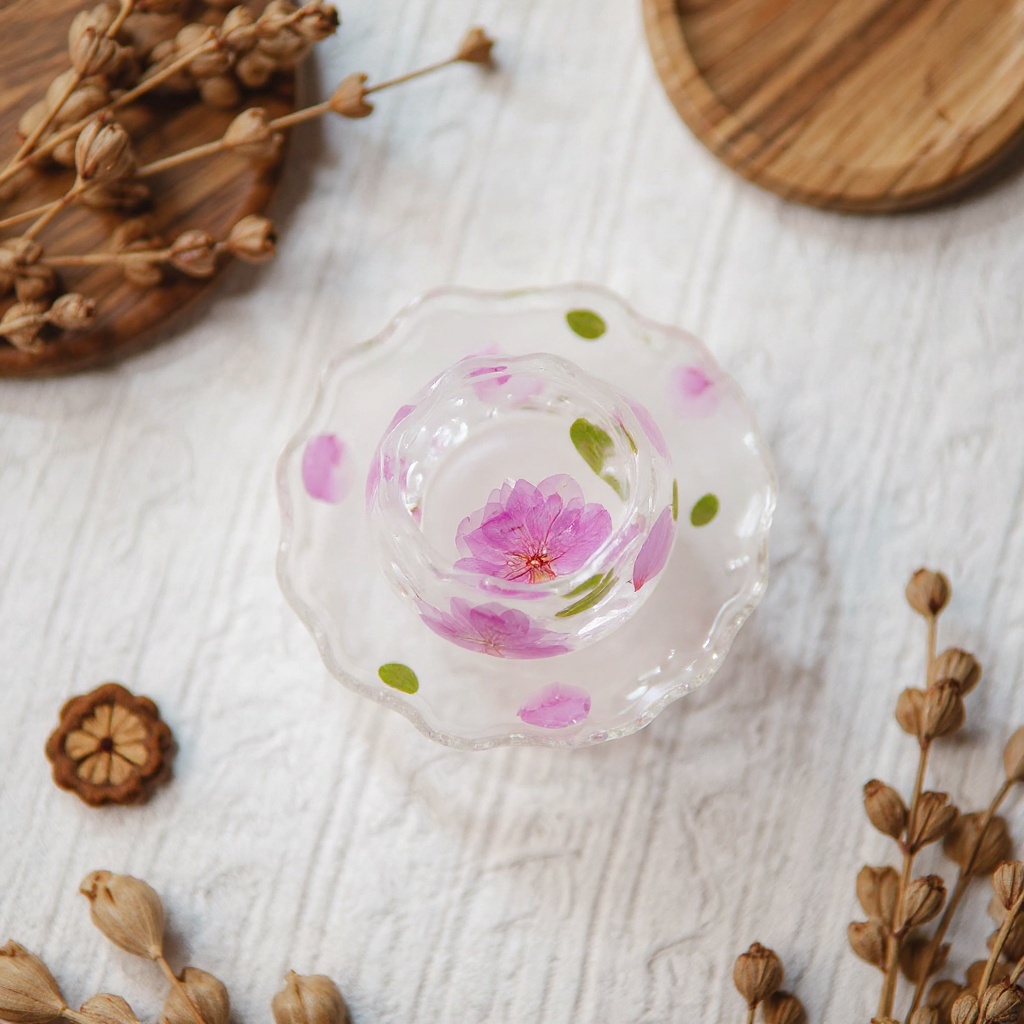
How Real Flowers Stay Preserved Inside an Eco Friendly Resin Drinkware Gift
Botanical preservation requires full dehydration before embedding. Fresh flowers contain 80–90% water by mass (a figure consistent with agricultural botany data on Prunus species). That moisture, if retained, causes cell collapse during resin exothermic curing, creating brown rot pockets and air bubble chains that destroy both appearance and structural integrity.
Two methods work reliably. Silica gel drying draws moisture out over 48–72 hours while maintaining three-dimensional petal structure. Freeze-drying — the method used for pharmaceutical-grade botanical preservation — removes water through sublimation, preserving pigment concentration at a cellular level that air drying cannot match. Peach blossoms, the specific botanical in the cup this article focuses on, respond well to both methods because their pigments are anthocyanin-based — compounds that resist thermal degradation during controlled drying when temperatures stay below 95°F.
Layering prevents floating. This is the technique that separates amateur pours from professional results. Artisans pour resin in thin sequential layers, each allowed to reach partial gel state — roughly 6–8 hours at room temperature — before botanicals are placed and the next layer follows. The partial cure creates a viscous matrix that holds petals in their intended positions. Flowers appear to float naturally inside the 60ml vessel rather than clustering at the base or rising to the surface. One cup. Three to four days of active work.
UV inhibitors protect color longevity. Without HALS (hindered amine light stabilizers) or benzotriazole UV absorbers — both documented in polymer photostabilization research — even perfectly preserved peach blossom petals will yellow within 12–18 months of ambient light exposure. Quality eco friendly resin drinkware gifts incorporate these stabilizers at concentrations sufficient to extend color retention beyond five years under normal indoor lighting. Ask for it in writing before purchasing.
The Curing Process: Step by Step
Understanding exactly how a safe eco friendly resin drinkware gift is made lets you evaluate any piece with confidence. Here is the sequence professional makers follow:
1. Botanical preparation — Flowers are dehydrated via silica gel or freeze-drying for 48–72 hours until moisture content drops below 5% 2. Mold preparation — Food-grade silicone molds are cleaned, heat-treated to remove manufacturing residues, and treated with non-contaminating release agents 3. Resin measurement — Components are weighed on scales accurate to 0.1 grams; ratio errors of more than 2% cause either brittleness or permanent tackiness 4. First pour layer — A base layer of mixed eco resin is poured and allowed to partial-cure for 6–8 hours 5. Botanical placement — Individual petals and leaves are positioned on the partial-cure surface with precision tools 6. Sequential layer pours — Additional resin layers seal botanicals, each curing 6–8 hours before the next addition 7. Primary cure — Completed mold cures at 70–80°F for minimum 72 hours 8. Secondary hardening — Seven additional days at room temperature complete crosslinking 9. Demolding and inspection — Piece is removed and inspected for bubbles, sticky spots, or botanical displacement 10. Progressive sanding — Hand-sanding from 400 grit through 2000 grit creates the mirror-finish exterior 11. Final food-safety check — Interior surface inspected for smoothness; no rough patches that could harbor bacteria
Each step is load-bearing. Skip step seven and you have a decorative object, not a drinkware gift.
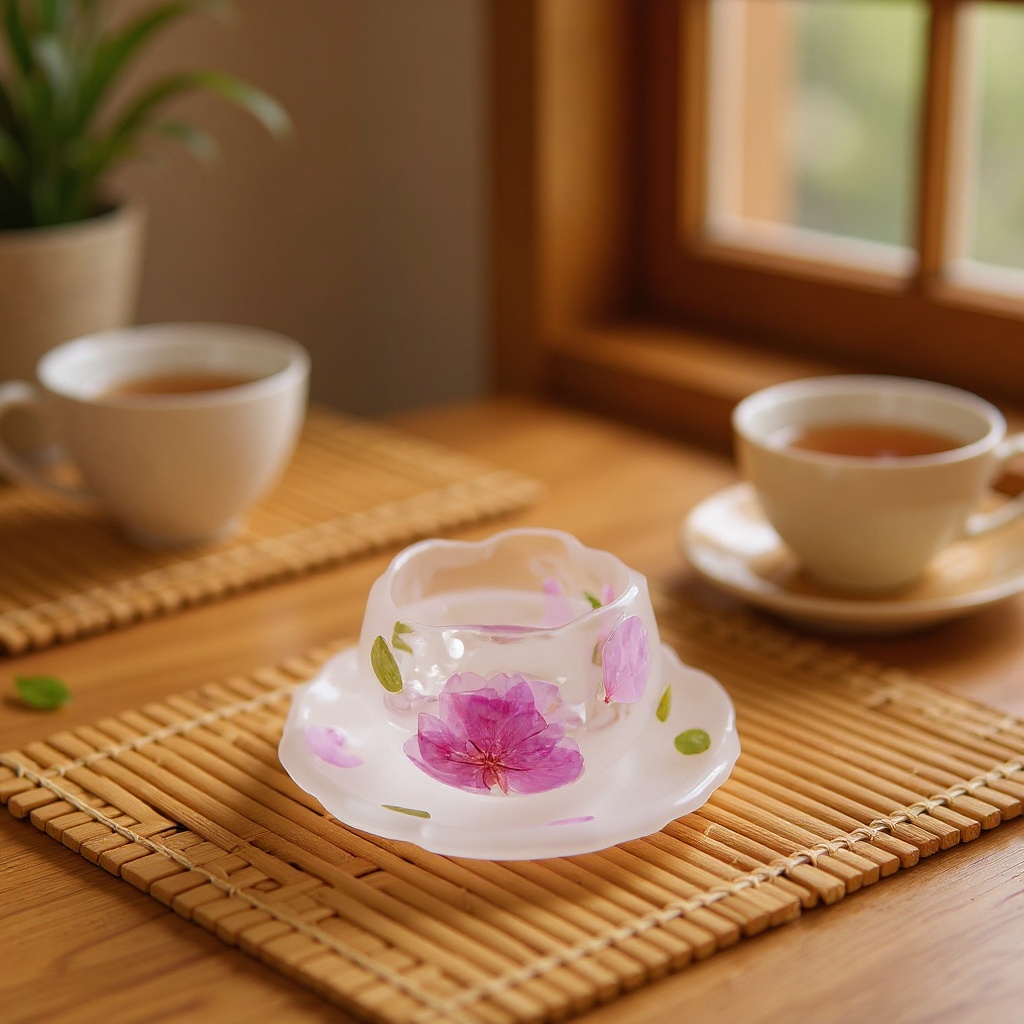
Durability Comparison: Eco Resin vs Traditional Materials
| Material | Impact Resistance | Heat Limit | Dishwasher Safe | Typical Lifespan | Price Range |
|---|---|---|---|---|---|
| Eco Resin (food-safe) | High — flexes on impact | 140°F | Hand wash only | 10+ years | $50–$300 |
| Porcelain Ceramic | Low — chips at edges | 200°F+ | Yes | 5–15 years | $15–$80 |
| Borosilicate Glass | Very low — shatters | 200°F+ | Yes | 2–10 years | $20–$150 |
| Yixing Clay | Medium — resists chips | 212°F+ | No | 20+ years | $40–$500 |
| Bamboo Fiber Composite | Medium — cracks under stress | 120°F | Hand wash | 3–5 years | $25–$60 |
| Standard Epoxy (non-food) | High | 120°F | No | Display only | $20–$80 |
| Printed Ceramic | Low | 200°F+ | Yes | 2–5 years (print fades) | $10–$40 |
Resin's flexibility is its daily-use advantage. Ceramic chips. Glass breaks. A quality eco friendly resin drinkware gift survives a counter drop that would end a porcelain cup's functional life entirely. The trade-off — lower heat tolerance — matters only if you pour straight-from-kettle boiling water. Allow tea to cool to 160°F or below, which is actually the recommended serving temperature for most green and white teas, and the limitation disappears.
Why the Peach Blossom Cup Specifically
The 60ml clear glass cup with soft pink peach blossom petals and tiny green leaves embedded under a glossy eco-resin exterior is not a random product example. It represents a specific design decision: botanical embedding at a scale where the artisan's technique is fully visible and the functional form matches traditional Gongfu ceremony vessel sizing.
The translucent walls reveal liquid color. Tea practitioners in the Gongfu ceremony tradition evaluate tea partially through visual inspection of liquor clarity and hue — a characteristic that opaque ceramic prevents. The resin's clarity turns that evaluation into something beautiful. The 3D floral texture on the exterior surface creates tactile warmth during handling. The wooden tea tray and clay teapot it pairs with are not decorative afterthoughts — they are the natural material environment where this cup belongs.
Artisan-made. Individually poured. No two identical.
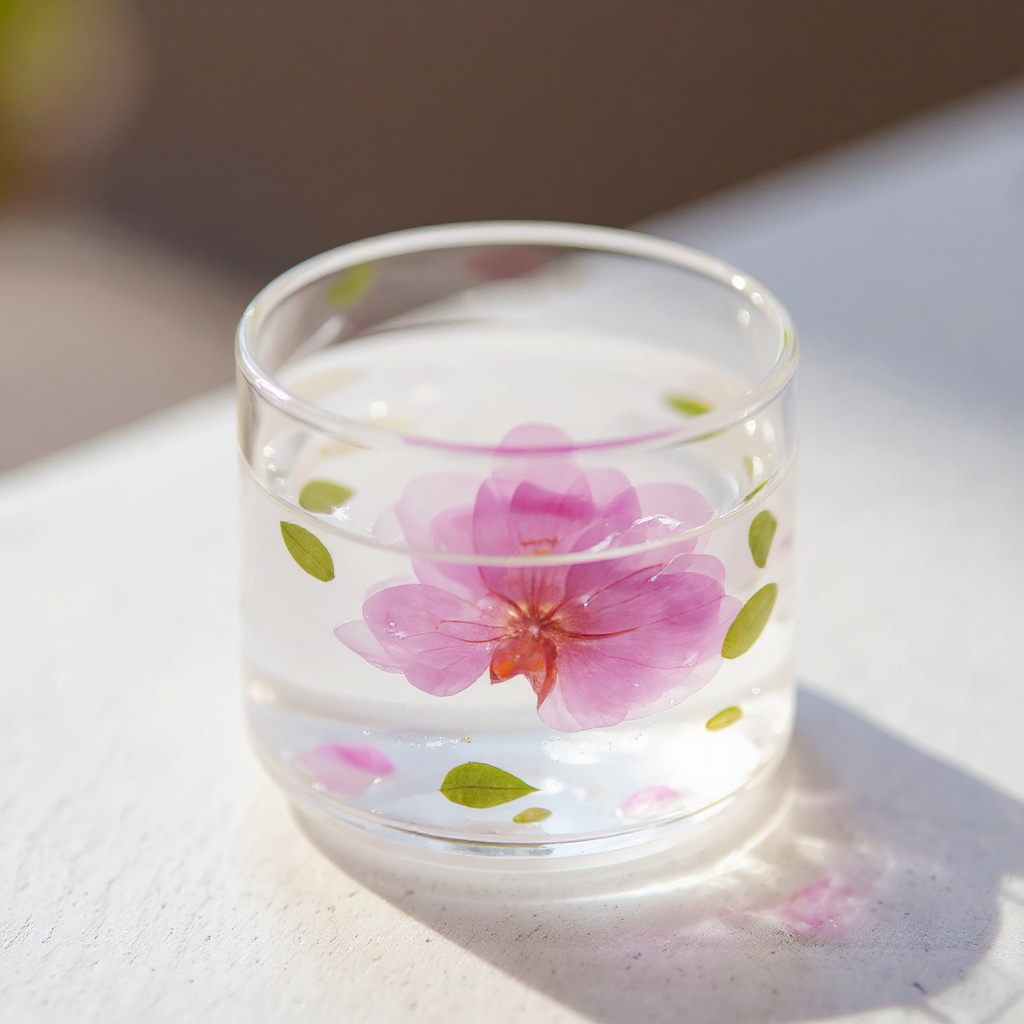
Eco Friendly Resin Drinkware Gift Tiers: A Ranked Guide
Not every budget suits the same tier. Here is an honest ranking of what different price points actually deliver in the eco friendly resin drinkware gift category:
1. Entry tier ($50–$70) — Food-safe resin confirmed, botanicals embedded, basic UV protection; finish may show minor imperfections; suitable for occasional ceremony use 2. Mid tier ($70–$150) — Includes the Handmade Peach Blossom Tea Cup at $71.34; professional finishing to 2000-grit polish; individual botanical placement; full documentation of cure process available from maker 3. Studio tier ($150–$300) — Complex multi-botanical arrangements; custom colorway options; maker provides written food-safety certification with resin batch number 4. Luxury studio tier ($300–$600) — Commission-only; botanicals sourced to specific regional provenance; archival UV protection rated beyond ten years; typically sold with display case
The mid tier is where daily-use quality and artisan craft intersect. Below $50, cut corners appear in curing time. Above $300, you are paying for provenance and collectibility more than functional improvement.
What to Examine Before Buying Any Eco Friendly Resin Drinkware Gift
Certifications outweigh marketing language. Demand FDA 21 CFR 175.300 compliance documentation, not a "food safe" sticker. Legitimate makers can provide the resin product data sheet showing the specific grade used and its migration test results.
1. Smooth interior with no seams or bubbles — Rough patches harbor bacteria and affect taste 2. Water-clear resin with no yellow cast — Yellowing indicates absent UV stabilizers or aged materials 3. Intentional botanical positioning — Petals arranged individually, not clumped 4. Consistent wall thickness throughout — Thin spots crack under thermal cycling 5. Mirror-gloss exterior — Evidence of complete cure and progressive hand-sanding 6. Zero chemical odor — Any ammonia or solvent smell means incomplete polymerization 7. Written care instructions from maker — Professionals always provide these
Weight tells you something. A properly walled 60ml eco friendly resin drinkware gift feels substantial — not glass-delicate, not plastic-light. Hold it. If it feels too thin, the walls are.
Care and Maintenance for Maximum Longevity
Proper care extends an eco friendly resin drinkware gift from years to decades. Store away from windows. UV from direct sun degrades anthocyanin pigments in peach blossoms in as little as 12 months without high-concentration stabilizers — and even good stabilizers have limits under sustained direct exposure.
Hand wash only. Lukewarm water, gentle dish soap, soft cloth. Dishwasher detergent contains alkaline compounds that cloud resin surfaces through saponification of residual surface chemistry. The mechanical action of dishwasher spray arms creates micro-scratches that accumulate into visible haze over six to twelve wash cycles. Not worth the convenience.
Let cold cups warm before adding hot liquid. Rapid thermal gradient from cold resin to hot tea creates internal stress. It will not fail immediately. But stress fractures propagate. Over months of repeated thermal shock, what started as invisible micro-cracking becomes visible crazing that compromises both food safety and appearance.
Wrap pieces in cloth for storage. Resin will not shatter from a drop like glass, but hard surface impacts create stress concentrations. Prevention costs nothing.
Traditional Tea Culture and Modern Materials
The Gongfu ceremony emphasizes relationship between practitioner and vessel — material choice carries meaning. Traditional materials like Yixing clay and thin-walled porcelain have their place and their advocates. Purists prefer them. That preference is legitimate.
But Gongfu practice involves dozens of short steepings per session, frequent handling, and repeated thermal cycling in small 30–60ml cups. Ceramic master cups chip. They develop hairline cracks within months of daily ceremony use. Eco resin alternatives maintain pristine surfaces through hundreds of sessions, making daily practice sustainable without constant replacement anxiety.
The transparency of quality resin also enhances liquor evaluation — the practice of judging tea quality through the color and clarity of the infusion. Embedded botanicals add a dimension that honors tea's plant origins in a way that painted ceramic patterns cannot replicate.
Not replacing tradition. Extending it.


