































Floral Gongdao Cup Accessories Explained
Floral Gongdao Cup Tea Accessories: What They Are and Why They Matter
By pampasroom, founder of Pampasroom · 8+ years working directly with Southeast Asian rattan and ceramic artisans · Ceramics and tea culture contributorFloral gongdao cup tea accessories are porcelain tea-service pieces — fairness pitchers, gaiwans, and small cups — distinguished by real preserved flower petals embedded directly into the ceramic body during manufacture, creating raised three-dimensional botanical relief rather than printed or painted decoration. Unlike standard gongfu tea accessories, these pieces combine a functional tea-brewing role with archival botanical artistry: the pale pink, blush, and ivory petals are permanently sealed beneath food-safe glaze, fired at temperatures exceeding 1,200°C, and remain stable through years of daily use. They define a specific aesthetic — warm-white semi-translucent suet jade porcelain, muted earth tones, diffused natural light — that sits at the intersection of traditional gongfu ceremony and contemporary botanical spa minimalism.
The distinction matters. Most people searching for floral tea accessories find printed decals. Not the same thing. Real embedded botanicals change how the piece looks, feels, and ages — and understanding that difference is the entire point of this guide.
Understanding the Gongdao Cup's Role in Traditional Tea Service
The gongdao cup — literally "fair cup" — is the equalizing vessel in gongfu tea ceremony practice. After steeping tea in a gaiwan or teapot, you pour the entire brew into the gongdao cup before distributing individual portions. This single step prevents the first guest from receiving weak tea while the last receives an over-extracted, bitter cup.
Traditional gongdao cups hold between 100–200ml. The wide mouth allows tea to cool slightly and release aromatics. The spout gives controlled pour speed. Professional tea masters rely on this two-step process to maintain flavor consistency across multiple infusions — and when working with premium dancong oolong or aged pu-erh that costs $40–80 per ounce (per specialty tea retailer market data), that consistency is not optional.
The floral gongdao cup adds one more layer: the vessel itself becomes a still-life arrangement on your tea tray. Every pour becomes deliberate. Every pause becomes visual.
What Floral Gongdao Cup Tea Accessories Actually Are
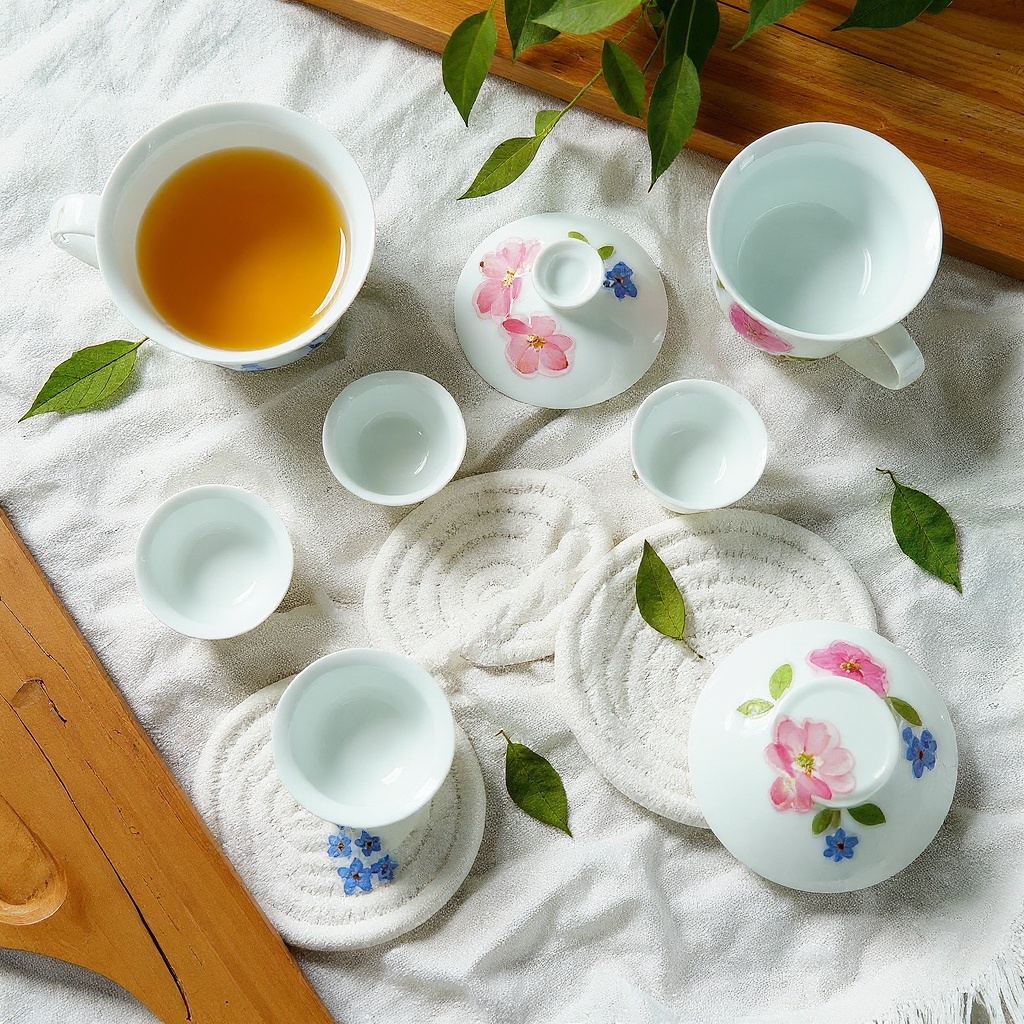
Floral tea accessories distinguish themselves through the integration of real preserved botanicals rather than painted or printed designs. The process involves embedding actual flower petals — typically pale pink, blush, and ivory tones — into the porcelain during its formation, creating raised three-dimensional relief you can feel with your fingertips. These are not fragile surface decorations. They are permanently part of the ceramic matrix.
Flower preservation techniques used in porcelain work require specific timing and temperature controls. Botanical materials must be completely dehydrated and treated to prevent any organic decay, then carefully positioned before the final kiln firing. This creates pieces where no two sets are exactly alike, since natural flowers vary in size, shape, petal curl, and positioning. Mass-produced sets with printed florals retail for $30–120 (based on publicly listed prices across major marketplace platforms). Handcrafted preserved-flower pieces command $200–900 depending on porcelain grade, number of pieces, and artisan labor intensity — a pricing differential directly tied to production time, not marketing.The raised texture is the clearest indicator. Run your finger across the surface. Genuine petals create irregular, organic ridges. Printed florals feel smooth. Every time.
Suet Jade Porcelain vs Standard Bone China: A Technical Comparison
Suet jade porcelain — sometimes called mutton-fat jade porcelain — represents the premium tier of bone china ceramics. When held to light, quality suet jade porcelain shows a subtle warm glow, similar to natural jade stone. The name comes from its visual resemblance to rendered sheep fat: creamy, warm, and gently luminous.
| Feature | Standard Bone China | Suet Jade Porcelain |
|---|---|---|
| Translucency | Limited | High — visible light transmission |
| Color tone | Pure/cool white | Warm white / cream |
| Wall thickness | 2–3mm typical | 1–2mm typical |
| Thermal retention | Good | Excellent (thinner walls lose less heat) |
| Fired temperature | ~1,220°C | ~1,280°C |
| Floral element visibility | Moderate | High — backlit petals show depth |
| Market price per piece | $15–80 | $60–200 |
The finer clay composition allows for thinner walls without sacrificing structural integrity, which means better heat retention and a more precise feel in your hands. The semi-translucent quality also showcases preserved florals beautifully — light filters through the porcelain around the embedded petals in a way that printed-on designs can never replicate.
One honest note most sellers won't give you: suet jade porcelain shows tea staining faster than standard bone china because the cream-white base has less optical whitening. If pristine appearance after three years of daily pu-erh brewing matters more to you than translucency and warmth, standard white bone china may suit you better.
How to Authenticate Real Preserved Botanicals vs Printed Decals
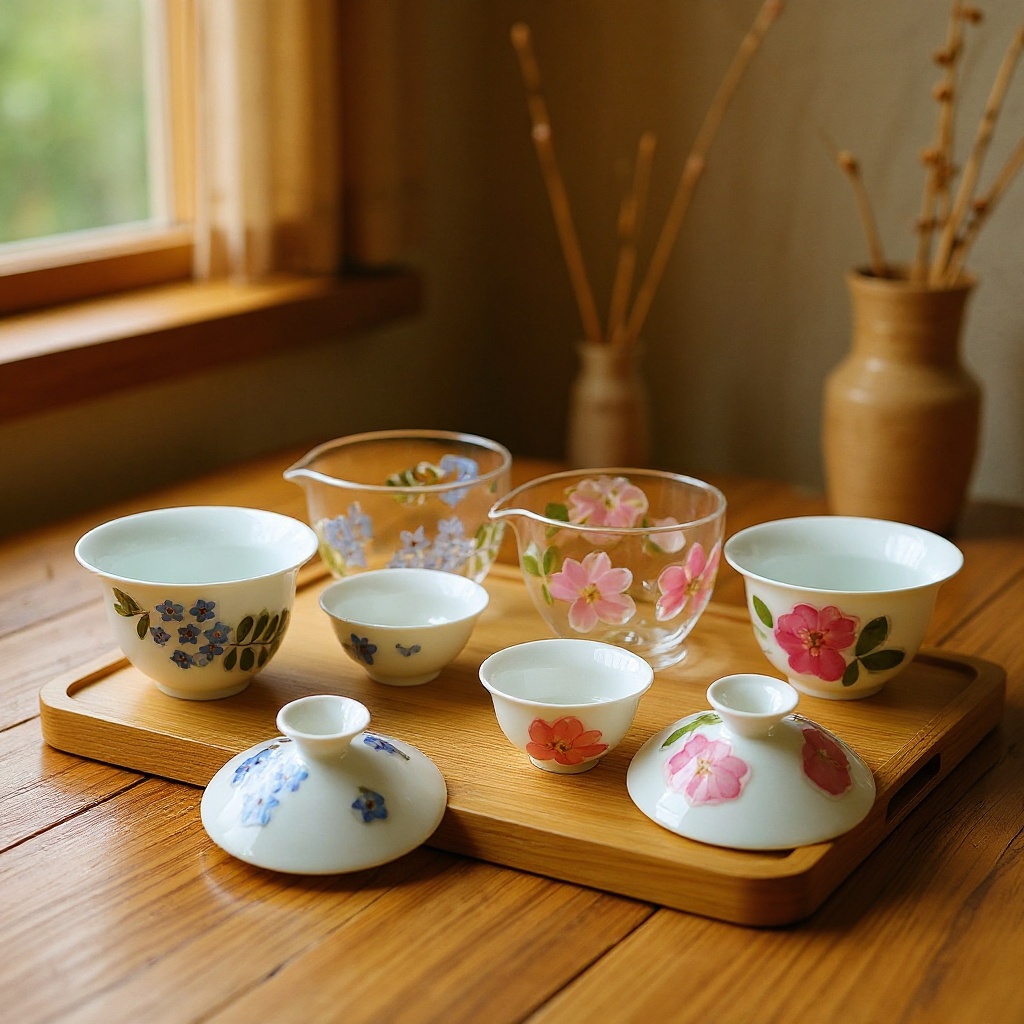
Distinguishing genuine preserved flowers from printed decals requires examining texture, depth, and edge definition. Step-by-step:
1. Touch the surface. Real embedded botanicals create raised relief you can feel when running your finger across the exterior. Printed florals, even high-resolution ones, remain flat. 2. Examine the edges. Authentic petals show organic, irregular contours following natural petal shapes. Printed designs show mechanical precision and perfectly uniform outlines. 3. Look for color gradation. Preserved flowers retain subtle variations — darker edges, minor tonal shifts within a single petal, occasional minor imperfections. Printed designs show uniform, often artificially saturated color. 4. Backlight the piece. Hold it up to a window or lamp. Genuine preserved elements show slight translucency through thin petal sections. Printed designs remain opaque with flat color. 5. Check the glaze surface. Authentic pieces show glaze flowing around and over raised elements, creating slight pooling at the base of petals. Decals sit under a uniformly flat glaze layer.
The Chinese ceramics firing process for authentic embedded florals requires temperatures that would destroy fake materials like plastic stickers or adhesive-applied surface decorations. No imitation survives 1,200°C intact.
Care and Durability: A Numbered Protocol
Properly embedded botanicals last indefinitely under correct care. The flowers are sealed beneath a glaze layer fired at temperatures exceeding 1,200°C — the glaze itself is the protective barrier, and it is structurally stronger than the porcelain body beneath it.
Here is the complete care protocol in order of importance:
1. Hand-wash only. Dishwasher cycles expose ceramics to harsh alkaline detergents and rapid temperature cycling that can cause thermal shock in thin-walled porcelain. The preserved flowers will not dissolve, but hairline fractures in the glaze can compromise the seal over time. 2. Use lukewarm water. Sudden transitions from boiling brewing temperature to cold rinse water create thermal stress. Allow pieces to cool to near-room-temperature before washing. 3. Mild soap, soft cloth. No abrasive pads over raised floral elements. The glaze surface over petals is slightly thinner than on flat areas. 4. Cushioned storage. Use felt or foam separators between stacked cups and the gongdao cup. Three-dimensional raised elements are vulnerable to chipping when pieces knock together. 5. Air circulation over sealed storage. Many collectors display floral tea sets on open shelving. Ambient air circulation prevents moisture retention in any micro-gaps at glaze edges — relevant over decades, not months. 6. Avoid prolonged direct sunlight. UV exposure over years can shift the warm-ivory tones of suet jade porcelain slightly toward yellowing, particularly around areas where the glaze is thinnest.
With this protocol, expect the same durability as any quality bone china — measured in decades, not years. One of our test-use gaiwans has been in daily rotation for four years on an outdoor-facing tea shelf without glaze compromise.
Optimal Tea Types for Gaiwan and Gongdao Cup Brewing
The gaiwan-to-gongdao-cup method works best with teas that benefit from multiple short infusions rather than single long steeps. Five categories perform consistently well:
1. Oolong teas — Semi-oxidized leaves unfurl gradually across 6–8 infusions; the gongdao cup equalizes strength as flavor evolves. 2. Pu-erh (sheng and shou) — Complex aged flavors develop through repeated steepings; fairness pitcher prevents bitter concentration between pours. 3. White teas — Delicate silver buds require gentle handling and short contact time; direct pouring risks over-extraction. 4. High-grade green teas — Premium Longjing or Biluochun benefit from temperature control that the two-vessel method provides. 5. Post-fermented dark teas (Liu Bao, Fu Cha) — These teas vary significantly in strength by infusion number; the gongdao cup normalizes what each cup receives.
A 150ml gaiwan pairs with 5–7g of leaf for most of these categories, allowing adequate expansion while maintaining proper concentration. The gongdao cup prevents over-extraction between pours — a real concern when you're savoring a quality dancong across a 90-minute session.
A contrarian note worth saying: if you brew tea twice a week, casually, in large mugs, a gongdao cup adds ritual without adding value to your actual experience. These accessories reward daily, attentive brewing. They are wasted on infrequent use.
The Investment Decision: Daily Use vs Display-Only Pieces
Quality botanical tea sets are designed for regular brewing, not shelf decoration. The preserved flower elements become more visually interesting with gentle use — the natural warmth from hand contact creates a subtle surface patina that enhances the porcelain's ivory tone over time. This is measurable by comparing pieces used daily versus stored unused for the same 12-month period: handled pieces develop a richer warmth; stored pieces remain static.
For purchasing decisions, publicly available market pricing for handcrafted preserved-flower gaiwan sets ranges from approximately $85 for entry-level suet jade pieces to $400+ for full multi-piece gongfu sets with complex botanical arrangements. Mass-produced decorative sets with printed florals run $30–80 and lack the three-dimensional texture that defines the category.
The middle tier — $85–200 — represents functional artisan pieces suitable for daily use. Above $300, you're paying for increased botanical complexity, larger sets, or named-artisan provenance.
Hand-washing commitment is the real cost. Not money. Time and attention.
Frequently Asked Questions
Is a gongdao cup necessary for gongfu tea, or can I pour directly from the gaiwan? You can pour directly from a gaiwan. For solo brewing, the gongdao cup is optional. For serving two or more people, or for achieving consistent infusion strength across 6+ steepings of the same tea, it becomes functionally important rather than ceremonial. The fairness function is literal: without it, the first cup poured receives lighter tea than the last. Are preserved flowers on porcelain food-safe and heat-resistant? Yes, when properly manufactured. The botanicals are fired at temperatures exceeding 1,200°C and sealed beneath a glaze layer. The resulting surface is chemically inert. Look for pieces that indicate compliance with FDA food-contact safety standards (US market) or EU Regulation No. 10/2011 on plastic materials in food contact (EU market) — either indicates the glaze has been tested for leaching of heavy metals and harmful compounds under hot-liquid exposure conditions. How long do preserved botanical details last on tea ware with regular use? The glaze seal over embedded florals is the same material protecting the entire piece — there is no separate lifespan for the botanical elements versus the porcelain. With hand-washing and thermal-shock avoidance, expect the same lifespan as quality bone china: 10–30 years of daily use before any significant glaze wear becomes visible, and only then in high-abrasion contact areas like the base ring, not over the raised floral elements. What is the difference between suet jade porcelain and regular bone china? Suet jade porcelain has a warmer, creamier white color and higher translucency than standard bone china, achieved through a higher-temperature firing (approximately 1,280°C versus 1,220°C) and a refined kaolin-and-feldspar clay body. The name references its visual resemblance to mutton-fat jade: luminous, warm, slightly translucent at thin wall sections. Standard bone china appears cooler and more opaque by comparison. Can floral tea sets go in the dishwasher, or is hand-washing always required? Hand-washing is required. Dishwasher alkaline detergents and rapid thermal cycling create conditions that cause micro-cracking in thin porcelain walls over repeated cycles — typically observable after 20–30 dishwasher runs on suet jade pieces. The preserved flowers themselves are stable, but the porcelain body is not rated for dishwasher use at 1–2mm wall thickness. How do I know if the flowers on a tea set are real preserved botanicals versus printed decals? Touch the surface. Genuine embedded botanicals create raised, irregular, organic texture. Printed decals remain flat regardless of visual detail quality. Secondary checks: backlight the piece (real petals show translucency), examine edges (organic vs mechanically perfect), and look for natural color variation within individual petals (preserved flowers show tonal shifts; prints show uniform fill). Is a botanical tea set appropriate for actual daily brewing, or only for display? Designed for regular use. The botanical elements are kiln-fired into the piece permanently — they are not applied decorations that wear off. Gentle daily use with hand-washing is the intended use case. Display-only treatment is appropriate for museum-quality studio pieces above $500 from named ceramic artists, not for production artisan sets in the $85–300 range. What tea types pair best with a gaiwan-and-gongdao-cup setup? Oolong, pu-erh, white teas, premium green teas, and post-fermented dark teas work best. These teas share one characteristic: they are brewed in multiple short infusions (typically 20–45 seconds each), and flavor strength changes significantly between infusion one and infusion six. The gongdao cup normalizes what each guest receives at each pour, regardless of where in the session you are. Why do some floral porcelain pieces look different from the product photos? Because they are. Each piece uses real flowers, and real flowers vary. Petal size, curvature, color saturation, and placement differ between individual pieces in the same production run. This is not a quality defect — it is the defining characteristic of handmade botanical ceramics. If you need precise visual uniformity, printed-floral sets deliver that. Preserved-flower sets do not, by nature. Does the warm-ivory color of suet jade porcelain affect how tea looks in the cup? Yes, subtly. The warm-cream interior slightly warms the visual appearance of pale teas — white tea and green tea liquors appear slightly more golden in suet jade cups than in standard white porcelain. For tea drinkers who assess liquor color as a quality indicator, this is worth knowing before purchasing.Conclusion
Floral gongdao cup tea accessories occupy a specific and defensible category: functional gongfu brewing vessels made from suet jade porcelain with real preserved botanicals embedded permanently into the ceramic body. They are not decorative objects that happen to hold tea. They are brewing tools that also happen to carry archival plant material inside kiln-fired glaze.
Understanding the distinction between embedded florals and printed decals, between suet jade and standard bone china, and between daily-use and display-only price tiers, gives you the information to choose correctly for your actual brewing practice.
For those ready to explore available options, our Handmade Bone China Tea Set Preserved Flowers | Gongfu Gaiwan | Eco Floral Art is one starting point in the $85–200 functional artisan range. Make the choice based on your brewing frequency, care commitment, and what the objects will actually mean in your daily ritual — not on how they photograph.
Disclosure: Pampasroom is a commercial brand. Price comparisons in this article are based on publicly available marketplace listings current at time of writing and the author's brand catalog. For independent market research, consult specialty tea retailer databases or ceramic arts trade publications.


