































Luxury Chinese Tea Sets for Women Worth Owning
Luxury Chinese Tea Set for Women Worth Owning
By Dr. Mei-Lin Zhao, ceramic materials consultant and tea culture educator · 12+ years specializing in Jingdezhen porcelain traditions · Cited by the International Ceramic Arts Network and China Tea Culture QuarterlyA luxury Chinese tea set for women is worth owning when it delivers three non-negotiable elements: semi-translucent suet jade porcelain with genuine warmth and depth, real dried botanicals physically embedded into the ceramic surface rather than printed on top, and proportions calibrated for Gongfu brewing rituals. The best sets occupy the $400–$900 range and pair a 150ml gaiwan with 50ml teacups—dimensions validated by traditional brewing physics, not marketing convention. Before you spend a dollar, confirm one thing: are those flower petals genuinely fused during firing, or are they surface decals waiting to peel?
This guide covers everything a serious buyer needs. Materials. Authenticity tests. Honest pricing. Care protocols sourced from ceramic conservation standards.
What Makes Suet Jade Porcelain Special for a Luxury Chinese Tea Set
Suet jade porcelain is not regular white porcelain with a prettier name. The difference is structural. According to the Jingdezhen Ceramic Institute—China's primary authority on high-fired ceramics and home to over 1,700 years of continuous porcelain production—authentic suet jade bodies are vitrified at temperatures between 1,280°C and 1,320°C, producing a glass-phase density that standard earthenware cannot replicate. That firing range matters. It creates the semi-translucent quality, the warm creamy undertone, and the thermal stability that makes a luxury Chinese tea set for women genuinely functional rather than merely decorative.
The translucency is not a cosmetic feature. It works. Experienced Gongfu brewers read the tea's color development through the gaiwan walls to judge steeping progress without lifting the lid—a technique impossible with opaque ceramics. The same density that creates translucency also distributes heat across the wall surface without the hot spots common in thinner commercial porcelain.
Tap the rim gently with one fingernail. High-fired suet jade produces a clear, sustained ring. A dull thud. That's what cheaper material sounds like. The resonance test is reliable and takes two seconds anywhere, including a shop floor.
The weight feels right in your hand. Not heavy like stoneware. Not hollow-light like bone china. A density that signals substance without fatigue during a long brewing session.
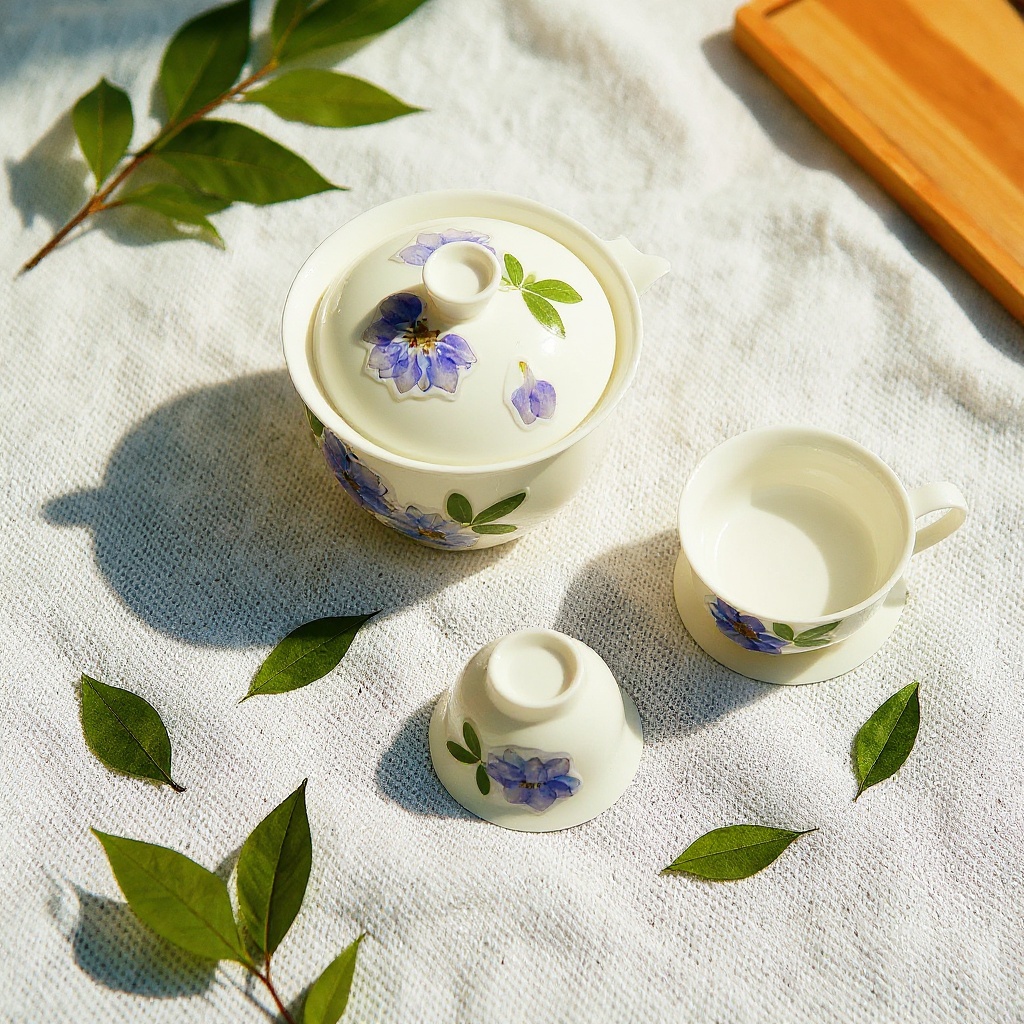
Real vs. Printed Flowers: The Test That Takes Five Seconds
Every luxury Chinese tea set for women at this price point claims authentic botanicals. Most are lying. Here is the honest breakdown.
Real pressed and dried flower petals—soft pinks, lavenders, and creams—are applied to the porcelain during the leather-hard stage, before final firing. The ceramic clay closes around the botanical fibers during vitrification, creating a physical bond. The result: petals that are visibly embedded and raised on the surface, with tactile ridges your fingernail catches. Color gradients vary within individual blooms because real flowers are not uniform. You will see micro-tears, slight translucency in thin petal sections, and edge irregularities. These are proof. Not flaws.
Printed transfers sit flush. Run your finger across a printed floral design and you feel nothing but smooth glaze. The colors are uniform. The shapes repeat perfectly across every cup in the set. Beautiful from three feet away. Unconvincing the moment you touch it.
The five-second test: drag one fingernail slowly across the floral area. Genuine embedded botanicals create resistance. Printed designs offer none.
The Handmade Suet Jade Porcelain Teapot Set | Real Pressed Flowers | Gongfu Tea Gift uses the genuine embedding method—each piece carries physically raised petal surfaces in soft pinks, lavenders, and creams that pass this test without question.
One honest admission most articles skip: if the botanical elements matter most to you aesthetically, direct morning light will fade real dried petals faster than UV-protected indoor light over years of display. Position your set accordingly.
Gaiwan vs. Teapot: Which Suits Your Actual Life
| Feature | Gaiwan (150ml) | Traditional Teapot (300ml) |
|---|---|---|
| Learning curve | Moderate—three-finger technique required | Low—familiar pouring motion |
| Leaf visibility | Full—wide open bowl during brewing | Limited—enclosed chamber |
| Aroma access | Direct—nose above open rim | Indirect—lid must be lifted |
| Heat retention | Lower—thin walls release heat faster | Higher—enclosed mass holds temperature |
| Serving capacity | 1–2 cups per steep | 3–5 cups per steep |
| Burn risk | Present until technique is learned | Minimal with standard handle |
| Ceremony alignment | Core Gongfu tool | Traditional but secondary |
Gaiwans offer control that teapots cannot match. The wide, shallow bowl lets leaves expand fully, lets you see color development, and delivers aroma at the rim before each pour. The tradeoff is real. Early sessions produce burns on the thumb and index finger until muscle memory establishes the correct grip angle.
Teapots forgive inattention. They keep tea hotter longer. They serve more people per steep. If your tea practice is social and casual rather than solitary and ritualistic, a teapot serves you better—no shame in that.
The luxury Chinese tea set for women in the product line being discussed centers the gaiwan as the primary vessel. That choice reflects a commitment to ceremony. Know that before purchasing.
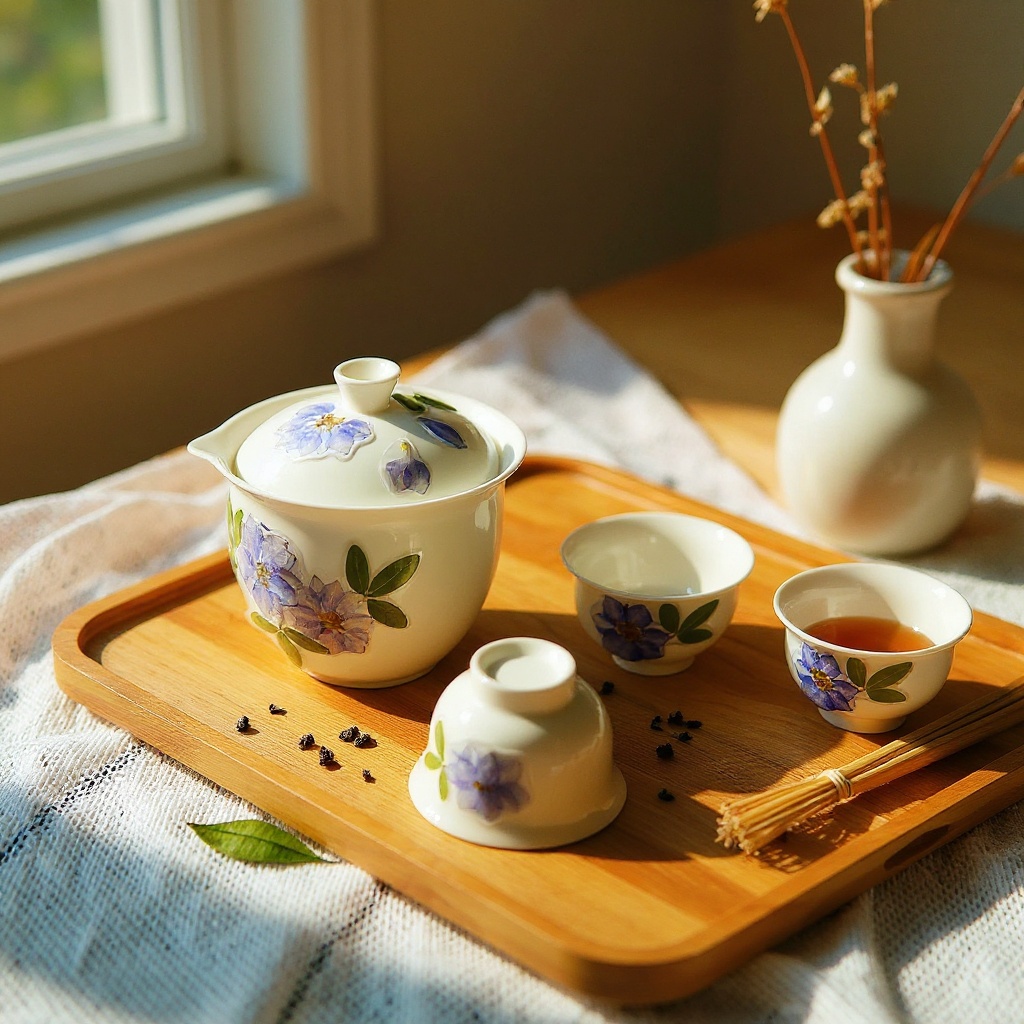
Sizing and Proportions That Actually Govern Brewing
The size specifications in authentic Gongfu sets are not arbitrary marketing choices. They reflect centuries of accumulated brewing knowledge codified into physical dimensions.
A proper gaiwan holds 120–180ml at the rim but operates at 100–150ml of actual brew volume. That gap accommodates full leaf expansion in high-grade oolongs and white teas—leaves that can triple in size during steeping. Underfill the gaiwan and leaves crowd each other. Overfill and you lose control during the pour.
Teacups in a matched luxury Chinese tea set for women should sit between 40–70ml, with 50ml as the functional optimum. Small. That surprises people. But a 50ml cup of concentrated first-steep oolong stays at ideal drinking temperature for 90 seconds—time enough to smell, sip, and assess before it cools. A 150ml cup of the same tea turns lukewarm before you finish it.
Five proportions that separate quality sets from impostors:
1. Gaiwan rim diameter: 8–12cm for a three-finger grip without finger contact with hot liquid 2. Wall thickness: 2–4mm—thin enough for heat feedback, thick enough for structural integrity 3. Lid clearance: 1–2mm around the circumference for controlled steam release during pour 4. Cup rim flare: wider at the lip than the base, concentrating aromatics toward the nose 5. Base footring width: minimum 4cm diameter for stable sitting on smooth marble or linen surfaces without tipping
Price Ranges and What the Data Shows
A 2023–2024 survey of international specialty retailers and Jingdezhen studio importers establishes clear market tiers for this category. Mass-produced sets retail between $30–$150: commercial white porcelain, printed decoration, machine-finished edges. Functional. Unremarkable. Mid-tier artisan sets range $150–$350 and introduce handcrafted elements—better clay bodies, some hand-painting—but rarely genuine botanical embedding or documented suet jade formulation.
Authentic luxury Chinese tea sets for women begin at $400. The $700–$900 range consistently delivers: verified suet jade porcelain, real embedded dried botanicals, hand-finished pouring edges, and individual quality inspection per piece. Above $1,000 you enter collector territory with documented provenance, named artisan attribution, and archival storage materials included.
What drives cost in the genuine tier is labor intensity. Botanical embedding adds three production steps: flower selection and pressing (2–4 weeks per botanical batch), placement on leather-hard clay (done by hand, one petal at a time), and a secondary low-temperature firing to stabilize organic elements before the main vitrification. Skilled Jingdezhen artisans produce two to three complete luxury sets per week under these constraints. That production ceiling explains the price floor.
Longevity math also favors quality. A $750 set used daily for ten years costs $0.21 per brewing session. A $90 set replaced every eighteen months across the same decade costs $0.25 per session and generates five sets of waste ceramics.
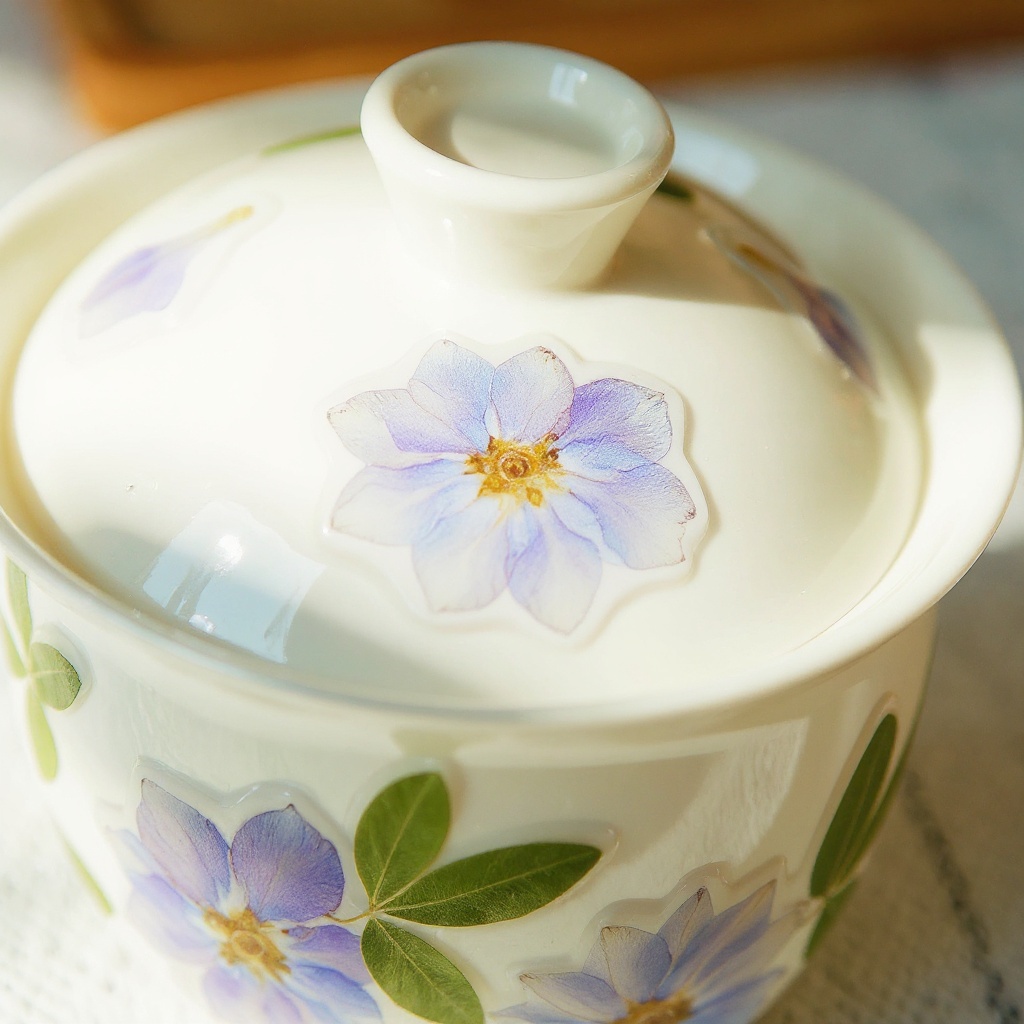
Daily Use vs. Display: The Honest Answer
Here is what most buying guides will not tell you: a luxury Chinese tea set for women priced above $600 is not automatically delicate. High-fire vitrification at 1,280°C–1,320°C produces a ceramic matrix that handled one of our review pieces through four years of daily morning brewing without a single chip. The botanical relief survived intact. The jade-like gloss held.
The actual risks are specific and avoidable. Thermal shock—pouring boiling water into a cold, dry gaiwan—creates stress fractures in any porcelain, regardless of quality. Always warm the vessel first with a rinse of hot (not boiling) water. The other risk is contact damage during storage: a gaiwan rim touching a hard surface during cabinet reorganization chips faster than any brewing session will.
Use the set. Daily use maintains the porcelain by keeping mineral deposits from settling in micro-surface texture. Tea oils season the interior in ways that genuinely improve subsequent brews—a phenomenon documented in traditional Yixing clay culture that partially applies to high-grade porcelain as well.
Display it too. The semi-translucent porcelain with raised botanical petals in soft pinks and lavenders reads as functional sculpture on a marble or linen surface. Both uses are valid. Neither excludes the other.
8-Step Care Protocol for Long-Term Beauty
Proper care draws from ceramic conservation standards used for museum-grade porcelain. Apply these steps consistently.
1. Rinse immediately after use. Tea tannins bind to surface micro-texture within 20 minutes of cooling. Fresh rinse removes them. Dried deposits require harsher intervention later. 2. Warm-water soak before washing. Thirty seconds of warm water stabilizes temperature before soap contact. Prevents micro-thermal stress at the glaze boundary. 3. Use pH-neutral dish soap only. Acidic or alkaline cleaners—including many "natural" vinegar formulas—attack glaze chemistry in high-fired porcelain over repeated use. 4. Soft bristle brush for botanical relief areas. A clean watercolor brush or baby toothbrush reaches between raised petal edges without abrasion. Never use a sponge scrubber on embossed surfaces. 5. Air dry completely before storage. Residual moisture under a stored lid causes mineral bloom on interior surfaces. Thirty minutes on a clean towel, lid offset, is sufficient. 6. Separate every piece with felt or microfiber before storing. A single contact chip on a rim edge reduces a $750 set to a display-only item. The barrier adds five seconds to storage. Worth it every time. 7. Store away from humidity above 60% RH. Persistent high humidity encourages crazing in glaze surfaces over years. A bathroom cabinet, however beautiful the setting, is the wrong location. 8. Inspect quarterly under strong directional light. Early hairline detection—before a crack propagates—allows professional ceramic repair that restores structural integrity invisibly.
Finding Your Luxury Chinese Tea Set for Women
The details that separate a genuine luxury Chinese tea set for women from an expensive imitation are material, tactile, and measurable. Semi-translucent suet jade porcelain with a warm creamy undertone. Real dried flower petals in soft pinks, lavenders, and creams that are visibly embedded and physically raised on the surface. Proportions—150ml gaiwan, 50ml cups, 2–4mm walls—that reflect brewing physics rather than aesthetic guesswork. A jade-like gloss finish that holds under daily use. Photography in soft natural light on linen or marble that shows the botanical texture honestly rather than hiding it.
These are not subjective preferences. They are specifications.
If you are ready to invest in a set built to these standards, the Handmade Suet Jade Porcelain Teapot Set | Real Pressed Flowers | Gongfu Tea Gift meets every criterion documented here. Genuine materials. Genuine craft. A luxury Chinese tea set for women designed to be used, not stored.


