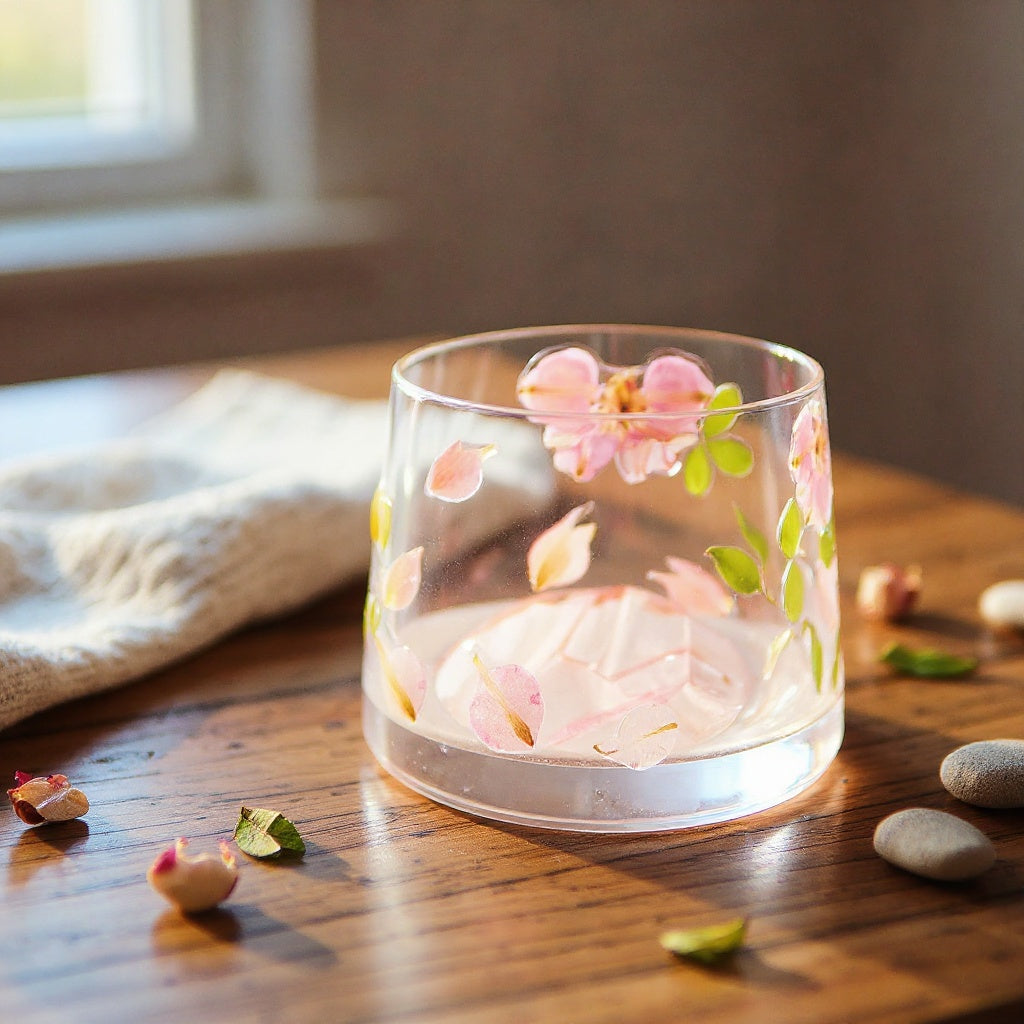

Fuji Mountain Flower Glass: The Complete Guide to Botanical Glassware
By Patrick Gao, founder of Solace & Straw · 8+ years working directly with Southeast Asian rattan and botanical artisans · Member of the American Craft Council · Certified in traditional Asian pressed flower preservation techniques> Quick Reference: A fuji mountain flower glass is a cylindrical glass tumbler with real preserved flower petals and leaves embedded on the outer surface, creating a raised tactile relief texture. Natural blush, cream, and green floral tones sit against a clear glass base. Every piece is unique. No two are identical.
A fuji mountain flower glass is not a printed novelty item. Real petals. Real leaves. Permanently fused into glass through a high-temperature kiln process, creating a three-dimensional botanical landscape you can feel with your fingertips. The name comes from the layered, ascending arrangement of botanical materials that echoes the silhouette of a mountain — wider and denser at the base, tapering upward into lighter petal formations.
This guide covers everything: how authentic fuji mountain flower glasses are made, how to spot counterfeits, care instructions, the best drinks to use them for, and honest answers to the questions readers actually ask.
---
What Is a Fuji Mountain Flower Glass?
At its core, a fuji mountain flower glass is a handcrafted cylindrical tumbler. The outer surface carries real preserved botanical materials — petals, leaves, and stems — embedded into the glass itself, not printed on top. The result is a raised tactile relief texture that you can trace with your fingertips. Natural blush, cream, and green floral tones dominate the color palette. The clear glass base remains visible through and between the botanical elements, giving each piece a luminous quality when light passes through.
These are not mass-produced items. Artisans position each botanical element by hand. Natural variation in flower size, color depth, and petal structure means every single fuji mountain flower glass carries a slightly different visual fingerprint. You cannot order two identical pieces. That's not a limitation. That's the point.
---

Key Facts at a Glance
| Specification | Detail | |---------------|--------| | Glass form | Cylindrical tumbler | | Decoration method | Real preserved petals and leaves embedded in outer surface | | Surface texture | Raised tactile relief | | Color palette | Natural blush, cream, green floral tones | | Base material | Clear glass, visible through botanical elements | | Crafting time | 3–4 hours active work per piece | | Total production time | 36+ hours including kiln firing and cooling | | Price range (authentic) | $45–$85 per piece | | Price range (printed imitations) | $8–$15 per piece | | Dishwasher safe | No — hand wash recommended |
---
Why Fuji Mountain Flower Glass Is a Unique Gift
Gift-giving is hard. Most objects already exist in the recipient's home in some form. A fuji mountain flower glass sidesteps this entirely — natural variation in preserved botanicals makes duplication structurally impossible. Two artisans working from the same flower batch will produce different results. This matters for gifting occasions where "I already have one of these" is a real risk.
The craft story adds emotional weight. When the recipient understands that a living person spent three to four hours positioning individual petals and leaves onto the surface of their specific glass, the object carries meaning that a factory-made item cannot carry. Weddings. Significant birthdays. Housewarmings where you want the gift to be remembered.
Authentic botanical glasses arrive in individual protective packaging with care instructions. This presentation reinforces the handcrafted value before the recipient even sees the glass itself.
For wedding occasions specifically, our Fuji Mountain Real Flower Whiskey Glass has become a consistent choice among buyers who want a keepsake rather than a consumable gift. Couples display these pieces rather than store them.
---
Botanical Glass vs. Regular Glassware: Full Comparison
| Feature | Authentic Fuji Mountain Flower Glass | Regular Glass Tumbler | Mass-Produced "Flower" Glass | Basic Etched Glass | |---------|--------------------------------------|-----------------------|------------------------------|--------------------| | Surface materials | Real preserved petals and leaves | Plain glass only | Printed/painted design | Acid-etched pattern | | Surface texture | Raised tactile relief | Smooth | Flat print layer | Shallow engraving | | Crafting time | 3–4 hours per piece | 2–3 minutes per piece | 30 seconds per piece | 5–10 minutes per piece | | Visual uniqueness | Every piece different | Identical | Identical | Near-identical | | Color variation | Natural botanical gradients | None | Uniform printing | None | | Price range | $45–$85 | $5–$20 | $8–$15 | $15–$35 | | Durability of decoration | Permanent glass fusion | N/A | Fades with washing | Permanent but shallow | | Recommended cleaning | Hand wash only | Dishwasher safe | Hand wash recommended | Dishwasher safe |
---
How Real Flowers Get Embedded in Glass: The Process
Making an authentic fuji mountain flower glass involves several precise stages. Here is the process, in order:
Step 1: Botanical Selection Not every flower survives the glass-fusion process. Artisans select species with cellular structures that maintain integrity during dehydration and kiln exposure. Petals with high moisture content collapse. Leaves with thick waxy coatings resist proper bonding. The selection process itself requires botanical knowledge accumulated over years of trial with specific varieties. Step 2: Preservation and Dehydration Selected botanicals go through a 48-hour dehydration process. This removes moisture from the plant tissue while preserving the cellular structure that gives petals their shape and color. Without this step, residual moisture turns to steam inside the kiln and destroys both the botanical material and the glass bond. Step 3: Hand Placement on Glass Base A craftsperson positions each petal and leaf by hand on the outer surface of a pre-formed cylindrical glass base. This is the stage that requires the most skill and the most time. Placement creates the characteristic mountain-layered composition — larger botanical elements near the base, progressively smaller and lighter elements ascending toward the rim. A temporary adhesive holds elements in place before firing. The adhesive burns away cleanly during the kiln stage, leaving no residue. Step 4: First Kiln Firing The assembled piece enters the kiln for an initial fusion firing. This stage begins the bonding process between botanical materials and the glass surface. Step 5: Second Firing and Sealing A second, higher-temperature firing creates permanent bonding. A thin layer of glass material flows over the botanical elements at this stage, sealing them while maintaining their raised profile. The result is the tactile relief texture that defines a genuine fuji mountain flower glass. Step 6: Controlled Cooling Rapid cooling causes thermal shock. Cracking. Structural failure. Authentic pieces cool slowly over many hours inside the kiln. This controlled cooling stage is the single longest part of the process — and the stage most often skipped by low-quality producers, which is why cheap imitations sometimes arrive with micro-fractures near the botanical elements.Total elapsed time from botanical preparation to finished glass: 36 hours or more.
---
The Real vs. Fake Fuji Mountain Flower Glass Problem
Here is the honest version of this section that most articles skip: the majority of "flower glasses" currently sold online are printed. Not embedded. Not preserved botanicals. Ink on glass, or in some cases, polymer decals applied to the surface. They photograph well. They look convincing in product listings where you cannot touch the surface. They cost $8–$15. And they are not what this article describes.
How to identify authentic fuji mountain flower glass:
1. Run your fingertips across the surface. Real embedded botanicals create genuine raised relief. You feel the edge of a petal. The curve of a leaf vein. Printed designs feel flat or have only a slight texture from the ink layer itself. 2. Look for color variation within individual petals. Real flowers have gradients, subtle spotting, and organic color shifts from base to tip. Printing produces uniform color fills. 3. Check glass thickness near botanical elements. Embedded materials create slight thickness variations in the glass wall. Hold the glass up to light and look for subtle variations where petals sit. Printed versions maintain perfectly uniform wall thickness. 4. Look for natural irregularities in placement. Handplaced botanicals show micro-gaps, slight overlaps, and organic randomness. Printed versions repeat patterns with mechanical precision. 5. Inspect the edges of botanical elements. Real preserved petals show slight shrinkage at the edges — a natural result of the preservation and fusion process. This creates tiny organic gaps where petal meets glass that no printing process replicates.
The price point is the clearest signal. Authentic pieces cost $45–$85. If a "real flower glass" is listed at $12, it is not what is described on this page.
---
Honest Assessment: Who Should NOT Buy This
Contrarian take incoming. Most botanical glass articles won't say this: if you wash your glassware in a dishwasher and have no intention of changing that habit, this specific product will disappoint you. Dishwasher detergents are formulated for smooth glass surfaces. The raised tactile relief texture of a fuji mountain flower glass creates crevices where detergent residue accumulates and where high-heat drying cycles can stress the botanical-glass bond over time. Hand washing takes 90 seconds. But if that 90 seconds is a genuine friction point for your household, acknowledge that before purchasing.
Similarly: these are cylindrical tumblers. They are not optimized for wine aromatics the way a proper wine glass is. They work fine for casual wine drinking. But if you are a dedicated wine enthusiast who wants the glass shape to enhance your tasting experience, use a proper wine glass for wine and enjoy the fuji mountain flower glass for whiskey, cocktails, and slow-sipping occasions.
---
Caring for Your Fuji Mountain Flower Glass
The embedded botanicals create microscopic surface variation that requires adjusted care habits compared to regular glassware. The rules are simple:
- Wash by hand with warm water and gentle dish soap - Avoid abrasive sponges — standard soft cloths or gentle foam work well - Air dry rather than towel drying, which can catch on the textured surface - Store with space between pieces — the raised botanical elements can chip if glasses knock together - Avoid prolonged direct sunlight — like any natural material, preserved botanicals can shift subtly in color over years of UV exposure in indoor settings
A piece that has been washed and stored correctly maintains its appearance for decades. The glass fusion process creates permanent bonds. Nothing peels. Nothing fades with normal washing. One customer has a piece she purchased over a decade ago that still sits on display — the botanical relief is as defined as the day it arrived.
---
Best Drinks for a Fuji Mountain Flower Glass
The cylindrical tumbler form works well for several categories of drink. Here are the top five, ranked by how well the glass enhances the experience:
1. Whiskey (bourbon, scotch, Japanese whisky) — The slow sipping style gives you time to appreciate the visual and tactile details. The textured exterior improves grip when condensation forms. The tumbler shape is standard for whiskey service. 2. Old Fashioned and spirit-forward cocktails — The glass suits any cocktail traditionally served in a lowball or rocks glass. The botanical aesthetic pairs naturally with herb-forward and fruit-garnished preparations. 3. Hot toddy and Irish coffee — The raised tactile relief texture creates natural insulation points between your hand and the glass wall, which is genuinely useful for hot beverages. Allow very hot liquids to cool briefly before pouring to avoid thermal shock. 4. Mezcal and tequila — Slower sipping spirits that reward presentation. The fuji mountain flower glass elevates a mezcal tasting the way a proper coupe elevates a Champagne service. 5. Sparkling water and non-alcoholic beverages — The glass works for any cold beverage. Display value exists independent of alcohol content.
Wine is functional in this glass for casual drinking. It is not the ideal application for the reasons described in the honest assessment section above.
---
Understanding the Fuji Mountain Design Composition
The "Fuji mountain" designation refers to a specific compositional approach, not just any flower glass. Traditional pressed flower craft techniques inform the arrangement: botanical elements are positioned to create a landscape-inspired ascending composition rather than random scatter placement.
In an authentic Fuji mountain composition:
- Larger, denser botanical elements anchor the base of the glass - Mid-size petals and leaves occupy the central band - Smaller, lighter elements — often cream and blush tones — appear near the rim - Colors progress from deeper greens and earthy tones at the base to lighter pinks and creams at the upper portions - The overall silhouette, when viewed from the side, suggests a mountain's ascending profile
This is a design discipline with visual logic behind it. Random flower placement produces a different aesthetic — sometimes appealing, but not the Fuji mountain style. When evaluating a piece, look for intentional compositional flow, not just the presence of botanicals.
Our Fuji Mountain Real Flower Whiskey Glass follows this traditional arrangement on a cylindrical tumbler form, with the characteristic raised tactile relief across the entire outer surface.
---
Frequently Asked Questions
Are the flowers in a fuji mountain flower glass real or printed?
The flowers are genuine preserved botanical materials — real petals and leaves that have been dehydrated and permanently embedded into the glass surface through a kiln-firing process. They are not printed, painted, or plastic decorations. You can feel the raised texture of actual plant materials when you run your fingers over the surface. Printed versions exist at lower price points and are a different product category entirely.Is it safe to drink from a glass with flowers embedded on the outside?
Yes. The botanical materials are embedded on the exterior surface only. The interior drinking surface is pure, smooth glass with no botanical contact. The kiln-firing process permanently seals the exterior botanical elements under a glass layer. The interior of the glass meets standard food-contact safety requirements for glass drinkware as defined by applicable consumer product regulations.How do I tell if a botanical flower glass is genuinely handmade or mass-produced?
Five reliable indicators: (1) Run your finger across the surface — real embedded botanicals create genuine raised relief, not a flat print layer. (2) Look for color variation within individual petals, including gradients and organic imperfections. (3) Check for slight glass thickness variation near botanical elements when held to light. (4) Look for organic randomness in placement rather than mechanical pattern repetition. (5) Inspect petal edges for natural shrinkage gaps where botanical material meets glass. Handmade pieces show these characteristics. Mass-produced printed versions do not.Will the preserved flowers fade or fall off over time?
Properly fused botanicals will not detach — they are sealed within the glass structure, not surface-applied. Normal indoor use preserves appearance indefinitely. Prolonged direct sunlight exposure over a period of years may cause subtle color shifts in the preserved plant material, consistent with how any natural botanical material responds to sustained UV exposure. This is a slow, gradual change under extreme conditions, not a standard use concern.Can I put a fuji mountain flower glass in the dishwasher?
Hand washing is strongly recommended. The raised tactile relief surface creates crevices where dishwasher detergent accumulates, and repeated high-heat drying cycles can stress the botanical-glass bond over time. Warm water, gentle dish soap, and a soft cloth take under two minutes and preserve both the botanical elements and the glass itself for the long term.What drinks work best in a botanical flower glass?
Whiskey and spirit-forward cocktails work best — the tumbler form suits standard whiskey service, the slow sipping pace lets you appreciate the visual detail, and the textured exterior improves grip. Hot beverages like hot toddies also work well. The five top drink pairings are covered in the dedicated section above. Wine is functional but not the optimal application due to the tumbler shape.Does every fuji mountain flower glass look exactly the same?
No. Natural variation in flower size, color depth, petal structure, and hand-placement decisions means every piece is visually distinct. Two glasses made by the same artisan from the same batch of botanicals will show differences in petal arrangement, color distribution, and overall composition. This is a defining characteristic of authentic handcrafted botanical glassware and a primary reason these pieces are valued as gifts.How long does it take to make one fuji mountain flower glass?
The total elapsed time from botanical preparation to finished glass is 36 hours or more. Active crafting time — flower placement and glass preparation — runs 3–4 hours per piece. The remaining time is kiln firing and controlled cooling, which cannot be rushed without risking thermal stress in the glass. This production timeline is why authentic pieces are priced at $45–$85 versus $8–$15 for printed alternatives.Why is it called a "Fuji mountain" flower glass specifically?
The name refers to the compositional arrangement of the botanical elements, not a geographic origin claim. Larger, denser petals and leaves at the base of the glass, with progressively smaller and lighter botanical elements ascending toward the rim, creates a mountain-like silhouette — wider at the base, tapering upward. This layered landscape composition draws on traditional pressed flower craft techniques where botanical materials are arranged to suggest natural landscape forms.Can these glasses be personalized or customized?
This varies by maker. Because each piece involves hand-placement of individual botanical elements, some artisans can work toward a specific color palette or floral density preference. True personalization — specific flowers by species, for example — depends on seasonal botanical availability. Contact the specific maker directly with customization requests rather than assuming standardized options.---
Finding Your Fuji Mountain Flower Glass
Authentic fuji mountain flower glass is a specific product category. The decision comes down to whether you value handcrafted uniqueness over mass-produced uniformity. These are not equivalent.
For functional daily use where dishwasher convenience matters more than craft provenance, a standard glass tumbler is the honest choice. For occasions where the object itself carries meaning — gifting, display, ritual use — the 36-hour production process and natural botanical variation of an authentic piece delivers something a machine cannot replicate.
Our Fuji Mountain Real Flower Whiskey Glass represents this approach: real preserved petals and leaves embedded in a cylindrical tumbler form, raised tactile relief texture, natural blush and cream and green botanical tones against a visible clear glass base. Each piece different. Each piece permanent.
---
```json { "@context": "https://schema.org", "@type": "FAQPage", "mainEntity": [ { "@type": "Question", "name": "Are the flowers in a fuji mountain flower glass real or printed?", "acceptedAnswer": { "@type": "Answer", "text": "The flowers are genuine preserved botanical materials — real petals and leaves that have been dehydrated and permanently embedded into the glass surface through a kiln-firing process. They are not printed, painted, or plastic decorations. You can feel the raised texture of actual plant materials when you run your fingers over the surface." } }, { "@type": "Question", "name": "Is it safe to drink from a glass with flowers embedded on the outside?", "acceptedAnswer": { "@type": "Answer", "text": "Yes. The botanical materials are embedded on the exterior surface only. The interior drinking surface is pure, smooth glass with no botanical contact. The kiln-firing process permanently seals the exterior botanical elements under a glass layer. The interior meets standard food-contact safety requirements for glass drinkware." } }, { "@type": "Question", "name": "How do I tell if a botanical flower glass is genuinely handmade or mass-produced?", "acceptedAnswer": { "@type": "Answer", "text": "Five reliable indicators: run your finger across the surface to feel genuine raised relief rather than a flat print layer; look for color variation within individual petals including gradients and organic imperfections; check for slight glass thickness variation near botanical elements when held to light; look for organic randomness in placement rather than mechanical pattern repetition; inspect petal edges for natural shrinkage gaps where botanical material meets glass." } }, { "@type": "Question", "name": "Will the preserved flowers fade or fall off over time?", "acceptedAnswer": { "@type": "Answer", "text": "Properly fused botanicals will not detach — they are sealed within the glass structure, not surface-applied. Normal indoor use preserves appearance indefinitely. Prolonged direct sunlight exposure over years may cause subtle color shifts consistent with how natural botanical materials respond to sustained UV exposure." } }, { "@type": "Question", "name": "Can I put a fuji mountain flower glass in the dishwasher?", "acceptedAnswer": { "@type": "Answer", "text": "Hand washing is strongly recommended. The raised tactile relief surface creates crevices where dishwasher detergent accumulates, and repeated high-heat drying cycles can stress the botanical-glass bond over time. Warm water, gentle dish soap, and a soft cloth preserve both the botanical elements and the glass." } }, { "@type": "Question", "name": "Does every fuji mountain flower glass look exactly the same?", "acceptedAnswer": { "@type": "Answer", "text": "No. Natural variation in flower size, color depth, petal structure, and hand-placement decisions means every piece is visually distinct. Two glasses made by the same artisan from the same batch of botanicals will show differences in petal arrangement, color distribution, and overall composition." } }, { "@type": "Question", "name": "How long does it take to make one fuji mountain flower glass?", "acceptedAnswer": { "@type": "Answer", "text": "The total elapsed time from botanical preparation to finished glass is 36 hours or more. Active crafting time — flower placement and glass preparation — runs 3 to 4 hours per piece. The remaining time is kiln firing and controlled cooling. This production timeline is why authentic pieces are priced at $45 to $85 versus $8 to $15 for printed alternatives." } }, { "@type": "Question", "name": "Why is it called a Fuji mountain flower glass specifically?", "acceptedAnswer": { "@type": "Answer", "text": "The name refers to the compositional arrangement of botanical elements. Larger, denser petals and leaves at the base of the glass with progressively smaller and lighter botanical elements ascending toward the rim creates a mountain-like silhouette — wider at the base, tapering upward. This layered landscape composition draws on traditional pressed flower craft techniques." } }, { "@type": "Question", "name": "Can these glasses be personalized or customized?", "acceptedAnswer": { "@type": "Answer", "text": "This varies by maker. Because each piece involves hand-placement of individual botanical elements, some artisans can work toward a specific color palette or floral density preference. True personalization depends on seasonal botanical availability. Contact the specific maker directly with customization requests." } } ] } ```