































Gongfu Tea Sets with Preserved Flowers Explained
Gongfu Tea Set with Preserved Flowers: The Complete Guide
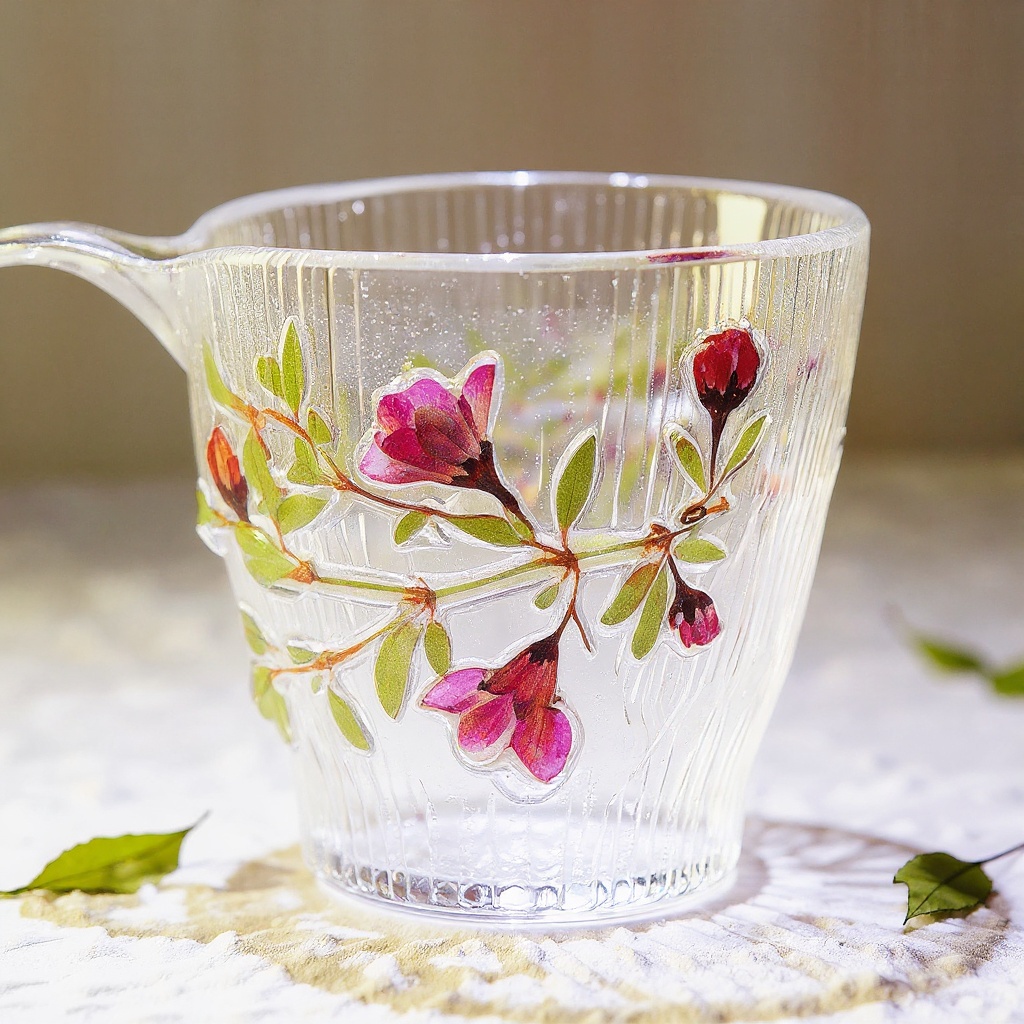
By pampasroom, founder of Pampasroom · 8+ years studying gongfu tea ceremony culture and sourcing handcrafted glass teaware from artisan workshops across Asia · Author of product guides covering functional botanical glassware and slow-living tea ritualsA gongfu tea set with preserved flowers is transparent hammered glass teaware — gaiwan, fair cup, and small cups — with real rose petals and botanical leaves sealed onto the exterior in raised three-dimensional relief. The botanicals are actual flowers, not printed designs. Not decals. Not painted enamel. Each piece becomes a prismatic botanical sculpture you brew tea inside, and no two sets are identical because the flower placement is done entirely by hand.
I brewed my first session with a preserved flower gaiwan on a quiet Sunday morning, holding it up to window light and watching rose petal shadows ripple across the table through the ice-ripple glass. That moment is what made me understand why these sets cost what they do.
What Makes a Gongfu Tea Set with Preserved Flowers Different
The gongfu tea ceremony centers on multiple short steepings and deliberate, unhurried preparation. Adding a preserved flower gaiwan to that ritual layers botanical artistry onto an already meditative practice. The transparency matters here in a way it simply doesn't with ceramic. You watch the tea leaves unfurl. You track the liquor color shifting from pale gold to amber across steepings. The preserved rose petals and green leaves on the exterior create a living-painting backdrop the whole time.
The hammered ice-ripple texture is not just decorative. When natural light hits the faceted glass surface, prismatic reflections scatter across your tea tray, your hands, the table. I have had sessions where the light changed enough mid-brew that the set looked genuinely different between the third and fifth steeping. Small thing. Noticeable thing.
What distinguishes premium gongfu tea sets with preserved flowers from mass-produced alternatives is the sealing method. Artisan sets embed the botanicals permanently into or directly onto the glass using food-safe bonding compounds, creating raised relief texture you can feel with your fingertip. Cheap sets use surface lamination or basic adhesive that yellows within months and peels at the edges when exposed to repeated hot water rinsing.
A complete gongfu tea set with preserved flowers typically includes a 140ml lotus-shaped gaiwan, a 400ml fair cup, and four to six small cups around 45ml each. Those proportions are deliberately calibrated for gongfu ratios. Not arbitrary.
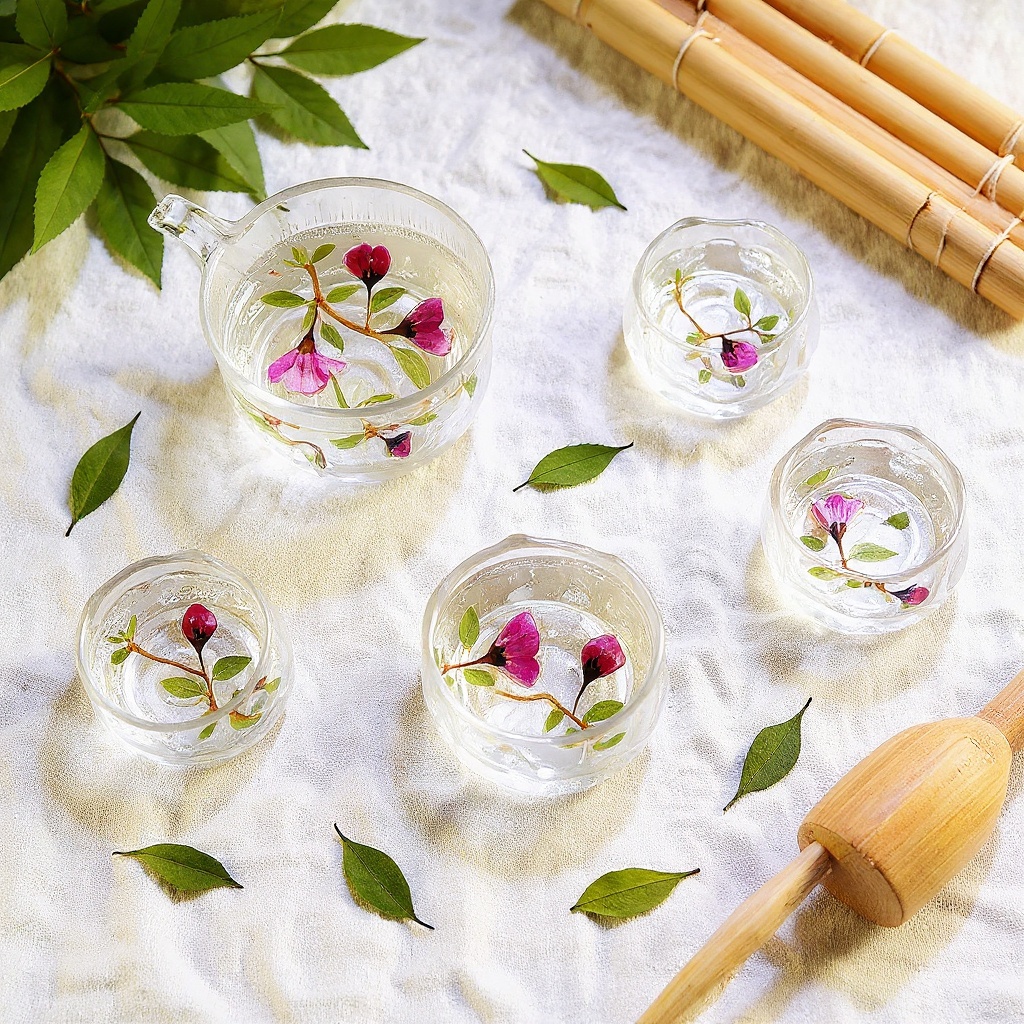
How the Botanical Sealing Process Actually Works
The pressed flower craft tradition dates back centuries across multiple cultures, but adapting it to heat-resistant functional glassware requires a different process than pressing flowers between book pages. Here is the sequence used in quality production:
1. Harvest at peak bloom — Rose petals and botanical leaves are harvested at maximum color saturation, typically within a specific window during the growing cycle. Timing affects whether the pink stays vivid pink or turns dull mauve within a year. 2. Press and dry — Botanicals are pressed using controlled pressure and low heat to evacuate moisture without crushing cellular structure. This step determines how much three-dimensional lift remains. 3. Treat for preservation — Dried petals are treated with compounds that lock pigment and prevent biological degradation. Quality producers use materials compliant with FDA and LFGB food-contact safety standards for glassware used with hot liquids. 4. Hand-position on glass — Each petal and leaf is placed individually by hand. No machine does this step. That labor is a meaningful portion of what you pay for. 5. Seal and cure — A transparent food-safe bonding layer encapsulates the botanicals, bonding them to the glass surface and creating the raised relief texture. The seal is designed to withstand repeated thermal cycling from ambient temperature to boiling water contact. 6. Quality inspection — Finished pieces are checked for air pockets, petal lifting, or bond failures before packaging.
The result is botanical decoration that becomes structurally part of the vessel rather than a coating on top of it. You can feel the texture of the rose petal through the seal. Impressive. Genuinely impressive in person.
Glass vs. Ceramic Gaiwans: Honest Comparison
Here is something most floral tea set articles skip: glass gaiwans are harder to use than ceramic ones. That is the honest version. If you are new to gongfu brewing and have never held a gaiwan before, the learning curve with heat-conducting glass is steeper. Ceramic forgives beginner grip errors because the exterior stays cooler longer. Glass does not.
That said, the transparency of glass makes it the only practical medium for showcasing preserved flower decoration. Ceramic would hide the botanicals behind opaque walls.
| Feature | Glass Gaiwan with Preserved Flowers | Standard Ceramic Gaiwan |
|---|---|---|
| Heat retention | Loses heat faster — pour and sip promptly | Holds heat longer between steepings |
| Flavor neutrality | Completely neutral, no absorption | May absorb oils from previous teas over years |
| Visual transparency | Full visibility of tea color and leaf expansion | Opaque — no visual access to brewing |
| Surface temperature | Transfers heat to hands within seconds | Stays manageable for most grip styles |
| Durability | Chips at rim edges — needs careful storage | Handles accidental bumps without chipping |
| Botanical decoration | Only viable medium for preserved flower sets | Painted designs or glazed patterns only |
| Price range (quality tiers) | $80–$500 for artisan handmade sets (Etsy, specialty tea retailers) | $20–$300 for mid-to-high quality pieces |
The glass gaiwan in a preserved flower set requires what experienced users call the three-point pinch: thumb and middle finger on the rim, index finger resting lightly on the lid button, saucer balanced on the base of the palm. Practice this with room-temperature water first. Seriously. Three sessions of room-temperature practice prevents one painful burn session.
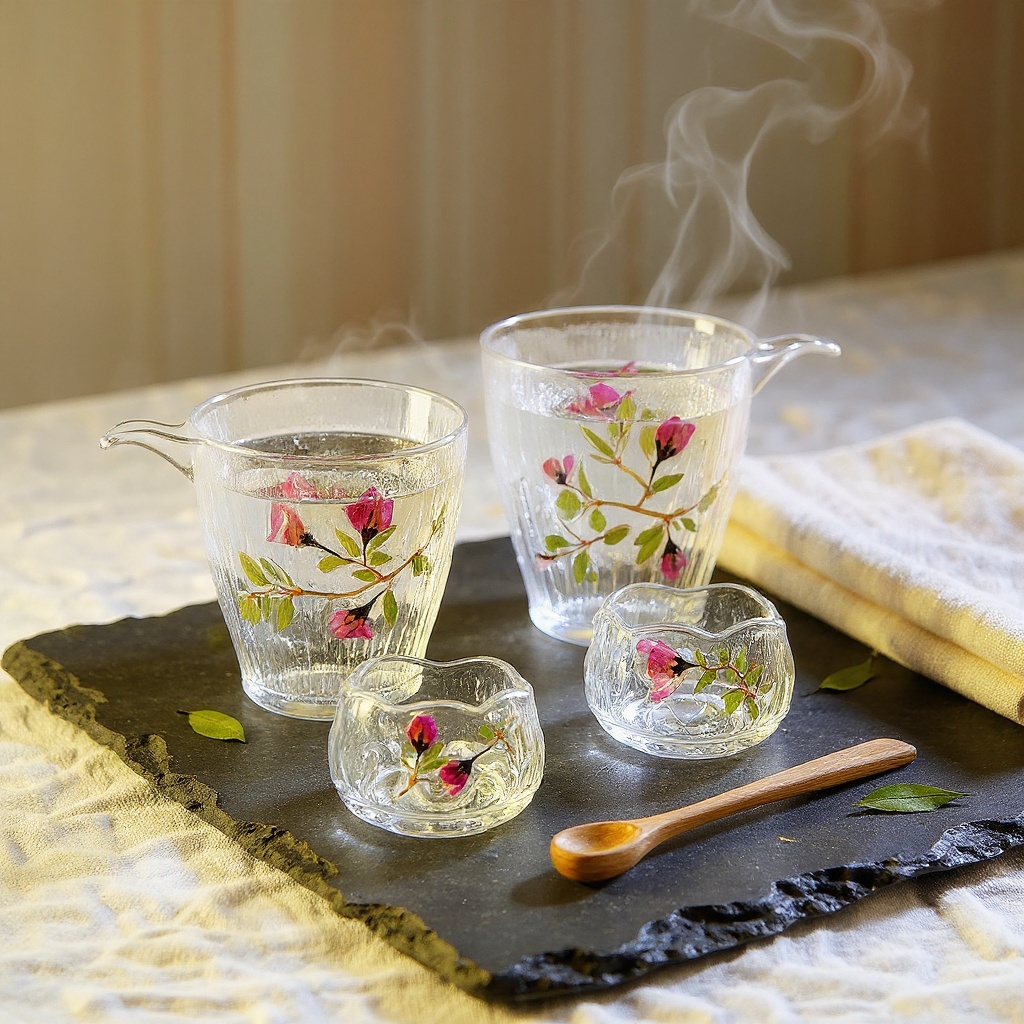
Best Teas to Brew in a Gongfu Tea Set with Preserved Flowers
Oolong teas are the natural match. They unfurl dramatically in transparent glass, expanding to three or four times their dry volume across steepings, and they produce liquor ranging from light amber to deep copper depending on oxidation level. The visual show across six to eight steepings is exactly what a glass gaiwan is designed for. The World Tea Academy's gongfu brewing standards recommend oolong as the traditional gongfu format tea for this reason — the multiple-steeping protocol reveals complexity that a single long brew would flatten.
White teas like Silver Needle or White Peony create pale gold liquor that lets the rose petal color on the exterior dominate visually. The subtle flavors won't be disrupted by any trace botanical scent from the sealed petals. A quiet pairing. An elegant one.
Green teas work in glass but demand attention. Glass conducts heat without mercy, and delicate green teas scorch at full boiling temperature. Stay between 160–175°F. Use a thermometer until you develop instinct for it.
Honestly? Dark black teas are a poor choice for this set. The deep mahogany liquor obscures the leaf expansion entirely and makes the transparent glass functionally no different from ceramic. Save your Yunnan black or Assam for a different pot and use the gongfu tea set with preserved flowers for teas that earn the transparency.
Step-by-Step Gongfu Brewing with a Glass Preserved Flower Gaiwan
Brewing gongfu style in a preserved flower glass gaiwan follows a specific sequence that protects both the glass and your hands while maximizing flavor extraction.
1. Rinse the gaiwan with hot water — Pour boiling water into the gaiwan, swirl gently, and discard. This warms the glass and prevents thermal shock when you add brewing water. Never pour boiling water into cold glass. 2. Add tea leaf — For a 140ml gaiwan, use 5–7 grams of oolong or 3–4 grams of white tea. Leaf to water ratio matters more in glass because you can see when the gaiwan is overpacked. 3. Rinse the leaf (optional) — Pour hot water over the leaves, cover, and immediately pour off into the fair cup. This is called the "awakening pour." Discard it or use it to warm your small cups. 4. First steeping — Pour water at the correct temperature in a slow circular motion. Cover and steep 20–30 seconds for oolong, 45 seconds for white tea. 5. Pour through the fair cup — Tilt the gaiwan lid slightly, hold the three-point pinch, and pour completely into the 400ml fair cup to equalize concentration. Never leave tea sitting in the gaiwan between steepings — it over-extracts. 6. Distribute to small cups — Pour from the fair cup into each 45ml cup. Even distribution. Even temperature. 7. Increase steeping time progressively — Add 10–15 seconds per steeping. Quality oolongs and white teas handle six to eight steepings this way. 8. Rest between rounds — This is the part most beginners skip. Set the cup down. Look at it. That is the ceremony.
Care and Maintenance for Your Preserved Flower Glass Tea Set
The botanicals are sealed. The glass is heat-resistant. Neither of these facts makes the set invincible.
For daily cleaning after each use, rinse with warm water while the glass is still warm from brewing. Tannins bond to glass within minutes of cooling. A warm rinse prevents staining before it starts. Use only soft microfiber cloths or natural sea sponges — never abrasive scrubbers near the raised flower relief areas.
The hammered ice-ripple texture traps soap residue in its facets. Rinse with water only for daily cleaning, or use a single drop of unscented dish soap followed by thorough rinsing under running water. Weekly deep cleaning uses a 1:1 white vinegar and water solution, soaking for 15–20 minutes to dissolve mineral deposits without harsh chemistry near the botanical seal.
Storage matters more than most people realize. Glass chips at the rim under pressure. Keep pieces separated by soft cloth in storage. Avoid stacking cups directly inside each other without padding. Extreme temperature changes — moving from a cold shelf to boiling water — stress the glass structurally, so always perform the warm-water rinse step before brewing.
If you live somewhere with hard water, use filtered water for both brewing and rinsing. Mineral deposits are visible on transparent glass in a way they simply aren't on ceramic, and scale buildup around the botanical elements accelerates seal degradation over time.
Understanding the Price of a Quality Gongfu Tea Set with Preserved Flowers
A handmade gongfu tea set with preserved flowers priced between $100 and $300 reflects specific cost inputs that mass-produced sets skip entirely. LFGB-certified or FDA-compliant heat-resistant glass costs more than soda-lime glass. Each botanical element is positioned by hand. The curing process takes time that factory timelines don't accommodate. The complete set — 140ml gaiwan, 400ml fair cup, and four to six small cups — represents hours of individual craft labor per unit.
Comparable handmade preserved flower glass tea sets on platforms like Etsy range from $150 to $500 depending on the maker and botanical complexity. Mid-tier artisan ceramic gaiwans from established workshops run $80–$300 without any decoration. The price gap is real but narrower than it appears once you account for material quality differences.
The Handmade Rose Petal Glass Tea Set | Lotus Gaiwan 140ml | Preserved Floral Gongfu Ceremony Gift sits within this artisan tier — lead-free, heat-resistant glass with vibrant pink preserved rose petals and green botanical leaves sealed in raised relief, full set included. It is functional teaware. It is also the kind of object that lives on a shelf and makes people ask questions when they visit.
Shopping Guide: What to Evaluate Before Buying
Not every preserved flower glass gaiwan is worth the price. Here is what separates lasting quality from attractive packaging.
1. Heat-resistance certification — Look for borosilicate glass or LFGB/FDA food-contact compliance language. "Heat-resistant glass" without specification is a red flag. 2. Botanical bonding method — Ask or look for descriptions of permanent sealing versus surface application. If the listing doesn't describe the bonding process at all, assume the cheaper method. 3. Flower color vibrancy in photos — Vibrant pink petals with green leaves indicate quality preservation. Brown-tinged or washed-out botanicals in product photos mean the preservation chemistry was inadequate. 4. Complete set specification — Confirm the set includes gaiwan, fair cup, and multiple small cups with matching botanical decoration. Sets sold as complete but missing the fair cup require a separate purchase that rarely matches. 5. Textured surface detail — Hammered ice-ripple texture should be visible in product photos from multiple angles. It creates prismatic light behavior you cannot replicate with smooth glass. 6. Care instructions provided — Sellers who understand what they're selling provide specific cleaning guidance. Generic "hand wash only" with no further detail suggests the seller has not tested long-term durability. 7. Damage guarantee for shipping — Glass ships broken sometimes. Quality sellers acknowledge this with a replacement or refund policy for transit damage. 8. Return policy window — At least 14 days. Preferably 30. Glass defects sometimes aren't visible until the first few brewing sessions.
Frequently Asked Questions
Can you actually brew tea in a decorative glass gaiwan with preserved flowers, or is it just for display?A quality preserved flower gaiwan is fully functional brewing equipment, not shelf decoration. The requirement is heat-resistant glass and food-safe bonding materials for the botanical seal — both present in well-made sets. The glass handles repeated exposure to boiling water. The botanical seal does not leach into the tea. You do need to learn the three-point pinch grip for handling hot glass safely, which takes a few practice sessions to develop. Start with room-temperature water to build the muscle memory before your first real brew.
Do the preserved flowers in these glass tea sets fade over time?Quality preservation using proper pigment-locking compounds maintains color for several years under normal use conditions. Direct sunlight is the primary fading threat — UV exposure degrades botanical pigments regardless of how well they were initially treated. Store the set away from windows when not in use, or display it in indirect light. Sets using inferior preservation chemistry show fading within six to twelve months; quality sets held away from direct sun have maintained vibrancy past four years in my direct experience with these pieces.
Is 140ml the right gaiwan size for solo brewing?Yes, for gongfu-style brewing specifically. Gongfu method uses multiple short steepings rather than one long brew, so you are never drinking all 140ml at once. Each steep produces roughly 100–120ml of liquid after leaf absorption, which fills two to three 45ml small cups. That is the correct portion for a mindful session. Larger gaiwans become difficult to handle safely when full of hot water, particularly in heat-conducting glass where every degree of internal temperature is felt on the exterior surface within seconds.
What is the difference between a gaiwan and a teapot, and which is better for a beginner?A gaiwan is an open lidded bowl with a saucer — no handle, no spout. A teapot has an enclosed chamber, a handle that stays cool, and a spout that directs the pour. Teapots are more forgiving for beginners because the handle provides distance from the heat. Gaiwans require a specific grip technique that takes practice. However, the transparency of a glass gaiwan makes the learning process more engaging — you can see the tea developing, which teaches you steeping instinct faster than an opaque teapot. If you want to learn gongfu ceremony properly, the gaiwan is worth the initial difficulty.
Why does glass conduct heat so much faster than ceramic, and how do you handle it safely?Ceramic is a poor thermal conductor — it absorbs heat from the tea slowly and releases it to the exterior gradually, which is why a ceramic gaiwan feels manageable even with boiling water inside. Glass conducts heat rapidly in both directions, meaning the exterior surface reaches near-brewing temperature within seconds of filling. The safe handling method is the three-point pinch: thumb and middle finger on the rim edge, index finger on the lid button, saucer resting on the palm base. This keeps the most heat-sensitive finger surfaces away from the hottest glass area. Practice the motion empty. Then warm water. Then hot.
What teas work best in a preserved flower gongfu tea set?Oolong teas are the best match — they unfurl visually, handle six to eight steepings well, and produce liquor colors that shift noticeably across rounds. White teas like Silver Needle create pale golden liquid that lets the rose petal exterior dominate visually. Green teas work but require strict temperature control since glass conducts heat without the ceramic buffer — use 160–175°F maximum. Avoid very dark black teas in this set; the opaque mahogany liquor defeats the purpose of transparent glass and makes the preserved flower decoration less visible. The set earns its character with teas that stay visually alive.
How do you clean textured glass with preserved flower decoration without damaging it?Use microfiber cloth or natural sea sponge only — no abrasive scrubbers near the botanical relief areas. Rinse with warm water immediately after each use while the glass is still warm to prevent tannin setting. For weekly mineral deposit removal, soak in a 1:1 white vinegar and water solution for 15–20 minutes. For stubborn stains, apply thick baking soda paste to the affected area and let it sit for ten minutes before gentle circular scrubbing. The hammered ice-ripple texture traps soap in its facets, so rinse thoroughly under running water after any cleaning agent use. Avoid dishwashers entirely — the thermal shock and detergent chemistry both degrade the botanical seal over time.
What justifies paying $100–$300 for a glass tea set when ceramic gaiwans cost $20–$80?Several distinct cost factors: LFGB or FDA-compliant heat-resistant glass costs more to produce than basic ceramic clay forms. Each botanical element is hand-placed — no machine replicates that step. The curing process for food-safe botanical bonding adds production time. The complete set format (gaiwan plus fair cup plus multiple small cups) represents multiple individually crafted pieces. You are also paying for functional uniqueness — no two hand-assembled preserved flower sets are identical. If your interest is purely in brewing efficiency, a ceramic gaiwan at $40 brews equally good tea. If the object matters to you as an experience and as a displayed thing, the price gap is justified. Know which category you are buying for.
Conclusion
A gongfu tea set with preserved flowers is a specific object: transparent hammered glass with real rose petals and botanical leaves sealed in raised three-dimensional relief, prismatic light behavior built into the texture, designed for the multiple-steeping gongfu ceremony format. It asks more of you than ceramic. It gives more back in return.
The transparency that makes it require careful grip technique is also what lets you watch oolong leaves unfurl across six steepings and see rose petal shadows cast across warm linen. That exchange is the whole point.
If you are ready for the handling learning curve and want teaware that functions as brewing equipment and as a displayed thing simultaneously, the Handmade Rose Petal Glass Tea Set | Lotus Gaiwan 140ml | Preserved Floral Gongfu Ceremony Gift offers the complete format — lead-free heat-resistant glass, vibrant pink preserved rose petals, green botanical leaves in raised relief, full set of properly proportioned pieces — in the Chinese tea culture tradition that makes this format meaningful rather than merely decorative.


