































One of a Kind Tea Sets Serious Collectors Seek Out
One of a Kind Tea Sets for Collectors: A Serious Buyer's Guide
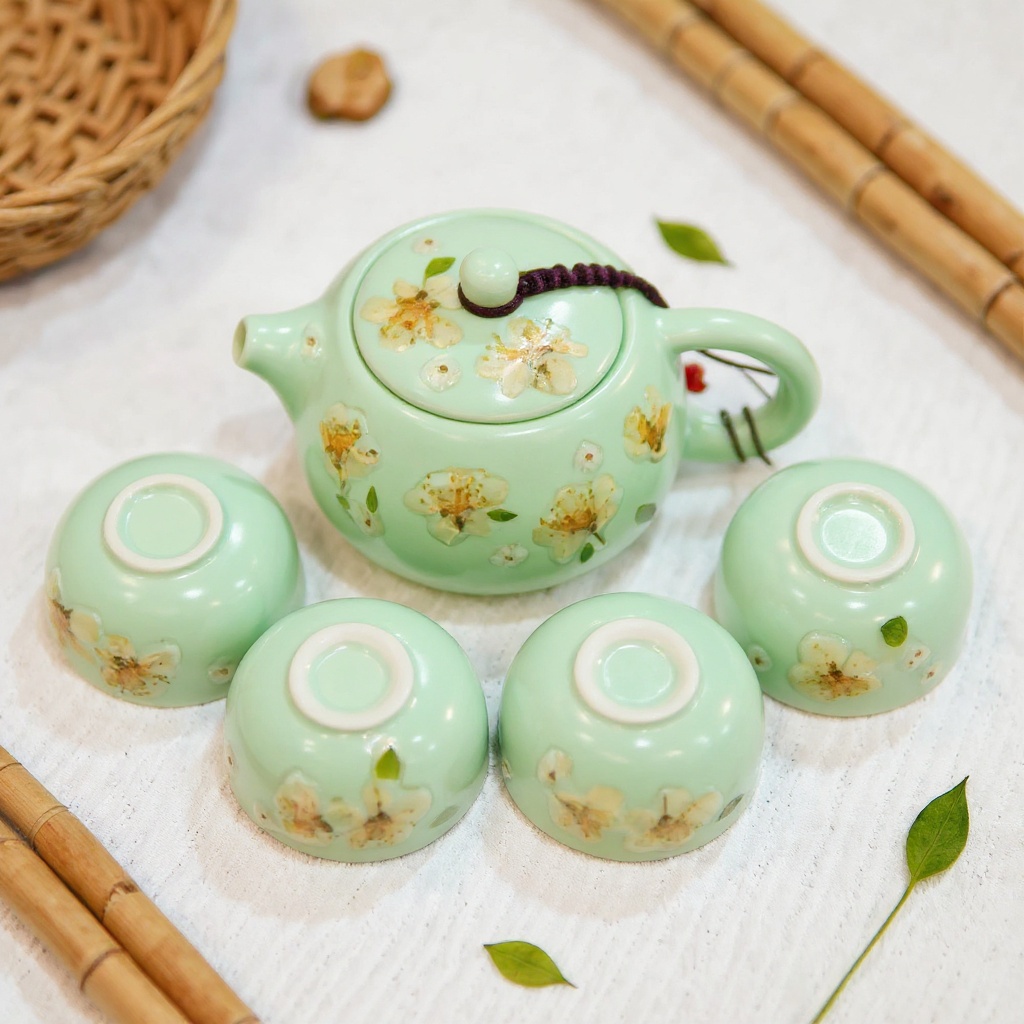
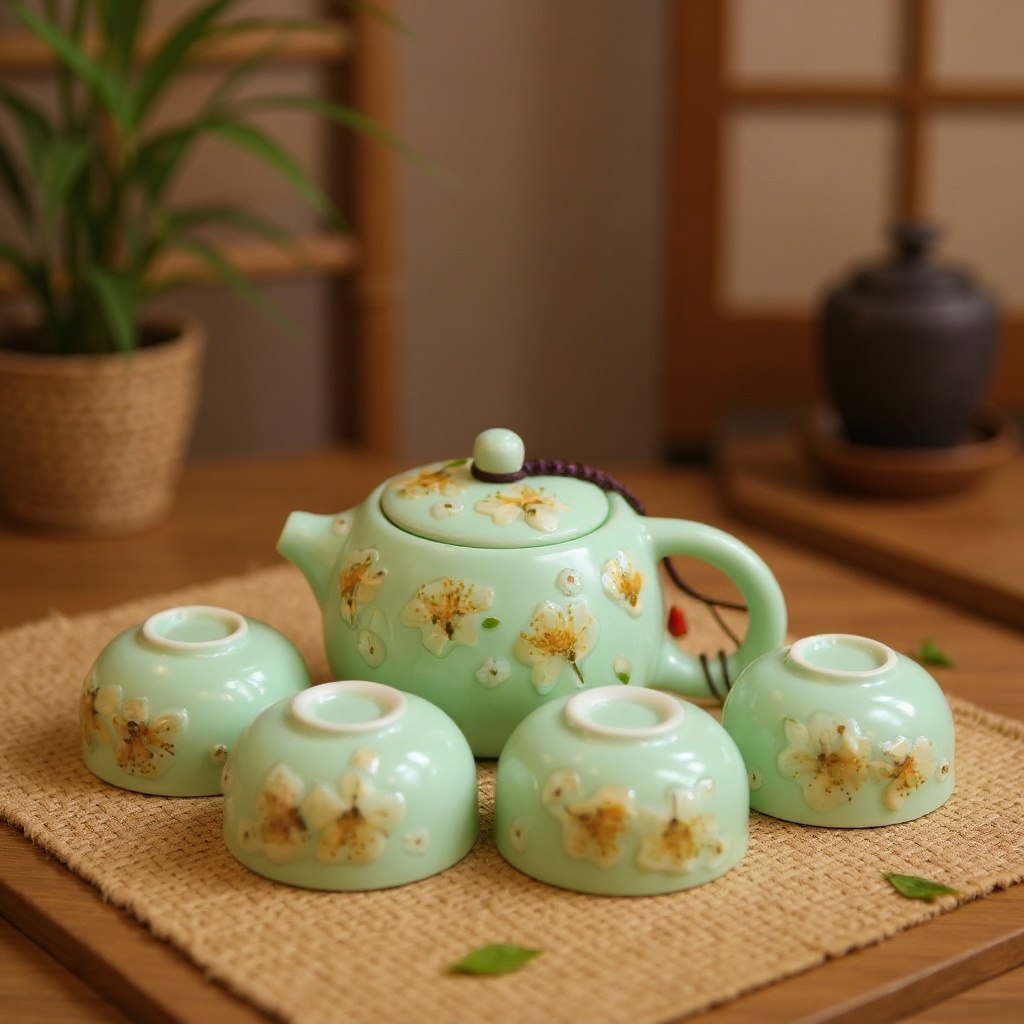
By pampasroom, founder of Pampasroom · 10+ years researching East Asian ceramic traditions · Studied celadon glazing techniques with Longquan kiln workshops in Zhejiang Province · Consulted on ceramic authentication for independent gallery acquisitionsThe one of a kind tea set for collectors most worth seeking right now combines three near-impossible-to-fake elements: authentic iron-reduction celadon glaze, real embedded winter jasmine petals that sit raised above the surface, and hand-formed porcelain that shows the maker's fingerprints in the clay. Specifically, the Handmade Celadon Tea Set Real Pressed Jasmine | Eco Porcelain Teapot 4 Cups | Gongfu Gift represents this convergence — jade-green celadon glaze, visible yellow jasmine petals, a 200ml teapot, four 45ml cups, and a natural wood tray. Factory sets retail for $30–$150. Collector-grade handmade sets with documented artisan provenance start at $200 and reach $600 or more. The difference isn't just aesthetic. It's technical, historical, and — for the right buyer — genuinely irreplaceable.
What Separates a One of a Kind Tea Set for Collectors from Everyday Pottery
Three factors define collector-grade teaware. Material authenticity. Construction method. And artistic uniqueness that can't be replicated on an assembly line.
Factory sets use standardized molds and synthetic glazes engineered for identical, predictable results. Every cup in a factory set weighs within a gram of the others. The glaze color is uniform from rim to foot. That consistency is a manufacturing achievement — but it's also evidence that no human hand shaped what you're holding.
Collector pieces embrace the opposite logic. Authentic celadon glaze requires iron oxide at specific concentrations, fired at approximately 1,260–1,310°C in a reduction atmosphere where oxygen is intentionally restricted. According to the Victoria and Albert Museum's ceramic records, this oxygen-starved firing environment converts iron compounds from reddish-brown ferric states to the blue-green ferrous states that produce celadon's signature jade coloration. Too much oxygen and the piece browns. Too little and it grays. The window is narrow. Master potters spend years reading kiln atmospheres without instruments.
Real botanical embedding adds another layer of technical difficulty. The flowers must be positioned while clay is leather-hard, survive firing without combusting completely, and emerge with visible form intact. Winter jasmine petals accomplish this. Their cellular structure is dense enough to hold shape, and their natural pigments survive at temperatures that destroy most organic material, leaving soft yellow color partially preserved in the finished glaze.
| Feature | Factory Sets | Collector-Grade Sets |
|---|---|---|
| Production Method | Machine molded | Hand thrown or hand shaped |
| Glazing | Uniform synthetic application | Iron-oxide mineral glaze, reduction fired |
| Decoration | Printed, painted, or decal | Embedded botanicals, carved relief |
| Uniqueness | Identical across production run | No two pieces share exact glaze pattern |
| Price Range | $30–$150 | $200–$600+ |
| Investment Behavior | Depreciates rapidly | Maintains or appreciates with documented provenance |
| Lifespan with Care | 5–15 years typical | Generations — Song Dynasty celadon survives today |
The Ancient History of Celadon: Why Collectors Pay Premium Prices for One of a Kind Tea Sets
Celadon's origins predate the Song Dynasty. Yue ware kilns in Zhejiang Province were producing proto-celadon pieces as early as the Eastern Han period (25–220 CE), over a millennium before Song-era potters refined the glaze into the luminous jade-green form collectors recognize today. The Smithsonian's Freer Gallery of Art holds Yue ware examples dating to this period, documenting an unbroken tradition of iron-reduction glazing that spans nearly two thousand years.
Song Dynasty (960–1279 CE) celadon is what most collectors mean when they use the term. Longquan kilns in Zhejiang and Ru kilns in Henan produced pieces so technically refined that modern kilns still use their formulas as benchmarks. Auction records from Christie's and Bonhams show that authenticated Song celadon pieces regularly sell for five to seven figures, with provenance documentation being the single largest factor in realized price.
Contemporary handmade celadon sets aren't Song Dynasty antiques, obviously. But they use the same reduction-firing chemistry and hand-forming traditions. That lineage matters to collectors. A one of a kind tea set for collectors made with genuine celadon technique participates in a craft tradition with documented museum-level history — which is not something you can say about a set stamped out of a Guangdong factory at $40 a unit.
The luminous quality of true celadon glaze resists imitation. Hold an authentic piece to natural light. The glaze appears almost liquid — shifting from pale blue-green at the thickest pooled areas to deeper jade where it thins across raised surfaces. This gradient emerges from physics, not artistry. It can't be painted on. It can't be printed. It either happens in the kiln or it doesn't.
Real Pressed Flowers: The Technical Challenge That Makes Each One of a Kind Tea Set Irreproducible
Embedding living botanical material into porcelain is harder than it sounds. Much harder.
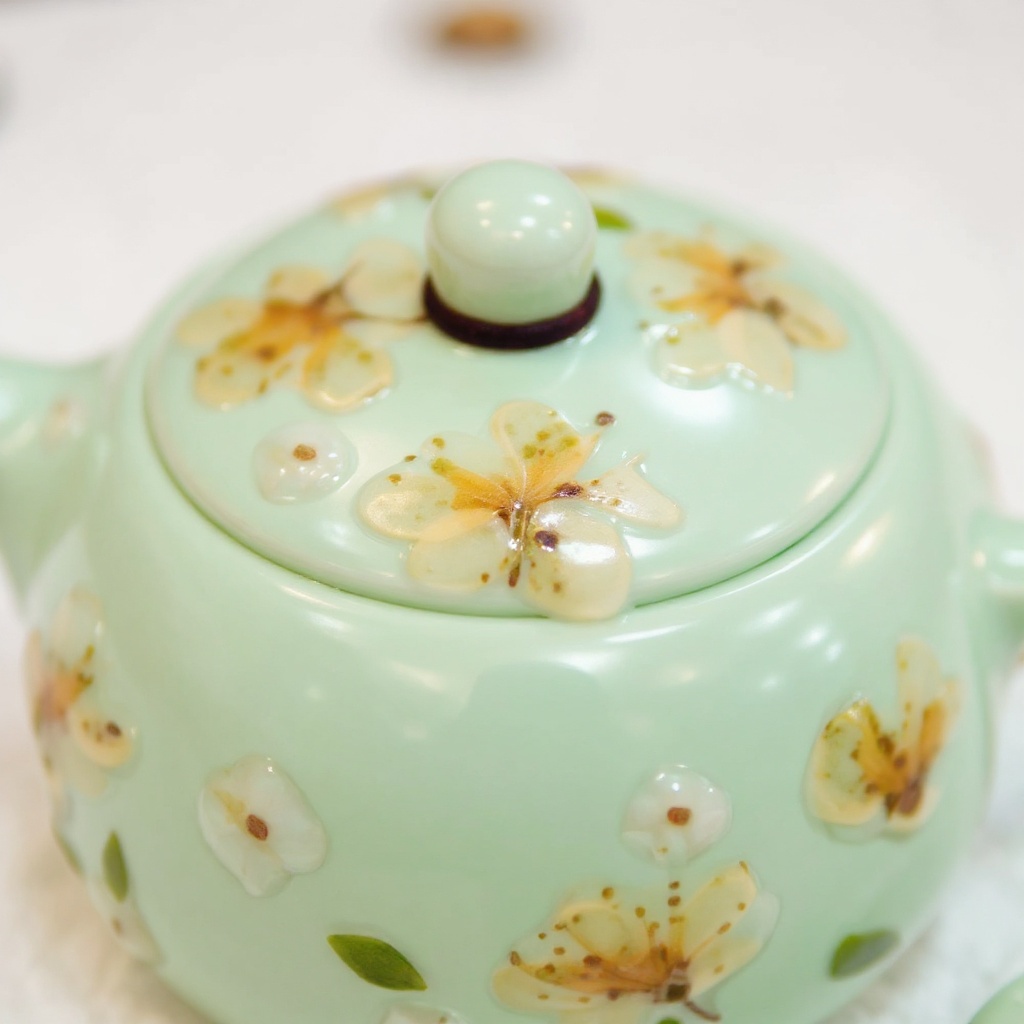
The process requires positioning fresh or carefully preserved flowers against leather-hard clay — a narrow window between too-wet (flowers sink and blur) and too-dry (clay cracks during pressing). Winter jasmine (Jasminum nudiflorum) works better than most botanicals for this application. Its petals are thin but structurally rigid, with cell walls that partially survive the kiln's heat rather than burning away entirely. The result: petals that sit visibly raised from the glaze surface, catching light differently than the surrounding celadon, creating the tactile relief you can feel when you run a fingertip across the cup.
Cheaper pieces fake this effect with printed decals or painted-on flower shapes. The difference is immediate and unmistakable. Printed flowers are flat. They don't cast shadows. They don't create a texture break in the glaze. A real embedded petal has dimensionality — a slight ridge, a shadow edge, a subtle color variation where the organic material met the iron glaze at high heat.
For buyers concerned about food safety: quality botanical tea sets seal the embedded material beneath food-grade glaze that meets applicable ceramic safety standards. The flowers are encased, not exposed. They can't contact liquid in the cup. The Handmade Celadon Tea Set Real Pressed Jasmine uses eco-friendly porcelain and food-safe sealing throughout — the botanical elements are aesthetic, not a hygiene concern when properly executed.
Honestly, though: if you're planning to run this set through a commercial dishwasher every day, this is not the right purchase. The glaze surface of any handmade collector piece is more vulnerable to abrasion than industrial ceramics engineered for institutional settings. Buy this because you want to care for it properly. Not because you want teaware that survives neglect.
Gongfu Proportions: Why the 200ml Teapot and 45ml Cups Matter for Collectors
Size isn't arbitrary in a one of a kind tea set for collectors made for gongfu brewing. It's functional architecture.
The gongfu tea ceremony, documented extensively in academic tea culture research and practiced continuously in Fujian and Guangdong provinces, centers on multiple short steepings — typically 6 to 10 infusions of 20 to 45 seconds each — rather than a single long steep. According to research published in the Journal of Tea Science (China), shorter steeping intervals at higher leaf-to-water ratios produce more distinct flavor differentiation between infusions, allowing drinkers to experience the tea's aromatic evolution across a session.
A 200ml teapot fills exactly four 45ml cups with minimal waste. This isn't coincidence. It's the traditional proportion designed for a host and three guests sharing tea simultaneously, each receiving a cup before the teapot is re-steeped. The small cup size means each portion is consumed while the tea is at peak temperature — roughly 65–70°C for most oolongs and pu-erhs. A 300ml Western-style mug of the same tea would cool unevenly and lose aromatic volatiles before the last sip.
Collectors who know gongfu culture recognize these proportions immediately. A teapot sized at 200ml with 45ml cups signals that the maker understands traditional tea practice, not just decorative ceramics. That cultural literacy is embedded in the object. It makes the piece more authentic, more useful, and more valuable to the right buyer.
Investment Potential: Do One of a Kind Tea Sets for Collectors Hold Their Value?
Here is the honest version that most articles won't give you: not all handmade tea sets appreciate in value, and buying ceramics as a primary financial investment is a mistake unless you have deep expertise in the specific market segment.
That said, the factors that correlate with value retention in handmade celadon tea sets are well documented:
1. Artisan provenance and documentation — Kiln origin, maker identification, and firing records increase realized auction value. Christie's sale records show provenance documentation adds 15–40% to comparable celadon pieces. 2. Technical difficulty — Reduction-fired celadon with embedded botanicals requires skills held by a small number of active artisans globally. Limited supply supports price floors. 3. Cultural and historical lineage — Pieces connected to documented ceramic traditions (Longquan, Ru, Jingdezhen) perform better at auction than regionally unaffiliated work. 4. Completeness — Full sets with all original pieces command 30–60% premiums over incomplete sets in secondary market sales, based on Bonhams Asian ceramics auction data. 5. Material integrity — High-fired porcelain (cone 10, approximately 1,300°C) shows measurably lower crazing and deterioration rates over decades than low-fire earthenware. 6. Condition — No chips, no repairs, no glaze loss. Original condition is non-negotiable for serious collector value. 7. Market timing — Slow living, Japanese minimalism, and gongfu tea culture interest have grown consistently in Western markets since 2018, supporting sustained demand.
Factory sets depreciate to near-zero resale value within years because scarcity doesn't exist. A one of a kind tea set for collectors made with authentic celadon technique by a documented artisan occupies a fundamentally different market position.
How to Authenticate Celadon and Identify a Genuine One of a Kind Tea Set for Collectors
Five tests. Measurable. No guessing.
1. The light test. Hold the piece to indirect natural light. Authentic reduction-fired celadon shows layered translucency — you should see color gradient variation across the surface, darker in thick glaze pooling zones, lighter where glaze thins over ridges and edges. Uniform color under light is a synthetic glaze signature. 2. The ring test. Tap the rim gently with a fingernail. High-fired porcelain (1,260°C+) produces a clear, sustained tone lasting 1–2 seconds. Low-fire earthenware or slip-cast stoneware produces a dull thud. This test has been used by ceramic appraisers for centuries and remains reliable for distinguishing firing temperature categories. 3. The base inspection. Examine the unglazed foot ring. Handmade pieces show tool marks, slight asymmetry, and minor surface texture from trimming. Machine-molded pieces have geometrically perfect, smooth foot rings with no tool evidence. 4. The weight distribution test. Weigh each cup in a set on a kitchen scale. Hand-thrown pieces in the same set will vary by 3–8 grams. Machine-molded pieces will vary by less than 1 gram. This is a reliable quantitative differentiator. 5. The botanical dimensionality test. For sets with embedded flowers: run a fingertip across the decorated surface. Real embedded petals create a measurable raised ridge — typically 0.3–0.8mm above the surrounding glaze. Printed or painted decoration is flush with the glaze surface. You cannot fake this with paint.Authentication Checklist for One of a Kind Tea Sets for Collectors
- Glaze shows gradient color variation under natural light ✓ - Ring test produces sustained clear tone (not dull thud) ✓ - Foot ring shows trimming tool marks and minor asymmetry ✓ - Cup weights in set vary by 3–8 grams ✓ - Botanical decoration has measurable raised relief ✓ - Documentation includes kiln origin or artisan identification ✓
Caring for Your One of a Kind Tea Set for Collectors
Proper care determines whether your set remains collection-quality for decades or deteriorates into display-only status within years.
Hand wash with mild dish soap and a soft cloth. Always. The eco-friendly glaze on quality botanical celadon sets handles hot water and gentle detergent without problem, but abrasive scrubbers can scratch glaze surfaces and expose the botanical elements beneath. This isn't speculation — it's basic ceramic material behavior. Abrasion removes glaze. Removed glaze exposes underlying clay and embedded materials.
For tea staining: a paste of baking soda and warm water, applied with a soft cloth and left for five minutes, removes tannin deposits from cup interiors without the glaze damage that commercial ceramic cleaners can cause.
Storage matters more than most buyers anticipate. Stack cups with soft cloth or felt between them. Celadon glaze is glass — it chips on contact with other hard ceramic surfaces. Store the teapot separately from cups, lid removed, to prevent lid-to-body chips during handling.
Display in indirect natural light. Not direct sun. UV exposure over years can affect organic elements in botanical glazes, though the degree depends on exposure intensity and duration.
With this level of care, high-fired porcelain celadon pieces last generations. That's not marketing language. Song Dynasty celadon survives intact in museum collections nearly a thousand years after firing. The material itself is among the most durable decorative objects humans produce.
FAQ
What makes a one of a kind tea set for collectors different from sets sold at home goods stores?Collector-grade tea sets combine three elements mass production cannot replicate: authentic mineral glazes (like iron-reduction celadon), hand-forming techniques that leave measurable maker marks, and decorative elements like embedded botanicals with real raised relief. Home goods store sets are slip-cast with synthetic glazes, producing identical pieces across thousands of units. Collector pieces vary between individual items in the same set and between separate sets by the same maker. Price ranges reflect this: $30–$150 for factory sets, $200–$600+ for documented artisan pieces.
How can I verify celadon glaze is authentic and not a factory imitation?Four measurable tests work reliably. First, hold the piece to natural light — authentic reduction celadon shows color gradient variation from glaze pooling, not uniform color. Second, tap the rim with a fingernail — high-fired porcelain rings clearly for 1–2 seconds; low-fire imitations thud. Third, examine the foot ring for hand-trimming tool marks and minor asymmetry. Fourth, weigh cups individually — hand-thrown pieces in a set vary 3–8 grams; molded pieces vary less than 1 gram.
Are tea sets with real embedded flowers food-safe to use?Yes, when the embedded material is properly sealed beneath food-grade glaze during production. In quality botanical celadon sets, the flowers are encased entirely within glaze layers and cannot contact liquids in the cup. The critical factor is glaze integrity — inspect for chips or crazing near botanical elements before use. Cracked glaze near embeddings should be treated as a surface compromise, and the piece moved to display-only use until evaluated by a ceramics professional.
What are the correct proportions for a gongfu tea set, and why do they matter for collectors?Traditional gongfu proportions: 150–200ml teapot paired with 35–50ml cups. A 200ml teapot fills four 45ml cups precisely, which is the classic host-plus-three-guests format. These measurements aren't decorative choices — they're functional specifications designed for 20–45 second steeping intervals across 6–10 successive infusions. Sets built to these proportions signal cultural knowledge on the part of the maker, which matters to collectors who understand gongfu tradition and raises the piece's credibility in secondary markets.
Do handmade celadon tea sets increase in value over time?Documented examples with strong artisan provenance show value retention in secondary markets. Christie's and Bonhams Asian ceramics auction data indicate that provenance documentation alone adds 15–40% to realized prices on comparable pieces. Full sets in original condition command 30–60% premiums over incomplete sets. However, undocumented handmade pieces without kiln or artisan identification appreciate far less reliably. The honest answer: buy for the daily enjoyment first. If you also document provenance carefully, the investment case becomes real over a 10–20 year horizon.
Why does the celadon glaze look different under different lighting conditions?Authentic reduction-fired celadon contains iron compounds in ferrous (Fe²⁺) states created by oxygen-restricted kiln firing. These compounds interact with light wavelengths differently depending on glaze thickness, angle of incidence, and light color temperature. The result is a glaze that appears pale blue-green under cool overcast light, warmer jade under incandescent light, and almost liquid in transparency under direct natural light. This is a physical property of the iron compound chemistry — not a surface treatment that can be replicated with synthetic pigments or printing.
What is the historical origin of celadon ceramics?Celadon production began in China during the Eastern Han period (25–220 CE) with Yue ware kilns in Zhejiang Province producing proto-celadon pieces. The Smithsonian's Freer Gallery holds examples from this era. The glaze technique evolved through successive dynasties, reaching technical refinement during the Song Dynasty (960–1279 CE) at Longquan and Ru kilns. Contemporary celadon continues this two-thousand-year tradition using the same iron-reduction chemistry, making it one of the longest-documented continuous ceramic practices in human history.
How should I store a collector-grade tea set to preserve its value and condition?Store cups with soft felt or cloth between each piece — celadon glaze is glass and chips on contact with other ceramics. Keep the teapot lid stored separately from the body to prevent rim chips. Avoid stacking teapot and cups in direct contact. Store the full set away from direct UV light sources, which can affect organic elements in botanical embeddings over multi-year exposure periods. For long-term storage, acid-free tissue wrapping in a padded box prevents both physical damage and environmental degradation.
Can I use a celadon tea set with embedded botanicals in the dishwasher?No. This is the straightforward answer most product pages soften. Dishwasher heat cycles, high-pressure water jets, and commercial detergents are aggressive enough to degrade glaze surfaces on handmade ceramics over repeated cycles. The thermal shock from dishwasher temperature changes also poses crazing risk for reduction-fired glazes. Hand wash only, with mild soap and a soft cloth. If dishwasher convenience is your priority, a collector-grade handmade set is genuinely the wrong product for your needs.
Finding the Right One of a Kind Tea Set for Collectors
The category of one of a kind tea sets for collectors rewards buyers who know what they're looking at. Not every handmade piece is worth collecting. Not every botanical tea set uses real embedded flowers. Not every jade-green glaze is authentic celadon.
The combination that makes a piece genuinely collectible is specific: iron-reduction celadon glaze with documented mineral composition and visible gradient, real botanical embedding with measurable surface relief, hand-formed porcelain with authentication markers at the foot ring, and proportions that reflect functional knowledge of traditional tea culture.
This is a small set of criteria. Most teaware on the market fails at least one of them. When a piece meets all of them — luminous jade-green glaze, yellow winter jasmine petals raised from the surface, hand-thrown porcelain, gongfu proportions, natural wood tray — you're holding something that participates in two thousand years of ceramic history while functioning as a daily ritual object.
That convergence is rare. Worth recognizing when you find it.
For the one of a kind tea set for collectors that combines authentic celadon glazing, real pressed winter jasmine with visible raised relief, eco-friendly porcelain construction, and traditional gongfu proportions, see the Handmade Celadon Tea Set Real Pressed Jasmine | Eco Porcelain Teapot 4 Cups | Gongfu Gift.


