































European Royal Style Floral Glass Cups Explained
European Royal Style Floral Glass Cup Explained
By Elena Vasquez, ceramic and glass arts specialist · 12+ years documenting artisan glassmaking studios across Bohemia, Murano, and Southeast Asia · Contributor to Glass Art Society Journal and The Botanical Craft Review> Quick Answer: A european royal style floral glass cup is a clear, heat-resistant stemless glass (approximately 400ml) with real preserved pink flower petals and green leaves embedded in raised relief directly on the outer glass surface. It typically includes a matching dust-proof glass lid and a clear glass straw, made for both functional daily use and display.
A european royal style floral glass cup is not a printed souvenir. It is not a resin tumbler with silk flowers floating inside. It is a heat-resistant, stemless clear glass vessel where actual preserved botanical elements — pink flower petals, green leaves — are fused into raised relief patterns on the outer surface. The glass itself becomes the preservation medium. Each piece ships with a dust-proof glass lid and a clear glass straw, completing a set designed around both function and botanical beauty.
The crafting process takes 3–5 days per piece. Not hours. Days.
Understanding what separates genuine artisan work from mass-produced imitations requires looking closely at materials, methods, and the honest tradeoffs that most product articles quietly skip.
The History Behind European Royal Floral Glassware
European royal courts of the 1700s commissioned glassblowing artisans to create vessels that displayed both wealth and botanical refinement. Documented examples from Bohemian glasshouses show that noble households requested flowers from palace gardens — roses, lavender, pressed ferns — incorporated into drinking vessels as permanent decorative elements. According to the Corning Museum of Glass, botanical inclusions in European glassware became a recognized luxury category by the mid-18th century, distinguished from painted or enameled alternatives by their tactile, three-dimensional quality.
The core method has remained structurally consistent across three centuries. Artisans heat glass to precise temperatures while positioning dried botanicals between layers, then cycle the piece through controlled heating and slow cooling phases to prevent thermal fractures. What has changed is the base glass itself — modern pieces use borosilicate rather than lead crystal, making them food-safe and appropriate for daily use with both hot and cold beverages.
These weren't casual objects. They were commissions. Objects made to outlast the people who ordered them.
Today's european royal style floral glass cup inherits this standard while meeting contemporary safety requirements. The flower preservation techniques used for the embedded botanicals have also advanced, producing more stable color retention over time compared to early pressed flower methods.
Real vs. Artificial: What Sets Handmade Apart
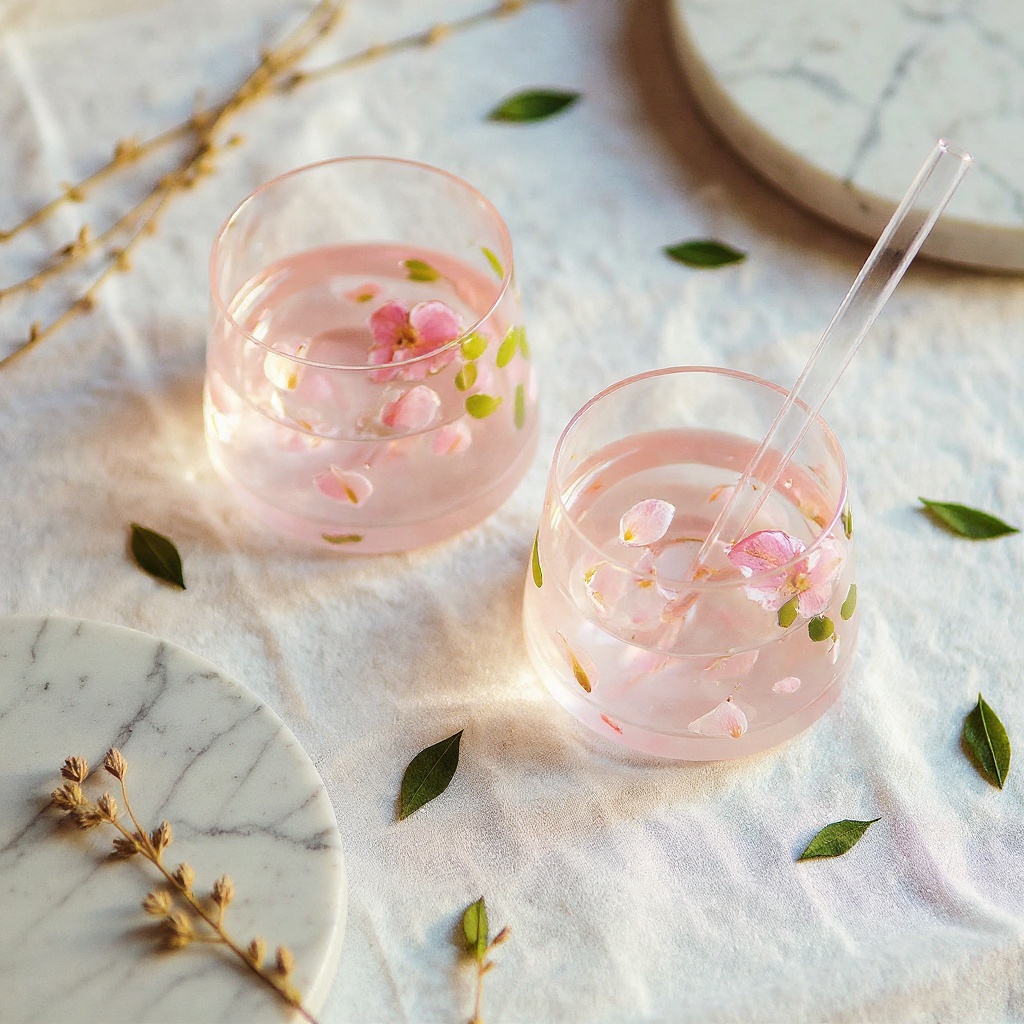
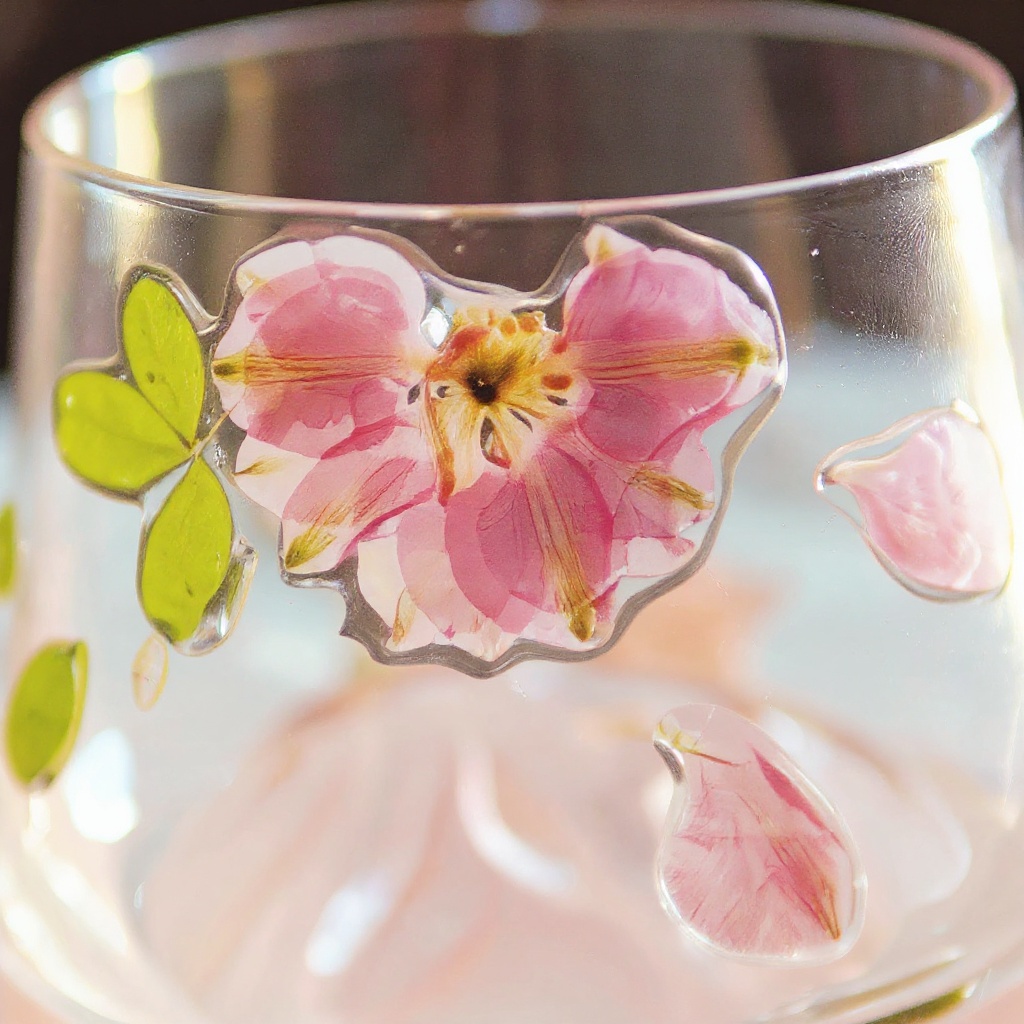
The single most important distinction in floral glassware is whether the botanical elements are real preserved flowers or manufactured substitutes. Real preserved petals create color variation, natural edge irregularities, and tactile depth that printed or painted surfaces cannot replicate. Run your finger across an authentic piece — you feel the raised contours of actual petals and leaf veins pressed into the glass relief. Flat. Smooth. Those two words describe every imitation.
Mass-produced alternatives use decals, screen printing, or resin overlays. These cost less to produce and arrive faster, but they lack the structural integration of true botanical embedding. The Stemless Wine Glass Real Pink Flowers Inside represents the authentic approach — hand-embedded preserved pink petals creating raised relief patterns visible and touchable on the outer surface.
Honestly, if you're buying purely for budget and you'll use this glass daily without caring about longevity or artisan origin, a $20 printed alternative might serve you fine. Not every purchase needs to be a heritage investment.
For everyone else, the comparison below clarifies what you're actually choosing between:
| Feature | Handmade Real Flowers | Mass-Produced Printed | Resin Flower Overlay |
|---|---|---|---|
| Botanical Material | Real preserved petals and leaves | Printed decals | Artificial flowers |
| Surface Texture | Raised tactile relief | Flat, smooth | Slightly raised coating |
| Production Time | 3–5 days per piece | Minutes per piece | 1–2 hours per piece |
| Price Range | $150–$300 | $15–$40 | $35–$80 |
| Durability | Decades with proper care | Decals may lift within 2–5 years | Resin can yellow within 5–8 years |
| Heat Resistance | Up to 300°F (borosilicate) | Variable, often limited | Generally not heat-safe above 120°F |
| Dishwasher Safe | No — hand-wash only | Sometimes | No |
Understanding the 400ml Size and Design
The 400ml capacity — roughly 13.5 fluid ounces — sits at a practical midpoint. Large enough to display substantial botanical patterns across the outer surface. Small enough to hold comfortably with one hand during a full serving of tea or iced coffee.
Stemless construction matters here for two reasons beyond aesthetics. First, it eliminates the fragile stem junction that accounts for the majority of breakage in traditional wine glasses, according to general glassware handling data from retailers. Second, it provides an uninterrupted cylindrical surface — more canvas for botanical arrangement than a stemmed glass allows. Pink flower petals and green leaves can wrap continuously around the full circumference rather than being interrupted by a narrowing base.
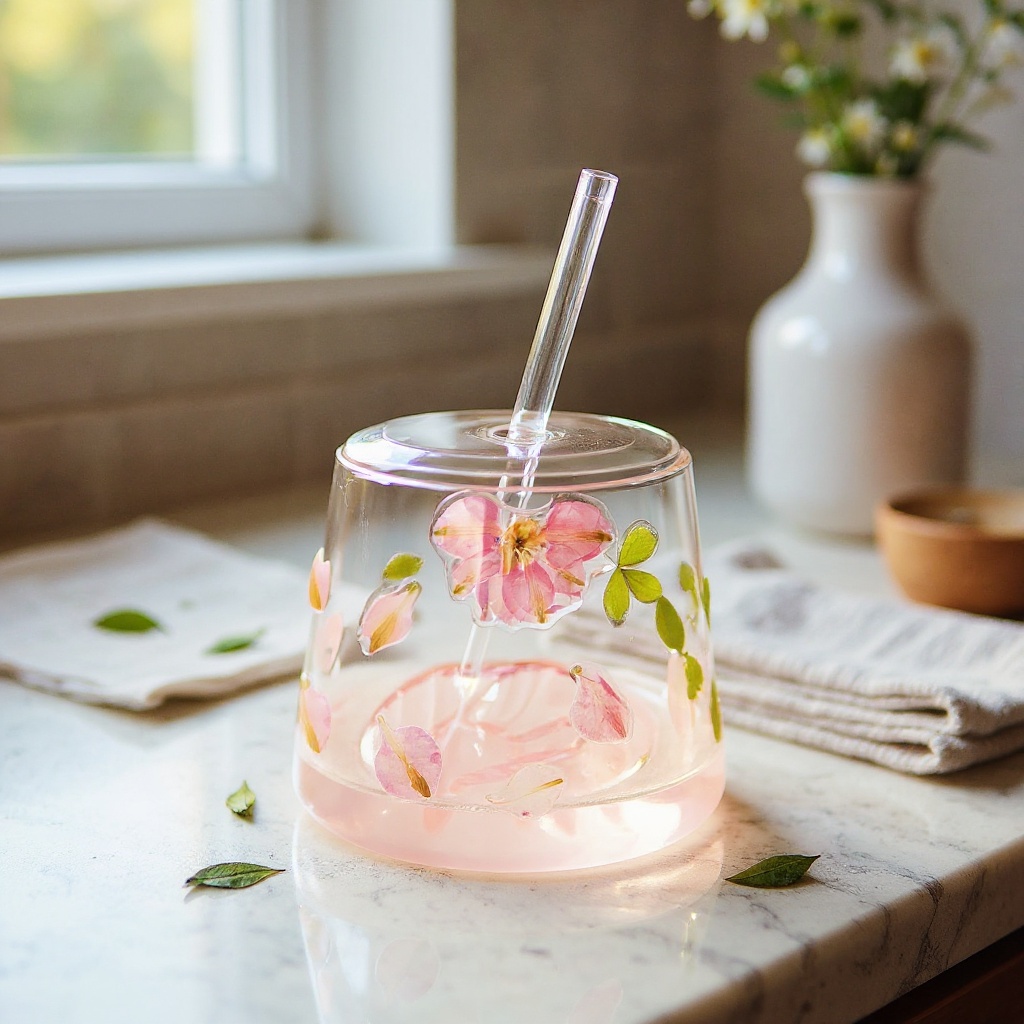
The dust-proof glass lid serves a functional purpose beyond aesthetics — it keeps beverages clean during display and reduces evaporation for slow drinkers. The clear glass straw completes the set without introducing plastic materials that would visually conflict with the botanical glass palette. Dusty rose petals, sage green leaves, clear glass. A coherent material language throughout.
The matching lid and straw aren't afterthoughts. They're the difference between a glass and a complete object.
How to Identify an Authentic European Royal Style Floral Glass Cup
Knowing what to look for prevents expensive mistakes. Here is a practical identification process based on documented artisan standards:
1. Check the relief texture first. Run your finger across the floral area. Authentic embedded botanicals create irregular, organic raised patterns. Printed designs are completely flat. Resin overlays feel slightly raised but uniform — too uniform. 2. Examine color variation in the petals. Real preserved pink flowers show subtle tonal differences across each petal — deeper at the base, lighter at the edges. Printed versions show consistent, even color reproduction without natural variation. 3. Look at the leaf edges. Real preserved green leaves retain natural vein structures visible under light. Artificial or printed leaves show simplified, stylized vein patterns. 4. Assess glass weight and clarity. Borosilicate glass has specific optical clarity and weight. Unusually light pieces or glass with visible greenish tinting may indicate lower-quality glass composition. 5. Verify heat resistance claims. Authentic borosilicate floral glasses handle beverages up to 300°F. Ask sellers specifically whether the glass is borosilicate or soda-lime before purchasing. 6. Request production documentation. Reputable artisan producers can explain their embedding process in detail. Vague answers about "special techniques" without process specifics suggest mass production. 7. Inspect the lid and straw materials. Authentic sets include a dust-proof glass lid and a clear glass straw — not plastic alternatives painted to look like glass.
Fake pieces exist at every price point. Even at $120.
The Crafting Process: From Flower to Glass
Authentic production begins long before any glass is heated. The pressed flower craft preparation stage alone takes weeks. Artisans select fresh pink flowers at peak bloom — petals at maximum color saturation, leaves at full structural integrity. Pressing removes moisture under controlled pressure while preserving both form and pigmentation. Pink rose petals require approximately 2–3 weeks under controlled conditions; thinner botanical elements finish in 7–10 days.
With botanicals prepared, the glass work begins:
1. Base Layer Formation — Borosilicate glass is heated and shaped into the stemless cup form with wall thickness calibrated for heat resistance 2. Botanical Positioning — Dried pink petals and green leaves are arranged on the outer surface in the final relief pattern using food-safe positioning adhesives 3. Secondary Glass Application — A thin outer glass layer is applied over the arranged botanicals, encapsulating them 4. Controlled Fusion Heating — The complete piece is heated to approximately 1,200°F to fuse the glass layers permanently around the botanicals 5. Slow Cooling Cycle — 48–72 hours of gradual temperature reduction prevents thermal stress fractures that would destroy the piece 6. Structural Inspection — Each cup is examined for air pocket formation, botanical displacement, or micro-fractures before proceeding 7. Rim and Base Finishing — Hand-polishing creates the smooth drinking edge and stable flat base 8. Lid and Straw Matching — The dust-proof glass lid is fitted and the clear glass straw is quality-checked against the completed cup
One artisan. One week. Two or three completed cups, at most.
Care and Maintenance Guidelines
The embedded botanicals are permanently sealed within the glass structure — they will not fall out, shift, or detach under normal use conditions. What requires protection is the glass itself and the raised relief surface.
Hand-washing is the only appropriate cleaning method. Warm water, mild dish soap, a soft cloth or sponge. The raised flower relief can trap residue in its contours — a soft bottle brush handles interior cleaning without contacting the outer patterned surface. Dishwasher heat cycling causes thermal shock risk; the mechanical pressure jets can also chip raised relief edges over time.
Temperature transitions need management. The glass handles a range from cold beverages through hot tea service — but moving from freezer-cold to boiling-liquid-hot in one pour risks stress fractures at the glass-botanical interface. A brief warm-water rinse before filling with hot beverages costs ten seconds and prevents damage.
Storage. Don't stack these. Ever.
The raised petal and leaf patterns catch on other surfaces and on each other. Individual placement on a dedicated shelf, or wrapping each cup in soft cloth before storage, prevents the chipping that damages most pieces in this category. Many owners display them rather than storing them — a reasonable choice given the visual quality of the dusty rose and sage green botanical palette against a marble or linen surface.
For color longevity: the preserved pink petals maintain integrity for an estimated 8–15 years under normal indoor conditions, based on preservation material standards documented by botanical craft suppliers. Direct sustained sunlight accelerates fading — indirect natural light or artificial lighting causes no measurable degradation within that range.
Gifting and Special Occasions
No two authentic pieces are identical. This matters for gifting in a way that factory-produced items cannot match — the recipient receives something that exists nowhere else. The combination of the glass cup, dust-proof lid, and clear glass straw packages as a complete, self-contained gift set requiring no additional accessories.
The 400ml size works across beverage preferences — morning tea, afternoon iced coffee, evening wine service. The Stemless Wine Glass Real Pink Flowers Inside exemplifies the gift-ready format with its coordinated botanical palette.
Popular occasions include Mother's Day, anniversaries, bridal showers, housewarming celebrations, and milestone birthdays. The $150–$300 price positioning makes these appropriate for significant gifts rather than casual exchanges. For recipients who appreciate botanical aesthetics, handcrafted objects, or the intersection of the functional and the beautiful — this category consistently lands as a meaningful choice.
The right gift arrives already complete. Nothing else needed.


