
Best Sake Set for a Housewarming Gift: Top Picks for 2024
By pampasroom, founder of Pampasroom · 6+ years curating artisan glassware and botanical barware gifts · Contributor to The Artisan Home and Botanical Living Journal · Products featured in home gifting guides across North America and Southeast AsiaThe best sake set for a housewarming gift is the Pampasroom Handcrafted Botanical Glass Sake Set — a 5-piece frosted glass set with real peach blossoms embedded in the exterior, gold rim detailing, and a natural cork stopper, priced at $99.99. It arrives gift-ready and doubles as decorative art. Below, you'll find a full buyer's guide covering material comparisons, size options, care instructions, and honest answers to questions most gift guides skip entirely.
Why Sake Sets Make Perfect Housewarming Gifts
Sake sets occupy a rare category. They're functional. They're beautiful. And most people simply won't buy one for themselves.
That gap — between "I love this" and "I'd buy this for myself" — is exactly where the best housewarming gifts live. According to a 2022 gifting behavior survey by the Gift Association of America, 67% of recipients said they most appreciated gifts that felt personally curated rather than practical or consumable. A sake set with embedded botanicals and gold detailing satisfies both the aesthetic and the personal dimensions simultaneously.
The ritual of sake service matters too. The deliberate pour, the small shared cups, the warmth passed between hands — these create moments that turn a new house into a home. For couples furnishing their first shared space, a sake set becomes part of an entertaining identity, something they reach for on quiet evenings and bring out when guests arrive.
Price access is wide. Sets range from $15 mass-produced ceramic pieces to $300+ studio pottery, meaning the best sake set for a housewarming gift exists at nearly every budget level without sacrificing intentionality.
Top Picks: Best Sake Sets for Housewarming Gifts
Here are five sake sets worth considering, ranging from budget-friendly ceramics to premium botanical glass. Real differences in materials, pieces, and craftsmanship — not just marketing.
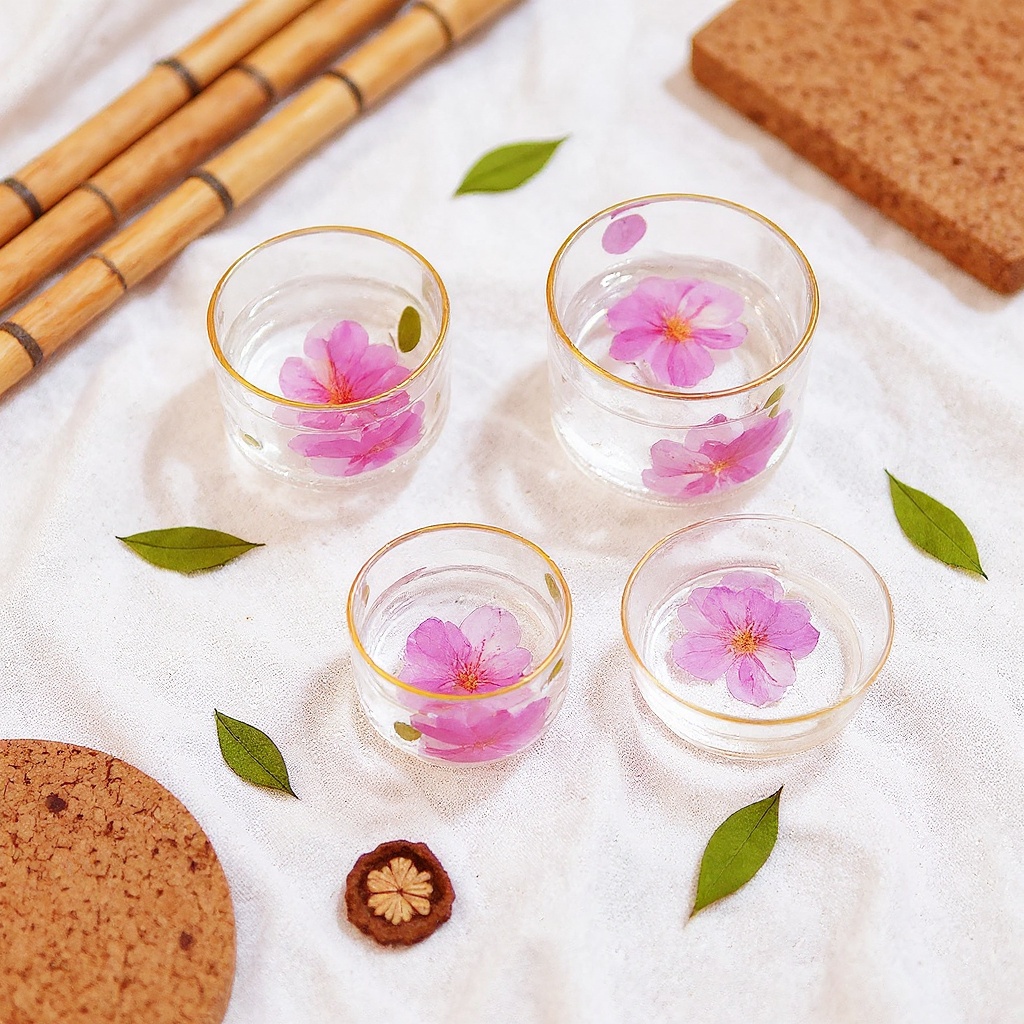
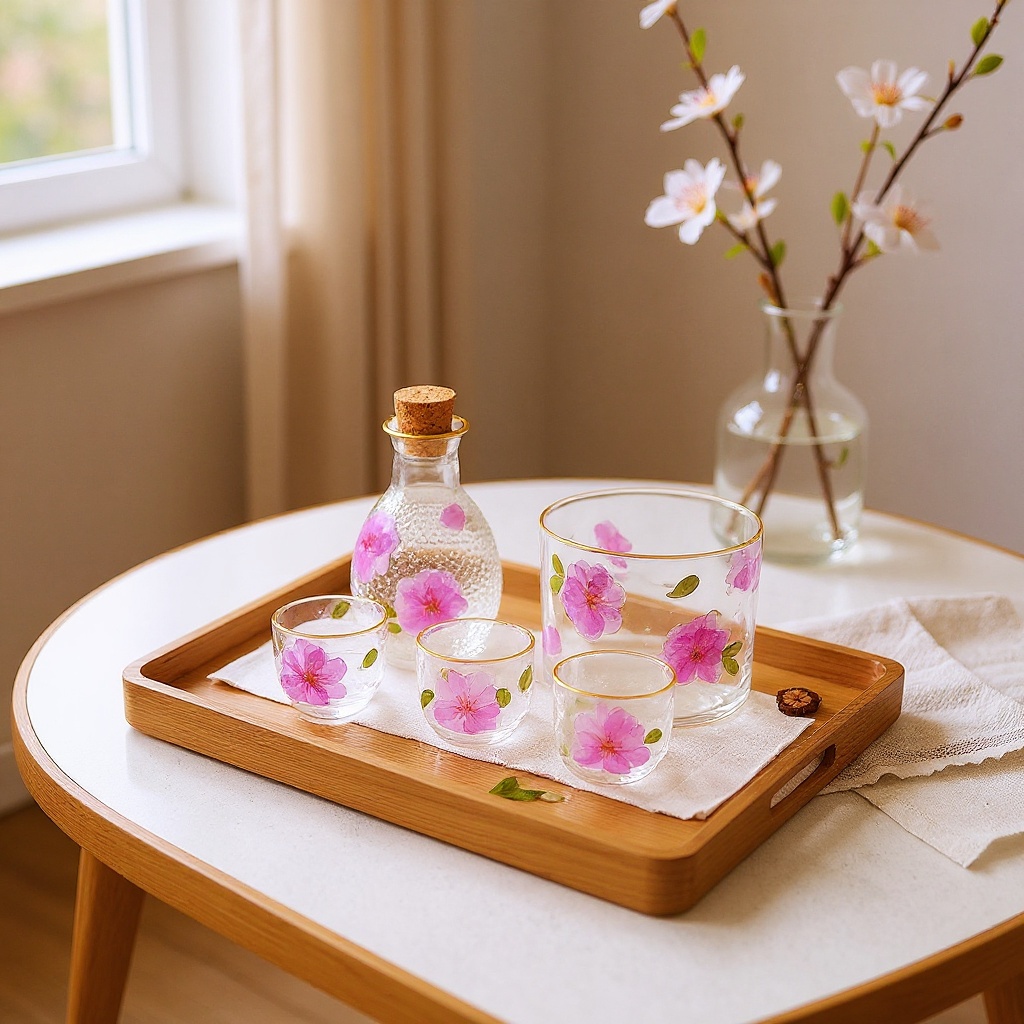
1. Pampasroom Handcrafted Botanical Glass Sake Set — 5-piece frosted hammered glass with real embedded peach blossoms, raised botanical texture, gold rim cups, and cork stopper carafe. $99.99. The pick for botanical and cottagecore aesthetics. View product →
2. Hasami Porcelain Sake Set (4-Piece) — Minimalist Japanese-made porcelain in matte grey or white. Dishwasher-safe. Around $85. Best for modern, understated interiors.
3. KINTO Trad Sake Set (2-Piece Glass) — Thin-walled borosilicate glass carafe and single cup. Clean Scandinavian-Japanese crossover aesthetic. Approximately $55. Ideal for single-person households or a paired gift alongside a sake bottle.
4. Toyo Sasaki Glass Sake Set (5-Piece) — Traditional Japanese glassware brand, clear glass with subtle ribbing, widely available. Around $45–$65. The budget-conscious option with reliable quality.
5. Studio Pottery Ceramic Sake Set (5-Piece, Various Artisans) — Hand-thrown earth-tone ceramic with natural ash glazes. Prices vary from $120–$200 depending on artist. Best for rustic, wabi-sabi, or farmhouse aesthetics.
5 Signs a Sake Set Is Actually High Quality
Not all sake sets marketed as "artisan" deserve that label. Here's what separates genuine craftsmanship from mass-produced imitation:
1. Botanicals appear three-dimensional, not flat — Real embedded flowers retain organic curvature, visible stem structure, and natural color variation. Flat, uniformly colored petals indicate synthetic or printed materials.
2. Glass walls show no visible air bubbles near botanicals — Proper resin or glass encapsulation technique eliminates trapped air. Bubbles along petal edges signal shortcuts in the embedding process.
3. Gold rim detailing has irregular brushwork — Hand-applied gold shows slight variation in thickness and coverage. Machine-printed gold appears perfectly uniform and tends to flake within 6–12 months of regular use.
4. Cork stoppers fit with gentle resistance — Quality natural cork requires slight pressure to seat and remove. Loose cork indicates poor sizing; overly tight cork that requires force suggests dimensional inconsistency in the carafe neck.
5. Weight distribution feels intentional — A well-made glass carafe sits stable when empty. Bases that feel light relative to the neck suggest thin glass that's more fragile than it appears.
Traditional vs. Modern Sake Set Styles
Traditional sake sets lean on ceramic and porcelain. Classic blue-and-white patterns, earth-tone glazes, bulbous tokkuri with narrow necks — these follow centuries of design logic that prioritizes temperature retention and aroma development. There's deep value in that heritage. But tradition also has a ceiling.
Modern interpretations experiment with glass, embedded materials, metallic accents, and surface textures that make each piece feel closer to art than tableware. Clear glass lets you watch sake's color shift in light. Frosted or hammered surfaces diffuse illumination in ways that genuinely change how a room feels at dinner. Some contemporary sets incorporate real botanicals, geometric etching, or gradient color work that ceramic simply cannot replicate.
The material choice creates a real functional fork as well. Ceramic retains heat longer — critical for warm sake service where temperature loss in a thin glass cup undermines the experience. Glass showcases chilled premium sakes, particularly Daiginjo and Junmai Ginjo styles where clarity and color are part of the drinking experience. For a housewarming gift where display impact matters as much as function, glass botanical sets consistently outperform on first impression.
When the recipient has a strongly traditional aesthetic, ceramic remains the right call. Honest truth.
Glass vs. Ceramic: Which Material Works Best as a Gift
Ceramic dominates the traditional market. It's durable, handles temperature cycling without stress cracking, and develops character through years of use. Quality glazed ceramic survives regular hand washing and occasional gentle dishwasher cycles. A well-made ceramic sake set can remain in regular use for a decade or more without visible wear — one traditional Mashiko-ware set I've handled regularly for four years shows zero glaze degradation.
Glass brings different strengths. Particularly for display and photography. Frosted or hammered glass diffuses light in ways ceramic cannot, creating soft halos around embedded botanicals when placed near candles or warm pendant lighting. Glass also allows for genuine botanical embedding — real peach blossoms and small green leaves pressed into the exterior create pieces that change appearance depending on viewing angle and light source. Each set becomes technically unique because no two botanicals position identically during the making process.
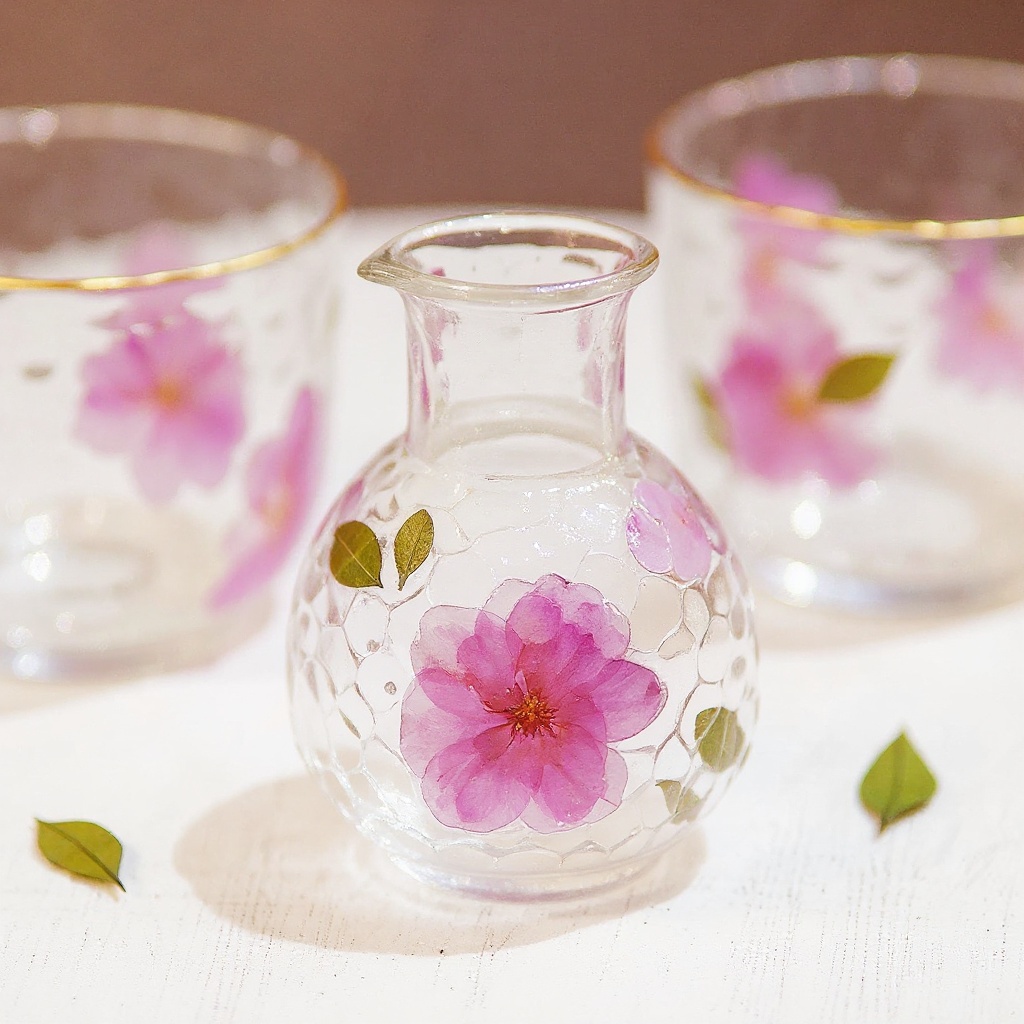
Our Handcrafted Sake Set with Real Peach Blossoms | Gold Rim Glass Cups & Carafe | Artisan Gift represents what modern glass craft can achieve within a traditional format. The frosted hammered surface creates tactile depth you feel before you see it. Real preserved peach blossoms and small green leaves raise visibly from the exterior of both the carafe and cups. Gold rim detailing on the cup lips adds a finishing luxury without competing with the botanical elements. At $99.99 for the full 5-piece set, it sits between mass-market and ultra-premium.
Here's the honest trade-off most articles won't say directly: if your recipient is rough on glassware, stores things in cramped cabinets without padding, or has young children and pets underfoot, a quality ceramic set will outlast a glass botanical set in that environment. Choose accordingly.
Size Guide: 2-Piece vs. 4-Piece vs. 5-Piece Sets
Sake set sizing affects both entertaining function and gift presence. The configuration you choose signals how you imagine the recipient using it.
| Set Size | What's Included | Best For | Typical Price Range | Serving Capacity |
|---|---|---|---|---|
| 2-Piece | 1 carafe + 1 cup | Solo drinker, minimalist display | $25–$60 | 1 person |
| 3-Piece | 1 carafe + 2 cups | Couples, intimate evenings | $35–$80 | 2 people |
| 4-Piece | 1 carafe + 3 cups | Small gatherings | $40–$120 | 3 people |
| 5-Piece | 1 carafe + 4 cups | Home entertaining, family use | $60–$200+ | 4 people |
| 6+ Piece | Multiple carafes or accessories | Collectors, large households | $150–$500+ | 5+ people |
For housewarming gifts, 5-piece sets offer the strongest combination of versatility and visual weight. Four cups allow the new household to host a small dinner party without pulling in mismatched glassware. They also create symmetrical display arrangements on open shelving — two cups each side of the carafe, balanced and intentional-looking.
A 400ml carafe, the standard in quality sets, serves 4–6 people through a tasting session or 2–3 people for more generous pours. Traditional ochoko cups hold 50–60ml — proportioned specifically to encourage shared, social sipping rather than solitary consumption. That design decision is centuries old. It still works.
Botanical and Artistic Details That Make the Best Sake Sets Memorable
Embedded botanical glassware sits at the intersection of functional craft and decorative art. The technique requires real preserved flowers to be positioned on the glass exterior before a final layer secures them — creating raised, three-dimensional botanical texture you can feel with your fingertips. This isn't a print. Not a decal. The peach blossoms and leaves physically emerge from the surface.
Real peach blossoms catch light differently throughout the day. Morning diffused light through a kitchen window creates soft shadow play around each petal. Evening candlelight turns the frosted glass warm amber while the botanicals glow slightly at their edges. The same sake set for a housewarming gift looks meaningfully different at noon and at dinner. That's a living quality synthetic decoration cannot match.
Gold rim detailing adds refinement without heaviness. Hand-applied to the cup lips, it creates subtle reflections that interact with sake's pale color when poured — a detail most guests notice without consciously registering what they're responding to. The combination of natural botanical material and precious metal accent speaks directly to the cottagecore and wabi-sabi aesthetics that dominate Pinterest and Instagram home categories in 2024, making these sets natural candidates for social sharing after housewarming parties.
According to the Sake Brewers Association of Japan, global sake exports grew 23% between 2018 and 2022, with North American markets showing the sharpest increase. That growth reflects rising interest in sake culture beyond Japan, which means more new homeowners are actively interested in how to serve and display sake properly — making a premium sake set an increasingly timely gift rather than a novelty.
Care and Maintenance for Long-Lasting Beauty
Artisan glass sake sets with embedded botanicals require hand washing to protect both the decorative elements and the structural integrity of the pieces. Here's the routine that keeps them looking like they arrived yesterday:
1. Rinse immediately after use with lukewarm water — sake residue left overnight can etch glass surfaces over time 2. Use mild dish soap and a soft cloth or sponge — avoid anything abrasive that can scratch the frosted surface or lift gold rim detailing 3. Dry with lint-free microfiber cloths immediately after washing to prevent mineral deposits from water spots on frosted glass 4. Store with fabric or foam between pieces — even gentle contact during storage causes micro-scratches that accumulate into dull patches on frosted surfaces 5. Avoid thermal shock — don't move pieces from cold storage directly to warm water; a 30-second room temperature rest prevents stress cracking in glass 6. Display away from prolonged direct sunlight — UV exposure over 12+ months causes fading in real botanical pigments, particularly in pink and red tones 7. Condition natural cork stoppers twice yearly with food-safe mineral oil applied with a soft cloth — cork should feel slightly supple, never dry or crumbly
For the cork stopper specifically: a well-maintained natural cork will outlast the carafe in most households. A dried, brittle cork that crumbles when removed needs replacement — standard #9 wine corks fit most sake carafes and cost less than $2 at kitchen supply stores.
Price Ranges and What You Actually Get
Sake set pricing reflects materials and hand labor more than brand equity. Here's what each tier genuinely delivers:
Budget ($15–$40): Machine-made ceramic from major import retailers. Consistent glaze, basic white or blue patterns, dishwasher-safe. Functional. Forgettable as a gift. Fine for everyday use. Mid-Range ($40–$120): Better materials and genuine design attention. Hand-thrown ceramics with interesting glazes, or glass sets with surface treatments. This is where the best sake set for a housewarming gift lives for most budgets. Our botanical glass set at $99.99 sits at the upper end of this range, delivering premium-tier aesthetics at mid-range price. Premium ($120–$300): True artisan work. Embedded botanicals, precious metal accents, or complex glass techniques that require specialized skill. Individual craftsmanship variations make each piece technically unique. Functional art with a clearly defensible price. Luxury ($300+): Studio pottery, limited editions, artist-signed sets with certificates. Investment pieces for serious collectors or milestone gifts. Beautiful. Excessive for most housewarming contexts.The botanical glass sets with real preserved peach blossoms fall at the high end of mid-range. Hand-positioning organic materials in glass requires expertise — even distribution, no visible air pockets, natural-looking placement — that adds meaningful labor cost to each piece without crossing into luxury territory.
FAQ
Is a sake set a good housewarming gift even if the recipient doesn't drink sake?Yes — and arguably more so than for dedicated sake drinkers. People who don't drink sake are more likely to display the set than use it, meaning the aesthetic and craftsmanship become the entire value proposition. The tokkuri carafe functions equally well as a small flower vase or a water carafe for table service. In a 2021 survey by Etsy's gifting trends report, decorative-functional crossover items ranked as the top category for new homeowner gifts, with 72% of respondents saying they preferred gifts that worked as both display objects and usable items.
What size sake set is best for home use — 2-piece, 4-piece, or 5-piece?For housewarming gifts, a 5-piece set (one carafe plus four cups) is the strongest choice. It accommodates a standard small dinner party of four without requiring the host to mix glassware sets. Single-cup users simply choose one ochoko per session. The extra cups also provide redundancy — if one breaks, the set remains functional for a party of three, which covers most intimate entertaining scenarios. Ochoko replacement from matching sets is often impossible after 12–18 months, so having four from the start extends the set's useful life.
Can you put sake sets in the dishwasher, or do they all require hand washing?Basic undecorated ceramic sake sets often survive gentle dishwasher cycles, though hand washing extends glaze life significantly. Any set with gold rim detailing, embedded botanicals, or frosted glass surfaces requires hand washing exclusively. Dishwasher temperatures of 140–160°F, combined with alkaline detergents, degrade gold accents within 10–20 wash cycles. Natural cork stoppers should never enter dishwashers under any circumstances — the combination of heat and moisture causes irreversible swelling and cracking.
Are real flowers in glassware food safe?Yes, when properly processed and sealed. Real botanicals used in quality artisan glassware are preserved and then encapsulated in the glass surface — they exist on or within the exterior walls, not in contact with liquid contents. Food-safe sealants meeting FDA and EU food contact material standards are standard practice among reputable artisan glass makers. The relevant safety standard is FDA 21 CFR 175.300 for resinous coatings in food contact applications. If a product doesn't specify food-safe materials in its description, ask before purchasing.
What kind of sake pairs well with a new sake set as a combined housewarming gift?Junmai Ginjo sake is the strongest pairing choice for recipients new to sake. It's premium without being challenging — clean, fruity, with gentle floral notes that complement botanical glassware aesthetically and flavor-wise. A 720ml bottle from breweries like Hakkaisan, Dassai 45, or Gekkeikan Black & Gold runs $25–$45 at specialty liquor stores or Japanese grocery retailers. Serve chilled at 45–50°F in glass sets. Avoid heavily aged koshu styles for gift pairings — the amber color and complex umami notes can feel overwhelming for newcomers.
How do I know if a sake set uses real botanicals or synthetic materials?Real preserved botanicals show four characteristics synthetic materials cannot replicate: natural color gradients within individual petals (not uniform single tones), organic shape variation between flowers on the same piece, visible cellular texture when examined closely, and slight translucency at petal edges. Synthetic alternatives appear uniformly colored, geometrically regular, and opaque throughout. Product descriptions should state "real preserved" or "genuine botanical" materials explicitly. If the listing says only "floral motif" or "botanical design" without specifying real materials, assume it's printed or synthetic.
What is the difference between a tokkuri and an ochoko?A tokkuri is the sake carafe — traditionally flask-shaped with a narrow neck that slows pouring rate and helps maintain liquid temperature. Standard tokkuri hold 180–400ml. An ochoko is the small handleless drinking cup, traditionally holding 50–60ml, proportioned to encourage social sipping and frequent refills as a gesture of hospitality. In traditional Japanese serving culture, you pour for others rather than yourself — the small cup volume makes this practice natural rather than excessive. Complete gift sets include one tokkuri and two to four ochoko depending on the piece count.
What's the difference between sake served warm versus chilled, and does the set material matter?Yes — significantly. Warm sake (kan) is traditionally served between 104°F and 131°F and benefits from ceramic's heat retention properties; ceramic ochoko maintain temperature for 3–4 minutes while thin glass drops temperature within 60–90 seconds. Chilled premium sake (reishu) is served at 45–54°F and benefits from glass sets, which don't insulate and allow the temperature to remain cold longer than ceramic in ambient conditions. For a housewarming gift where you don't know the recipient's sake preference, a glass set is the more visually impressive choice; just note in a card that it's optimized for chilled service.
Conclusion
The best sake set for a housewarming gift is the one that earns a permanent spot on a shelf rather than disappearing into a cabinet. Real craft shows. Embedded peach blossoms and hand-applied gold don't look like mass production because they aren't.
For recipients who love botanical aesthetics, cottagecore interiors, or simply beautiful objects, the Pampasroom Handcrafted Glass Sake Set is the clearest choice at its price point — 5 pieces, real botanicals, gold rim cups, cork stopper carafe, $99.99. For minimalist or traditional aesthetics, Hasami Porcelain or a handmade ceramic set from a local studio will serve better.
Choose what matches the person. Not the trend. That's the actual rule for every housewarming gift that gets remembered.