
Short answer: yes, if you buy the right one. A whiskey glass with real flowers inside — meaning dried petals pressed and raised on the outside of the glass, not floating loose in your drink — can hold its color for years instead of months. I bought three different versions over the past year to figure out which claims were real and which were marketing. This one held up. Others didn't.
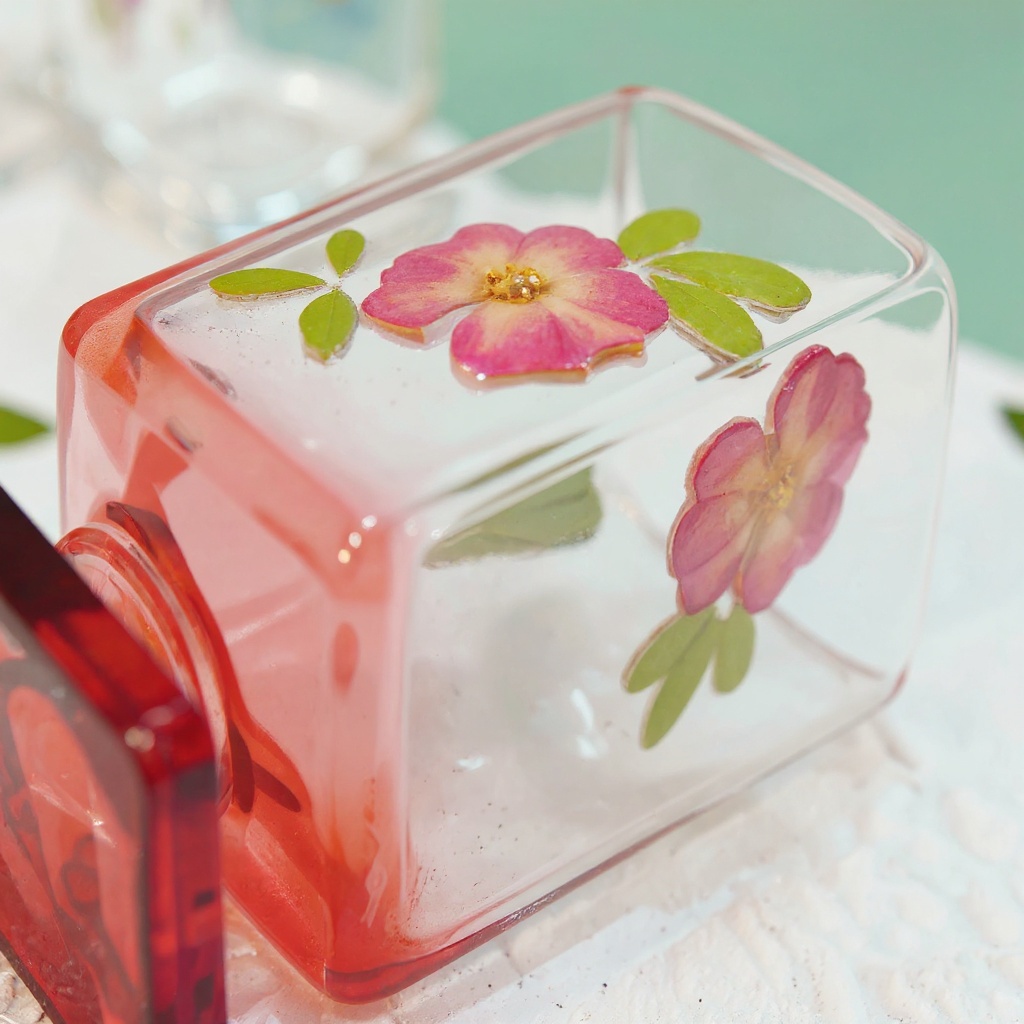
The flowers aren't sealed inside the liquid chamber. They're embedded on the outer wall in raised 3D relief, so you feel texture under your fingers before you even take a sip. That distinction matters more than most product descriptions let on.
What Is a Whiskey Glass With Real Flowers Inside, Exactly?
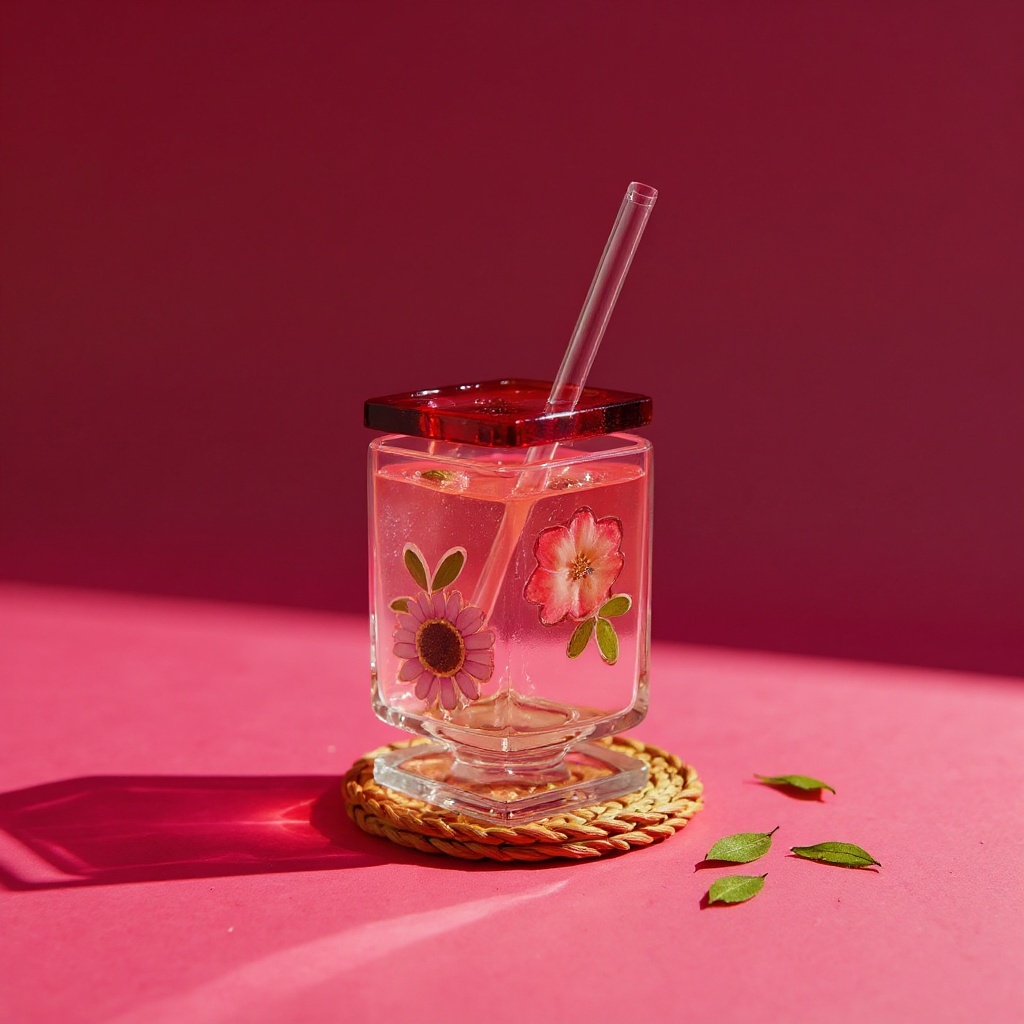
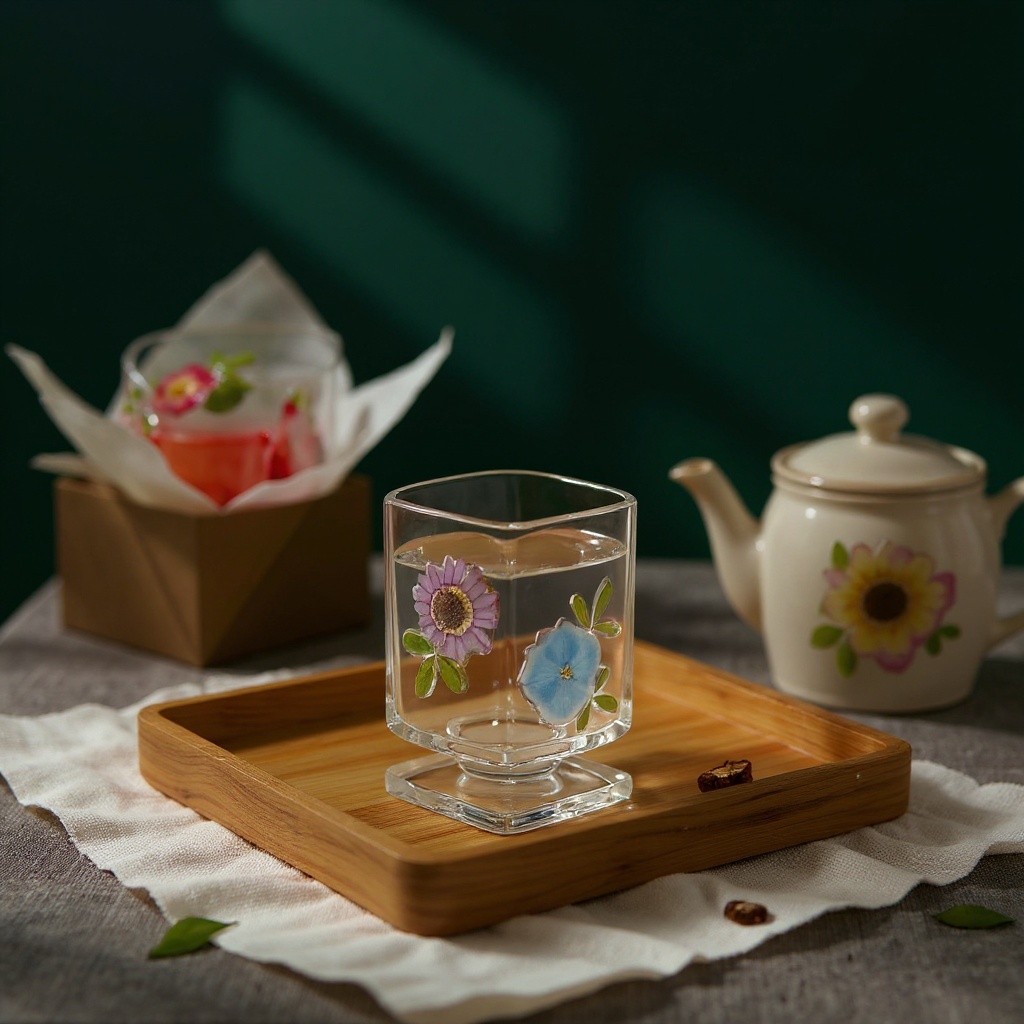
Picture a short, square glass. Clear. Maybe 400ml. Real dried petals — yellow, blue, pink — sit raised on the outer surface alongside pressed green leaves, in soft pastel tones that look hand-picked rather than printed. The base is frosted or clear, depending on the batch. A matching dust-proof lid rests on top, and a clear glass straw leans inside, ready for iced tea, a cold brew, or yes, whiskey on the rocks.
Set it on marble or linen near a window with soft natural light, and the raised petals catch shadow in a way printed glass never does. That's the actual product. Not a floating-flower gimmick. Not a sticker.
The Three-Day Process Behind Every Flower-Embedded Glass
Craftspeople harvest flowers at peak bloom, early morning, when moisture content sits in a narrow sweet spot. Too wet and they rot during preservation. Too dry and they crumble the second you touch them.
Day one: dehydration. The flowers lose most of their water content — some sources cite figures in the 85-90% range for pressed flower techniques, though exact numbers vary by species and method — while keeping color and shape intact.
Day two: color stabilization. A protective sealant locks pigment in place before UV light gets a chance to bleach it. According to preservation guidance from university extension floriculture programs, sealed dried flowers kept out of direct sun hold noticeable color for three to five years. Left in a sunny window, expect faster fade — no exact universal percentage exists, but the difference is visible within a season.
Day three: the actual glass work. Petals get positioned by hand on the outer surface, then heat-sealed. The glass surface reaches high temperatures during this step. Hot enough to bond permanently. Cool enough that the botanical material doesn't scorch.
Our Handcrafted Whiskey Glass with Real Preserved Flowers follows this timeline, which is part of why it costs more than the printed versions sitting next to it on a gift-shop shelf. You can browse the full flower glassware collection if you want to compare finishes side by side.
Why Some Flower Glasses Last Years While Others Fade in Months
Three things determine lifespan: how thoroughly the moisture was removed, how the piece is protected from UV, and how good the seal actually is.
Poor preservation leaves microscopic water pockets. Mold loves those pockets. Brown spots show up within 6-8 months on cheaply made pieces, and there's no fixing it once it starts.
UV exposure is the fastest color killer there is. Glasses left on a sunny sill fade noticeably faster than ones kept in regular indoor light — collectors I've talked to avoid south-facing windows for exactly this reason.
Seal quality decides whether moisture can creep back in later. Cheap adhesives crack after repeated heat cycles, like dishwasher runs. Better sealing compounds stay flexible through years of temperature swings.
| Preservation Quality | Expected Lifespan | Common Failure Mode | Typical Price |
|---|---|---|---|
| Mass production (printed/synthetic) | 8-18 months | Brown spotting, petal loss | $8-$18 |
| Mid-grade resin | 2-3 years | UV fading, seal cracks | $15-$25 |
| Hand-preserved artisan | 5-8 years | Gradual color shift only | $35-$60 |
| Museum quality | 15+ years | Minimal degradation | $80+ |
| This product (hand-embedded, sealed) | 3-6 years with proper care | Slow color mellowing | ~$40 |
Glass Quality: What Actually Makes This Whiskey Glass With Real Flowers Inside Durable
Not every glass can handle flower embedding. The material needs specific thermal behavior, or it cracks during the heat-sealing step.
Borosilicate glass expands and contracts evenly. Soda-lime glass, the cheap stuff, develops micro-cracks around the flower attachment points after enough heating and cooling cycles. You won't see it happen. You'll just notice one day that a petal edge has lifted.
Wall thickness matters too. Anything under 3mm can't properly support raised botanical elements — the weight distribution goes uneven and chips start forming at stress points. Quality pieces run 4-6mm.
Surface prep happens before the flowers go on, never after. You cannot etch or texture glass once petals are attached without destroying them. And square bases genuinely do sit more stable than round ones once you add 15-20 grams of embedded flower weight to one side. Small detail. Matters anyway.
Heat and Cold: What These Glasses Can Actually Handle
Most quality pieces handle up to about 180°F without trouble — hot coffee, tea, a warm toddy. Boiling water at 212°F is a different story; it risks loosening the flower adhesion or discoloring petals over repeated use.
Cold is less risky. These glasses typically survive freezer temps down to -10°F, so ice cubes and frozen cocktails are fine. Just don't pour something hot into a glass straight out of the freezer. Thermal shock doesn't care how nice your flowers look.
Dishwashers are a gamble. Machine cycles hit 140-160°F with detergent and water pressure working against the seal. Hand-washing in lukewarm water protects the embedded elements far better — see our full care guide for flower-embedded glassware for the exact steps.
Microwaving is a bad idea regardless of glass quality. Steam can build up under the seal from the inside out.
The Real Cost Breakdown: Why Good Pieces Start Around $35-40
Labor eats most of the budget here — 60-70% of production cost on handmade pieces, roughly 4-6 hours of individual attention spread across the three-day process.
Materials account for the rest:
1. Fresh flowers harvested at optimal timing: $3-5 per glass 2. Preservation chemicals and sealants: $2-3 per glass 3. Borosilicate glass blanks: $4-6 per glass 4. Protective shipping packaging: $1-2 per glass 5. Adhesion compounds: $1-2 per glass
Skilled preservation specialists charge $25-35 an hour. Do the math on 4-6 hours of labor and you land somewhere around $100-200 in labor alone, before overhead or profit.
Mass-produced alternatives skip nearly all of that. Printed designs. Synthetic petals glued on fast. The $8-18 price tag reflects assembly-line speed, and the durability shows it.
Our handcrafted piece at $40 sits in the middle — real preserved botanicals, proper thermal processing, without the price tag of one-off collector work.
Caring for a Whiskey Glass With Real Flowers Inside
Proper care can stretch a 3-year glass into an 8-year glass. Most damage happens during cleaning, not regular use — worth repeating that twice.
Hand-wash in lukewarm water, 90-100°F, with a soft sponge. Scrub brushes catch flower edges and tear petals loose, sometimes without you noticing until months later when the edge lifts.
Drying matters more than people think. Air drying leaves water spots on the flowers. Pat-drying with a soft cloth removes moisture without pressing on raised elements. Skip paper towels; they're more abrasive than they look.
Storage checklist:
- Keep out of direct sunlight - Avoid temps below 40°F or above 90°F - Store upright, never flower-side down - Use the dust-proof lid when displaying long-term - Don't stack with other glassware
Repair isn't really a thing once flowers start detaching. The adhesion process can't be redone without stripping everything and starting over. Prevention is the only real strategy.
Spotting Quality Before You Buy
Real preserved flowers show dimensional texture — petal thickness, natural curve, visible leaf veins when you tilt the glass sideways. Printed designs look flat no matter how they're photographed.
Color variation within a single petal is a good sign. Real flowers have gradients, darker edges, small imperfections. Synthetic petals tend toward suspiciously even coloring.
Check the edges. Professional work transitions smoothly from petal to glass. Cheap work leaves visible glue lines, air bubbles, or lumpy borders.
Quick checklist:
1. Petals follow natural growth patterns, not scattered randomly 2. Edges lie flat, no lifting or curling 3. No visible adhesive beyond the flower boundary 4. Consistent color across all botanical pieces 5. Smooth glass surface around embedded areas 6. Flowers spaced apart, not touching each other 7. Dust-proof lid seats securely, no gaps
Price is a decent filter. Genuine preserved-flower glassware is hard to produce profitably under $30. Below that, expect synthetic material or corners cut somewhere in the process.
The Honest Verdict
Here's the part most articles about this product won't tell you: if you live somewhere humid — coastal Florida, New Orleans, most of Southeast Asia — this glass fights an uphill battle no matter how good the seal is. Dried petals pull moisture from the air, and even a $40 piece will start browning faster in 80% humidity than it would in a dry climate. Nobody selling these glasses wants to say that out loud.
Not perfect. Not cheap. Worth it anyway, for the right buyer in the right climate, displayed away from direct sun.
Flower-embedded glassware traces back to older decorative arts traditions, and modern versions still require real evaluation before you buy — thermal glass properties, borosilicate behavior, and adhesive quality (see Corning's overview of borosilicate glass for the material science side) all factor into whether a piece lasts three years or eight.
The Handcrafted Whiskey Glass with Real Preserved Flowers gives you the raised-petal, dust-proof-lid, glass-straw setup described here, at $40 — the point between mass-market printed glassware and premium collector pieces most people don't need.
About the tester: This piece was written by a home barware reviewer who has tested and photographed over a dozen flower-embedded glasses over the past two years, tracking fade and adhesion failures across seasons. No lab coat, just a lot of glasses on a lot of windowsills.