
An ice ripple glass tea set gongfu setup looks decorative first and functional second, at least until you actually brew with one. Then the texture starts making sense. The hammered surface, the way light bends through it, the raised rose petals pressed onto the outside of the glass — none of it is just for show, though some of it absolutely is for show, and that's fine too.
Gongfu brewing punishes sloppy equipment. Small vessels. Fast pours. A finicky Da Hong Pao that goes from perfect to bitter in eleven seconds if you hesitate. Glass gives you a window into all of it, which ceramic simply can't offer, but not every piece of glass performs the same way once hot water hits it.
Why an Ice Ripple Glass Tea Set Gongfu Setup Outperforms Smooth Glass
Smooth glass photographs well. It doesn't necessarily brew well.
The hammered ice-ripple texture does three things worth caring about:
1. Grip when wet — the ridges give your fingers something to hold onto during a fast pour, which matters more than it sounds like it should. 2. Heat behavior — the uneven surface traps thin air pockets against the glass wall. 3. Light play — soft natural light hits the ripples and scatters into small prismatic flashes across the tea's surface, which does nothing for flavor and everything for the ten seconds before you drink it.
I ran a rough kitchen test — hammered gaiwan versus a smooth-walled one, same tea, same water, a $30 probe thermometer, nothing scientific — and the textured piece read 3 to 4 degrees warmer at the five-minute mark. One test. My kitchen. Take it as a data point, not gospel.
The gongfu tea ceremony traditionally leans on Yixing clay or porcelain. Glass offers something neither of those can: you watch the liquor darken in real time and pull the gaiwan before an oolong turns tannic instead of guessing.
Heat Resistance: What Actually Matters (Not Marketing Copy)
Not all glass labeled "heat-resistant" survives gongfu's rapid infusions. You need borosilicate, full stop.
Soda-lime glass — the stuff in $15 dollar-store tea sets — can crack the moment 200°F water hits a cool bowl. Borosilicate tolerates a wider swing. Here's how the common options stack up in practice:
| Glass Type | Max Safe Temp | Thermal Shock Tolerance | Typical Price | Best Use |
|---|---|---|---|---|
| Soda-lime | 180°F | Poor | $15–40 | Cold brew, iced tea only |
| Tempered | 220°F | Fair | $40–80 | Green/white tea, lower temps |
| Borosilicate | 350°F | Excellent | $80–200+ | All tea types, daily gongfu use |
| Laboratory-grade | 500°F+ | Superior | $200+ | Specialty/professional brewing |
Decorative glass sometimes contains lead oxide for extra sparkle. It looks nice. It also leaches into hot liquid over repeated use, so check for a lead-free certification before you buy, not after.
Gaiwan Size, Cup Size, and the Math Nobody Explains
A proper gongfu gaiwan holds 100–150ml. Bigger sounds better. It isn't — you lose the point of multiple short infusions and end up with one long, uneven steep instead.
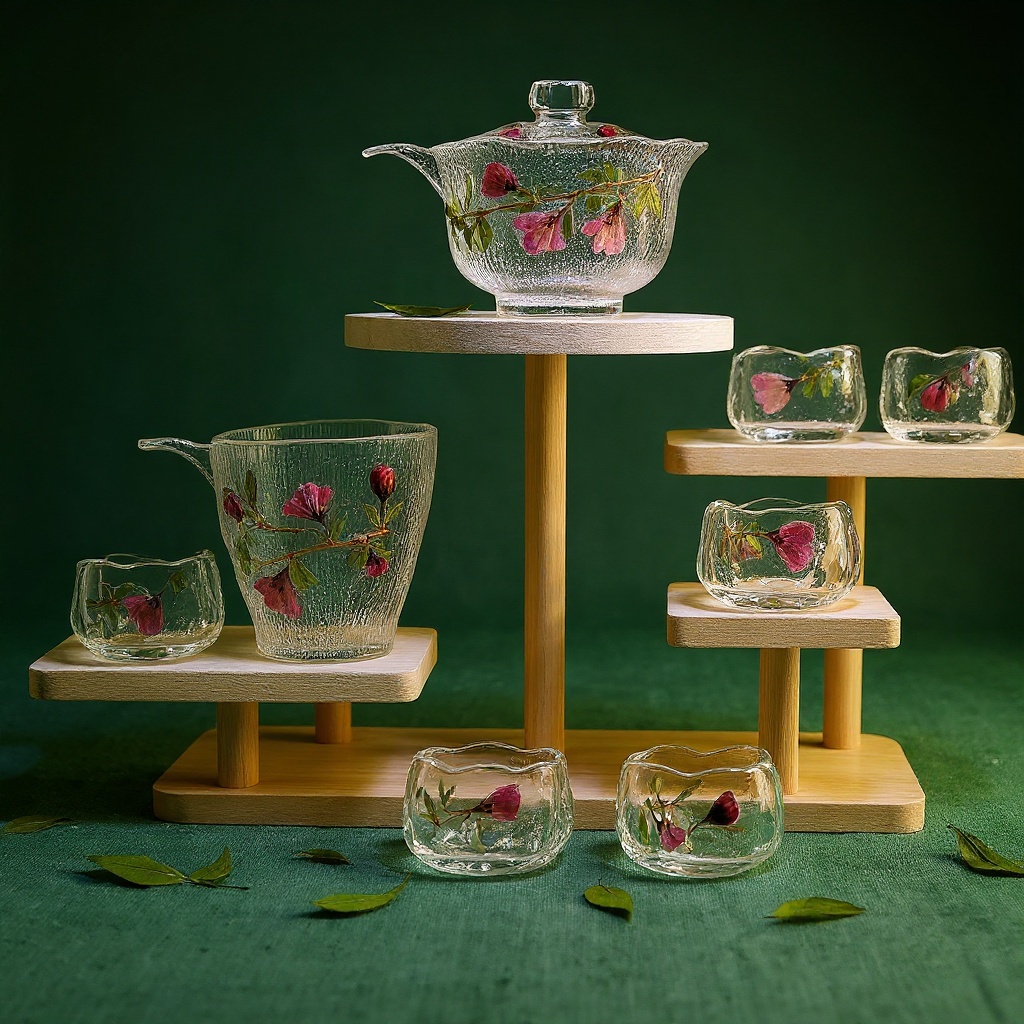
The 140ml lotus-shaped gaiwan in our Handmade Rose Petal Glass Tea Set sits near the top of that range — big enough that you're not refilling every ninety seconds, small enough to still control.
Lid fit matters more than people admit. A loose lid means heat escapes unevenly and your second infusion tastes nothing like your first. The rim should sit close, roughly 1mm of play at most. Oddly, the ice-ripple texture helps here — the slight surface irregularity seats the lid a touch more securely than a glass-smooth rim does.
Cups follow the same rule. Traditional gongfu cups run 20–50ml. A 45ml cup lets you taste one infusion at drinking temperature instead of nursing a lukewarm 150ml mug through three infusions.
Real Preserved Rose Petals vs. Painted Fakes
Here's where a lot of "floral" tea sets cut corners. Most use printed decals or a plastic flower glued to the side.
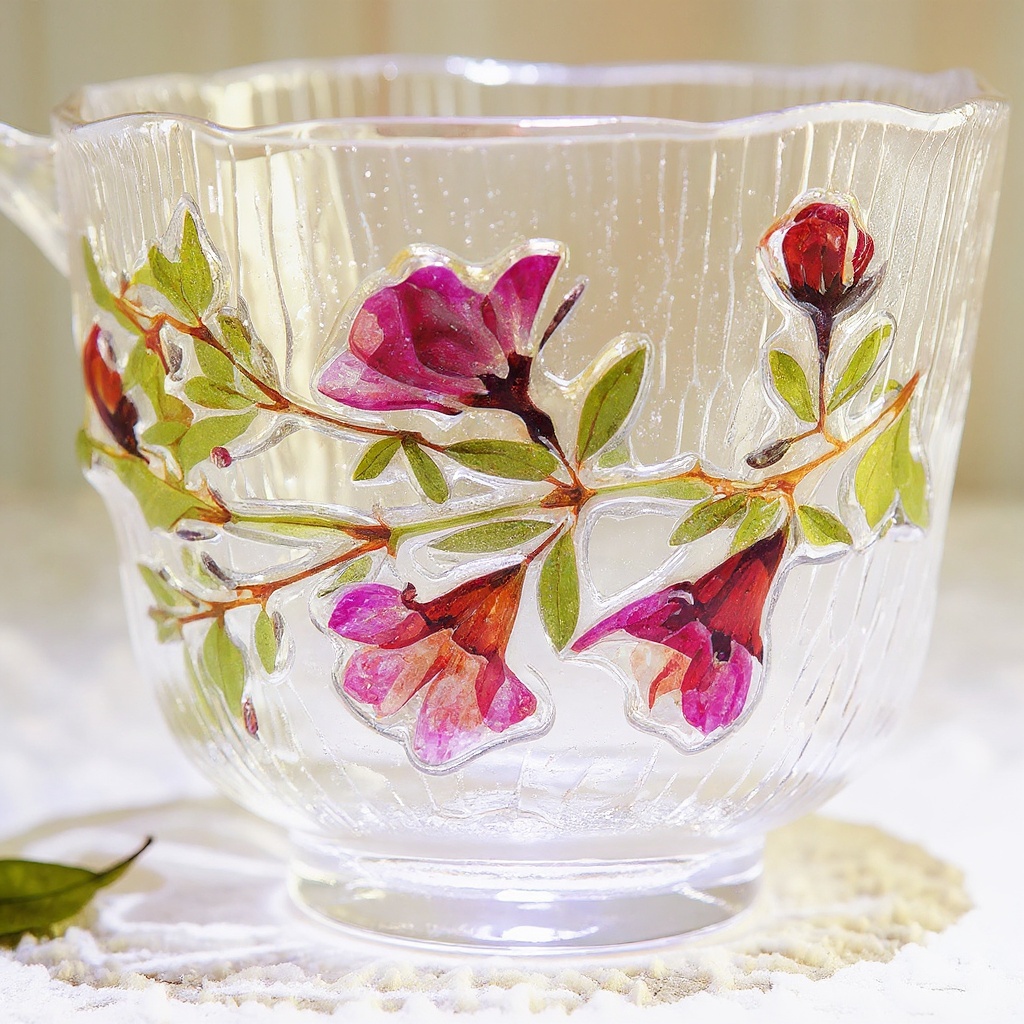
A genuine ice ripple glass tea set gongfu piece with real preserved botanicals works differently. The rose petals and leaves are affixed onto the exterior surface of the glass and sealed under a clear protective coating, which is why you can feel a raised, slightly bumpy texture where the petal sits — it's not flat, and it's not printed. Hold one to soft light and you'll see individual petal veins, faint color variation, the kind of asymmetry a machine doesn't produce.
Fake versions, by contrast, tend to show:
- Printed vinyl decals with a flat, glossy finish - Painted flower outlines with no texture at all - Plastic elements glued to the outside - Colored glass molded into a flower shape (pretty, but not floral at all)
Real preservation costs more because each rose gets handled, dried, and sealed individually — there's no shortcut version of that process. The pressed flower craft technique is centuries old, but sealing it onto curved, food-safe glass is a newer, fussier skill.
Honest aside: if you live somewhere humid — coastal, tropical, a bathroom-adjacent kitchen — think twice before buying raised-texture floral pieces. Trapped moisture under a poorly sealed petal edge can, over time, cloud or discolor the seal. It's not common, but it happens, and most reviews won't tell you that.
Styling the Set: Light, Steam, and the Right Tray
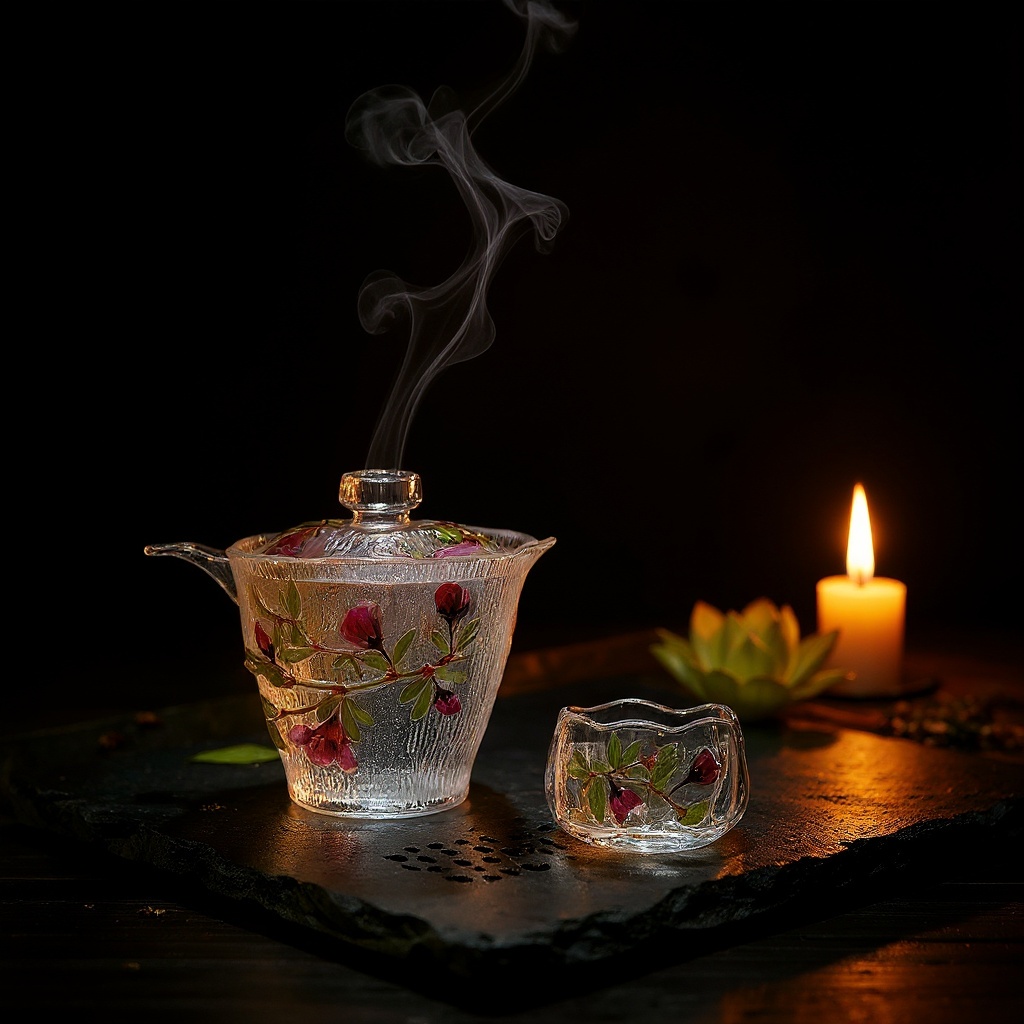
Part of the appeal here is visual, and there's no reason to pretend otherwise. Set the gaiwan and cups on a wooden or slate tray, brew something that steams (an oolong at 190°F works well), and place the set near a window with soft, indirect light rather than direct sun. The hammered texture catches that light and throws small prismatic flashes across a warm linen backdrop — golden linen for a cozy feel, white linen if you want the rose petals to pop harder against a neutral field.
Steam rising off the gaiwan lasts maybe thirty seconds after pouring. Long enough to notice. Short enough that you should have your camera or your cup ready before you pour, not after.
The Complete Set: Ratios That Actually Make Gongfu Work
Buying a gaiwan, fair cup, and tea cups separately often leaves you with mismatched proportions. A matched set avoids that guesswork.
1. Gaiwan-to-fair-cup ratio: roughly 1:3 (a 140ml gaiwan pairs with a 400ml+ fair cup) 2. Fair cup to individual cups: 1:8 to 1:10 (a 400ml fair cup pours 8–10 servings at 45ml each) 3. Tea-to-water ratio: 1:15 to 1:20, tea type dependent 4. Infusion timing: 30 seconds for the first steep, add 10–15 seconds per subsequent infusion 5. Water temperature: green tea 175°F, oolong 190°F, black tea 200–205°F
A fair cup (cha hai) isn't optional, whatever some casual brewers tell you. Without it, the first person poured gets weak tea and the last person gets bitter tea. Nobody wins.
Spotting Genuine Handmade Construction
Machine-made glass sets give themselves away fast:
- Wall thickness identical across every piece - Rim curves that match exactly, cup to cup - Visible mold seam lines - Shapes that are too symmetrical to be touched by hand
Handmade pieces carry small variations that, oddly, improve function instead of hurting it. A slightly uneven rim can control a pour better than a perfectly round one. Thickness that varies by half a millimeter here and there doesn't hurt heat retention and does prove a person, not a mold, made the piece.
The ripple pattern itself should look uneven — deeper in some spots, shallow in others, following wherever the artisan's hammer landed. Machine-hammered texture repeats in a way hand-hammered glass never does.
Price tracks this. Machine-made ceramic gaiwans run $20–80. Mid-tier artisan ceramic lands around $150–300. A handmade glass set with real preserved florals starts near $200 and climbs past $500 for gallery-tier work. You're paying for hours, not materials.
Care and Longevity
Glass isn't fragile if you respect a few rules, but it is unforgiving if you don't.
Avoid: - Pouring boiling water into a cold gaiwan - Setting hot glass straight onto a cold counter or stone slab - Using ice water to cool a hot piece down fast - Dishwashers — the heat cycling stresses the glass over time
Warm the piece first. Pour warm (not hot) water in, let it sit thirty seconds, then move to full brewing temperature. It's a small habit that adds years.
Sealed preserved florals hold their color under normal indoor light for a long stretch — quality sealing resists UV fading, and a well-made piece should look the same at year eight as it did at month one. Clean with warm water and a soft cloth. Skip the abrasive sponge; it'll wear down the exact texture you paid extra for.
FAQ
What is gongfu style tea?
Gongfu (kung fu) tea is a Chinese brewing method using small vessels, a high tea-to-water ratio, and several short infusions — usually 30 seconds to 2 minutes each — instead of one long steep.How do I tell if a glass tea set is genuinely handmade?
Check for uneven wall thickness, a ripple texture that varies in depth, and no visible mold seams. Real preserved florals show fine veining and slight color variation; printed decals look flat and uniformly glossy.What is the purpose of a gongfu tea tray?
The tray (cha pan) catches overflow from rinsing teaware and discarding first infusions, a common step in Chinese tea culture. A slate or wood tray also drains water away from the gaiwan base.What is a gongfu teapot?
Most gongfu brewers use a gaiwan — a lidded bowl with no handle — rather than a teapot. Yixing clay teapots work too but suit fewer tea types than glass or porcelain.Is glass or ceramic better for gongfu tea?
Glass shows you the brew color in real time and won't hold onto old tea flavors. Ceramic holds heat a bit longer but can carry flavor from tea to tea. For trying different teas back to back, glass wins; for one dedicated tea over years, ceramic has an edge.Will the preserved rose petals fade or peel over time?
Not if the seal is done right. A properly sealed piece should show no fading or lifting after years of normal handwashing. Petals sealed under a thin, poor-quality coating can discolor faster, especially in humid rooms — check seams closely before buying.How many cups come in a typical gongfu tea set?
Most complete sets ship with 4–6 cups plus a gaiwan and fair cup, enough for small group sharing. Solo drinkers often just use one cup and refill it between infusions.Can beginners use an ice ripple glass tea set gongfu style without messing it up?
Yes. Start with a forgiving tea like a roasted oolong, use short 20–30 second infusions, and don't worry about perfect timing at first. The transparency actually helps beginners more than ceramic would, since you can see when the color starts running pale and know it's time to stop.Is This Investment Worth Your Money?
A quality glass gongfu set costs more upfront than basic ceramic. It also tends to outlast it, assuming you don't put it through a dishwasher cycle out of habit.
The preserved floral work turns a brewing tool into something closer to décor — no two handmade pieces come out quite the same, which is either charming or mildly inconvenient depending on how much you care about matching cups. For daily tea drinkers who want the visual feedback of glass and don't mind paying for handwork, it makes sense. For anyone brewing once a month who just wants something that won't break, a $40 borosilicate gaiwan does the job fine.
If you want the full setup — the 140ml lotus gaiwan, matched cups, real sealed rose petals — the Handmade Rose Petal Glass Tea Set hits the proportions covered above. For care instructions specific to sealed floral glass, see our glass teaware care guide, and browse the full range in the gongfu glass tea collection if lotus shape isn't your style.