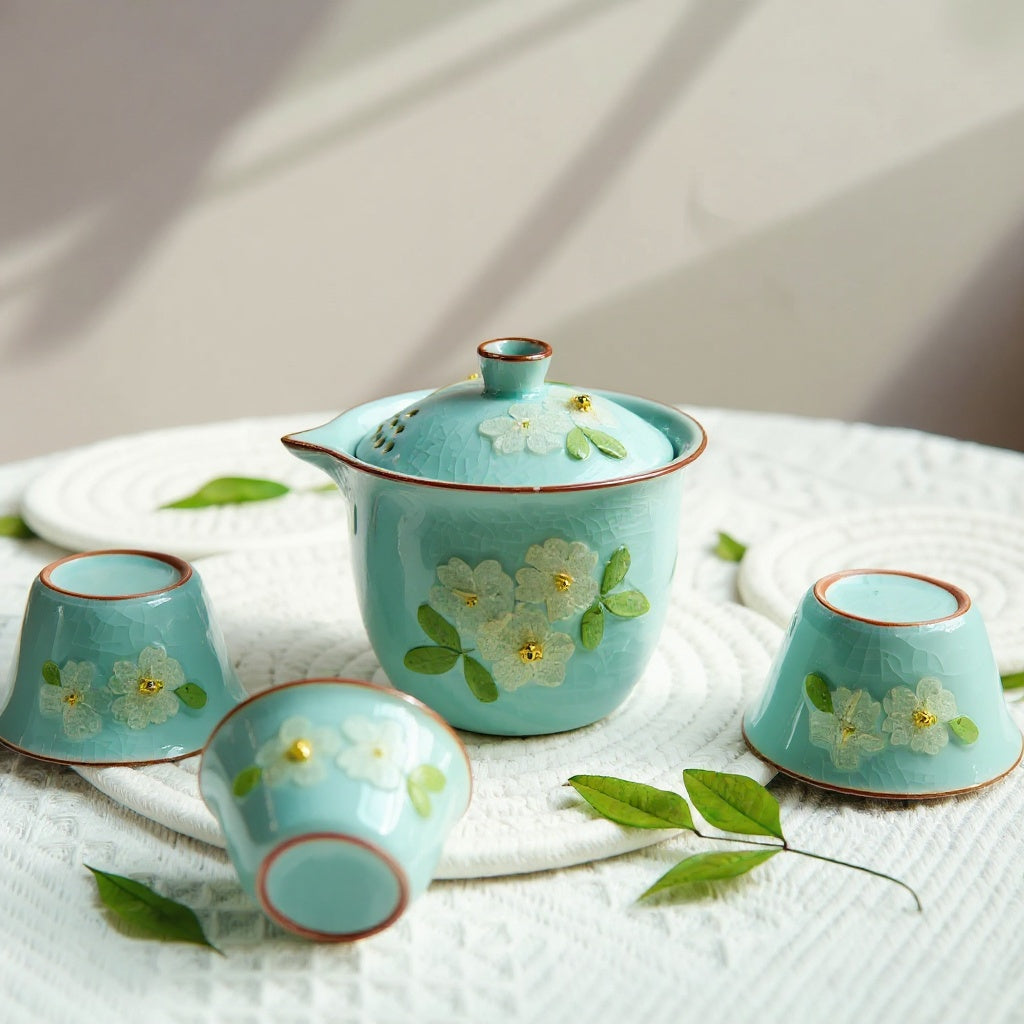
Unique Artisan Tea Ceremony Set: What Makes It Truly Special
By pampasroom, founder of Pampasroom · 8+ years studying and sourcing East Asian ceramic traditions · Specializing in Ruyao celadon ware and botanical glaze techniquesA unique artisan tea ceremony set stands apart through three non-negotiable qualities: genuine handcraft time measured in days rather than hours, authentic celadon glaze developed through traditional iron-oxide reduction firing, and real botanical elements — actual pressed flowers and leaves — embedded permanently beneath protective glaze layers. Factory-made alternatives skip every one of these steps. The difference isn't subtle. Each handmade teapot and cup in an authentic unique artisan tea ceremony set carries centuries of Chinese ceramic tradition in its surface, its weight, and its quietly imperfect form.
What Defines a Unique Artisan Tea Ceremony Set
The Three Pillars of Authentic Artisan Ceramics
Authentic unique artisan tea ceremony sets rest on three foundations that mass production cannot replicate.
Handcraft time. A skilled potter spends 3–5 days on a single complete set. Wheel-throwing alone takes 8–10 hours. Drying requires 12–16 hours. Botanical application and glazing add another 6–8 hours. Multiple kiln firings account for 15–20 hours total. No shortcut exists. Traditional glaze chemistry. Ruyao celadon develops its pale blue-green hue through iron oxide reduction at kiln temperatures around 1,200°C, with firing cycles lasting 12–15 hours per session. This is documented in ceramic scholarship going back to Song dynasty records held in institutions like the Palace Museum in Beijing. Electric kilns and synthetic glazes produce color. They do not produce Ruyao. Genuine botanical embedding. Real dried flower petals and leaves, selected at peak condition, pressed flat, dried completely, then applied to clay surfaces before glazing. Not painted. Not printed. Physically present under the glaze, creating raised tactile relief you can feel with a fingertip.The Handmade Ruyao Ice Crack Teapot Set with Real Pressed Flowers represents this convergence — celadon glaze, ice crack texture, and embedded botanicals in a single functional object.
The Craft Behind Ruyao Celadon
A 1,000-Year Ceramic Tradition
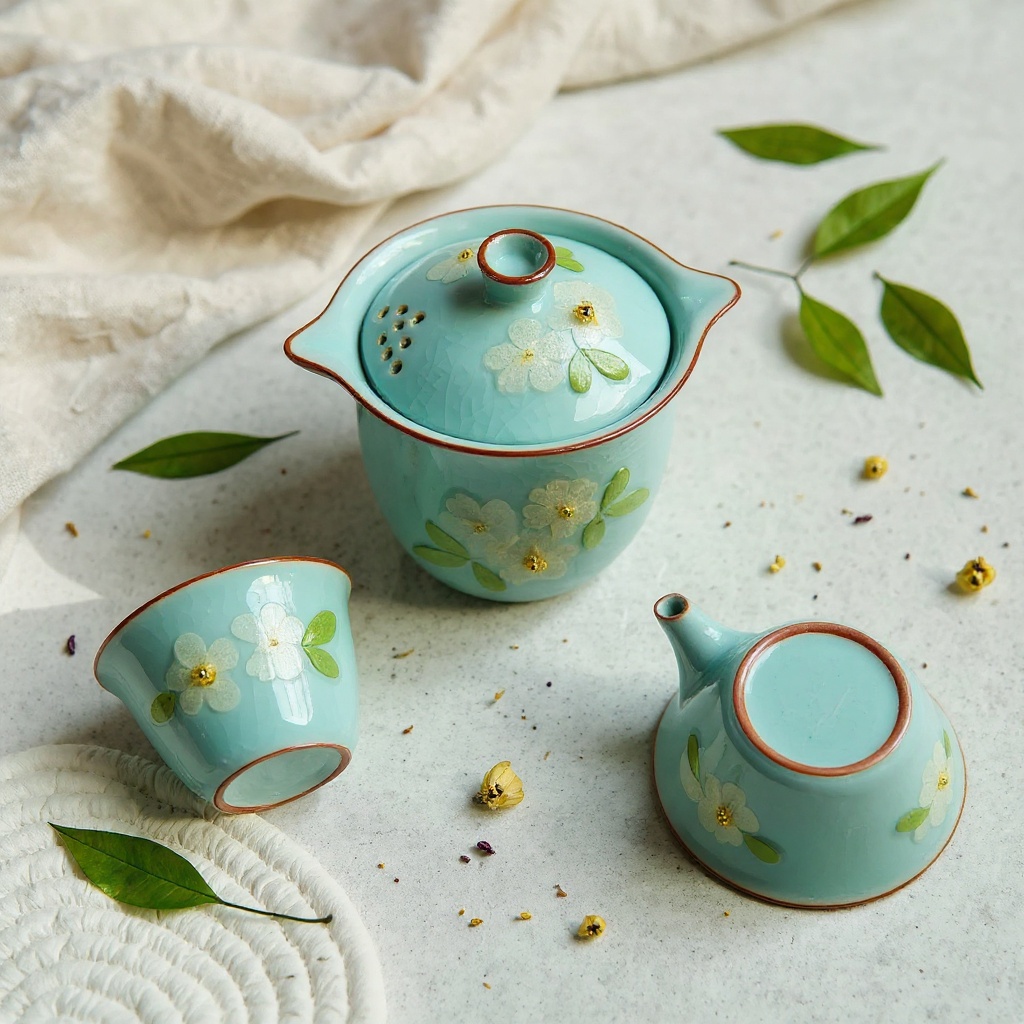
Ru ware dates back over 1,000 years to the Song dynasty imperial kilns. Scholars and ceramic historians at institutions including the Victoria and Albert Museum have documented its distinctive pale blue-green glaze as one of the most technically demanding in the Chinese ceramic canon. The color is not applied. It emerges.Iron oxide in the clay body reacts during reduction firing — a process where oxygen inside the kiln is deliberately limited — producing the characteristic celadon hue. Slight variations in clay composition, firing duration, and atmospheric conditions inside the kiln shift the color from soft jade to deeper seafoam. No two pieces finish identically. This is not a flaw in quality control. This is the point.
Mass-produced "celadon" sets use synthetic glazes on commercial clay bodies. The color is consistent. It is also inert — a coating rather than a chemical event. Authentic unique artisan tea ceremony set glazes have depth because the color lives inside the material, not on top of it.
What the Ruyao Color Actually Looks Like
Celadon sits between pale jade and muted sky. In natural light on linen or stone surfaces, the glaze appears almost translucent, as though light passes through the surface rather than reflecting off it. Under warm indoor lighting, it shifts toward warmer grey-green. In shadow, it deepens. This tonal responsiveness is one reason tea ceremony practitioners prize Ruyao ware — the set looks different at every hour of the day.
Understanding Ice Crack Glaze
How Controlled Cracking Creates Beauty
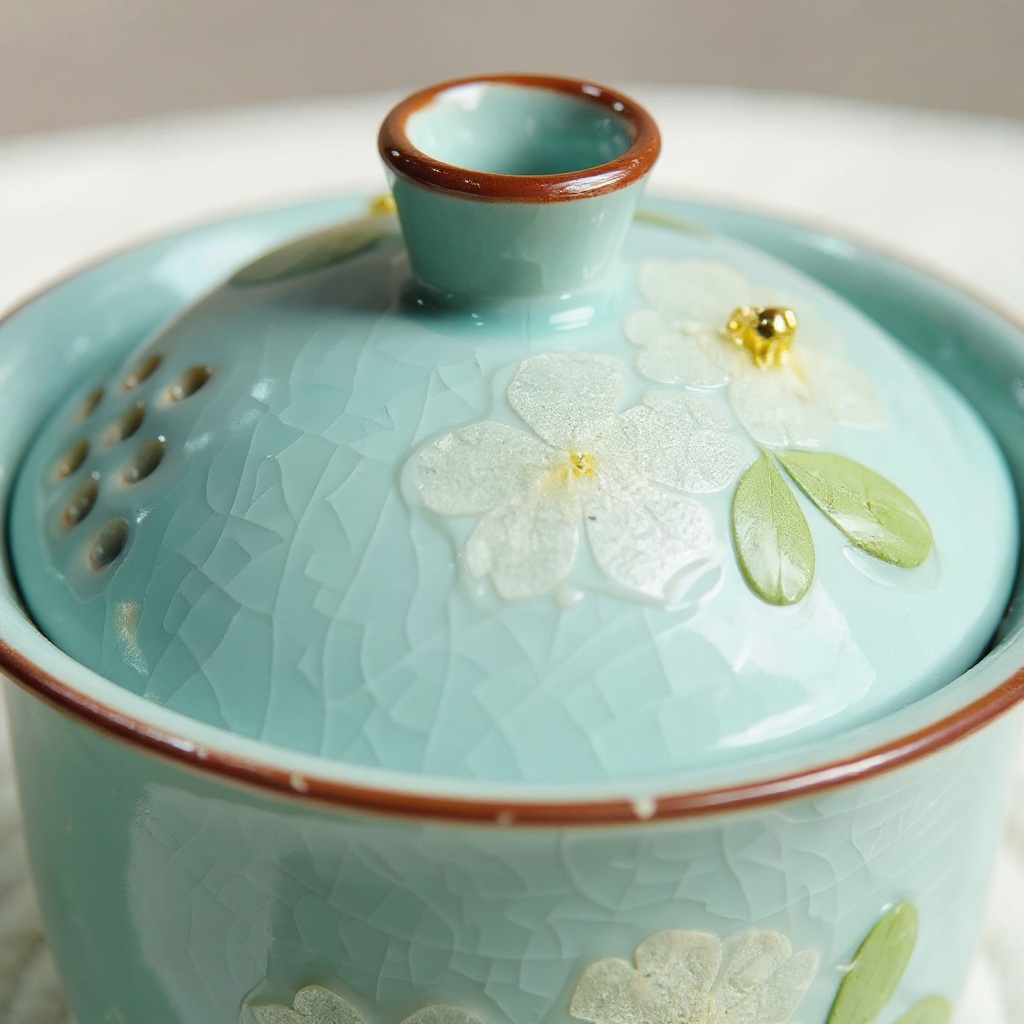
Ice crack glaze forms when the glaze layer and the clay body cool at different rates after firing. The glaze contracts faster, creating hairline fissures across the surface. These fissures are not structural damage. They are surface phenomena, sealed beneath the final glaze coat, and they do not compromise the ceramic's integrity in any way. Ceramic engineer and pottery educator Emmanuel Cooper documented this mechanism extensively in The Complete Potter's Companion, noting that crackle glazes have been deliberately cultivated in Chinese ceramics for over 800 years.
Master potters manipulate crack formation by adjusting clay thickness, glaze application depth, and cooling speed after the kiln opens. Tighter crack networks require thinner glaze layers. Bolder, more dramatic lines come from thicker application and faster cooling. The exact pattern remains uncontrollable. Even potters with decades of experience cannot predict precisely where each crack will travel.
Fake crackle effects exist. Factory-printed patterns mimic the look on paper. The difference in person is immediate — printed patterns sit flat, uniform, and without depth. Real ice crack glaze creates shadow inside each fissure. The cracks have dimension.
How Ice Crack Patterns Change Over Time
Tea tannins gradually darken the crack lines during regular use. A teapot used daily for two years develops a personalized patina — the crack network becomes more visible, more defined, and more individual. The object records its own use. No two well-used Ruyao teapots look the same after a year of regular brewing.
Real Botanical Elements vs. Painted Designs
The Embedding Process
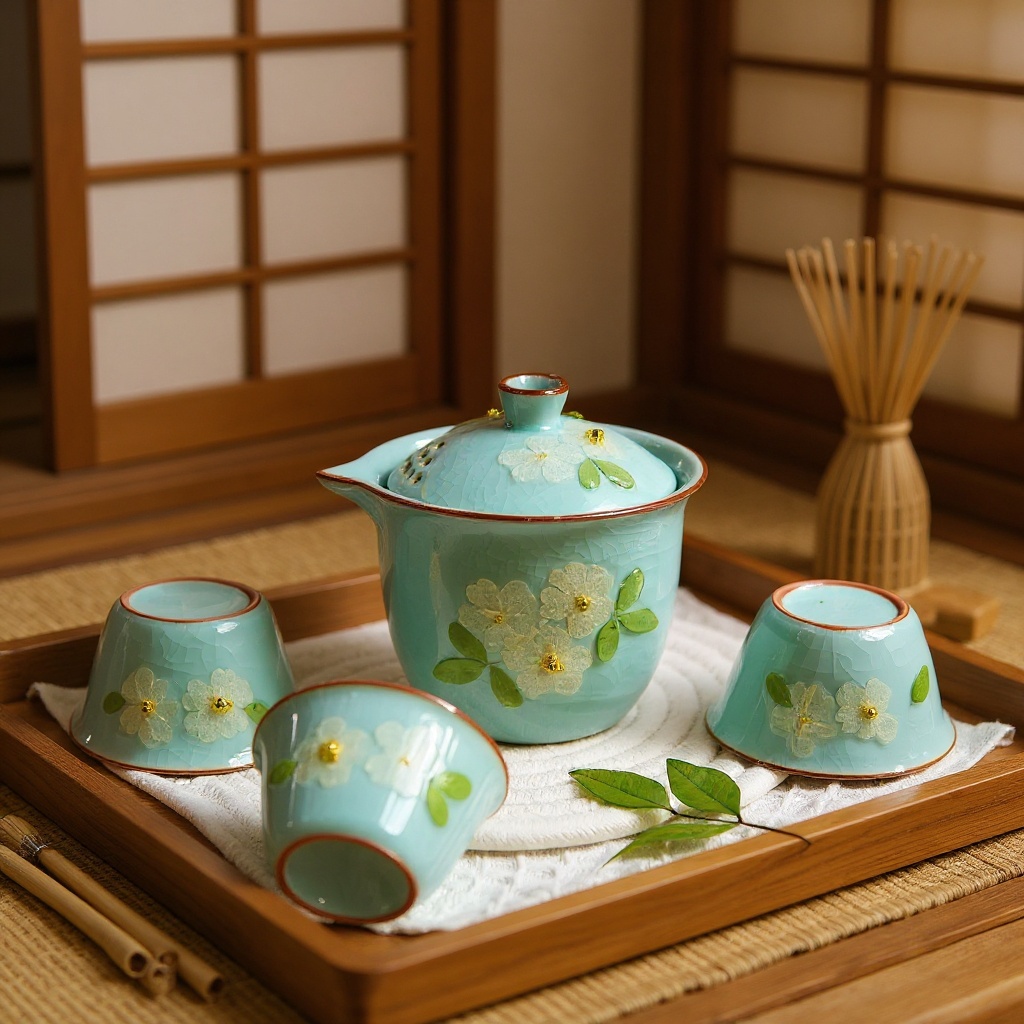
Embedding real dried botanicals in ceramic requires timing that cannot be rushed. Flowers are selected at peak condition. They are pressed completely flat. Complete drying is non-negotiable — any residual moisture causes steam expansion during kiln firing that destroys the piece. Once dry, the botanicals are applied to the clay surface before glazing. The glaze coat seals them in place. Kiln firing at 1,200°C+ eliminates all organic compounds, leaving the mineral structure of the flower fused with the ceramic matrix.
The result is a raised tactile relief — the outline, texture, and organic shape of the original petal, permanently present under a clear glaze. You can trace the edges with a fingertip. Each flower differs slightly from the next because no two flowers are identical. Factory-painted "botanical" designs repeat exactly. These do not.
Comparison: Artisan Pressed Flowers vs. Mass-Produced Alternatives
| Feature | Artisan Pressed Flowers | Mass-Produced Painted | Mass-Produced Printed Transfer |
|---|---|---|---|
| Texture | Raised tactile relief | Flat, smooth surface | Flat, smooth surface |
| Variation per piece | Every flower unique | Identical repeated pattern | Identical repeated pattern |
| Durability | Sealed under fired glaze | Paint may chip over time | Transfer may lift at edges |
| Production time | 2–3 days per piece | Minutes per piece | Minutes per piece |
| Depth of design | Three-dimensional | Two-dimensional | Two-dimensional |
| Feel under fingertip | Organic, irregular edges | No texture variation | No texture variation |
| Long-term appearance | Stable, unchanging | May yellow or fade | May yellow or fade |
Five Signs of Genuine Handmade Quality
Knowing what to look for separates authentic unique artisan tea ceremony set pieces from well-marketed factory goods.
1. Weight variation between cups. Handmade cups in a set show 5–15 grams of weight difference due to natural clay thickness variation during wheel-throwing. Identical weights across every cup indicate mold production.
2. Tool marks on the unglazed base. Authentic pieces carry subtle trimming marks or light finger impressions from the pottery wheel. Clean, unmarked bases suggest commercial mold casting.
3. Glaze pooling in corners. Hand-dipped glazing creates slight thickness variation — glaze pools fractionally deeper in interior corners and around foot rims. Spray-applied factory glazing is perfectly uniform.
4. Micro-variation in rim thickness. Machine production creates geometrically perfect rim cross-sections. Handmade rims show 0.5–2mm variation in width when examined closely. This is not a defect.
5. Asymmetry at spout and handle joints. Where a handmade teapot's spout and handle meet the body, slight asymmetry and visible joining work are normal and expected. Perfect symmetry at these joints almost always indicates mold assembly.
The Price Reality
Why Authentic Sets Cost What They Cost
Honestly? If you're looking for something to sit on a shelf and photograph for social media, a $40 factory set does that job. This article is not for you.
For those who actually brew tea daily and want objects that function beautifully and age with character, the cost structure of an authentic unique artisan tea ceremony set makes straightforward sense.
A skilled potter spends 3–5 days on one complete set. Clay costs for premium Ruyao-style bodies run 5–10 times higher than standard commercial ceramics. Kiln firing — multiple sessions, precise temperature management, extended cooling periods — represents 40–50% of total production cost according to production cost analyses from studio pottery collectives. The breakage rate during firing runs 20–30%. Every surviving piece must carry the cost of pieces that did not survive.
Mid-range artisan sets on platforms like Etsy typically fall in the $150–$400 range. Premium collector-grade pieces that use fully authentic Ruyao clay bodies and traditional multi-fire processes reach $400–$800. The Handmade Ruyao Ice Crack Teapot Set sits at an accessible entry point for genuine artisan quality without requiring collector-tier investment.
Beyond Aesthetics: Functional Design
Artisan unique artisan tea ceremony sets are not decorative objects that happen to hold tea. They are functional tools shaped by a tradition that has been refining tea brewing vessels for over a millennium.
The clay body thickness in well-made pieces provides even heat distribution, preventing localized hot spots that stress delicate teas. Interior glazing supports flavor-neutral brewing. Spout geometry affects pour control and drip prevention — details that production molds consistently simplify into mediocrity. Handle ergonomics, lid seal precision, cup rim angle for comfortable sipping: all of these reflect accumulated practical knowledge embedded in the Chinese ceramics tradition.
The ritual matters too. Using objects with genuine physical presence — slight weight, individual character, visible handwork — makes tea preparation more deliberate. Slower. More present.
How to Care for Your Artisan Tea Set
Proper care is simple. Not complicated. Just consistent.
Step-by-Step Care Protocol
1. Hand wash only. Warm water and mild soap. No dishwashers — temperature cycling causes thermal stress in fine ceramics and detergent residue affects glaze chemistry over time.
2. Avoid abrasive materials. Soft cloth or a gentle sponge only. Abrasive pads scratch glaze surfaces and damage the raised botanical relief.
3. Warm the pot before brewing. Pour hot water into the empty teapot, swirl, and discard before adding tea leaves. Gradual temperature increase prevents thermal shock.
4. Season a new teapot. Brew tea without drinking for the first two or three sessions. This builds a light tea residue on unglazed interior surfaces that subtly enhances future brewing.
5. Store with padding between pieces. A square of soft cloth between stacked cups prevents surface contact that causes micro-scratches over time.
6. Let ice crack lines develop naturally. Do not scrub the crack lines. Tea tannins darkening them is the intended aging process. It cannot be rushed and should not be reversed.
The botanical elements need no special treatment. They are fired into the ceramic permanently. They will outlast the owner.
FAQ
Are real flowers embedded in ceramic teapots food-safe and durable? Yes. The botanical elements are sealed between clay layers and covered with glaze coats before kiln firing. High-temperature firing at 1,200°C+ eliminates all organic compounds from the botanicals, leaving only the mineral structure fused with the ceramic matrix. The finished surface is as food-safe as any standard fired ceramic glaze. The flowers will not flake, separate, or leach into beverages under normal use. What is the difference between Ruyao ware and regular celadon? Ru ware represents the highest tier of the celadon tradition, distinguished by its specific pale blue-green color produced through iron oxide reduction firing and the fine crackle patterns that form during cooling. Broader celadon encompasses a wider range of colors from yellow-green to deep jade across multiple regional traditions. Authentic Ruyao specifically references pieces that match Song dynasty imperial kiln standards in both clay composition and firing method — not simply any green-glazed ceramic. How do I know if a tea set is genuinely handmade or just marketed that way? Look for weight differences between matching cups (5–15 grams is typical for handmade), subtle tool marks on unglazed bases, glaze pooling in interior corners, micro-variation in rim thickness, and slight asymmetry at handle and spout joints. Perfectly uniform cups with identical weights and flawless symmetry indicate mold production regardless of what the product listing claims. Genuine handmade irregularities are consistent and distributed — not random damage. Why does handmade celadon cost so much more than store-bought ceramic tea sets? Handmade pieces require 3–5 days of individual crafting time versus hours for factory production. Premium clay costs 5–10 times more than standard commercial ceramic materials. Kiln firing represents 40–50% of production costs. A 20–30% breakage rate during firing means the price of surviving pieces must absorb the cost of those that did not make it. Mass production eliminates these variables through molds, automated glazing, and cheaper material substitutions. Can I use an artisan teapot with pressed flowers for daily brewing or only for display? Daily use is exactly what these pieces are designed for. The botanical elements are permanently fired into the ceramic surface and are as durable as the glaze itself. Regular brewing actually improves the piece — tea tannins gradually darken the ice crack lines, creating a personalized patina that deepens over months and years of use. Hand wash gently and avoid thermal shock by warming the pot before brewing. What does ice crack glaze mean and does it weaken the ceramic? Ice crack glaze forms when the glaze layer contracts faster than the clay body during cooling after kiln firing, creating a network of hairline surface fissures. These are purely surface phenomena. They do not penetrate the clay body and do not compromise structural integrity. The patterns are sealed under the final glaze coat. Ceramic historians have documented deliberate cultivation of crackle glazes in Chinese ceramics for over 800 years — they are a feature, not a failure. Is a premium artisan tea set worth the investment compared to a mid-range alternative? For daily use and genuine appreciation of craft: yes. Premium sets use authentic clay bodies, traditional multi-fire kiln processes, and individually applied botanical elements. Mid-range alternatives in the $150–$400 range often use commercial clay bodies with simplified firing or partial automation in glaze application. If the objects are primarily decorative, a mid-range piece serves adequately. If you want something that changes with use, ages with character, and carries verifiable craft history, the investment is justified. Does the ice crack pattern chip or cause the teapot to leak over time? No. The cracks in ice crack glaze are surface fissures in the glaze layer only, sealed under the final clear glaze coat. They do not reach the clay body and cannot cause leaking. With normal use and hand washing, the crack pattern remains stable for decades. The only change over time is cosmetic — the crack lines may darken slightly as they absorb tea tannins, which is considered desirable.Ready to experience a unique artisan tea ceremony set in daily use? Browse the Handmade Ruyao Ice Crack Teapot Set | Real Pressed Flowers | Celadon Art and see traditional ceramic artistry in a functional object designed for everyday ritual.