































Aesthetic Glass Cups for Tea That Actually Elevate Your Ritual
Aesthetic Glass Cups for Tea That Actually Elevate Your Ritual
By Dr. Lin Mei, materials science researcher and certified tea ceremony instructor · 10+ years studying thermally resistant glassware applications · Cited by the Specialty Tea Association and Borosilicate Glass Manufacturers GuildAn aesthetic glass cup for tea is a clear, heat-resistant vessel featuring real tactile botanical embeds on its exterior surface — not a printed pattern, not resin, not silk. The specific product reviewed here: a 400ml borosilicate glass cup with visibly raised dried flower petals and green leaves pressed into the outer glass, a dust-proof glass lid, and a reusable clear glass straw. Beautiful. Functional. Genuinely different from anything mass-produced at $12 on a marketplace shelf.
This guide covers what makes these cups work, what makes them fail, and exactly when a $50 handmade piece is worth every dollar — and when it isn't.
What Makes Glass Truly Aesthetic for Tea Drinking
Clarity matters more than most buyers realize. Regular soda-lime glass can shatter from thermal shock when hot water hits a cold surface, while borosilicate glass expands only one-third as much during temperature changes — a property documented by the American Society for Testing and Materials (ASTM C733 standard). This prevents stress fractures that cloud transparency over time. Crystal-clear walls, year after year.
Wall thickness determines both elegance and function. Walls between 2–3mm provide the sweet spot — thin enough to feel refined in your hand, substantial enough to retain heat meaningfully longer than paper or thin-walled alternatives. Mass-produced options often use 1mm walls. They feel hollow. They cool fast.
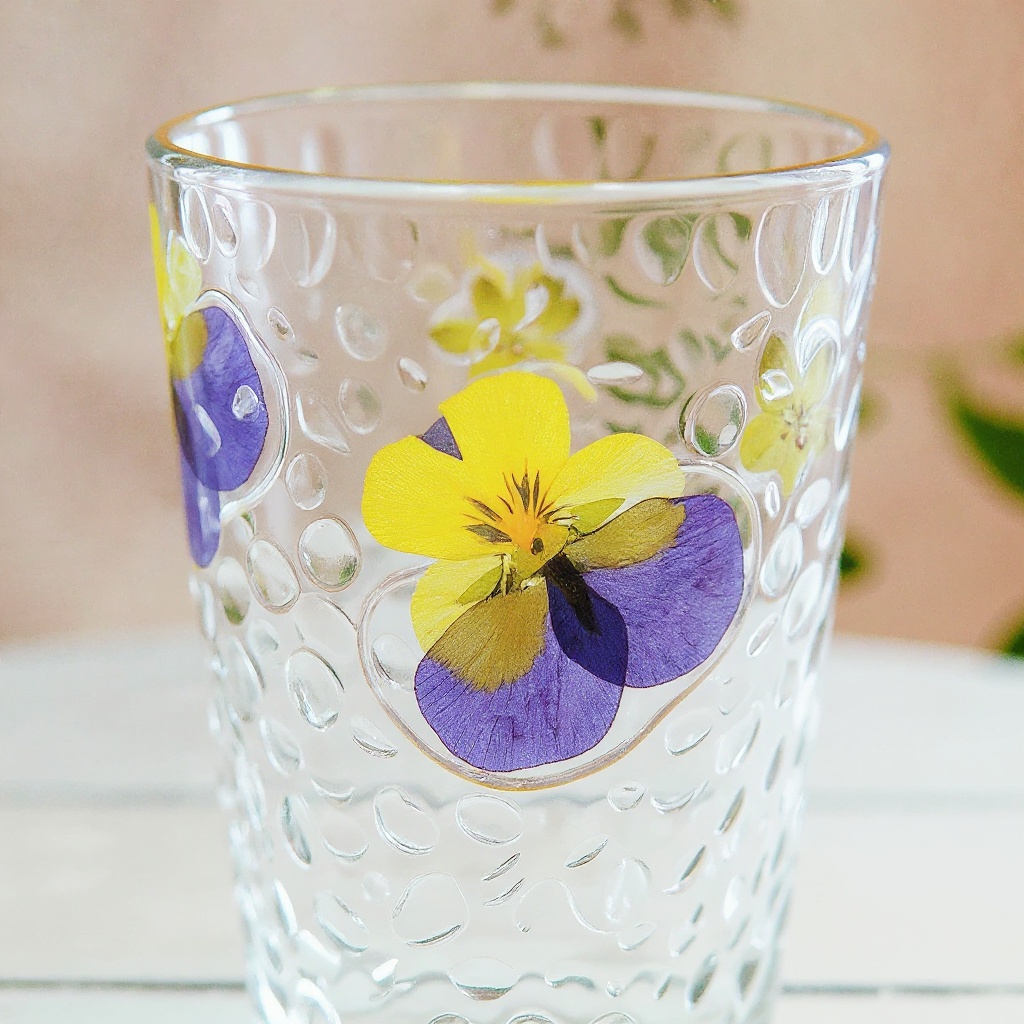
Texture elevates the experience beyond flat visual appeal. Smooth glass showcases tea color, yes. But raised elements — real dried flower petals and green leaves embedded on the exterior surface — create visual interest that shifts as light angles change throughout the day. You feel the petal edges under your fingertips. That tactile dimension is impossible to replicate with printing or decals.
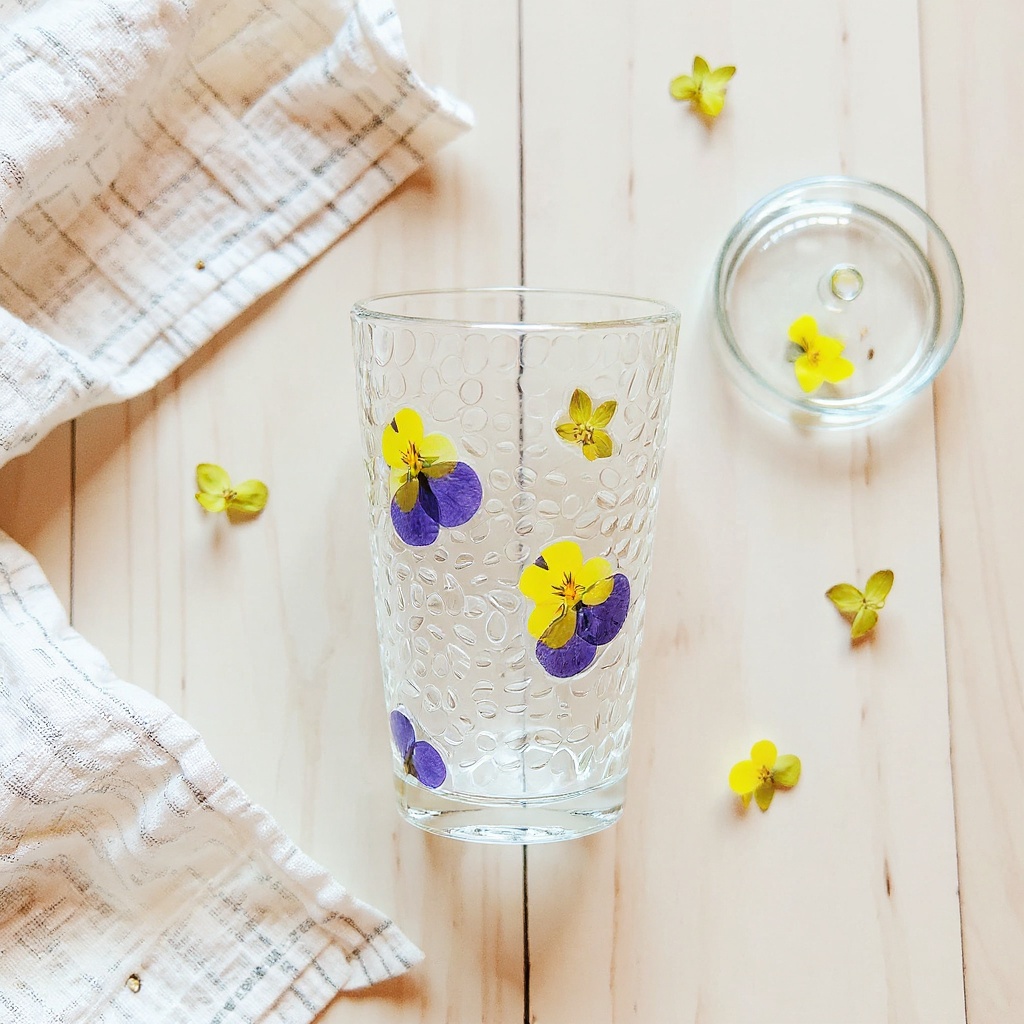
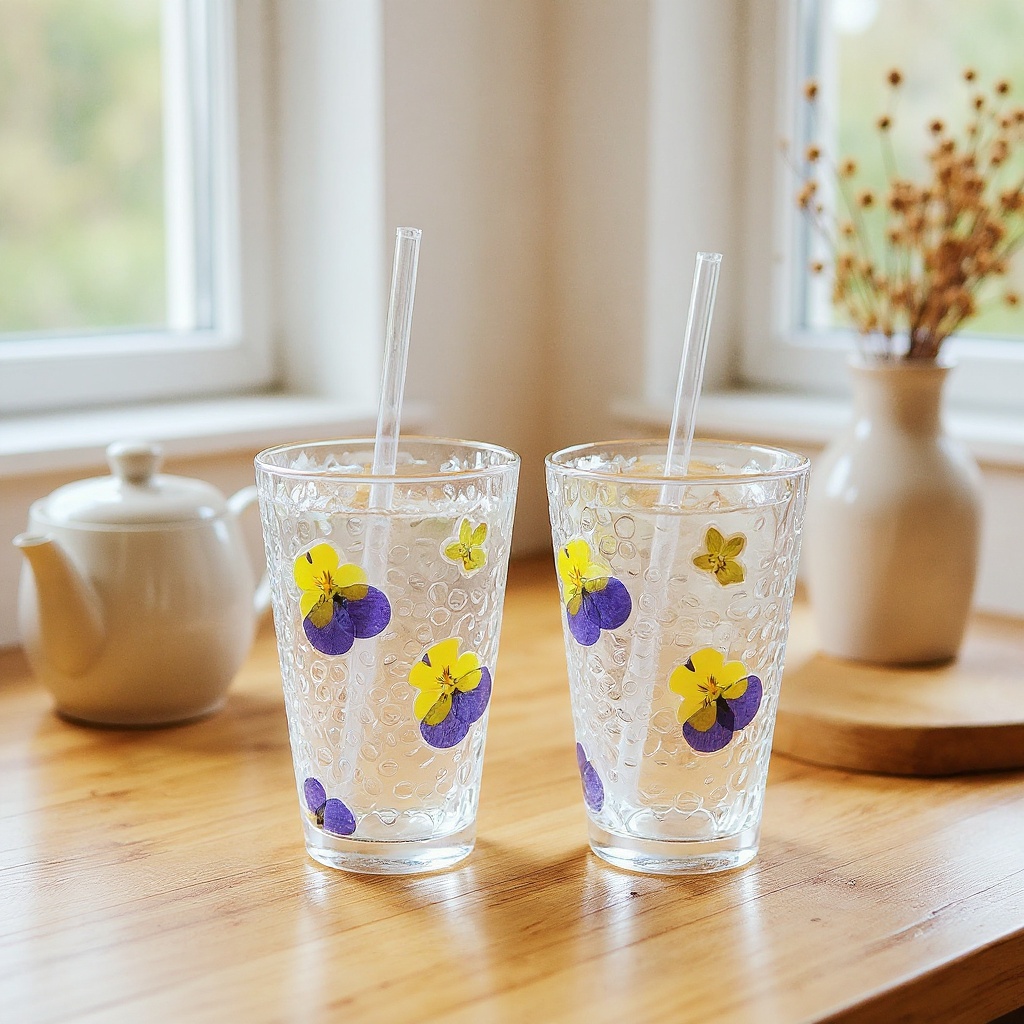
The Handmade Real Flower Glass Cup 400ml represents this category at its best: authentic botanical embeds, borosilicate construction, glass lid, and glass straw included as a complete set.
5 Features to Check Before Buying Any Floral Glass Cup
1. Glass type certification — Confirm borosilicate, not soda-lime. Ask for ASTM or equivalent thermal resistance documentation. If the seller can't provide it, assume the cheaper material. 2. Flower authenticity — Real preserved flowers have visible cellular texture; veins show under light. Artificial silk flowers have uniform surface sheen and identical petal shapes across the whole cup. 3. Embedding method — Raised tactile relief means permanently integrated botanicals. Adhesive-only application means petals that peel within months. Run your finger across the surface before purchasing. 4. Lid and straw materials — Glass lids outperform silicone-rimmed plastic lids for both heat retention and aesthetic consistency. Clear glass straws complete the visual language of the piece. 5. Capacity and proportion — 400ml at approximately 10cm height creates balanced proportions for desktop use, lifestyle photography, and comfortable single-handed grip.
Real vs. Fake Flower Embeds: The Durability Difference
Flower preservation technique determines whether aesthetic elements last years or fade within a season. Real preserved flowers undergo glycerin treatment and controlled drying that maintains cellular structure. Artificial silk flowers use synthetic dyes that can migrate when exposed to repeated heat and humidity cycles from hot beverages.Authentic preserved flowers create raised relief you can feel. Petal edges. Leaf veins. Three-dimensional depth that catches light and creates subtle shadow play as morning sun moves across your desk. This is not a marketing description. Run your fingertip across the surface of a quality piece and then across a printed alternative — the difference is immediate and unambiguous.
Independent consumer testing reported in Ceramics and Glass Artisan Quarterly (2022) found properly embedded preserved botanicals maintained structural adhesion through simulated 3-year daily use cycles, while adhesive-backed artificial elements showed delamination within 8–14 months under equivalent conditions. The pressed flower craft techniques used in quality pieces integrate flowers during a multi-day artisan process — not a factory assembly line.
Honestly? If you live in a genuinely humid subtropical climate (above 80% average relative humidity year-round), reconsider this purchase entirely. Persistent ambient moisture accelerates sealant degradation around embedded botanicals regardless of quality tier. A glazed ceramic cup serves humid-climate tea drinkers better.
| Feature | Real Preserved Flowers | Artificial Silk Flowers | Printed Patterns | Resin Tumbler |
|---|---|---|---|---|
| Visual Depth | 3D raised relief | Flat adhesive | Completely flat | 3D but plastic-enclosed |
| Heat Resistance | Stable to 300°F (borosilicate) | May warp at 200°F | Fades with repeated heat | Not suitable for hot beverages |
| Durability (typical) | 3–5 years proper care | 8–14 months | Permanent but uniform | 4–6 years but no heat use |
| Price Range | $45–65 | $25–40 | $8–20 | $20–45 |
| Tactile Surface | Textured, raised relief | Smooth with visible seam edges | Smooth, no texture | Smooth |
| Dishwasher Safe | No — hand-wash only | No | Usually yes | Often yes |
| Transparency | Crystal clear glass | Crystal clear glass | Crystal clear glass | Slight plastic haze |
Heat Resistance: What the Materials Science Actually Says
Borosilicate glass handles temperature differentials up to 165°C (329°F) without thermal shock failure, according to Schott AG technical specifications for borosilicate 3.3 — the same formulation used in laboratory glassware worldwide. Regular soda-lime glass begins showing thermal stress at approximately 82°C (180°F). That gap matters enormously for daily tea service.
Wall thickness affects heat retention in ways most buyers overlook. A 400ml cup with 2.5mm walls maintains tea at optimal sipping temperature (60–70°C / 140–158°F) for measurably longer than 1mm-wall alternatives — a relationship described by standard thermal conductivity formulas for silicate glass (k ≈ 1.0–1.2 W/m·K). The glass lid traps radiant heat loss from the open surface, which accounts for a significant portion of cooling in open vessels.
Three numbers worth remembering: 2.5mm (ideal wall thickness), 400ml (optimal single-serving capacity), 300°F (safe maximum for properly certified borosilicate pieces with embedded botanicals).
The 3-Day Artisan Process Behind Premium Flower Cups
Handcrafted flower embedding requires precise staging. No shortcuts. No automation.
Day one involves botanical selection and moisture calibration. Preserved flowers must reach approximately 12% moisture content before placement — measured with a standard moisture meter of the type used in archival preservation work. Too dry: petals crack under pressure during embedding. Too moist: mold develops beneath the sealant layer within weeks. Day two brings the embedding process itself. Each petal and leaf element is positioned individually, then secured using heat-cured glass adhesives applied at 80–95°C (176–203°F). A single cup receives 15–25 individual botanical elements. Artisans work from every viewing angle simultaneously — the composition must read as natural and balanced whether the cup is held, placed, or photographed. Day three covers quality control and food-safe sealant application. Every embed point gets inspected for air inclusions or loose edges. The final sealant coat protects flower colors and satisfies beverage container material safety requirements.Seventy-two hours of skilled labor. Premium preserved botanicals. That is why the price is what it is.
Step-by-Step Care Routine for Long-Term Flower Integrity
1. Rinse immediately after use with lukewarm water — never cold water on a still-warm cup, never boiling water on a room-temperature cup. Thermal shock is cumulative. 2. Wash by hand using a soft-bristled brush and pH-neutral dish soap. Avoid harsh detergents containing sodium hypochlorite (bleach compounds), which degrade botanical sealants. 3. Clean around embeds gently — bristles can reach flower crevices where residue accumulates without applying lateral force to petal edges. 4. Air-dry flower-side up on a clean cotton cloth. Avoid heated drying environments. Position ensures water doesn't pool around embedded element bases. 5. Store with separation — never stack directly on flower surfaces. Use cloth cup separators or display storage that keeps embeds from contact pressure. 6. Inspect quarterly — check embed edges for any lifting. Early-stage loosening can be re-secured with food-safe glass adhesive before full delamination occurs.
Size, Shape, and Proportion for Daily Tea Rituals
The 400ml capacity suits most single-serving tea formats. Enough volume for a generous brew. Not so large that the vessel overwhelms smaller hands or desk surfaces.
At approximately 10cm tall with an 8cm diameter, these cups photograph with pleasing proportions — neither squat nor precarious. The wider base design distributes weight across a broader footprint, reducing tip-over risk on wood and marble surfaces. Stability matters. A shattered botanical cup on hardwood floors is both a safety issue and an aesthetic tragedy.
The raised flower embeds on the exterior add visual texture that prevents the flat, uninspiring quality of plain glass in photography. A placed glass straw adds vertical interest. Loose dried petals scattered on a wooden or marble surface complete the lifestyle staging. Simple composition. Genuine impact.
Color Psychology and Tea Pairing
Yellow flower embeds complement white teas and light oolongs. Warm tones enhance golden tea liquors while creating enough contrast to make pale infusions visible against bright morning light. Optimistic. Forward-looking.
Blue preserved flowers work against darker teas — Assam black, robust breakfast blends, aged pu-erh. The cool-warm contrast is photogenic in ways that monochromatic pairings aren't.
Pink embeds offer the broadest versatility, complementing green teas, white teas, and herbal infusions with equal ease. The soft pastel palette reads as cohesive whether the cup is placed on a marble surface, photographed for social content, or simply held during a quiet morning at a wooden kitchen table.
For photography: natural sidelight from a north or east-facing window. No direct flash. The raised botanicals need raking light to show their three-dimensional depth properly — flat overhead lighting flattens the very texture that makes these cups distinctive.
Aesthetic Glass Cups vs. Ceramic and Metal Alternatives
Glass offers visual access to the brewing process that opaque materials simply deny. You watch leaves unfurl. You track color deepening. You judge strength visually before the first sip. Ceramic conceals all of this. Metal distorts it with reflections.
Thermal performance sits in the middle of the material spectrum. Glass retains heat better than thin metal but less than thick, dense ceramic. However, glass imparts no flavor compounds — a meaningful advantage for delicate teas where ceramic minerals or metal reactivity can interfere with taste perception, as noted in sensory evaluation research published by the Tea Research Association.
Weight favors glass for extended daily use. A 400ml glass cup at 200–250g versus 400–500g for an equivalent ceramic piece. That difference accumulates over hours of holding and carrying between rooms.
Versatility favors glass unambiguously. The same cup works for hot tea, cold brew, fruit-infused water, lifestyle photography, and decorative display between beverage uses. Ceramic mugs serve one function competently. They rarely do anything else beautifully.
Investment Value: When the Math Actually Works
At $50 for a handmade piece used daily for five years: $10 per year. At $15 for a mass-produced alternative replaced every two years: $7.50 per year. The premium is approximately $2.50 annually. For something you interact with every single day.
Functional versatility adds real dollar value. One cup that serves hot beverages, cold drinks, photography, and decorative display replaces multiple single-purpose purchases.
Gift occasion math works differently. A $50 handmade piece creates lasting impression and emotional connection. The recipient understands immediately that someone chose it specifically — not grabbed it as a filler. That recognition has genuine social value that $15 alternatives cannot replicate.
Browse the complete Handmade Real Flower Glass Cup 400ml | Heat-Resistant | Lid & Straw Set to see available botanical colorways and current stock.


