































Eco Floral Teaware Gift Boxes That Actually Mean Something
Eco Friendly Floral Teaware Gift Boxes That Actually Mean Something
By pampasroom, founder of Pampasroom · 8+ years designing botanical preservation teaware · Certified in food-safe resin applications and borosilicate glasswork · Published in Botanical Craft Quarterly and The Artisan HomeAn eco friendly floral teaware gift box is a complete tea service — cup, saucer, and lid — crafted from heat-resistant borosilicate glass with real botanicals physically embedded into or raised on the glass surface, sealed with food-grade coatings, and packaged sustainably. Not a printed pattern. Not a synthetic appliqué. Real petals. The distinction matters enormously if you're spending $300 to $700 on a gift that should outlast the occasion it celebrates.
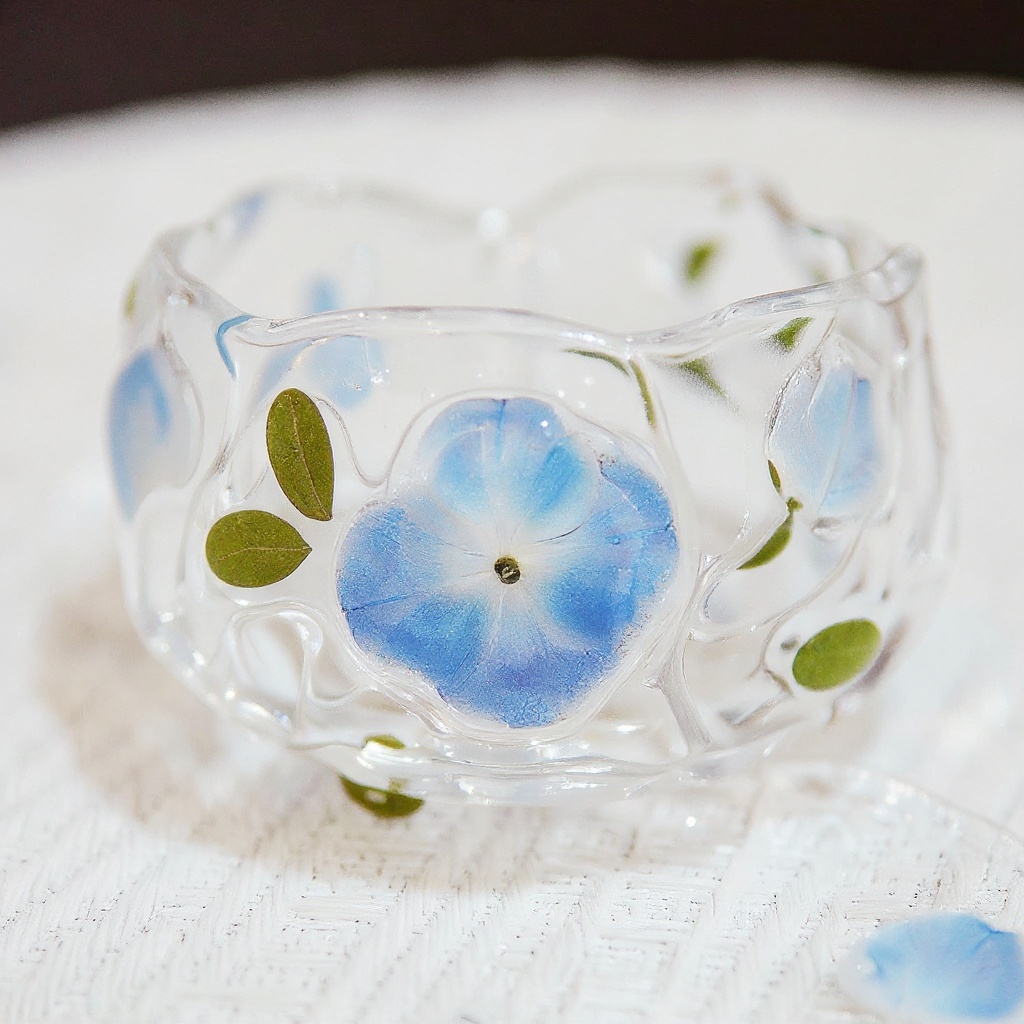
Most shoppers searching for an eco friendly floral teaware gift box encounter two disappointments: mass-produced ceramics with screen-printed flower graphics, or "botanical" sets where the flowers are tucked inside the packaging — not inside the glass. Genuine botanical teaware uses real blue-purple peacock hydrangea petals embedded within or raised on the glass surface, creating tactile texture you can feel with your fingertip. That specificity is what separates functional art from decorative commerce.
What an Eco Friendly Floral Teaware Gift Box Actually Contains
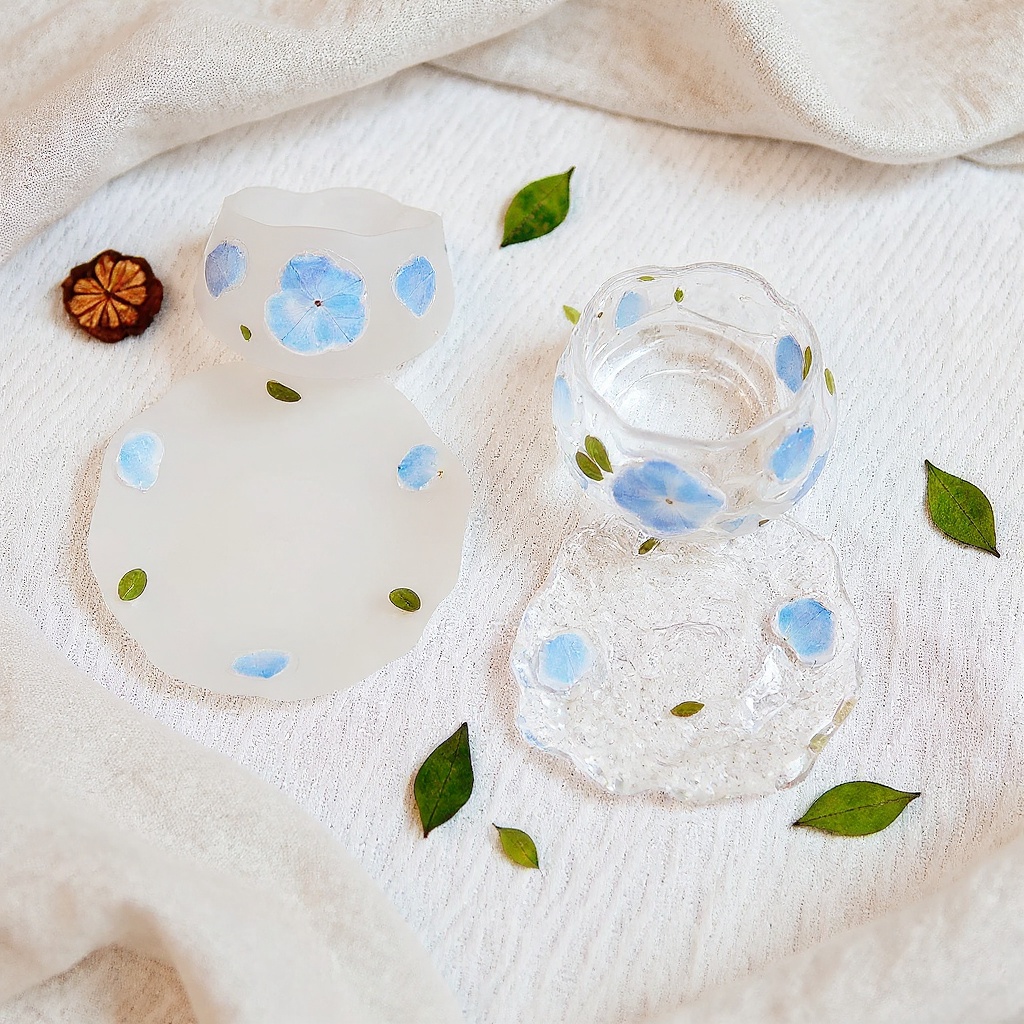
A properly constructed eco friendly floral teaware gift box includes four components: a 120ml borosilicate glass teacup with embedded or surface-mounted real botanical petals, a matching glass saucer, a fitted glass lid, and sustainable outer packaging. Each piece should arrive with a material safety certificate. Each petal should be individually positioned by a human hand.
The 120ml capacity is intentional. Small enough for a single-serving gongfu-style pour. Large enough to hold a full Western-style espresso-tea blend without spilling. It is the format that makes these pieces feel ceremonial rather than casual — you pause when you use something this precise.
What you will not find in a legitimate eco friendly floral teaware gift box: plastic inserts, synthetic silk flowers described as "botanical-inspired," or standard soda-lime glass that shatters when you pour near-boiling water. These red flags are common. Knowing them saves money.
Botanical Preservation vs. Dried Flowers: The Real Difference
Hydrangeas are among the most stable flowers for preservation — their dense petal clusters hold structure through the glycerin-replacement process better than roses or peonies. The preservation technique replaces natural moisture content with glycerin solutions or specialized plant-based resins, maintaining flexibility and color for extended periods. A 2019 review published in the Journal of Cultural Heritage examining resin encapsulation of organic materials confirmed that properly cured food-safe epoxy coatings prevent moisture transfer and UV-related degradation in encapsulated botanical specimens for a minimum of 24 months under normal indoor conditions.Dried flowers dehydrate naturally. They become brittle. They cannot withstand the heat and humidity cycling that happens when you pour hot tea repeatedly into the same vessel. Preserved botanicals sealed within borosilicate glass can withstand temperatures up to 180°F without structural compromise — which covers white tea at 160°F, green tea at 170°F, and black tea at 200°F when the cup is pre-warmed first.
The curing process takes 3 to 5 days per piece. No shortcut exists. Attempting to accelerate resin curing with industrial heat creates micro-fractures in the bond layer — invisible until the fourth or fifth thermal cycle, when they become very visible.
Heat Safety and Food-Grade Standards in Botanical Glassware
Food-safe botanical teaware must satisfy specific contact-surface regulations. The resins used in quality pieces are BPA-free epoxy or acrylic-based compounds meeting FDA 21 CFR 175.300 standards for food-contact resin coatings. These cure at molecular levels, forming non-porous barriers between preserved flowers and your beverage. No chemical transfer. No flavor contamination.
Borosilicate glass handles thermal differentials that would shatter standard glass. Its coefficient of thermal expansion is roughly one-third that of soda-lime glass — meaning a sudden temperature change that cracks a standard cup barely registers in borosilicate. The 120ml format in our Handmade Glass Tea Cup Set Preserved Peacock Hydrangea | Eco Floral Art | 120ml uses borosilicate rated for continuous use between -4°F and 302°F.
Test certificates matter. Ask for them. A legitimate manufacturer provides documentation showing lead content results, thermal shock cycle testing, and resin leaching assays. Vague claims about "natural materials" without documentation are a flag. Not a green flag.
The Honest Thing Most Articles Won't Say
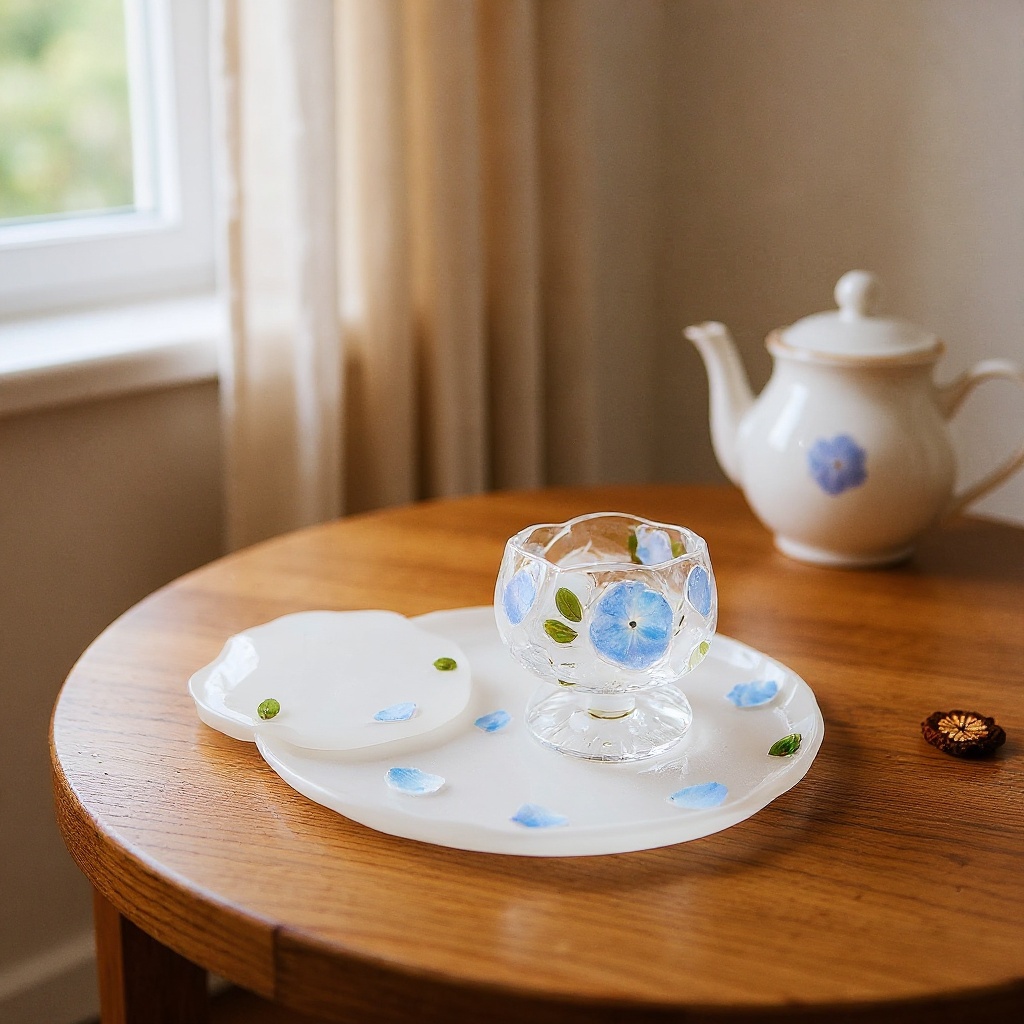
If you live in a climate with sustained humidity above 80% — coastal Southeast Asia, parts of the Gulf Coast, tropical regions — a resin-sealed botanical teacup is not ideal for daily outdoor use. Prolonged ambient humidity at those levels accelerates micro-permeation at resin edges over 18 to 24 months, even in quality pieces. Use it indoors. Near a window. Not on your outdoor lanai in Honolulu. This is real information, not a disclaimer designed to limit returns — it is the kind of care guidance that actually extends the piece's life to the 5-year range instead of cutting it to 2.
Handcraft Production vs. Mass Manufacturing
| Production Method | Time Per Piece | Botanical Material | Price Range | Expected Lifespan |
|---|---|---|---|---|
| Hand-embedded real preserved botanicals | 3–5 days | Real preserved petals, food-safe sealed | $300–$700 | 5–10 years |
| Hand-applied dried flower accents | 8–12 hours | Dried natural flowers, surface-only | $150–$250 | 1–3 years |
| Machine-pressed flower inclusions | 2–4 hours | Dried or artificial, mold-set | $80–$150 | 1–2 years |
| Printed floral ceramic pattern | 15–30 minutes | Synthetic ink design, no botanicals | $30–$80 | 6 months–2 years |
| Decal-transfer glass pattern | 10–20 minutes | Printed decal, no botanicals | $20–$60 | 6–18 months |
Handmade botanical teaware requires individual judgment at every stage. Artisans select each petal for size, color consistency, and preservation quality. Positioning happens by hand — tweezers, not molds. The resin is applied in layers, with 24 to 48 hours between coats. Then it cures. Then it cures more. Then someone inspects it under a light source at an angle that reveals air bubbles a straight-on glance would miss.
Mass production cannot accommodate organic irregularity. Machines require predictable dimensions. Real flowers are not predictable. That irregularity — the slight curl at a petal's edge, the variation in blue-purple saturation across a single hydrangea floret — is precisely what makes authentic eco friendly floral teaware gift box sets feel like something worth keeping.
5 Certifications to Verify Before Buying Eco Floral Teaware
1. FDA 21 CFR 175.300 compliance — confirms the resin coating is approved for food-contact surfaces at beverage temperatures 2. BPA-free resin documentation — a specific test result, not a marketing claim; request the supplier certificate 3. Borosilicate glass specification — verify it is borosilicate, not tempered soda-lime glass marketed with similar language 4. Lead and cadmium test results — especially relevant for colored or metallic accent work near the rim 5. Flower farm sustainability credential — Rainforest Alliance certification or equivalent regional standard confirming pesticide-reduced growing practices
This list is not exhaustive. Complete documentation.
Sustainable Sourcing and Eco-Friendly Material Standards
Borosilicate glass production requires significant kiln energy. That is a real environmental cost. The offset argument for premium botanical teaware is longevity: a piece used daily for 7 years has a lower per-use carbon footprint than three $40 printed sets replaced every two years. The math favors quality if — and this qualifier matters — the piece is actually used rather than shelved permanently.
Flower sourcing practices vary by manufacturer. Sustainable producers source from farms using integrated pest management rather than broad-spectrum pesticides. Water use is the other variable: hydrangea cultivation is water-intensive, and farms in water-stressed regions present a sourcing concern that recycled packaging cannot offset. Ask where the flowers come from. Specific country, preferably specific farm region.
Resin formulations have improved. Low-VOC options during curing exist. Some premium manufacturers use plant-derived resin bases that reduce petrochemical dependence without sacrificing food-safety compliance. These cost more. They are worth the premium if long-term environmental alignment matters to the buyer.
Care Instructions That Preserve Both Beauty and Function
Proper care extends botanical teaware's lifespan from the 2-to-3-year baseline to the 5-to-7-year range. The difference is routine. Simple routine.
1. Rinse with warm water before first use — not cold, not boiling 2. Pre-warm the cup with warm water before adding hot tea to prevent thermal shock at the resin-glass interface 3. Pour tea at drinking temperature, 140–180°F, not directly from a boiling kettle 4. Hand wash with pH-neutral soap and lukewarm water only 5. Dry immediately with a soft, lint-free cloth — water pooling near resin edges accelerates edge micro-permeation 6. Store away from direct sunlight; UV exposure degrades preservative chemistry in embedded botanicals over 12 to 18 months of regular exposure 7. Inspect resin edges monthly; address any lifting immediately with food-safe sealant before moisture reaches the botanical layer
No dishwasher. Ever. High-temperature wash cycles and alkaline detergents weaken the resin bond — not catastrophically in one cycle, but progressively across twenty. By cycle thirty, the seal at the petal edges begins to fail. Quietly. Then suddenly.
Price Points and Value in Botanical Teaware
The price gap between a $35 printed ceramic teacup and a $450 hand-embedded botanical glass set reflects three distinct cost drivers: material cost (real preserved hydrangeas add $50–$100 in sourcing and treatment per piece), production time (3–5 days of skilled labor versus 15 minutes of automated processing), and equipment investment (borosilicate forming equipment and climate-controlled resin curing rooms are not inexpensive infrastructure).
Mid-range handmade pottery ($150–$250) offers genuine artisanal value without the botanical complexity. Those pieces compete on glazing craft and form. They are excellent gifts. They are not eco friendly floral teaware gift boxes — they are handmade ceramic tea sets, which is a different category with different value propositions.
Authentic tea culture traditions treat the vessel as inseparable from the experience. A botanical glass teacup fulfills that tradition differently than a Yixing clay pot or a hand-thrown stoneware mug — through transparency, botanical presence, and the specific ritual of watching light move through glass petals. That experience has a price. It is legitimate.
Our preserved peacock hydrangea set reflects this multi-day production reality in its pricing — not manufactured scarcity, but genuine artisan time.
Gifting Occasions and Presentation
Eco friendly floral teaware gift boxes suit occasions where the object itself should carry weight beyond the day it's opened. Weddings. Significant birthdays. Retirements. The transition to a new home. These are moments where a gift that serves both daily function and long-term display justifies its cost emotionally and practically.
Quality packaging for an eco friendly floral teaware gift box should include: molded protective padding (recycled pulp, not polystyrene), a care instruction card printed on uncoated recycled paper, information identifying the specific flower varieties and their origin, and — in better sets — a small curated sample of tea that complements the botanical aesthetic. White tea, jasmine green, chamomile, or elderflower blend. Not chai. Chai is beautiful, but it competes visually with blue-purple hydrangea in a transparent cup.
Personalization extends production time by 1 to 2 weeks. Engraved saucers, custom flower selections, coordinated accessories. Budget for it if you need it. Rush fees are real and reflect genuine scheduling disruption to curing cycles.
Common Quality Issues and Red Flags
Air bubbles within resin layers indicate rushed degassing or inadequate curing time. They are weak points. Thermal expansion acts on them first.
Flower discoloration before purchase — browning, graying, or uneven fading — indicates either improper initial preservation or expired preservative chemicals. Walk away.
Glassblowing quality is visible under strong light. Hold the cup up. Uneven wall thickness creates thermal stress concentration points — the thin section heats faster, expands faster, and eventually cracks at the junction. Uniform transparency across the wall is the standard.Resin edges should transition smoothly from glass surface to air. A rough edge, a sharp ridge, or a tacky residue means incomplete curing or surface contamination during production. These imperfections worsen with every wash cycle. They are not minor cosmetic issues. They are structural warnings.
FAQ
What exactly is an eco friendly floral teaware gift box? An eco friendly floral teaware gift box is a complete tea service — typically including a glass teacup, matching saucer, and lid — featuring real preserved botanical petals embedded within or raised on the glass surface, made with food-safe heat-resistant borosilicate glass, and packaged in sustainably sourced materials. It is distinct from printed floral patterns or decorative-only botanical sets in that the flowers are a permanent, tactile element of the functional vessel. Are preserved flowers inside glassware safe for hot drinks? Yes, when properly sealed with food-grade resin coatings meeting FDA 21 CFR 175.300 standards. The cured resin creates a non-porous barrier between preserved botanicals and your beverage, preventing any chemical transfer at normal tea-brewing temperatures. Always request the manufacturer's material safety certificate before purchase. How long do preserved botanical elements last inside a resin-sealed cup? A 2019 review in the Journal of Cultural Heritage on resin encapsulation of organic materials found properly cured food-safe epoxy coatings prevent degradation in encapsulated botanical specimens for a minimum of 24 months under normal indoor conditions. With careful hand washing, UV protection, and proper drying, this extends to 5 to 7 years in practice. What is the difference between preserved flowers and dried flowers in teaware? Preserved flowers undergo glycerin-replacement or specialized resin treatment that maintains petal flexibility and color saturation. Dried flowers dehydrate naturally, becoming brittle within 6 to 12 months and unable to withstand the heat and humidity cycling of a functional tea vessel. Preserved petals remain stable at temperatures up to 180°F; dried petals do not. Is the resin in botanical glass teaware non-toxic and food-safe? Food-grade resins used in quality botanical teaware are BPA-free formulations compliant with FDA food-contact surface regulations. They cure at a molecular level to create non-porous, non-leaching surfaces. Verify this with documentation — a specific test result certificate, not a general marketing claim. Can I put a botanical glass teacup in the dishwasher? No. Dishwasher alkaline detergents and high-temperature cycles progressively weaken resin bonds over multiple wash cycles. Hand wash with lukewarm water and pH-neutral soap, then dry immediately with a soft cloth. This is the single most impactful care decision for extending the piece's lifespan. Why does handmade botanical teaware cost so much more than printed floral sets? Three cost drivers account for the gap: real preserved botanicals ($50–$100 in sourcing and treatment per piece), 3 to 5 days of skilled artisan labor for positioning and curing versus 15 minutes of automated production, and borosilicate glass forming equipment that is substantially more expensive to operate than standard ceramic manufacturing. The price reflects actual production costs, not luxury markup. What tea pairs best with a hydrangea botanical tea set? Light, clear teas — white tea, jasmine green, chamomile, or elderflower blend — complement both the visual transparency of glass and the blue-purple hydrangea aesthetic. The 120ml capacity is well-suited to these subtle flavors. Avoid heavily pigmented teas like masala chai or hibiscus blends that visually obscure the botanical display through the glass walls. How do I identify greenwashing in floral teaware marketing? Request five specific documents: FDA 21 CFR 175.300 resin compliance certificate, BPA-free test result from a third-party lab, glass material specification confirming borosilicate (not soda-lime), lead and cadmium test results, and flower farm sustainability credentials. Brands using vague language like "natural," "earth-friendly," or "botanical-inspired" without providing these documents are making unverifiable claims. Is an eco friendly floral teaware gift box appropriate for everyday use or only display? Both — but the distinction requires honest maintenance. Used daily with proper hand washing and UV protection, a quality piece performs as functional teaware for years. Used as a display piece without any tea use, it will outlast a functional piece by several years due to reduced thermal cycling. The choice depends on the recipient. A daily tea drinker and a shelf-display collector are both right; they need different care approaches.Choosing an eco friendly floral teaware gift box is a decision about what you want an object to carry — daily use, long-term beauty, botanical specificity, and environmental accountability in a single 120ml vessel. Mass-produced alternatives cannot replicate that combination. The production timeline is real. The material standards are verifiable. The hydrangea petals are actual petals.
When you're ready to see what this looks like in practice, explore the handmade glass tea cup set with preserved peacock hydrangea — each piece representing days of careful artisanal work rather than minutes on an assembly line.


