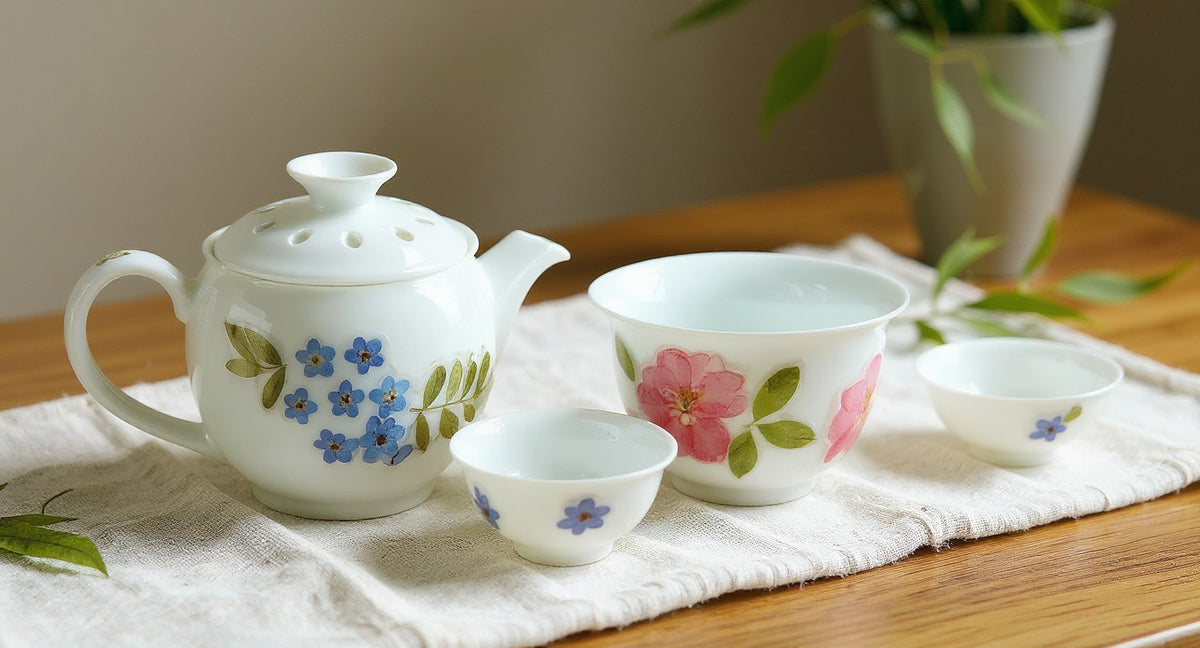
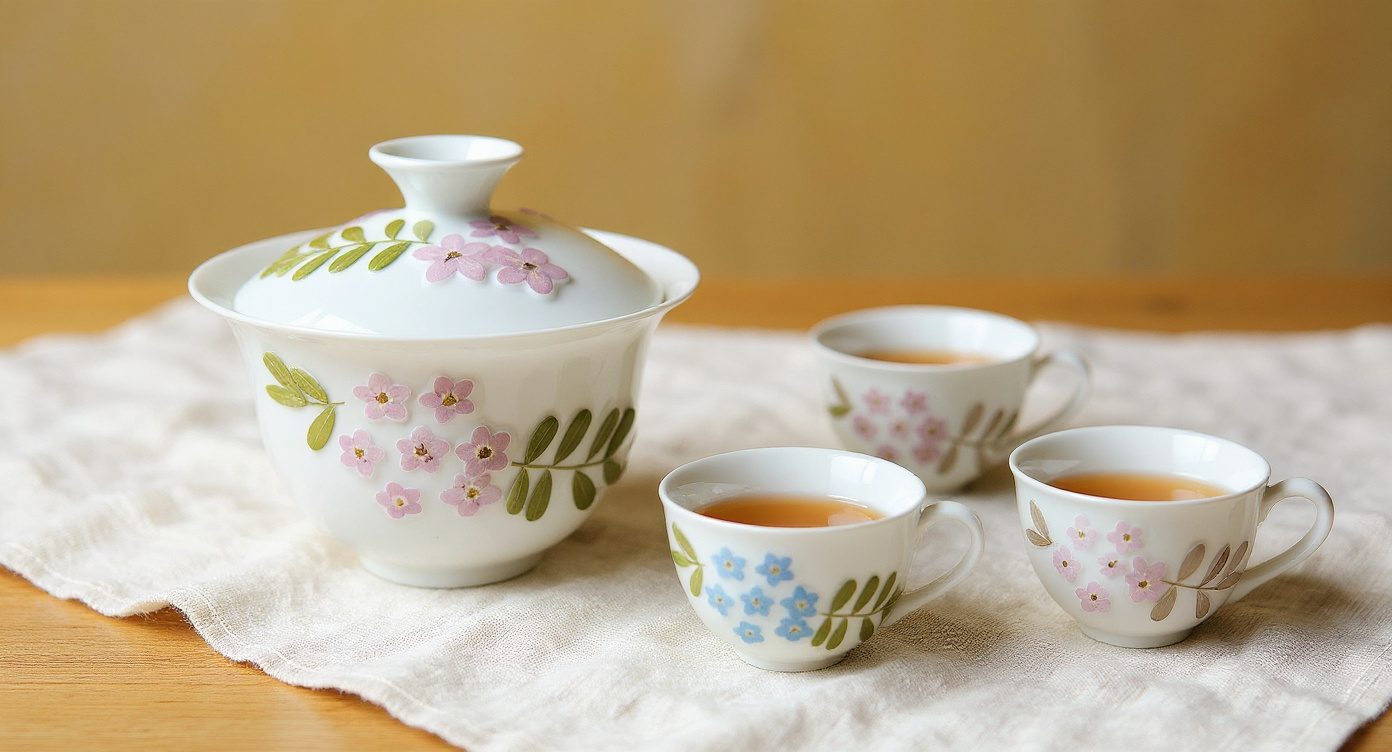
Pampasroom makes a very specific kind of floral tea ware, and that matters here. The reference point is not a painted rose decal set. It is a delicate semi-translucent warm-white porcelain gaiwan with small teacups, arranged in a serene botanical style, with pale pink, blush, and ivory preserved petals raised on the exterior.
So the better question is this: can a floral tea set under $600 be worth it when the flowers are real preserved botanicals rather than hand-painted decoration?
Yes, sometimes.
But not for everyone.
If the set is priced near $598.65, the money needs to show up in three places you can verify: porcelain quality, workable gongfu proportions, and exterior floral craftsmanship that doesn't interfere with brewing.
Best floral tea set under 600, what actually justifies the price
A lot of floral tea sets look expensive in photos and ordinary in the hand. The usual problems are easy to spot. Thick porcelain. Printed flowers. Clumsy lids. Cups sized for display instead of tea.
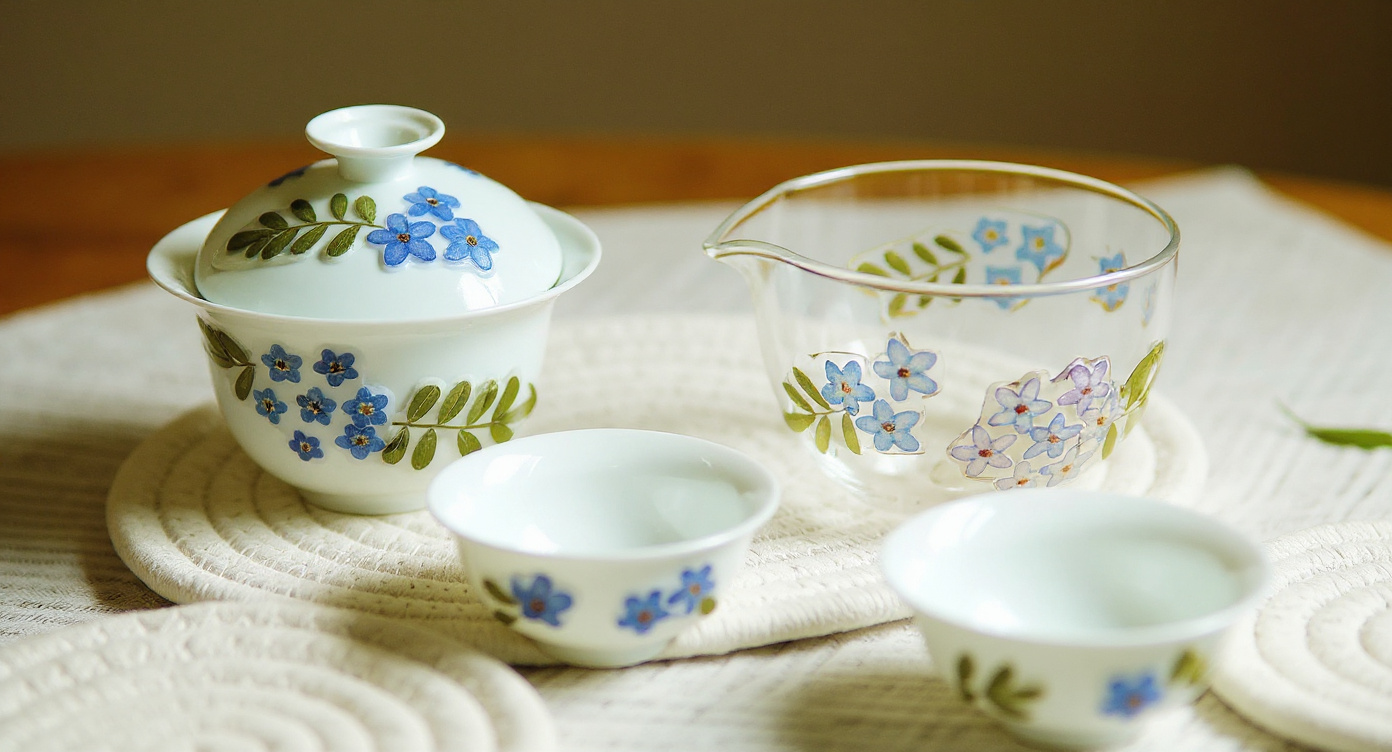
This product sits in a narrower lane. It is a suet jade porcelain gaiwan of about 150ml with small teacups of about 50ml each, finished with 3D raised preserved flower petals on the outside. That combination gives it a different care profile from smooth everyday porcelain, but it also gives it a reason to cost more than a factory floral gift set.
The material side matters first. Porcelain is standard tea ware for a reason. It is nonporous and neutral in flavor, which is why it is so common for gongfu brewing, as summarized in the reference entry on bone china. The shape matters just as much. Gongfu service depends on short infusions and controlled pouring, which is why gaiwan size and lid fit aren't decorative details, as outlined in the broad description of the gongfu tea ceremony.
Then there is the floral work.
Not paint. Not a decal.
Real preserved petals raised on the exterior.
That distinction changes both value and upkeep. Raised preserved botanicals can look far more special than printed flowers, but they also demand hand washing and careful storage. No honest maker should hide that.
How to choose a floral tea set under $600
Start with the body material. If a listing says only fine ceramic, that's not much help. This set names suet jade porcelain and bone china in the product context, which is more useful than vague language.
Next, look at the decorative method. Hand-painted floral ware, transfer-printed floral ware, and preserved-botanical relief ware are three different things. They shouldn't be lumped together just because all three have flowers.
Then check the brewing numbers. A 150ml gaiwan and 50ml cups make sense for shared gongfu infusions. Oversized floral sets often look romantic on a shelf and awkward in use.
Finally, read the care instructions as part of the product, not as a warning label to ignore. If the petals are raised on the exterior, hand-wash-only is the sensible instruction.
A contrarian point, because most articles won't say it: if the appeal is mainly that it looks floral in product photos, this kind of set is probably not worth $598.65. At that price, the buyer should care about the 150ml gaiwan format, the 50ml cups, and the preserved-botanical surface work, not just the flowers.
A direct comparison of common floral tea set types
The fairest comparison is by construction method, not by mood-board style.
| Floral tea set type | Material details | Decoration method | Brewing format | Price context | Main trade-off |
|---|---|---|---|---|---|
| Mass-produced printed floral set | varies by seller | transfer print or decal | varies by seller | varies by seller | Decorative look can come before pouring and lid fit |
| Hand-painted floral porcelain set | varies by seller | painted surface decoration | varies by seller | varies by seller | Worth depends on painting quality and usable shape |
| Boutique floral studio set | quote only | varies by seller | varies by seller | quote only | Distinctive work, but practicality varies a lot |
| Pampasroom preserved-flower gaiwan set | suet jade porcelain, bone china context | real preserved petals in 3D raised exterior relief | gaiwan about 150ml, cups about 50ml | $598.65 | Hand washing, gentle storage, and a more delicate exterior |
| Smooth plain porcelain gaiwan set | varies by seller | none or minimal | varies by seller | varies by seller | Easier maintenance, less visual character |
That last row matters more than people expect. Sometimes the right comparison for a floral set is not another floral set. It's a plain porcelain gaiwan that will tolerate less careful handling.
What makes this preserved-flower porcelain gaiwan different
The product identity is doing a lot of the work here.
Warm-white, semi-translucent porcelain. Small gongfu scale. Pale pink, blush, and ivory preserved petals raised on the outside. Natural linen or aged wood styling. Soft diffused light. Minimal botanical spa feel.
That sounds visual, but some of it has practical consequences too. Semi-translucent porcelain usually signals a more refined body than the thick, opaque floral sets commonly sold as gift bundles. A 150ml gaiwan is also a usable middle size for gongfu brewing. Not tiny. Not cumbersome.
The petals being on the exterior is important. Tea-contact surfaces should stay as plain and easy to rinse as possible. Exterior relief keeps the brewing chamber straightforward while still carrying the floral art on the outside.
This won't work if the owner wants stackable mugs, machine washing, or one set for every kind of rough household use.
It can work if the owner already enjoys slower tea sessions and doesn't mind treating tea ware more like porcelain than hardware.
At Pampasroom, that trade-off should be stated without dressing it up. The preserved flowers are the point, and also the fragile part.
Why preserved flowers change the care requirements
Preserved flowers are not the same thing as pigment on glaze. The goal of preservation is to retain the form of the botanical material beyond its fresh state, as described in the reference overview on flower preservation. Once those petals become raised exterior decoration, abrasion becomes the obvious risk.
So care is simple, but not casual.
Hand wash. No abrasive scrubbers. Give each cup space in storage.
That is not a flaw in itself. It is the cost of choosing dimensional floral work instead of a flat printed motif.
And this is where some floral tea sets underperform. They borrow the language of craft, then use decoration that could be reproduced by the thousand with almost no variation. Natural preserved petals don't behave that way. Variation is built in.

Is a floral tea set under $600 good value for actual tea drinking
Sometimes yes.
If the proportions are right, yes. If the floral work stays on the exterior, yes. If the buyer understands that decorative labor and careful use come together, yes.
If the main goal is rugged convenience, no.
That answer is less romantic than most gift guides. It is also more useful.
A 150ml gaiwan can be used for repeated gongfu steeps without feeling oversized, and 50ml cups fit that rhythm well. Those numbers are part of the value case. So is the fact that this product is not pretending to be hand-painted when it is actually preserved-botanical relief.
There is also a limit to the value argument. A person who drinks tea half-awake before work, washes everything in a crowded sink, and stores cups stacked rim to rim should skip this category entirely. A simpler gaiwan would make more sense.
What to check before buying a preserved-flower tea set
1. Confirm the stated material Porcelain, bone china, stoneware, and generic ceramic are not interchangeable terms. This product gives actual material language instead of a vague ceramic label.
2. Check where the floral work sits Exterior decoration is easier to live with than textured surfaces inside the brewing chamber.
3. Match the size to gongfu use About 150ml for the gaiwan and about 50ml for the cups is coherent for repeated infusions.
4. Treat hand-wash-only as part of the design Raised preserved petals and dishwasher cycles do not belong together.
5. Decide whether the piece is for daily use, display, or both This type can do both, but only with careful handling.
6. Look for a style that matches the object itself The right visual language here is serene, minimal, and botanical. Not loud cottage florals. Not glossy printed bouquets.
Where this product sits within Pampasroom's catalog
The useful thing about a Pampasroom floral tea set is that it belongs to a very narrow material and aesthetic category. Real preserved florals. Heat-conscious vessel design in the broader brand context. Soft botanical styling rather than bright novelty decoration.
For readers comparing within the brand, these related pages give the rest of the context:
- Handmade Bone China Tea Set Preserved Flowers | Gongfu Gaiwan | Eco Floral Art - Preserved flower glass cup collection - Dried flower decor collection
When I sealed my first batch of preserved blooms into a heat-resistant glass cup, the lesson was simple: flowers can be beautiful in functional ware, but only if the material choice and care expectations are stated plainly. The same logic applies here.
FAQ
Is this a hand painted floral tea set?
No. Based on the supplied product context, this is better described as a preserved-flower porcelain gaiwan set with raised exterior botanical relief. That distinction matters because paint, decals, and preserved botanicals behave differently in use and in care.What are the capacities of the gaiwan and cups?
The gaiwan is about 150ml, and each teacup is about 50ml according to the supplied product details.Are preserved flowers on the outside better than decoration inside the cup?
For tea use, exterior decoration is the safer design choice. It leaves the tea-contact surfaces smoother and easier to rinse.Can this tea set be used every day?
It can suit careful daily gongfu use. It is not a good match for rough handling, stacking, or dishwasher cleaning.Is semi-translucent porcelain just a visual feature?
Not entirely. It is also a clue that the porcelain body is more refined than many thick gift-box floral sets, though translucency alone does not guarantee quality.Is $598.65 reasonable for this kind of tea set?
That depends on what the buyer values. If the priority is preserved-botanical craftsmanship, 150ml gongfu brewing format, and gift-grade presentation, the price has a clear logic. If the priority is low-maintenance utility, a plainer set would make more sense.How should the cups be stored?
With space between them if possible. Raised floral surfaces do better when they are not rubbing against other hard pieces.Does each set look exactly the same?
No. With real preserved petals, some variation in petal shape and placement is expected.Is this more for display or for brewing?
Both, but with limits. It can function as tea ware, and the 150ml gaiwan plus 50ml cups support that. It also has a strong display presence because of the preserved floral relief and the soft warm-white porcelain body.Who should skip this category entirely?
Anyone who wants dishwasher-safe tea ware, stackable storage, or an all-purpose mug substitute. Wrong category. Wrong expectations.Final take
A floral tea set under $600 is only worth serious consideration when the product is honest about what it is. This one is not painted-floral porcelain in the usual sense. It is a warm-white, semi-translucent porcelain gaiwan set with pale pink, blush, and ivory preserved petals raised on the exterior, built around a 150ml gaiwan and 50ml cups.
That gives it a clear identity.
It also gives it limits.
For readers researching preserved-flower tea ware rather than printed floral tea sets, the Handmade Bone China Tea Set Preserved Flowers | Gongfu Gaiwan | Eco Floral Art is a precise example of what this category is trying to do. Pampasroom should be judged on those specifics: porcelain body, exterior preserved-botanical relief, and a usable gongfu scale, not on the assumptions people bring from mass-market floral tea sets.