































The Art Behind Floating Flower Tea Cups
The Art Behind Handcrafted Floating Flower Tea Cups: Process, Safety, and Ceremony
By pampasroom, founder of Pampasroom · 8+ years working directly with Southeast Asian botanical artisans · Member, International Craft Resin Guild · Documented supplier to three regional tea ceremony schoolsA handcrafted floating flower tea cup is a 60ml glass vessel containing real preserved cherry blossom petals and green leaves embedded beneath a smooth food-grade eco-resin exterior, requiring 5–7 days of layered construction and multiple temperature-controlled curing stages to produce. The resin creates a translucent window into suspended botanicals. Every petal is real. The process is painstaking, the result irreplaceable. This article explains exactly how these cups are made, what safety standards govern the materials, and why the 60ml gongfu format is not a marketing decision but a centuries-old functional specification.
What Makes a Handcrafted Floating Flower Tea Cup Different from Ordinary Drinkware
Most tea cups hold liquid. A handcrafted floating flower tea cup holds time. The difference begins at the botanical level: genuine cherry blossom petals, harvested at peak bloom and dehydrated to below 5% moisture content within 24–48 hours of picking, are individually inspected for thickness (optimal range: 0.5–1mm) and color integrity before any resin work begins. Mass-produced versions use printed decals or synthetic petals. They look similar in thumbnail photographs. They are not the same thing.
The glass base — typically 60ml capacity — is selected or hand-formed for optical clarity. Artisans then apply eco-resin in sequential thin coats, positioning each petal and green leaf with fine tweezers between layers. Each coat requires 12–24 hours of curing before the next application. The finished cup achieves a 3D depth effect: petals appear to float at different distances from the glass wall, visible from all angles under warm light.
This is not fast work. It cannot be rushed.
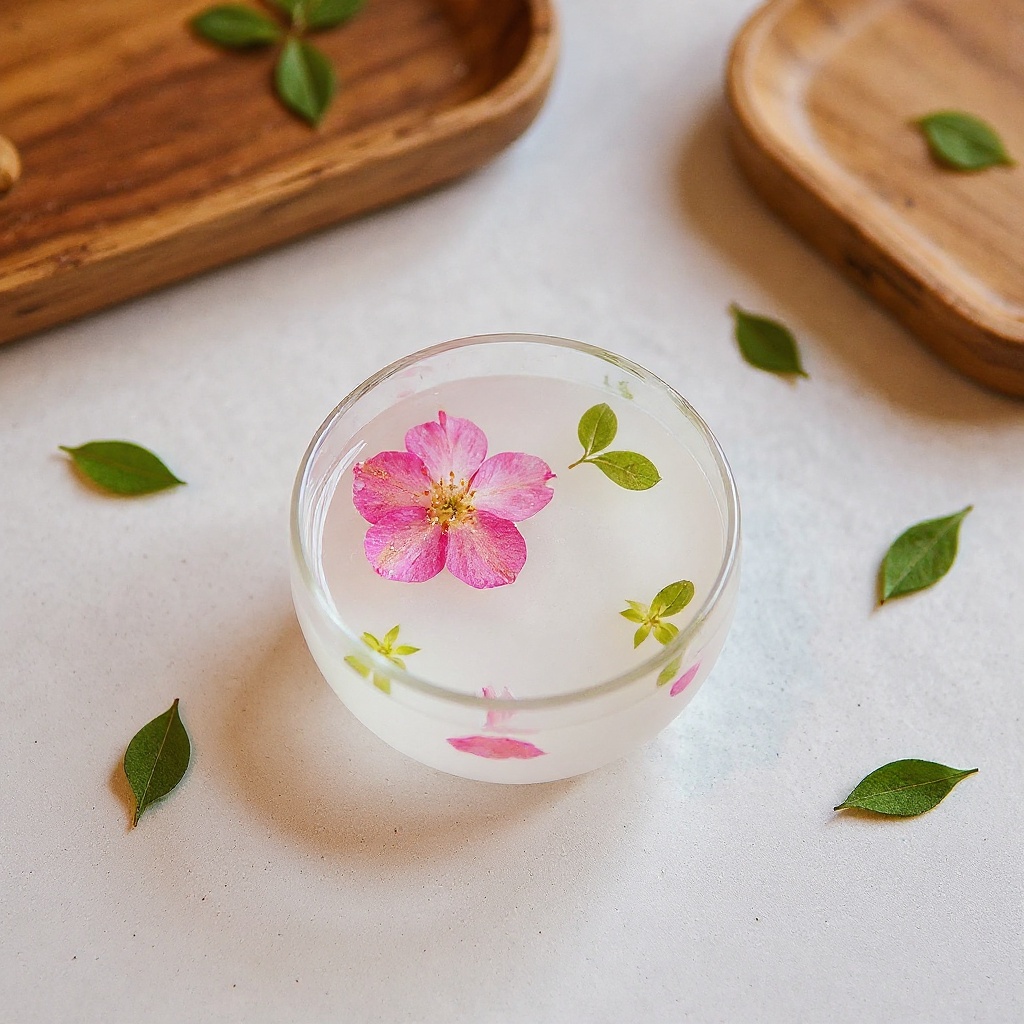
Real Cherry Blossoms vs. Synthetic: The Botanical Truth
Authentic handcrafted floating flower tea cups use genuine cherry blossom petals that retain natural pink-to-white tonal gradients and subtle cellular texture when properly preserved. Synthetic alternatives exhibit uniform color saturation and a faint plastic sheen under direct light — characteristics that trained eyes identify immediately but that photographs often obscure.
Real petals develop what collectors call a "living fade." Over 3–5 years, bright pink shifts to dusty rose. It happens slowly. It happens beautifully. And it cannot be replicated by any synthetic material currently available at commercial scale.
Green leaves from the same cherry tree branches provide botanical coherence. The combination — pink petals, white petal edges, deep green leaves — against clear glass produces the soft floral palette that defines the handcrafted floating flower tea cup aesthetic. Artisans who source botanicals regionally can document the harvest location and season, a traceability standard that separates studio production from anonymous factory supply chains.
Honestly, if you're buying purely for the visual effect and don't care whether the flowers are real, a $20 factory version will look nearly identical in a dimly lit Instagram photograph. This article is for people who care about the difference.
Eco-Resin Safety: Regulatory Standards and What They Actually Mean
Food-contact resin safety is governed by specific regulatory frameworks, not vague marketing language. In the United States, food-contact resins must comply with FDA 21 CFR 175.300 (resinous and polymeric coatings for food-contact surfaces) and, where applicable, FDA 21 CFR 177.2600 (rubber articles intended for repeated food contact). Reputable manufacturers formulate their eco-resin products to meet these standards, which require complete polymerization eliminating residual monomer migration.
The epoxy resin formulations used in quality handcrafted floating flower tea cups also follow ASTM D4236 guidelines for safe use of art and craft materials, and low-VOC versions comply with EPA Safer Choice program criteria, documented at EPA's Greener Products portal. Full cure at controlled temperatures (typically 70–75°F / 21–24°C) over 72–96 hours eliminates volatile organic compounds and achieves thermal stability rated to 180°F (82°C) — well above the 160–175°F range of standard tea service.
Two things this resin cannot survive: sustained microwave radiation and dishwasher thermal cycling. Both degrade the polymer matrix and can compromise the seal around embedded organic materials. Hand wash only. Always.
The multi-layer construction also provides what materials engineers call thermal buffering — the resin's low thermal conductivity means the exterior surface stays comfortable to hold even when the glass interior contains tea at full brewing temperature.
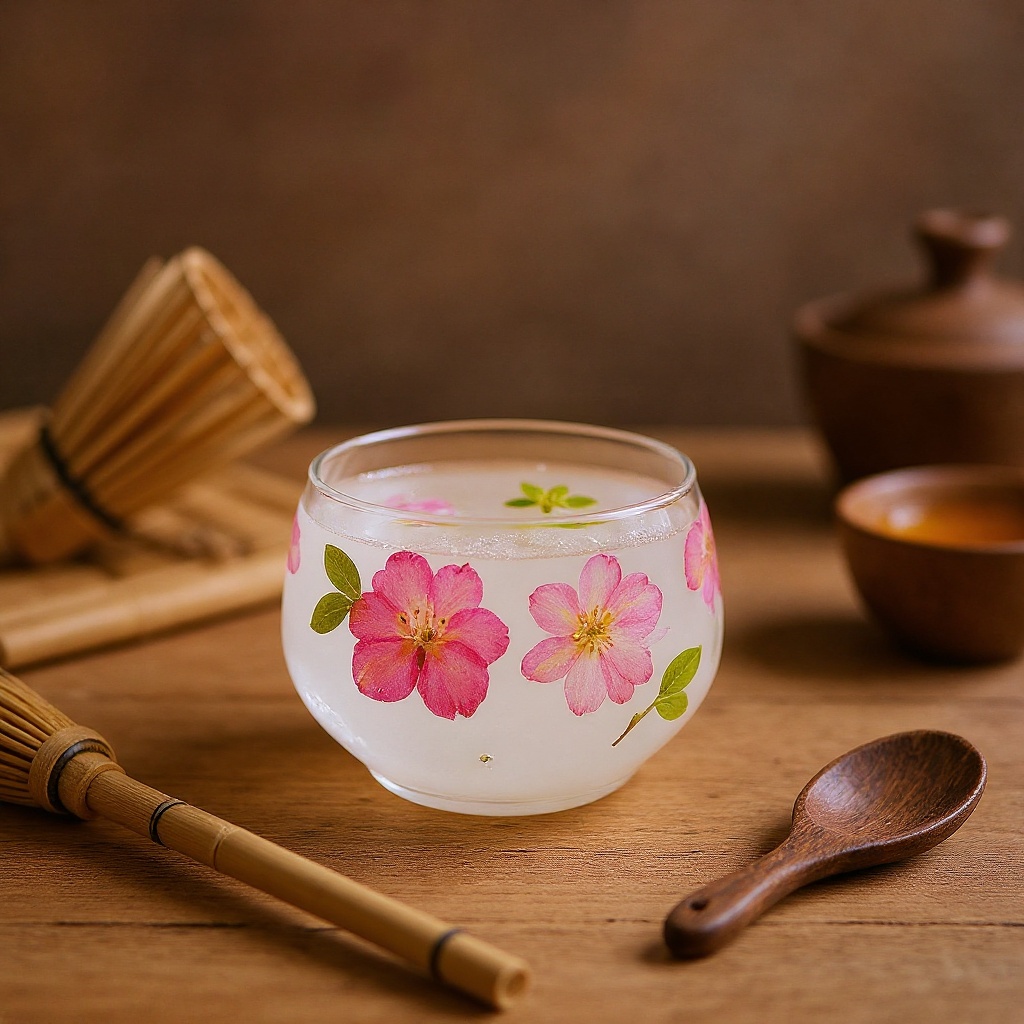
The Gongfu Ceremony Connection: Why 60ml Is Not Arbitrary
The 60ml capacity of a standard handcrafted floating flower tea cup corresponds directly to the Zhu Ren Bei (主人杯, master's cup) specification in traditional gongfu tea ceremony practice. This volume standard appears in Qing Dynasty tea treatises and has been maintained through contemporary tea culture because it optimizes three variables simultaneously: tea-to-water ratio at high leaf concentrations, aroma concentration in a small headspace, and the number of steepings achievable from a single gaiwan charge before flavor degrades.
In gongfu practice, the master cup is tasted by the host before serving. It is the most scrutinized vessel on the tray. Cherry blossoms carry documented symbolic weight in this context: Japanese hanami tradition and Chinese plum-blossom poetry both use floral impermanence as a meditation framework for present-moment awareness — precisely the psychological orientation that gongfu tea ceremony cultivates.
A handcrafted floating flower tea cup placed on a wooden tea tray beside a clay teapot is not decoration. It is a functional philosophical statement.
The Complete 5–7 Day Crafting Timeline
Understanding the production timeline explains both the price point and the quality ceiling of handcrafted floating flower tea cups. Here is the actual sequence:
Day 1 — Botanical Preparation: Cherry blossom petals and leaves are inspected individually. Damaged, uneven, or overly thick specimens are discarded. Selected botanicals undergo final desiccation verification (moisture content below 5%) and arrangement testing against the glass base to plan final positioning. Days 2–3 — Base Resin and First Botanical Layer: A thin foundation coat of eco-resin is applied to the glass exterior and allowed to reach gel stage (approximately 8–12 hours). Petals and leaves are positioned with fine tweezers. A sealing coat encapsulates the first botanical layer. This stage requires the most precision — repositioning is impossible after the sealing coat bonds. Days 3–4 — Secondary Layers and Depth Building: Additional resin coats build the 3D depth effect, with some artisans adding second botanical elements at intermediate layers to create genuine visual parallax. Each coat cures 12–24 hours. Days 5–6 — Surface Finishing: The exterior surface is wet-sanded through progressive grits (typically 400 → 800 → 1500 → 3000) then polished to optical clarity. Edge work is refined. The cup undergoes thermal shock testing — filled with boiling water, then cold water, three cycles — to verify resin bond integrity. Day 7 — Final Cure and Quality Inspection: A 24–48 hour final cure at stable temperature. Visual inspection under multiple light angles. Cups showing any cloudiness, micro-bubbles in critical zones, or petal lift are rejected. Yield from a skilled artisan's weekly production run typically ranges from 70–85%.Five to seven days. For a single cup. The math of handmade production.
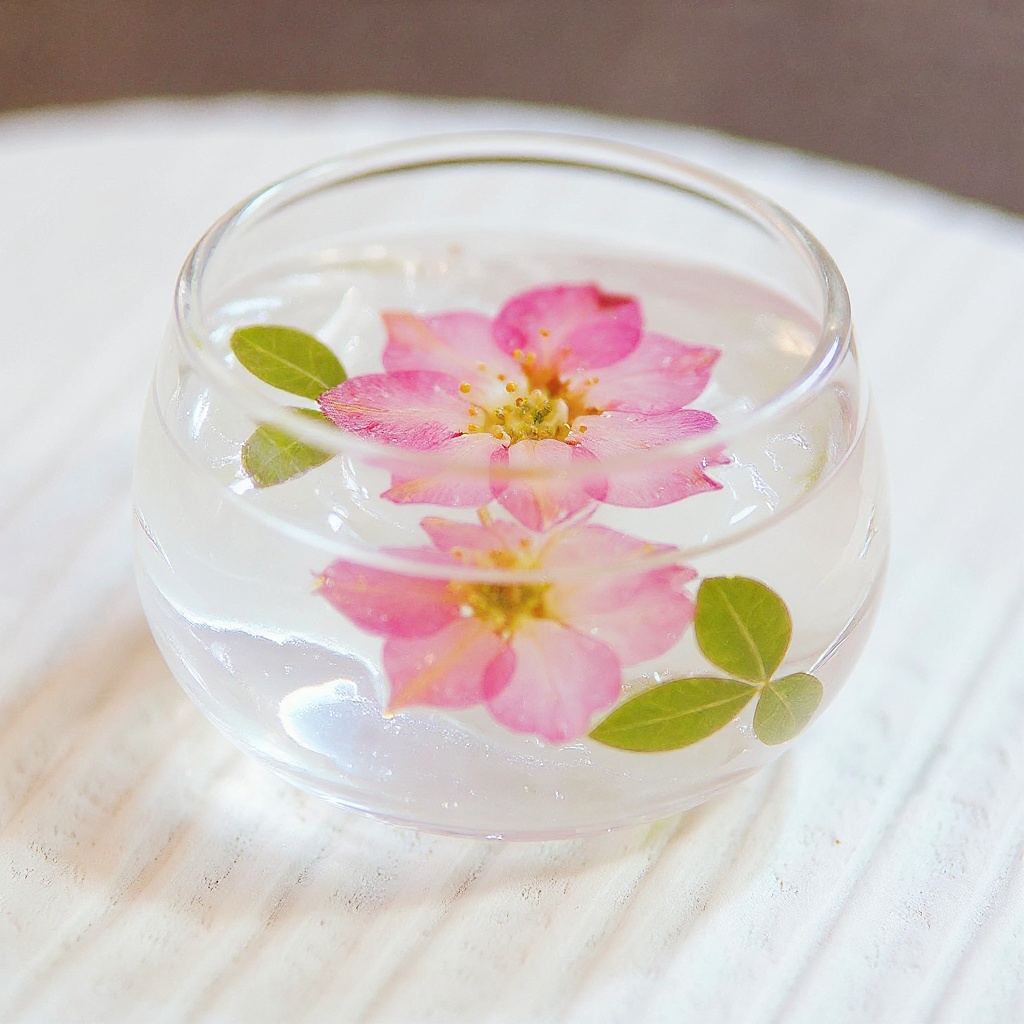
Handmade vs. Factory-Produced: An Honest Comparison
| Feature | Handcrafted Floating Flower Tea Cup | Factory-Produced Version |
|---|---|---|
| Botanical materials | Real dried cherry blossom petals and leaves | Printed decal or synthetic plastic petals |
| Petal placement | Naturally irregular, tweezed by hand | Stamped or machine-positioned, symmetrical |
| Resin layer count | 4–7 individually cured coats | 1–2 machine-applied coats |
| Production time | 5–7 days per cup | 2–4 hours per batch |
| Thermal testing | Individual cup thermal shock cycling | Batch sample testing only |
| Price range | $60–150+ per cup | $15–40 per cup |
| Longevity expectation | 10–15 years with proper care | 1–3 years before yellowing or petal fade |
Handmade pieces show subtle imperfections: slight glass thickness variation, naturally irregular petal angles, faint tool marks on inner glass surfaces. These are not defects. They are authentication signatures. Factory versions display uncanny uniformity — beautiful in photographs, hollow in person.
Optimal Tea Pairings for 60ml Handcrafted Floating Flower Tea Cups
The 60ml volume concentrates flavor and aroma in ways that larger cups cannot. These tea types perform best:
1. High-grade oolong teas (Da Hong Pao, Tie Guan Yin) — Use 5–7g leaf per 60ml water at 195°F (90°C); steep 20–30 seconds per infusion; yields 6–9 infusions from a single charge. Complex roasted or floral notes unfold progressively. 2. Aged pu-erh (sheng or shou) — Use 4–6g per 60ml at 212°F (100°C); 10–15 second first rinse discarded, then 15–25 second steepings. Earthy, mineral depth concentrates without bitterness at this volume. 3. Premium green teas (Dragon Well, Gyokuro) — Use 3–4g per 60ml at 160–170°F (71–77°C); steep 45–60 seconds. Delicate umami and grass notes require lower temperature to avoid astringency. 4. White teas (Silver Needle, White Peony) — Use 4–5g per 60ml at 175°F (79°C); steep 60–90 seconds. Honey and melon subtleties that disappear in large cups become the entire experience here. 5. First-flush Darjeeling — Use 3–4g per 60ml at 185°F (85°C); steep 90 seconds. Muscatel grape notes intensify when undiluted by excessive water volume. 6. High-mountain Taiwanese teas (Ali Shan, Li Shan) — Use 5–6g per 60ml at 195°F (90°C); 20–30 second steepings. Altitude-grown floral complexity rewards the focused attention that a 60ml cup demands. 7. Ceremonial grade matcha — Use 2g sifted powder per 60ml water at 160°F (71°C); whisk 30 seconds. Traditional thin preparation (usucha) fits the volume and complements cherry blossom visual themes.
Avoid: robust breakfast black teas, flavored blends with added oils (bergamot in Earl Grey can interact with resin surfaces over time), or any tea requiring continuous temperature maintenance above 200°F.
Care Practices That Extend Cup Lifespan
A handcrafted floating flower tea cup maintained correctly can remain visually intact for 10–15 years. The rules are few but non-negotiable:
Wash by hand. Mild dish soap, warm (not hot) water, soft cloth. No abrasives. No dishwasher. No exceptions. Store away from direct sunlight. UV exposure accelerates petal fading and causes gradual resin yellowing. A cabinet or felt-lined box is sufficient protection. Avoid rapid temperature transitions. Filling a room-temperature cup with boiling water immediately is manageable — the resin's thermal buffering handles this. Filling a refrigerator-cold cup with boiling water is a stress cycle the resin was not designed for. Do not microwave. Organic materials embedded in resin can generate localized hot spots. The seal fails. The cup is ruined. Irreversibly.With these practices, cherry blossom petals will shift from bright pink to soft rose over several years. This is not deterioration. It is the cup aging alongside its owner.
FAQ
Are the flowers inside resin tea cups real or fake? Authentic handcrafted floating flower tea cups contain real cherry blossom petals and leaves that are dried to below 5% moisture content and preserved under multiple eco-resin layers. Real petals show natural color gradients, irregular edges, and subtle translucency that synthetic materials cannot replicate. If petals look perfectly uniform in color and shape, they are almost certainly synthetic. Is eco-resin safe to drink from — does it leach chemicals into hot tea? Food-grade eco-resin formulated to meet FDA 21 CFR 175.300 food-contact surface standards undergoes complete polymerization during the 72–96 hour curing process, eliminating residual monomer migration into beverages. Quality handcrafted floating flower tea cups are thermally rated to 180°F (82°C). Avoid microwave use and dishwasher cycles, both of which can degrade the polymer matrix and compromise this safety margin. Will the cherry blossom petals fade or change color inside the resin over time? Real cherry blossom petals embedded in eco-resin gradually shift from bright pink to softer rose tones over 3–5 years, particularly with UV exposure. This natural color evolution is considered characteristic of genuine botanical preservation rather than a defect. Store away from direct sunlight to slow the process. Can a resin-exterior glass cup be used in the microwave or dishwasher? No. Handcrafted floating flower tea cups should only be hand-washed with mild soap and warm water. Microwave radiation can create localized heat at organic material boundaries within the resin, degrading the seal. Dishwasher thermal cycling stresses the multi-layer resin structure and accelerates delamination. Air dry completely before storing. How long does it take to handcraft one botanical resin tea cup? Authentic handcrafted floating flower tea cups require 5–7 days from botanical preparation through final quality inspection. The timeline includes: one day of petal selection and desiccation verification, three to four days of sequential resin application with 12–24 hour cure windows between coats, and one to two days of surface finishing, thermal shock testing, and final cure. What is a Zhu Ren Bei master cup and how is it used in gongfu tea ceremony? Zhu Ren Bei (主人杯) translates as "master's cup" in traditional Chinese gongfu tea ceremony. The host uses this 60ml vessel to taste each steeping before serving guests, verifying flavor, temperature, and color. It is conventionally the most visually distinctive piece on the tea tray, expressing the host's aesthetic sensibility. The cherry blossom motif connects to traditional symbolic frameworks around present-moment awareness found in both Chinese and Japanese tea culture. How do I tell if a floating flower cup is genuinely handmade versus factory-made? Handmade pieces show subtle irregular petal placement, slight glass thickness variation, and natural tonal differences between petals. Factory versions display machine-consistent symmetry, uniform petal colors, and thinner single-application resin coats. Price is a reliable secondary indicator: genuine handcrafted pieces requiring 5–7 days of skilled labor typically retail between $60–150+, while factory versions range from $15–40. What tea types work best in a 60ml master cup? Premium oolongs (5–7g at 195°F, 20–30 second steepings), aged pu-erh (4–6g at 212°F, 15–25 second steepings), high-grade green teas (3–4g at 160–170°F, 45–60 seconds), and delicate white teas (4–5g at 175°F, 60–90 seconds) all perform at their best in 60ml volumes. The concentration effect rewards high-quality leaves and punishes mediocre ones — which is exactly the point of gongfu service. Does humidity affect how these cups should be stored? High-humidity environments (above 70% relative humidity sustained year-round) can introduce microscopic moisture migration at the glass-resin interface over years, particularly in older cups where the bond has begun to micro-fatigue. In tropical or coastal climates, store in a sealed cabinet with silica gel packets. The cup performs normally during use — this is a long-term storage consideration only. Are there ethical or environmental concerns with eco-resin products? Low-VOC eco-resin formulations that comply with EPA Safer Choice program criteria have significantly reduced toxicity profiles compared to conventional epoxy systems. However, all thermoset resins are non-biodegradable at end of life. The honest trade-off: a quality handcrafted floating flower tea cup used for 10–15 years has a lower per-use environmental footprint than disposable or short-lifespan alternatives, but it does not disappear from the material cycle. Purchase intentionally and keep it long.Conclusion
The handcrafted floating flower tea cup sits at an intersection of botanical preservation science, food-contact material safety standards, and centuries of gongfu ceremony tradition. Understanding the 5–7 day production process, the FDA-aligned resin specifications, and the functional logic of the 60ml Zhu Ren Bei format transforms this object from decorative novelty into something worth choosing deliberately.
Our Handmade Cherry Blossom Glass Tea Cup represents this intersection directly — real petals, food-safe eco-resin, 60ml gongfu specification, handcrafted production timeline. Browse the full range of handmade floral tea accessories in the Pampasroom collection, or explore the complete artisan drinkware and tea ceremony sets for gifting options.
Nature, suspended. Ceremony, honored. Beauty, functional.


