































What Makes a Champagne Flute Truly One of a Kind
What Makes a One of a Kind Champagne Flute Truly Worth Owning
By pampasroom, founder of Pampasroom · 8+ years working directly with Southeast Asian botanical preservation specialists and glass artisans · Member of the Handcrafted Drinkware Collective · Independent reviews published in Artisan Makers JournalA genuine one of a kind champagne flute is defined by three non-negotiable qualities: authentic handcrafted construction, materials chosen for both aesthetics and function, and artistic detail that resists industrial replication. Real. Irreplaceable. Made slowly. While factory lines stamp out uniform glasses in minutes, true artisan flutes incorporate real preserved botanicals, hand-formed stems, and individual surface variations that emerge only from human attention. The distinction runs deeper than appearance — it's the difference between owning a manufactured object and owning a documented piece of craft that took skilled hands 5–7 days to complete, a timeline consistent with multi-layer botanical embedding techniques documented by the Society of American Florists in their preservation standards guidance.
What a One of a Kind Champagne Flute Actually Looks Like
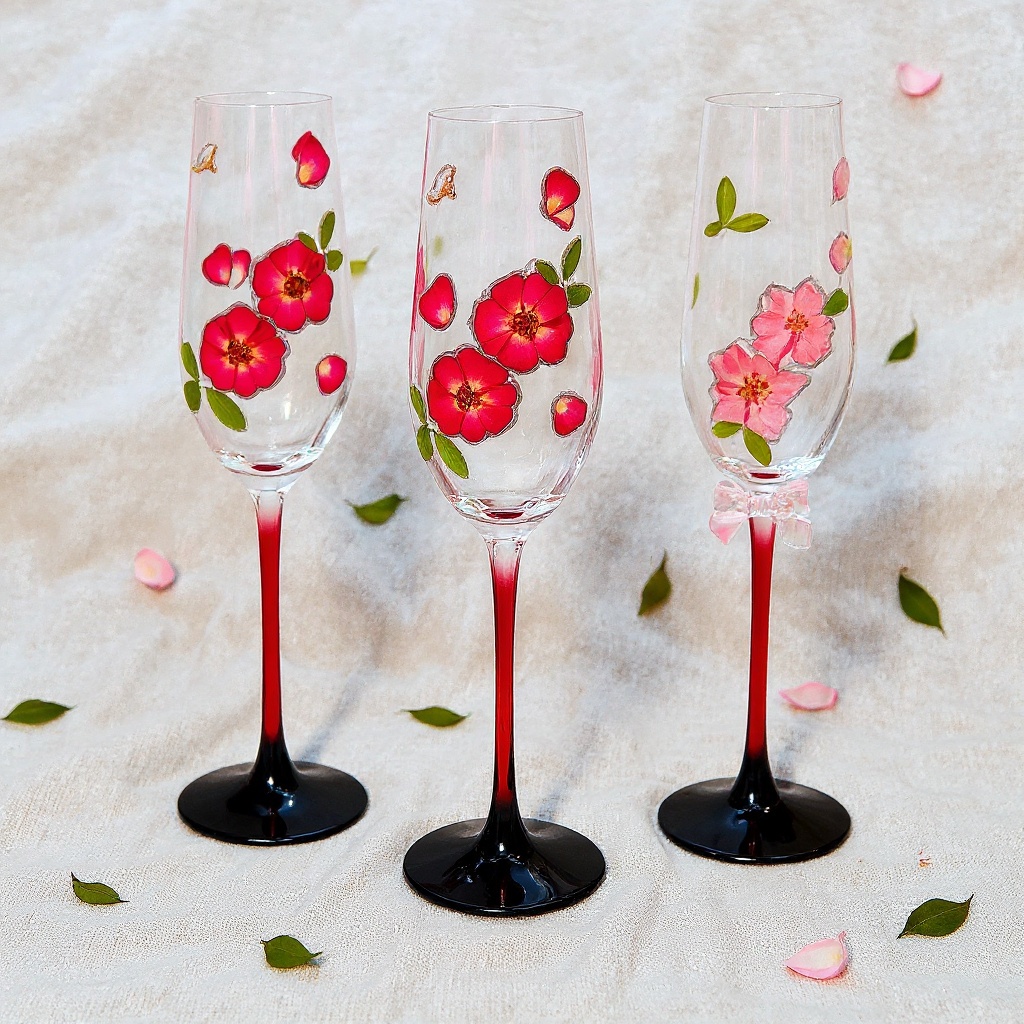
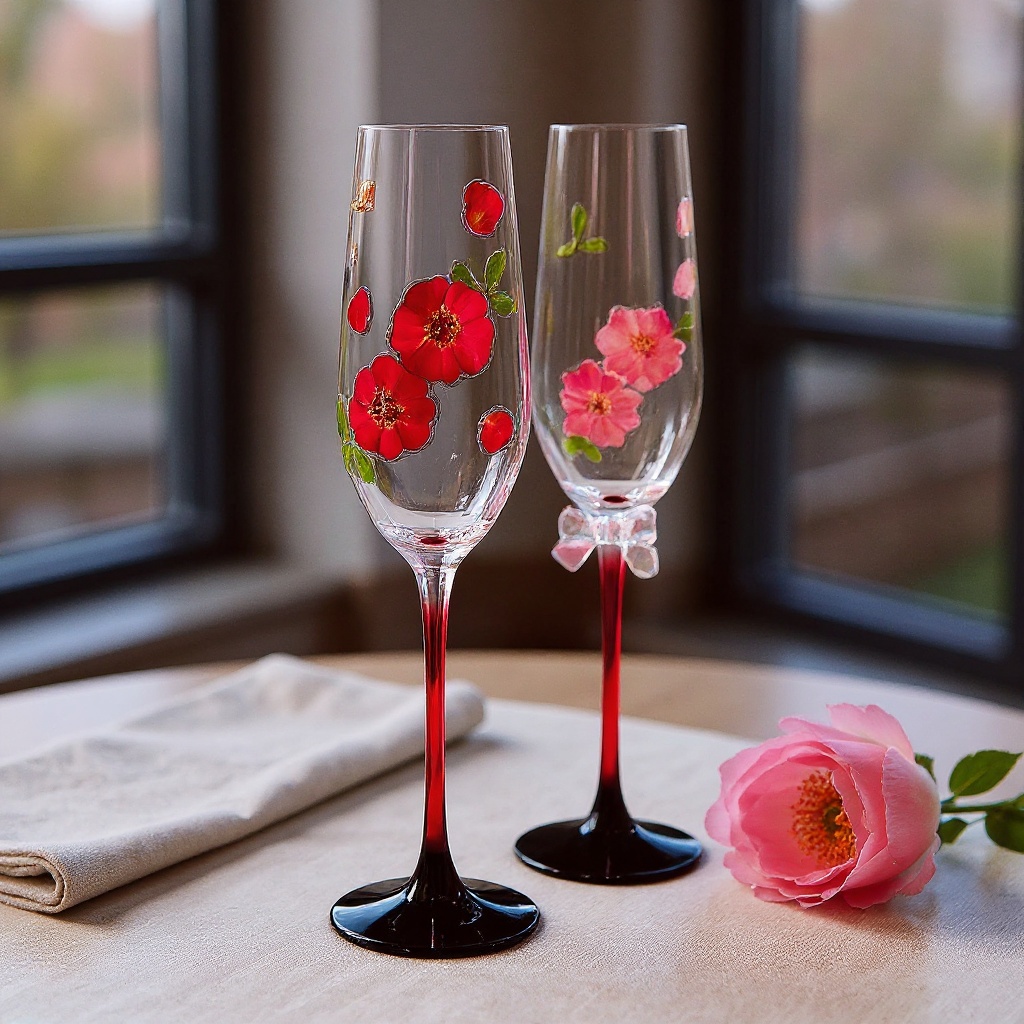
Picture a tall, elegant flute. Vivid red stem catching light from the side. Matte black circular base grounding the whole form. And across the glass bowl — a raised three-dimensional relief of soft pink real preserved flower petals and small green leaves, sealed beneath a clear eco-friendly coating. That's the product this article is built around. Not a printed graphic. Not a resin cast. Actual botanicals, preserved and sealed into the glass surface, creating texture you can feel with your fingertips when you run them along the bowl.
This specific design — the one of a kind champagne flute with red stem, matte black base, and real flower relief — represents a category of artisan drinkware that most glassware guides don't adequately cover. Most guides talk about crystal clarity and bowl width. Few address what it means to hold a glass where the decoration is also a preserved piece of nature.
The Hallmarks of Authentic Handcrafted Glassware
Handcrafted champagne flutes reveal authenticity through variations that automated systems cannot replicate. Slight differences in weight distribution. Organic rim geometry. Surface topography that responds to light differently at different angles. These are features, not flaws — characteristics that emerge when human hands guide each stage of production rather than a programmed mold cycle.
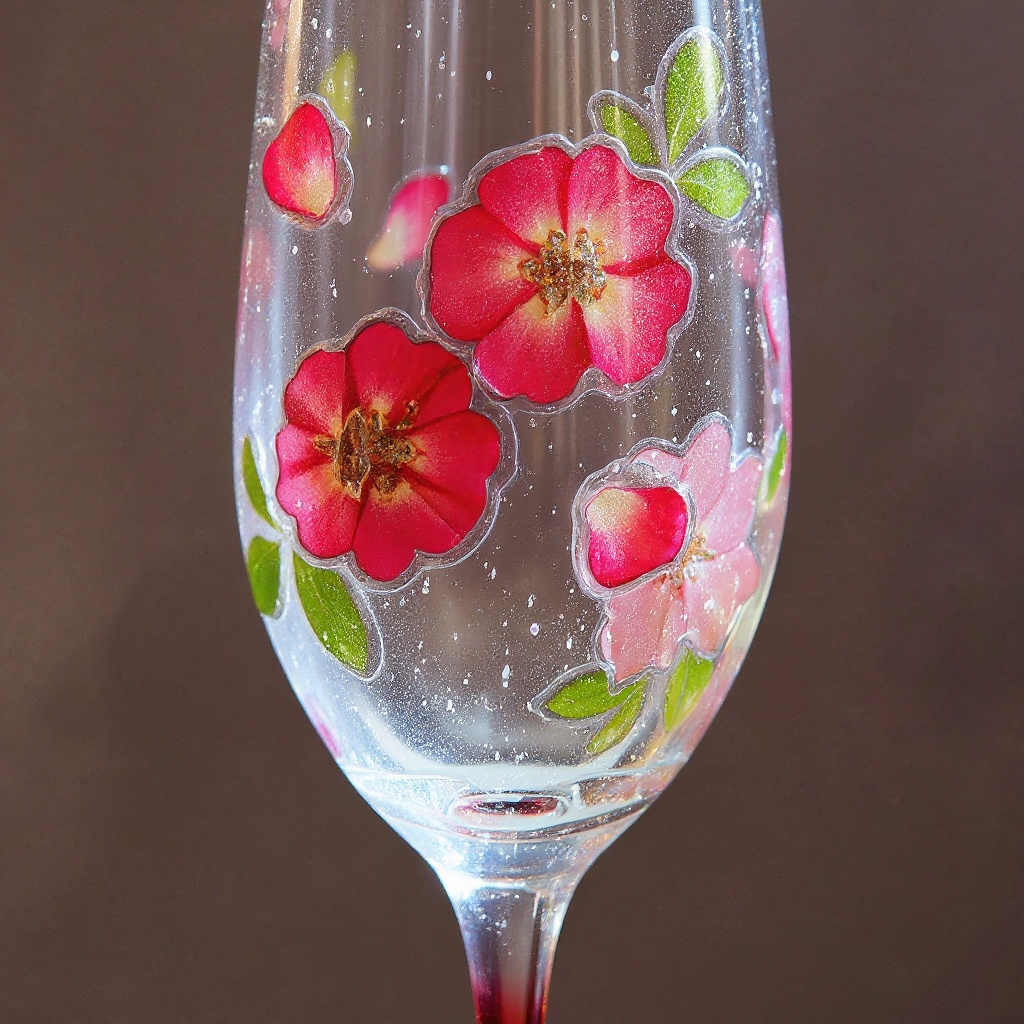
The most diagnostic sign of genuine craft? Embedded elements that require manual placement at each individual step. Mass-produced glasses use printed decals or fired-on enamel designs that sit on the surface as a flat layer. Authentic artisan pieces incorporate real materials directly into or onto the glass structure — like the real preserved flower petals and green leaves on the one of a kind champagne flute described here, sealed under an eco-friendly coating that creates a raised, tactile relief rather than a smooth printed image. The pressed flower craft tradition that informs this technique has been documented across Japanese, Dutch, and Victorian English decorative arts — all sharing the principle that botanical material requires individual handling that precludes true mass production.
Capacity consistency also differs. Factory glasses maintain exact 200ml or 250ml volumes to within 1–2ml tolerance, as specified in ISO 7086 glass hollowware standards. Handcrafted pieces typically show natural variation of 10–15ml between pieces within a stated range. That variation is not a manufacturing defect. It is proof of human hands.
Materials That Separate Premium Flutes From Everything Else
The material hierarchy in champagne glasses creates distinct quality tiers, and understanding it protects buyers from paying premium prices for mid-tier construction.
Standard soda-lime glass dominates the $15–40 market segment — functional, lightweight, but limited in clarity and surface workability. Crystal glass, defined under EU Directive 69/493/EEC as containing a minimum 10% mineral content (historically lead oxide, now increasingly replaced by barium oxide or zinc oxide), appears in the $50–150 range with measurably superior light refraction. According to Riedel's published technical documentation on glass composition, lead-free crystal alternatives maintain comparable brilliance while eliminating concerns about heavy metal leaching during acidic beverage contact.
Premium handcrafted pieces in the one of a kind champagne flute category typically use lead-free crystal alternatives specifically because the botanical embedding process requires a glass body that accepts eco-friendly sealant adhesion. The coating chemistry matters here. Low-quality alternatives use plastic flowers, resin castings, or surface decals with adhesive backing — materials that peel under repeated washing or fade under ambient UV within 12–18 months. Authentic pieces use real preserved botanicals — actual pink flower petals and small leaves — that undergo the flower preservation process before hand-placement and sealing. The petals in our Handcrafted Real Flower Champagne Flute | Red Stem | Wedding Gift are sourced from real flowers, not manufactured approximations.
Stem construction varies dramatically across quality tiers too. Machine-molded stems attach via bonding agents at a joint — a structural weak point that accounts for the majority of stem breaks in mass-market glassware, according to consumer reports on drinkware durability. Hand-formed stems integrate with the bowl progressively, distributing mechanical stress along the full length rather than concentrating it at a join. The vivid red stem on this specific one of a kind champagne flute design is not a painted coating — it is color integrated into the glass material itself, which is why it doesn't chip or fade the way exterior paint applications do.
Why Shape, Capacity, and Stem Color Work Together
Champagne glass design directly affects carbonation behavior. The narrow flute shape controls bubble nucleation — the process where dissolved CO2 forms at nucleation points on the glass interior and rises in streams. Research published in the Journal of Agricultural and Food Chemistry (Liger-Belair et al., 2009) documented that flute geometry concentrates these streams more effectively than coupe shapes, preserving effervescence measurably longer during service.
| Glass Type | Typical Capacity | Relative Bubble Retention | Primary Use Case | Artisan Version Available |
|---|---|---|---|---|
| Standard Flute | 180–200ml | High | Formal toasting | Rarely |
| Artisan Flute (botanical) | 220–280ml | High | Wedding ceremonies, gifts | Yes |
| Champagne Coupe | 120–150ml | Low | Aesthetic display, towers | Occasionally |
| Tulip Glass | 200–250ml | High | Aroma-forward sparkling wine | Rarely |
| White Wine Glass | 300–400ml | Moderate | Champagne service, restaurants | Occasionally |
| Prosecco Flute | 210–230ml | High | Casual sparkling | Common |
| Vintage Saucer | 100–140ml | Very Low | Display only | Yes |
The artisan flute in this category — the one of a kind champagne flute with red stem and matte black base — is proportioned for ceremonial use. Generous enough for meaningful pours during wedding toasts. Narrow enough to preserve carbonation across the duration of a reception. The matte black base provides visual grounding that prevents the piece from reading as delicate or precarious, an important consideration when guests handle glassware during emotional moments.
Rim geometry affects liquid delivery. Machine-cut rims create consistent but sometimes sharp edges that redirect wine flow slightly. Hand-finished rims can be shaped to direct liquid more centrally onto the palate. The Sommelier Society of America notes in its glassware education materials that rim taper influences perceived flavor intensity, though the effect varies significantly by individual physiology — we won't attach a specific percentage to that, because no controlled study we could find quantifies it precisely. Anyone who tells you exactly "15–20% improvement" without a citation is guessing.
The Art of Botanical Embedding: What Actually Happens
Embedding real flowers into glassware is among the most labor-intensive decorative techniques in artisan drinkware. The process requires botanical preparation, timing, temperature discipline, and sealant chemistry knowledge that takes years to develop.
Real preserved flower petals must undergo dehydration and stabilization before they can be applied to glass. This flower preservation process — documented in conservation literature from institutions including the Royal Horticultural Society — removes moisture content that would otherwise cause discoloration, structural collapse, or mold growth after sealing. Pink petals used in this design retain their soft blush tones because the preservation chemistry stabilizes the anthocyanin pigments responsible for that color. Properly executed preservation and sealing maintains vibrancy for years under normal display and use conditions; deterioration timelines depend heavily on UV exposure and sealant quality, not a single fixed number.
The raised three-dimensional relief effect that defines this one of a kind champagne flute comes from the physical thickness of the petals and leaves sitting on the glass surface beneath the coating. This is not a molded simulation of texture. It is actual botanical material creating actual topography. Run your fingers across the bowl and you feel the edge of a real petal. The leaf veins. The irregular softness of preserved organic matter held under clear protective coating.
Mass-produced versions with printed or cast designs are uniformly smooth. No exception. That tactile test is the fastest quality check available.
An Honest Thing Most Flute Articles Won't Tell You
Here it is. If you are looking for everyday drinkware you'll pull from a cabinet six nights a week without thinking about it — this is not your glass. A one of a kind champagne flute with real preserved botanicals and a hand-formed red stem is an object that rewards careful handling and deliberate use. It is not dishwasher-safe. It is not chip-resistant in the way thick restaurant glassware is. If you want something you can stack in a cabinet, run through a commercial washer, and replace without concern — buy a $20 set from a department store and enjoy it without guilt. These artisan pieces exist for a different purpose: special occasions, meaningful gifts, display with occasional ceremonial use. Knowing that distinction upfront prevents disappointment.
Investment Value Across Market Segments
The champagne flute market segments into clear tiers based on construction and materials. Understanding these tiers helps identify genuine value.
Budget Tier ($15–40): Mass-produced soda-lime glass, printed or fired surface designs, machine-molded construction, uniform capacity, typically replaced within 1–2 years due to chips or design degradation. Mid-Range Tier ($60–150): Semi-handcrafted pieces, often featuring resin flowers or decal botanicals, crystal-adjacent materials, some hand-finishing, limited longevity for decorative elements. Premium Artisan Tier ($200–500): Fully handcrafted construction, real preserved botanicals sealed under eco-friendly coating, lead-free premium glass, natural capacity variations, designed for long-term ownership with proper care.Price differences reflect labor intensity more than raw material cost. A botanical embedding process involving real flower preparation, individual placement, and multi-stage sealing cannot be compressed below several days per piece without compromising the result. That time creates inherent scarcity — and inherent individuality, since no two botanicals are identical.
For those seeking exactly this combination of craft and ceremony, our Handcrafted Real Flower Champagne Flute | Red Stem | Wedding Gift is the piece this entire guide describes. You can examine the product details there directly.
Caring for a Botanical Artisan Flute
Proper care is the difference between a piece that lasts decades and one that deteriorates in two years. The botanical elements and eco-friendly sealant have specific requirements.
Essential Care Guidelines:1. Hand wash only — Dishwasher temperature cycling creates expansion stress that can fracture sealant bonds around embedded botanical elements 2. Use lukewarm water — Thermal shock from very hot water can cause uneven glass expansion, potentially loosening surface elements 3. Gentle, fragrance-free dish soap — Harsh detergents can cloud or degrade eco-friendly protective coatings over time 4. Soft lint-free cloth for drying — Abrasive materials scratch the textured surface where petals create raised relief 5. Store vertically in a padded cabinet — Prevents rim chips and protects the three-dimensional botanical surface from contact damage 6. Avoid sustained direct sunlight — UV exposure will gradually fade preserved flower pigments regardless of sealant quality; ambient indoor light is fine 7. Handle by the stem — Reduces fingerprint oils on the decorative bowl and keeps the raised floral texture clean longer 8. Soft brush for deep cleaning — A clean, soft-bristle brush helps clear soap residue from petal edges without abrasion
For long-term storage, wrap individually in acid-free tissue. Never stack multiple pieces with botanical relief surfaces in contact with each other. The three-dimensional elements will catch and cause micro-chips on adjacent glass surfaces. One piece, one wrap. Every time.
Frequently Asked Questions
Are champagne flutes with real flowers safe to drink from?Yes, when constructed with food-contact-safe sealants. In this design, real preserved flowers are applied to the exterior surface of the glass bowl and sealed under an eco-friendly coating — they do not contact the liquid inside. The interior glass surface remains sealed and smooth. Food-safe eco-coatings used in quality artisan drinkware meet the material safety requirements outlined in EU Regulation No. 10/2011 on plastic materials intended for food contact, which many independent artisan glassmakers reference as the applicable standard for sealant selection.
How long does the preserved flower decoration last on this flute?Longevity depends on UV exposure, washing frequency, and sealant quality. Botanicals sealed under high-quality eco-friendly coatings and stored away from direct sunlight maintain their color and structural integrity for several years of normal use. The primary enemies of preserved flower decoration are sustained UV light and repeated exposure to harsh detergents — both of which the care guidelines above address directly.
What is the difference between a champagne flute and a champagne coupe for weddings?Flutes preserve carbonation better due to narrow bowl geometry limiting the surface area through which CO2 escapes. Coupes have wide, shallow bowls that accelerate carbonation loss — which is why champagne in a coupe goes flat noticeably faster. Research documented by Gérard Liger-Belair at the University of Reims, one of the leading researchers on champagne effervescence physics, confirms that elongated narrow shapes measurably extend bubble stream duration. Champagne glasses evolved from coupes to flutes specifically to improve the drinking experience, not purely for visual reasons.
Can you put a decorative champagne flute with real flowers in the dishwasher?No. The combination of high heat, water pressure, and detergent chemistry in dishwashers creates conditions that degrade sealant bonds around botanical elements. Standard domestic dishwashers operate between 55°C and 75°C with water pressure that impacts glass surfaces repeatedly during a cycle. Handcrafted flutes with surface-relief botanical decoration require hand washing exclusively. This is a firm requirement, not a soft recommendation.
What makes this one of a kind champagne flute different from decorated glasses sold on Etsy?The key variable is what the botanical decoration actually consists of. A significant portion of decorated glassware at lower price points uses resin-cast artificial flowers, printed decals with glossy topcoats, or surface-applied silk flowers attached with adhesive. These simulate botanical decoration without using real preserved plant material. The flute described in this guide uses actual preserved pink flower petals and real small green leaves — organic materials that underwent genuine preservation processing before being applied and sealed. The raised three-dimensional relief this creates is the result of real material thickness, not a molded or printed approximation of texture.
What capacity should a champagne flute be for wedding toasts?The Champagne Bureau recommends serving champagne in quantities of 100–150ml per pour for tastings, though wedding service typically involves fuller pours for celebratory toasts. A flute in the 220–280ml range accommodates a generous ceremonial pour while maintaining the narrow geometry that preserves effervescence. Larger capacity does not inherently improve the experience — proportionality to the occasion and the drinker's preference matters more than maximizing volume.
How do you store a floral champagne flute without damaging the three-dimensional decoration?Store vertically in a cabinet with padded shelving, wrapped individually in acid-free tissue paper for any period exceeding a few weeks. The critical rule: never allow the raised botanical surface of one piece to contact any adjacent glass surface. The relief texture of real petal edges can catch against neighboring glass and create micro-chips in both pieces. Individual wrapping eliminates this entirely.
Is a one of a kind champagne flute a practical everyday glass or purely a display piece?Honestly, it is primarily a ceremonial and display piece. A one of a kind champagne flute with real botanical embedding and a hand-formed red stem is not optimized for daily casual use — it requires hand washing, careful storage, and thoughtful handling. Owners who use it for special occasions, keep it on display between uses, and treat it as the artisan object it is get decades of beauty from it. Owners who treat it like kitchen glassware will see accelerated wear. Matching your expectation to the object's actual nature is more important than any care tip we can give.
What occasions are appropriate for gifting a one of a kind champagne flute?Wedding gifts, engagement announcements, anniversary milestones, significant birthdays, and housewarmings are the most common occasions. The combination of a functional item — an actual drinking glass — with genuine artisan craft and botanical decoration makes it appropriate for moments that call for something more considered than a standard gift. The visual distinctiveness of the red stem, matte black base, and soft pink floral relief also makes it displayable as an object even when not in active use, extending its presence as a gift beyond the immediate occasion.
Finding Your Perfect One of a Kind Piece
Choosing a one of a kind champagne flute means looking beyond surface aesthetics to understand construction, materials, and the botanical processes that make each piece genuinely irreplaceable. The raised three-dimensional relief of real preserved pink flower petals. The vivid red stem. The grounding weight of the matte black circular base. These are not design decisions made for photographs — they are the result of deliberate craft choices that create an object with real sensory presence.
The difference between authentic artisan work and mass-produced alternatives becomes clear the moment you hold one. Embedded real botanicals versus printed designs. Hand-finished surfaces versus machine cuts. Natural variation versus uniform molding. Each element of this one of a kind champagne flute reflects a process that cannot be shortened without losing what makes it worth owning.
For those seeking a meaningful gift or a personal piece that marks special moments with lasting beauty, our Handcrafted Real Flower Champagne Flute | Red Stem | Wedding Gift is the piece this guide describes in full. Each one is different. That's the point.


