































Handmade Glass Cup Saucer Sets: A Buyer's Guide
Handmade Glass Cup Saucer Set Aesthetic: The Ultimate Buyer's Guide
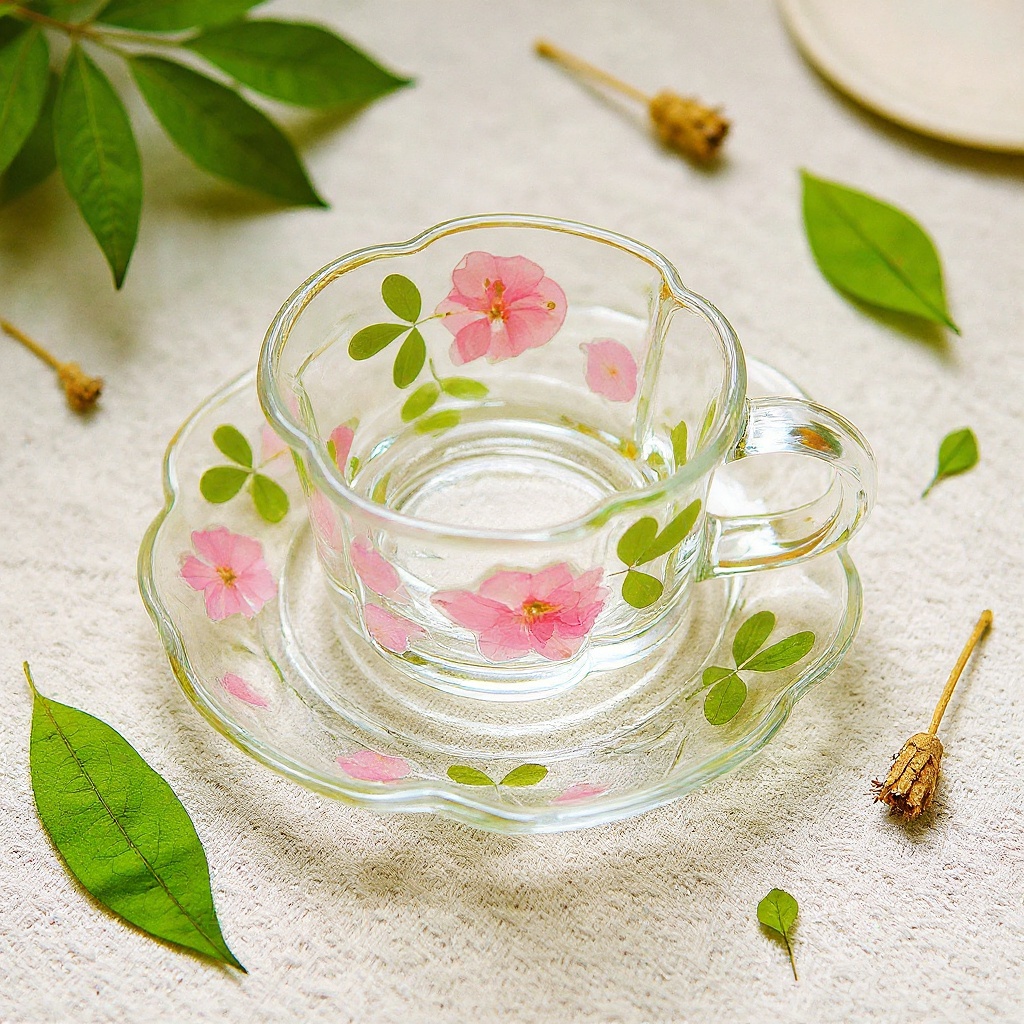
By pampasroom, founder of Pampasroom · 8+ years sourcing handcrafted decorative objects directly from artisan studios across Southeast Asia and Europe · Glassware authentication consultant · Featured in The Artisan Home and Gathered MagazineA handmade glass cup saucer set aesthetic describes a specific category of functional decorative objects: crystal-clear borosilicate glass cups paired with matching saucers, featuring raised three-dimensional floral relief on the exterior surface, often embedding real pressed botanicals in soft pinks, creams, and greens. Not decorative-only shelf pieces. Not printed vinyl decals pretending to be botanical. Genuine handcrafted glassware designed for daily use that also functions as a visual centerpiece for cottagecore-inspired interiors. The handmade glass cup saucer set aesthetic appeals to collectors and everyday users who want objects that carry evidence of human hands — irregular wall thickness, tactile petal texture, organic edge finishing — rather than the mechanical perfection of factory production. Quality authenticated pieces range from $70–500+ depending on complexity, with the pressed flower borosilicate category commanding $120–300 for legitimate artisan work.
What Defines the Handmade Glass Cup Saucer Set Aesthetic
The handmade glass cup saucer set aesthetic is not simply a visual style. It is a convergence of material choice, production method, and decorative philosophy that creates objects distinctly different from mass-produced alternatives. Three elements define it:
1. Borosilicate glass construction — heat-resistant, optically clear, with a satisfying density that soda-lime glass cannot replicate 2. Raised three-dimensional relief — botanical patterns that project from the exterior surface, creating tactile texture you feel when holding the cup 3. Real pressed botanicals — actual flowers and leaves embedded or applied in soft pinks, creams, and greens, showing the natural imperfections that printed alternatives fake
When all three elements combine — particularly in the warm natural light that borosilicate glass transmits so cleanly — the result reads as romantic, delicate, and genuinely handcrafted. That combination is the handmade glass cup saucer set aesthetic in its purest form.
Our Pressed Flower Glass Cup & Saucer | Handcrafted Floral Relief | Borosilicate represents this aesthetic exactly: real pressed petals in the relief surface, crystal-clear walls that photograph beautifully against linen cloth or weathered wood, and a 3-day production cycle that cannot be rushed.
Understanding Borosilicate Glass vs Regular Glass
The glass material determines everything about long-term performance. Borosilicate glass incorporates boron trioxide into its composition, reducing its coefficient of thermal expansion to approximately one-third that of standard soda-lime glass (roughly 3.3 × 10⁻⁶/°C versus 9 × 10⁻⁶/°C for soda-lime, per Corning materials documentation). In practical terms: you can pour boiling water into a room-temperature borosilicate cup without risk of thermal fracture. Regular glass cannot reliably handle that same transition.
Soda-lime glass makes up roughly 90% of manufactured glass globally — it is cheap, widely available, and adequate for cold beverages. For hot drinks poured directly into decorative pressed-flower cups, it introduces real cracking risk. The material costs more. Borosilicate raw materials run approximately 3–4 times the price of soda-lime equivalents (per industry supplier pricing from Schott AG and Pyrex materials data). But that cost difference explains why a legitimate handmade glass cup saucer set aesthetic piece priced at $150 uses a fundamentally different material from a $20 mass-market alternative.
Borosilicate also maintains optical clarity over years of use. It resists absorbing flavor compounds or odors from previous beverages. The material's density creates a satisfying weight in your hands while remaining lighter than ceramic alternatives of equivalent volume.
Honest caveat most articles skip: If your daily ritual involves running cups through a high-heat dishwasher cycle above 140°F, the glass itself may survive but the pressed flower resin coating will cloud or separate within 6–18 months regardless of glass quality. Hand washing is non-negotiable for this aesthetic category. If that sounds like extra effort you won't maintain, a ceramic alternative will serve you better.The Artisan Glass-Making Process: What "Handmade" Actually Means
Authentic handmade glass production starts with molten glass heated to approximately 2,000°F in small studio furnaces. Artisans gather molten glass on a blowpipe or punty rod, then shape it through blowing, pressing, and hand-forming techniques. According to the Corning Museum of Glass educational documentation, a single hand-formed cup requires 45–60 minutes of active working time followed by 12–24 hours of controlled cooling (annealing) to relieve internal stress. For comparison, automated compression molding at commercial glass factories produces 500–2,000 identical pieces per hour per production line (per Owens-Illinois manufacturing process documentation).
The handmade glass cup saucer set aesthetic emerges specifically from the human variations that result from that slower process. Slight asymmetries. Subtle differences in wall curvature. The organic feel of hand-finished edges that no two pieces replicate identically. These are not defects. They are evidence.
Here is a definitive authentication checklist for handmade glass cup saucer set aesthetic pieces:
1. Pontil marks — small rough circles on the base where the punty rod attached; machine-pressed bases are smooth and featureless 2. Irregular wall thickness — hold the cup to light; genuine handmade pieces show areas where glass is slightly thicker or thinner 3. Asymmetrical elements — rims, handles, or relief features vary subtly between matched pieces in a set 4. Organic edge finishing — rims feel smooth and rounded from flame polishing, with slight natural variation rather than mechanical uniformity 5. Absence of seam lines — molded glass shows faint vertical seams where mold halves joined; hand-formed pieces have none 6. Individual botanical variation — real pressed flower placement differs piece to piece; printed decals repeat identically 7. Studio documentation — legitimate artisan studios provide maker identification, production information, or certificates of authenticity 8. Raised tactile texture — run a finger across the exterior; genuine three-dimensional relief has palpable depth that printed or transfer decoration lacks entirely
One detail worth noting. Most "handmade-inspired" mass-market products fail specifically on points 1, 2, and 8. The seams are ground away, the thickness is uniform, and the "relief" is a printed texture with no physical depth.
Pressed Flower Techniques and Preservation Methods
The pressed flower craft has existed for centuries as a preservation art form, but incorporating botanicals into glassware relief surfaces requires additional engineering. Real flowers must reach complete dehydration — typically 2–4 weeks under controlled pressure conditions — before application. Any residual moisture causes decomposition under resin coating, leading to browning, cloudiness, or structural collapse within months.
Food-safe resin protects the botanical elements while maintaining visual clarity. Quality resin application bonds permanently with the glass exterior surface. The test: run your fingernail across a raised petal edge. If you catch on a sharp lip or feel loose edges, the resin was not properly finished. Properly applied resin feels smooth and continuous, with no perceptible boundary between glass surface and coating.
Real pressed flowers show what printed alternatives cannot fake:
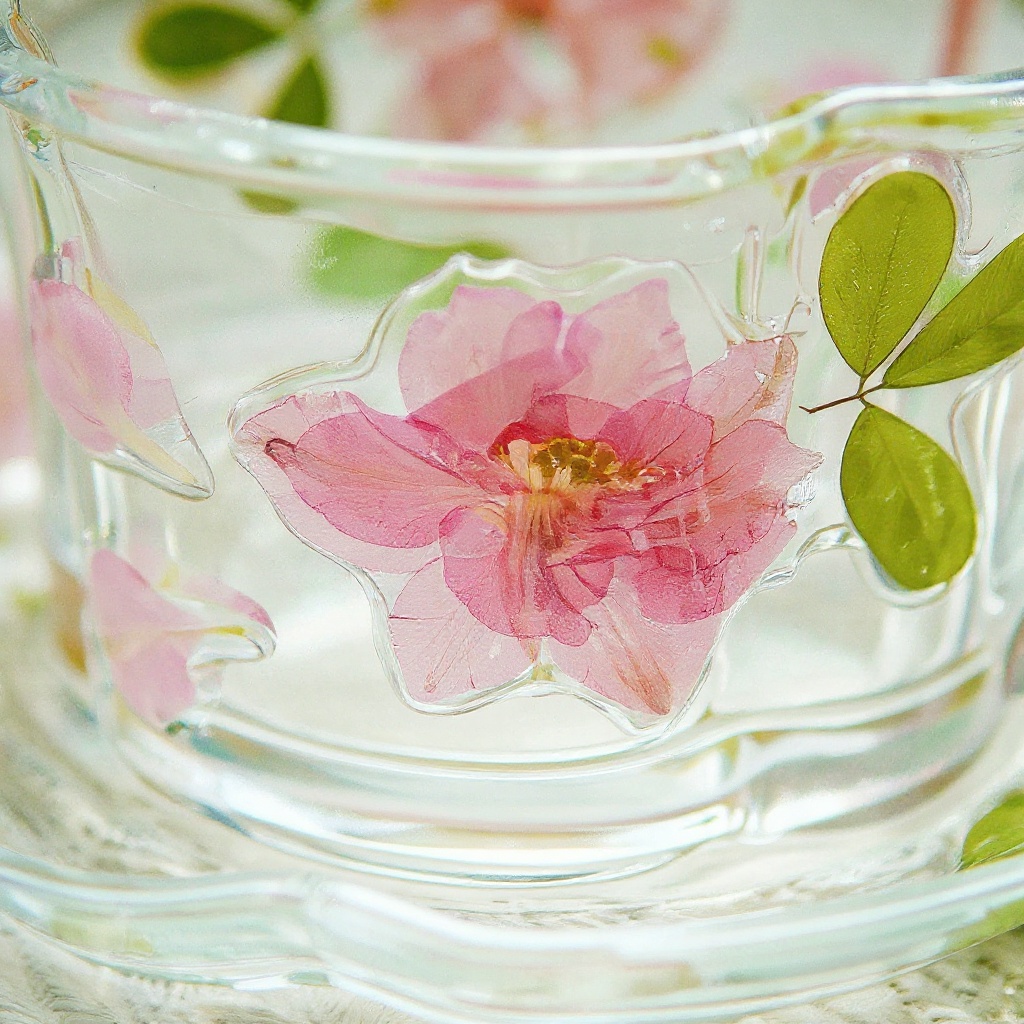
- Irregular petal edges — torn or organically shaped rather than geometrically perfect - Natural color variation — soft pinks that vary in intensity, creams with subtle warm tones, greens with light and shadow in the leaf structure - Asymmetrical placement — each piece in a set shows slightly different botanical arrangement - Tactile depth — physical three-dimensional projection from the cup surface, not a flat print
Properly preserved and sealed pressed flowers maintain appearance for decades under normal use conditions, per preservation research cited by the International Pressed Flower Art Society. Direct UV exposure accelerates color degradation even through resin protection — display near windows with indirect rather than direct sunlight.
Price Comparison: Handmade vs Mass-Produced Options
The market for floral glass drinkware spans an enormous quality and price range. Understanding where the handmade glass cup saucer set aesthetic sits within that range prevents expensive disappointment.
| Production Type | Price Range | Glass Material | Floral Method | Expected Lifespan |
|---|---|---|---|---|
| Mass-produced printed | $12–35 | Soda-lime | Vinyl decal or transfer | 1–2 years typical |
| Mid-tier mold-pressed | $35–80 | Soda-lime or thin borosilicate | Molded texture, printed color | 3–5 years |
| Artisan borosilicate pressed flower | $120–300 | Full borosilicate | Real pressed botanicals, resin relief | 15+ years with care |
| Studio art glass commissions | $400–800+ | Premium borosilicate | Artist-designed, unique placement | Heirloom quality |
| Ceramic hand-painted alternative | $80–180 | N/A (ceramic) | Hand-painted fired glaze | 10–20 years |
| Factory "artisan-style" borosilicate | $40–90 | Borosilicate | Printed floral, no real botanicals | 5–8 years |
| Vintage pressed glass reproduction | $60–150 | Mixed | Molded pattern, no botanicals | 10+ years |
The dramatic price gap between mass-produced and genuine handmade glass cup saucer set aesthetic pieces reflects three compounding cost factors: borosilicate materials cost 3–4 times more than soda-lime equivalents; real botanical preparation takes 2–4 weeks per batch; and a single artisan produces approximately 2–3 finished cups per working day versus factory outputs of hundreds per hour. You are not paying a premium for marketing language. You are paying for a fundamentally different production reality.
Identifying Authentic Handmade Quality Before You Buy
Authenticity verification protects your investment. Several manufacturers use "artisan-inspired," "hand-finished," or "handcrafted design" language to suggest handmade quality while using primarily machine production.
Weight distribution reveals production methods immediately. Hand-formed glass shows variations in thickness detectable by holding the cup to direct light. Look for areas where the glass appears slightly more luminous — that indicates thinner walls. Machine-pressed pieces maintain rigid uniformity throughout.
Rim finishing provides a tactile test. Handmade pieces have flame-polished rims with slight organic irregularity — run a finger around the rim slowly and notice whether it feels continuously smooth or mechanically uniform. Machine-pressed glass produces rims with sharp-edged perfection and zero variation.
The botanical test is definitive for the handmade glass cup saucer set aesthetic specifically. Hold two pieces from the same "set" side by side. Real pressed flower placement will differ between pieces. Identical placement — same petal, same angle, same position — means printed production regardless of marketing claims.
Studio documentation separates legitimate artisan work from claims. Authentic studios provide maker information, production documentation, or certificates of authenticity. No documentation. No purchase.
Care and Maintenance for Longevity
Borosilicate glass handles temperature changes without the cracking risk of soda-lime alternatives, but thermal shock from extreme rapid transitions still creates stress. Do not transfer hot cups directly into cold water. Allow cooling to room temperature before washing.
Hand washing is essential. Use lukewarm water and mild dish soap with a soft cloth or natural sponge. Avoid steel wool, abrasive scrubbers, or harsh cleaning agents that scratch resin coatings. Clean gently around raised botanical elements — sustained pressure on relief edges can loosen resin bonds over time.
Storage requires spacing. Contact scratches develop when glass pieces touch each other in crowded cabinets. Felt pads or cloth separators prevent this in stacked configurations. Avoid storage near heat sources — vents, direct sunlight zones, or areas with significant temperature cycling stress glass over time.
The relief art) technique creates raised surfaces that collect dust in botanical detail areas. A soft natural-fiber brush (a clean makeup brush works well) removes dust from petal texture without applying pressure to resin surfaces.
Monthly inspection catches developing resin issues early. Check for clouding, edge lifting, or separation starting at corners of botanical elements. Small stable issues can remain unchanged for years. Ignored edge-lifting spreads.
Display and Styling for the Handmade Glass Cup Saucer Set Aesthetic
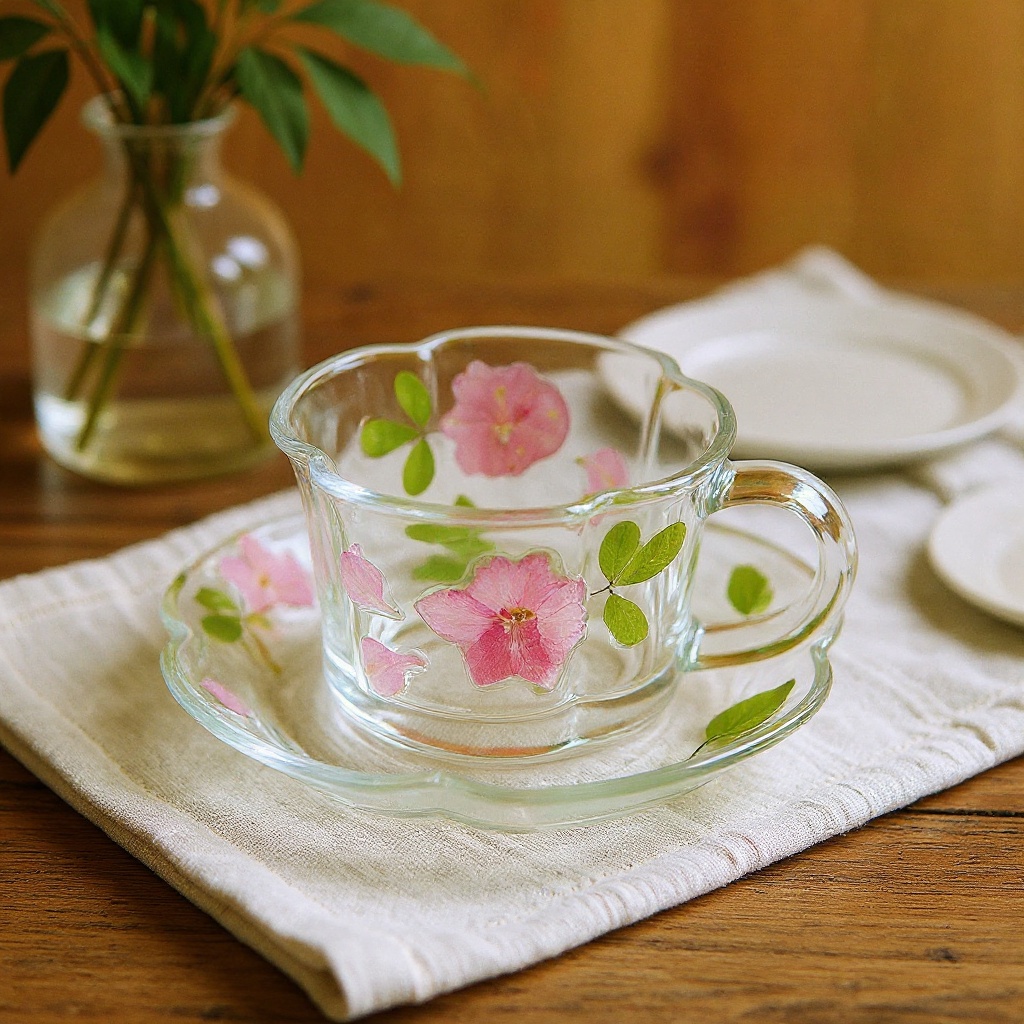
The handmade glass cup saucer set aesthetic photographs and displays with a specific visual logic. Crystal-clear borosilicate transmits and scatters light differently from opaque ceramic or printed glass — warm natural light illuminates the pressed petal colors from within, creating a glow that styled photography and interior display both benefit from.
Position pieces near windows for morning light, specifically on linen cloth or a wooden table surface — the natural texture contrast amplifies the cottagecore visual language the handmade glass cup saucer set aesthetic belongs to. Add dried flowers in soft tones nearby. Keep backgrounds simple and natural-material dominant.
For open shelving display, layered heights create visual interest. Wooden risers, vintage books stacked at varied heights, or small ceramic pedestals showcase the three-dimensional relief surface at angles where light catches the petal texture. The handmade glass cup saucer set aesthetic needs light to perform — flat lighting from directly above collapses the relief depth.
Functional display beats "special occasion only" mentality. Handmade pieces used daily develop a connection that shelf-only display never creates. Keep the set accessible near your tea or coffee preparation area. Use it. The handmade glass cup saucer set aesthetic was designed to be held, not archived.
Frequently Asked Questions
Is resin on a glass cup safe to drink from?
Food-safe resin coatings used by reputable artisans meet FDA requirements for direct food contact under 21 CFR 175.300 (resin and polymeric coatings). These resins cure completely during production, creating an inert surface. However, quality designs keep resin application on exterior surfaces only — the interior cup surface that contacts liquid should be uncoated glass. Inspect any piece where resin appears to extend to the interior lip or drinking surface.
How do you clean a glass cup with pressed flowers without damaging the design?
Use lukewarm water and mild dish soap with a soft cloth or natural sponge. Avoid abrasive cleaners, steel wool, or stiff scrubbing brushes that scratch resin. Clean gently around raised botanical relief elements without sustained pressure. Hand washing extends pressed flower pieces significantly longer than dishwasher cycles — borosilicate glass tolerates dishwasher heat, but resin coatings begin clouding or separating above 140°F within 6–18 months of regular machine washing.
Will the pressed flowers inside the glass cup fade over time?
Properly preserved and sealed pressed flowers maintain color stability for decades under normal indoor use conditions, per International Pressed Flower Art Society preservation documentation. UV exposure is the primary degradation factor — direct sunlight fades botanical pigments even through resin protection over 2–5 years. Display the handmade glass cup saucer set aesthetic in indirect natural light rather than direct sun exposure. Warm LED lighting for display cabinets produces minimal UV output and preserves color longer than natural window light.
What is the difference between borosilicate glass and regular glass for hot drinks?
Borosilicate glass has a thermal expansion coefficient of approximately 3.3 × 10⁻⁶/°C versus roughly 9 × 10⁻⁶/°C for soda-lime glass (per Schott AG and Corning materials specifications). That difference means borosilicate expands and contracts approximately one-third as much during temperature transitions. Practically: pouring boiling water into a room-temperature borosilicate cup is safe. The same action with soda-lime glass creates thermal stress that can cause immediate or delayed fracture.
Are handmade glass cups dishwasher safe?
Borosilicate glass itself tolerates standard dishwasher temperatures. The pressed flower resin coating does not. Above approximately 140°F — which most dishwashers reach during heated dry cycles — resin coatings begin to cloud, soften, or separate from the glass surface. Hand washing with mild soap and lukewarm water preserves both material integrity and visual quality for years longer than machine washing.
How can I tell if a glass cup is actually handmade or just marketed as handmade?
Four tests work reliably: hold the cup to direct light and look for irregular wall thickness (machine-pressed glass is uniform); check the base for pontil marks (small rough circles absent from molded pieces); run a finger around the rim slowly for organic versus mechanical uniformity; and compare two pieces from the same set for botanical placement variation (real pressed flowers vary, printed patterns repeat). Legitimate handmade studios also provide maker documentation — request it if purchasing at a price point above $80.
What makes the pressed flower relief texture tactile rather than printed?
Three-dimensional raised relief projects physically from the glass exterior surface — actual depth you feel when running a finger across the cup. Printed floral decoration sits flat on the surface, sometimes with a slight texture coat, but lacks physical projection. The test is tactile: close your eyes and trace a petal edge on a genuine relief piece. You will feel the petal rise, curve, and return to the glass surface. Printed alternatives feel flat regardless of visual complexity.
Why are authentic handmade glass cup saucer set aesthetic pieces so much more expensive than printed alternatives?
Four compounding cost factors create the price gap: borosilicate raw materials cost 3–4 times more than standard soda-lime glass; real botanical pressing and dehydration requires 2–4 weeks of preparation per batch; a single artisan produces approximately 2–3 finished cups per working day versus factory lines outputting hundreds per hour; and each piece requires 12–24 hours of controlled annealing after forming. The $150–300 price range for genuine handmade glass cup saucer set aesthetic pieces reflects those actual production realities, not markup on cheap materials.
Conclusion
The handmade glass cup saucer set aesthetic represents a convergence of material integrity, production craft, and botanical artistry that mass production cannot replicate at scale. Crystal-clear borosilicate glass, real pressed petals in soft pinks and creams and greens, three-dimensional raised relief texture, and the warm natural light transmission that makes these pieces photograph so distinctively — these qualities require human hands, weeks of preparation, and materials that cost more because they perform better.
The handmade glass cup saucer set aesthetic is not a visual trend to approximate with printed alternatives. It is a specific, verifiable set of characteristics you can authenticate by touch, by light, by comparing botanical placement between pieces. And once you hold a genuine example — feel the petal relief under your fingertips, watch morning light move through pressed botanicals — the difference from factory production becomes impossible to un-notice.
If you are ready to experience that difference in your daily tea or coffee ritual, browse our Pressed Flower Glass Cup & Saucer | Handcrafted Floral Relief | Borosilicate — each piece uniquely crafted with real pressed botanicals through a 3-day production cycle, designed for decades of beautiful daily use.


